- World rank, 2022-now
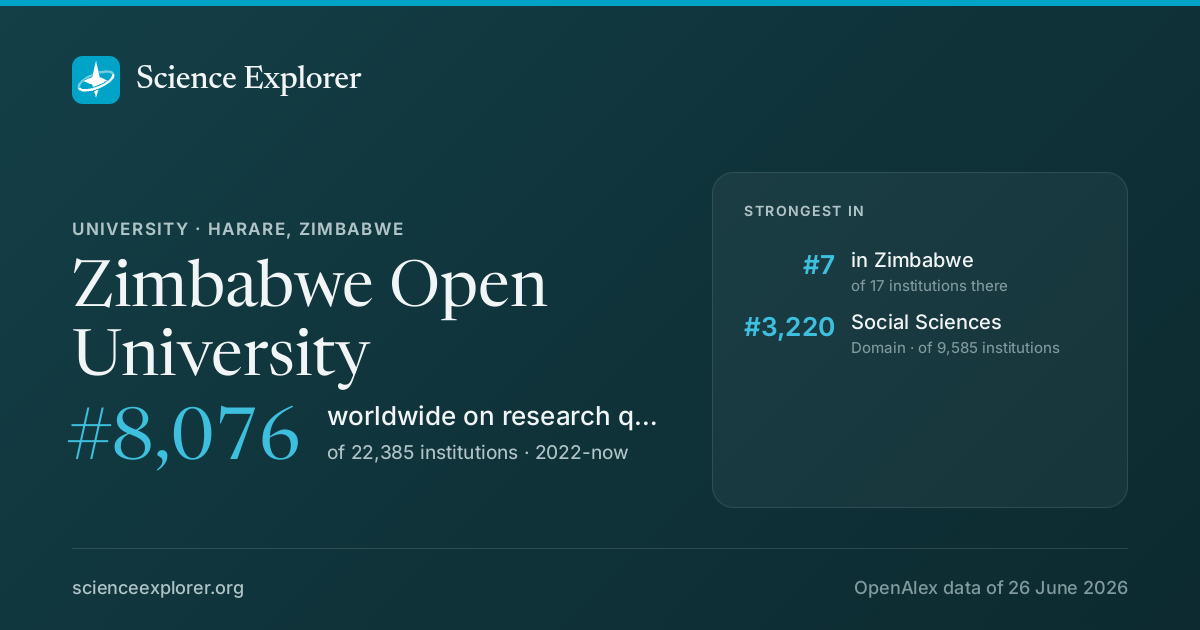
- #8,076 of 22,385 · #15,104 all time
- Rank in Zimbabwe
- #7 of 17
- Research works
- 1k ▲ 25% vs 2018-21
- Citations
- 3.4k 3.3 per fractional work
- Top-10% rate
- 6.1% all institutions 10.0%
- vs its own fields
- 0.93× 1.00× is exactly expected
- Open access
- 63% world 40%
- International
- 14% world 18%
What is Zimbabwe Open University known for in research?
The fields where it stands highest, 2022-now, ranked among every institution above the floor in each field.
| Field | World rank | Where that sits | Top-10% rate | Works | All time |
|---|---|---|---|---|---|
| Social SciencesDomain | #3,220 of 9,585 | 6.5% | 206 | #7051 | |
| Social SciencesField | #4,068 of 5,988 | 5.6% | 126 | #6189 |
Each strip is that field's whole ranked pool, with the notch where Zimbabwe Open University sits in it, in the colour of the band that rank falls in. The track under the rate is the rate itself: it carries no average mark, because the average differs by field (from about 6% in Dentistry to 21% in Economics).
Which fields of science does Zimbabwe Open University work in?
In 2022-now, 73% of research at Zimbabwe Open University is in Social Sciences, 11% in Physical Sciences. Its largest fields are Social Sciences (45%), Business, Management and Accounting (12%), Agricultural and Biological Sciences (9%). It does 2.9× the world's share of Social Sciences.
Each ring splits the one inside it: the four domains of science, their fields, their subfields. Size is fractional works in 2022-now. Every slice is a page; the interactive view zooms down to single topics and colours each by how much more of it this institution does than the world.
Its 4 domains and 20 fields, with their numbers
- Social Sciences24972.6%
- Social Sciences15645.4%
- Business, Management and Accounting4212.2%
- Economics, Econometrics and Finance154.4%
- Arts and Humanities154.3%
- Psychology113.3%
- Decision Sciences103.0%
- Physical Sciences3911.4%
- Computer Science164.5%
- Environmental Science144.1%
- Engineering61.7%
- Mathematics30.9%
- Energy00.1%
- Chemical Engineering00.0%
- Life Sciences3410.0%
- Health Sciences205.9%
- Medicine102.9%
- Health Professions102.8%
- Nursing10.2%
- Veterinary00.0%
Field profile
Location quotient across every field it publishes in: outside the ring is more than an institution of this size would be expected to publish, inside it is less.
Rings at 0.5×, 1× and 2×. Widest outward: Business, Management and Accounting, 3.8×. Every wedge is a field page.
All 20 fields, with their numbers
- Business, Management and Accounting3.78×42 works
- Social Sciences3.59×156 works
- Decision Sciences3.11×10 works
- Economics, Econometrics and Finance2.07×15 works
- Agricultural and Biological Sciences1.95×32 works
- Arts and Humanities1.48×15 works
- Psychology1.09×11 works
- Health Professions1.08×10 works
- Environmental Science0.83×14 works
- Mathematics0.74×3 works
- Computer Science0.58×16 works
- Nursing0.35×1 works
- Immunology and Microbiology0.16×1 works
- Medicine0.15×10 works
- Chemical Engineering0.14×0 works
- Energy0.13×0 works
- Engineering0.11×6 works
- Neuroscience0.09×0 works
- Biochemistry, Genetics and Molecular Biology0.08×2 works
- Veterinary0.07×0 works
- Business, Management and Accounting 3.8×
- Social Sciences 3.6×
- Decision Sciences 3.1×
- Economics, Econometrics and Finance 2.1×
- Agricultural and Biological Sciences 1.9×
- Arts and Humanities 1.5×
- Psychology 1.1×
- Health Professions 1.1×
- Environmental Science 0.8×
- Mathematics 0.7×
- Computer Science 0.6×
- Nursing 0.3×
- Immunology and Microbiology 0.2×
- Medicine 0.1×
- Chemical Engineering 0.1×
- Energy 0.1×
- Engineering 0.1×
- Neuroscience 0.1×
- Biochemistry, Genetics and Molecular Biology 0.1×
- Veterinary 0.1×
Who are the top researchers at Zimbabwe Open University?
Ranked on the quality score, Andrew Tapiwa Kugedera, Molly Manyonganise and Stephen Tsekea lead among researchers whose main affiliation is Zimbabwe Open University.
- 1
Andrew Tapiwa Kugedera
 Zimbabwe · #1,205,739 worldwide
305 citations · 42 works
- 2
Molly Manyonganise
Zimbabwe · #1,455,131 worldwide
301 citations · 63 works
- 3
Stephen Tsekea
Zimbabwe · #1,889,655 worldwide
136 citations · 16 works
- 4
Vincent Itai Tanyanyiwa
Zimbabwe · #2,137,848 worldwide
231 citations · 53 works
- 5
Godfrey Tsvuura
Zimbabwe · #2,714,216 worldwide
64 citations · 17 works
- 6
Jabulani Mpofu
Zimbabwe · #2,973,383 worldwide
153 citations · 33 works
- 7
Victor Chaboneka Ngwenya
Zimbabwe · #2,977,188 worldwide
106 citations · 24 works
- 8
Letticia Kudzai Kokerai
Zimbabwe · #3,178,086 worldwide
81 citations · 19 works
- 9
Angeline Mavis Madongonda
Zimbabwe · #3,391,693 worldwide
15 citations · 23 works
- 10
Regis Misheal Muchowe
Zimbabwe · #3,510,214 worldwide
34 citations · 42 works
Which keywords describe research at Zimbabwe Open University?
By fractional works in 2022-now, weighted toward what it does more of than the world: Colonialism, Social Justice, Nationalism, Political Economy, History, Land Reform, Agrarian Relations and Zimbabwe.
- Educational Leadership
- Professional Learning Communities
- Social Networks
- Rural Development
- Adaptation
- Postcolonialism
- Religion
- Teacher Professional Development
- Poverty Reduction
- Human Rights
- Higher Education
- Leadership
- Corporate Governance
- Educational Technology
- Globalization
- Sustainable Development
- Zimbabwe
- Land Reform
- Political Economy
- Social Justice
- Colonialism
- Nationalism
- History
- Agrarian Relations
- Sustainability
- Climate Change
- Education
- Technology Integration
- Social Capital
- Development
- Qualitative Research
- Supply Chain Management
- Sustainable Agriculture
- Gender Equality
- Smallholder Farmers
- Professional Development
- Gender Inequality
- NGOs
- Technology Adoption
- Reflective Practice
Size is fractional works in 2022-now in the topics tagged with each word; colour is the word's share of this institution's work against its share of the world's. The 40 words are chosen for being large and distinctive. Each links to the topic it comes from most.
All 40 words, with their numbers
- Colonialism36▲ 22×7 topics
- Social Justice35▲ 17×12 topics
- Nationalism31▲ 20×5 topics
- Political Economy30▲ 35×5 topics
- History29▲ 12×4 topics
- Land Reform29▲ 180×2 topics
- Agrarian Relations28▲ 881×1 topic
- Zimbabwe28▲ 881×1 topic
- Sustainability18▲ 2.2×30 topics
- Sustainable Development18▲ 3.4×24 topics
- Climate Change18▲ 1.92×26 topics
- Globalization18▲ 2.6×31 topics
- Education14▲ 2.5×19 topics
- Educational Technology12▲ 3.0×14 topics
- Technology Integration12▲ 11×8 topics
- Corporate Governance12▲ 4.8×14 topics
- Social Capital12▲ 6.5×10 topics
- Leadership10▲ 6.2×9 topics
- Development10▲ 8.3×7 topics
- Higher Education10▲ 5.5×13 topics
- Qualitative Research10▲ 3.4×17 topics
- Human Rights10▲ 2.8×13 topics
- Supply Chain Management10▲ 3.1×9 topics
- Poverty Reduction9▲ 21×5 topics
- Sustainable Agriculture8▲ 7.6×7 topics
- Teacher Professional Development8▲ 14×4 topics
- Gender Equality8▲ 7.9×7 topics
- Religion8▲ 4.8×9 topics
- Smallholder Farmers8▲ 10×4 topics
- Postcolonialism7▲ 15×6 topics
- Professional Development7▲ 10×8 topics
- Adaptation7▲ 7.1×4 topics
- Gender Inequality7▲ 15×6 topics
- Rural Development7▲ 5.7×6 topics
- NGOs6▲ 20×4 topics
- Social Networks6▲ 6.5×4 topics
- Technology Adoption6▲ 9.6×2 topics
- Professional Learning Communities6▲ 34×2 topics
- Reflective Practice6▲ 8.9×3 topics
- Educational Leadership6▲ 13×2 topics
Which research topics does Zimbabwe Open University publish most on?
By volume in 2022-now: African studies and sociopolitical issues, African cultural and philosophical studies, Agricultural Innovations and Practices and Teacher Education and Leadership Studies.
Area is fractional works; colour is the subfield each topic belongs to.
- 1 African studies and sociopolitical issues Sociology and Political Science 28 works
- 2 African cultural and philosophical studies Education 5 works
- 3 Agricultural Innovations and Practices General Agricultural and Biological Sciences 5 works
- 4 Teacher Education and Leadership Studies Education 5 works
- 5 Religion, Society, and Development Sociology and Political Science 5 works
- 6 COVID-19 Pandemic Impacts Economics and Econometrics 4 works
- 7 Poverty, Education, and Child Welfare Safety Research 4 works
- 8 Business Strategies and Management Research Management Science and Operations Research 4 works
- 9 Media Studies and Communication Communication 4 works
- 10 Education Systems and Policy Education 3 works
How open and international is its research?
Against the world's own shares: the tick on each track. Both are shares of its output, so they sit on one scale and can be read against each other as well as against the world.
World: 40% of research is openly available.
World: 18% is written across borders.
How has Zimbabwe Open University's research output changed?
Output in 2022-2025 was 25% higher than in 2018-2021.
The same series as a ribbon: one cell per year, darker for more. The line above answers how much; this answers when.
Its share of all research
Growing output can still be a shrinking share: all of science grows. This is Zimbabwe Open University as a percentage of every work published that year, 0.0011% in 2024.
Fractional works of Zimbabwe Open University over all fractional works that year. How the balance of science has shifted.
How much of it reaches the world top 10%
Year by year, against all institutions in the same year.
Of each year's output, the share that reached the world's 10% most cited for its field and year. Peak 7.7% in 2025.
Other research institutions in Harare
- University of Zimbabwe
- Forestry Commission
- Harare Institute of Technology
- Ministry of Health and Child Welfare
- Biomedical Research and Training Institute
- Department of Research and Specialist Services
- Women's University in Africa
- Zimbabwe Council For Higher Education

Share Zimbabwe Open University's ranking
Badges for a website1Each links back here and updates with every snapshot

Research measures only: rankings here say nothing about teaching, admissions or student experience. Comparable institutions and collaboration partners have tabs of their own, above.
Discussion
Ask a question or share a note about Zimbabwe Open University. Posts are plain text and can be reported.