Science Explorer Back to mapMap
Discussion
University · Cape Coast · Ghana

Cape Coast Technical University

In research, Cape Coast Technical University stands highest in Physical Sciences (#3,080 of 10,670 worldwide) and Social Sciences (#6,731 of 9,585 worldwide), 2022-now.

World rank, 2022-now
#5,785
of 22,385 · #11,640 all time
Rank in Ghana
#13
of 45
Research works
456
▲ 181% vs 2018-21
Citations
3.5k
7.7 per fractional work
Top-10% rate
12.6%
all institutions 10.0%
vs its own fields
1.10×
1.00× is exactly expected
Open access
69%
world 40%
International
24%
world 18%

What is Cape Coast Technical University known for in research?

The fields where it stands highest, 2022-now, ranked among every institution above the floor in each field.

FieldWorld rankWhere that sitsTop-10% rateWorksAll time
Physical SciencesDomain #3,080 of 10,670 16.2%99 #6519
Social SciencesDomain #6,731 of 9,585 8.6%104 #11611

Each strip is that field's whole ranked pool, with the notch where Cape Coast Technical University sits in it, in the colour of the band that rank falls in. The track under the rate is the rate itself: it carries no average mark, because the average differs by field (from about 6% in Dentistry to 21% in Economics).

Which fields of science does Cape Coast Technical University work in?

In 2022-now, 43% of research at Cape Coast Technical University is in Social Sciences, 40% in Physical Sciences. Its largest fields are Engineering (17%), Social Sciences (13%), Business, Management and Accounting (13%). It does 1.7× the world's share of Social Sciences.

Social Sciences: 118 fractional works · 42.8% of its workSocial Sciences: 37 fractional works · 13.4% of its workSociology and Political Science: 10 fractional works · 3.5% of its workEducation: 9 fractional works · 3.2% of its workLibrary and Information Sciences: 3 fractional works · 1.1% of its workUrban Studies: 2 fractional works · 0.9% of its workCommunication: 2 fractional works · 0.7% of its workDemography: 2 fractional works · 0.6% of its workTransportation: 2 fractional works · 0.5% of its workPolitical Science and International Relations: 1 fractional works · 0.5% of its workSafety Research: 1 fractional works · 0.5% of its workGender Studies: 1 fractional works · 0.4% of its workCultural Studies: 1 fractional works · 0.4% of its workHuman Factors and Ergonomics: 1 fractional works · 0.4% of its workHealth: 1 fractional works · 0.2% of its workSmaller subfields together: 1 fractional works · 0.4% of its workBusiness, Management and Accounting: 37 fractional works · 13.3% of its workStrategy and Management: 11 fractional works · 4.0% of its workAccounting: 5 fractional works · 1.9% of its workOrganizational Behavior and Human Resource Management: 5 fractional works · 1.9% of its workMarketing: 5 fractional works · 1.6% of its workManagement of Technology and Innovation: 4 fractional works · 1.5% of its workManagement Information Systems: 4 fractional works · 1.3% of its workBusiness and International Management: 2 fractional works · 0.9% of its workTourism, Leisure and Hospitality Management: 1 fractional works · 0.2% of its workDecision Sciences: 19 fractional works · 6.8% of its workManagement Science and Operations Research: 16 fractional works · 5.9% of its workInformation Systems and Management: 2 fractional works · 0.6% of its workStatistics, Probability and Uncertainty: 1 fractional works · 0.3% of its workEconomics, Econometrics and Finance: 10 fractional works · 3.6% of its workEconomics and Econometrics: 8 fractional works · 3.0% of its workFinance: 1 fractional works · 0.4% of its workGeneral Economics, Econometrics and Finance: 1 fractional works · 0.2% of its workPsychology: 10 fractional works · 3.5% of its workSocial Psychology: 8 fractional works · 2.9% of its workClinical Psychology: 1 fractional works · 0.2% of its workSmaller subfields together: 1 fractional works · 0.4% of its workArts and Humanities: 6 fractional works · 2.2% of its workConservation: 2 fractional works · 0.8% of its workMuseology: 2 fractional works · 0.7% of its workVisual Arts and Performing Arts: 1 fractional works · 0.3% of its workSmaller subfields together: 1 fractional works · 0.4% of its workPhysical Sciences: 111 fractional works · 40.2% of its workEngineering: 48 fractional works · 17.3% of its workBuilding and Construction: 15 fractional works · 5.5% of its workMechanical Engineering: 7 fractional works · 2.5% of its workMedia Technology: 5 fractional works · 1.6% of its workElectrical and Electronic Engineering: 4 fractional works · 1.6% of its workCivil and Structural Engineering: 4 fractional works · 1.6% of its workBiomedical Engineering: 4 fractional works · 1.3% of its workAutomotive Engineering: 2 fractional works · 0.9% of its workAerospace Engineering: 2 fractional works · 0.6% of its workSafety, Risk, Reliability and Quality: 1 fractional works · 0.5% of its workControl and Systems Engineering: 1 fractional works · 0.4% of its workMechanics of Materials: 1 fractional works · 0.4% of its workOcean Engineering: 1 fractional works · 0.2% of its workSmaller subfields together: 1 fractional works · 0.2% of its workEnvironmental Science: 22 fractional works · 8.0% of its workPollution: 7 fractional works · 2.5% of its workIndustrial and Manufacturing Engineering: 4 fractional works · 1.6% of its workEnvironmental Engineering: 3 fractional works · 1.2% of its workManagement, Monitoring, Policy and Law: 2 fractional works · 0.8% of its workEcology: 2 fractional works · 0.7% of its workWater Science and Technology: 1 fractional works · 0.5% of its workGlobal and Planetary Change: 1 fractional works · 0.5% of its workSmaller subfields together: 0 fractional works · 0.2% of its workComputer Science: 16 fractional works · 5.8% of its workInformation Systems: 7 fractional works · 2.5% of its workArtificial Intelligence: 4 fractional works · 1.3% of its workComputer Vision and Pattern Recognition: 3 fractional works · 1.0% of its workComputer Networks and Communications: 1 fractional works · 0.5% of its workHuman-Computer Interaction: 1 fractional works · 0.2% of its workSmaller subfields together: 0 fractional works · 0.1% of its workEnergy: 11 fractional works · 3.9% of its workRenewable Energy, Sustainability and the Environment: 7 fractional works · 2.6% of its workEnergy Engineering and Power Technology: 4 fractional works · 1.3% of its workMaterials Science: 3 fractional works · 1.2% of its workPolymers and Plastics: 2 fractional works · 0.8% of its workSmaller subfields together: 1 fractional works · 0.4% of its workMathematics: 3 fractional works · 1.2% of its workModeling and Simulation: 1 fractional works · 0.5% of its workStatistics and Probability: 1 fractional works · 0.3% of its workApplied Mathematics: 1 fractional works · 0.3% of its workSmaller subfields together: 0 fractional works · 0.1% of its workPhysics and Astronomy: 3 fractional works · 1.0% of its workStatistical and Nonlinear Physics: 2 fractional works · 0.8% of its workSmaller subfields together: 1 fractional works · 0.2% of its workChemistry: 2 fractional works · 0.8% of its workAnalytical Chemistry: 2 fractional works · 0.6% of its workSmaller subfields together: 0 fractional works · 0.2% of its workEarth and Planetary Sciences: 2 fractional works · 0.7% of its workGeophysics: 1 fractional works · 0.3% of its workGeology: 1 fractional works · 0.2% of its workSmaller subfields together: 0 fractional works · 0.2% of its workChemical Engineering: 1 fractional works · 0.4% of its workChemical Health and Safety: 1 fractional works · 0.4% of its workSmaller subfields together: 0 fractional works · 0.1% of its workLife Sciences: 24 fractional works · 8.8% of its workAgricultural and Biological Sciences: 21 fractional works · 7.5% of its workPlant Science: 8 fractional works · 3.0% of its workFood Science: 7 fractional works · 2.4% of its workSoil Science: 2 fractional works · 0.8% of its workInsect Science: 1 fractional works · 0.3% of its workAnimal Science and Zoology: 1 fractional works · 0.2% of its workGeneral Agricultural and Biological Sciences: 1 fractional works · 0.2% of its workSmaller subfields together: 2 fractional works · 0.5% of its workBiochemistry, Genetics and Molecular Biology: 3 fractional works · 0.9% of its workMolecular Biology: 1 fractional works · 0.3% of its workSmaller subfields together: 2 fractional works · 0.6% of its workImmunology and Microbiology: 1 fractional works · 0.2% of its workNeuroscience: 0 fractional works · 0.1% of its workPharmacology, Toxicology and Pharmaceutics: 0 fractional works · 0.1% of its workHealth Sciences: 23 fractional works · 8.3% of its workHealth Professions: 10 fractional works · 3.8% of its workRadiological and Ultrasound Technology: 7 fractional works · 2.4% of its workGeneral Health Professions: 2 fractional works · 0.6% of its workOccupational Therapy: 1 fractional works · 0.4% of its workSmaller subfields together: 1 fractional works · 0.4% of its workMedicine: 10 fractional works · 3.5% of its workPublic Health, Environmental and Occupational Health: 1 fractional works · 0.5% of its workBiochemistry: 1 fractional works · 0.4% of its workInfectious Diseases: 1 fractional works · 0.4% of its workPharmacology: 1 fractional works · 0.3% of its workSurgery: 1 fractional works · 0.3% of its workPediatrics, Perinatology and Child Health: 1 fractional works · 0.3% of its workPulmonary and Respiratory Medicine: 1 fractional works · 0.3% of its workHematology: 1 fractional works · 0.2% of its workSmaller subfields together: 2 fractional works · 0.9% of its workNursing: 3 fractional works · 1.0% of its workNutrition and Dietetics: 3 fractional works · 1.0% of its workALL ITS WORKCape CoastTechnical…277fractional works, 2022-now
Life Sciences9%Physical Sciences40%Health Sciences8%Social Sciences43%

Each ring splits the one inside it: the four domains of science, their fields, their subfields. Size is fractional works in 2022-now. Every slice is a page; the interactive view zooms down to single topics and colours each by how much more of it this institution does than the world.

Its 4 domains and 24 fields, with their numbers
    1. Social Sciences3713.4%
    2. Business, Management and Accounting3713.3%
    3. Decision Sciences196.8%
    4. Economics, Econometrics and Finance103.6%
    5. Psychology103.5%
    6. Arts and Humanities62.2%
    1. Engineering4817.3%
    2. Environmental Science228.0%
    3. Computer Science165.8%
    4. Energy113.9%
    5. Materials Science31.2%
    6. Mathematics31.2%
    7. Physics and Astronomy31.0%
    8. Chemistry20.8%
    9. Earth and Planetary Sciences20.7%
    10. Chemical Engineering10.4%
    1. Agricultural and Biological Sciences217.5%
    2. Biochemistry, Genetics and Molecular Biology30.9%
    3. Immunology and Microbiology10.2%
    4. Neuroscience00.1%
    5. Pharmacology, Toxicology and Pharmaceutics00.1%
    1. Health Professions103.8%
    2. Medicine103.5%
    3. Nursing31.0%
All of science, and how each field's share has moved since 1950: the Science domain explorer

Field profile

Location quotient across every field it publishes in: outside the ring is more than an institution of this size would be expected to publish, inside it is less.

Agricultural and Biological Sciences: 1.58× its world share, 21 worksAgricultural and Bio…Biochemistry, Genetics and Molecular Biology: 0.18× its world share, 3 worksBiochemistry, Geneti…Immunology and Microbiology: 0.20× its world share, 1 worksImmunology and Micro…Neuroscience: 0.04× its world share, 0 worksNeurosciencePharmacology, Toxicology and Pharmaceutics: 0.17× its world share, 0 worksPharmacology, Toxico…Chemical Engineering: 1.19× its world share, 1 worksChemical EngineeringChemistry: 0.48× its world share, 2 worksChemistryComputer Science: 0.74× its world share, 16 worksComputer ScienceEarth and Planetary Sciences: 0.43× its world share, 2 worksEarth and Planetary …Energy: 4.21× its world share, 11 worksEnergyEngineering: 1.15× its world share, 48 worksEngineeringEnvironmental Science: 1.62× its world share, 22 worksEnvironmental ScienceMaterials Science: 0.34× its world share, 3 worksMaterials ScienceMathematics: 0.99× its world share, 3 worksMathematicsPhysics and Astronomy: 0.47× its world share, 3 worksPhysics and AstronomyHealth Professions: 1.44× its world share, 10 worksHealth ProfessionsMedicine: 0.18× its world share, 10 worksMedicineNursing: 2.00× its world share, 3 worksNursingArts and Humanities: 0.76× its world share, 6 worksArts and HumanitiesBusiness, Management and Accounting: 4.12× its world share, 37 worksBusiness, Management…Decision Sciences: 7.02× its world share, 19 worksDecision SciencesEconomics, Econometrics and Finance: 1.69× its world share, 10 worksEconomics, Econometr…Psychology: 1.16× its world share, 10 worksPsychologySocial Sciences: 1.06× its world share, 37 worksSocial Sciences1×world share
more than its size predictsabout as predictedless

Rings at 0.5×, 1× and 2×. Widest outward: Decision Sciences, 7.0×. Every wedge is a field page.

All 24 fields, with their numbers
  1. Decision Sciences7.02×19 works
  2. Energy4.21×11 works
  3. Business, Management and Accounting4.12×37 works
  4. Nursing2.00×3 works
  5. Economics, Econometrics and Finance1.69×10 works
  6. Environmental Science1.62×22 works
  7. Agricultural and Biological Sciences1.58×21 works
  8. Health Professions1.44×10 works
  9. Chemical Engineering1.19×1 works
  10. Psychology1.16×10 works
  11. Engineering1.15×48 works
  12. Social Sciences1.06×37 works
  13. Mathematics0.99×3 works
  14. Arts and Humanities0.76×6 works
  15. Computer Science0.74×16 works
  16. Chemistry0.48×2 works
  17. Physics and Astronomy0.47×3 works
  18. Earth and Planetary Sciences0.43×2 works
  19. Materials Science0.34×3 works
  20. Immunology and Microbiology0.20×1 works
  21. Biochemistry, Genetics and Molecular Biology0.18×3 works
  22. Medicine0.18×10 works
  23. Pharmacology, Toxicology and Pharmaceutics0.17×0 works
  24. Neuroscience0.04×0 works

Who are the top researchers at Cape Coast Technical University?

Ranked on the quality score, Flavio Odoi-Yorke, Alhassan Mumuni and Emmanuel Kwaw lead among researchers whose main affiliation is Cape Coast Technical University.

  1. 1 Flavio Odoi-Yorke Ghana · #355,313 worldwide 1.5k citations · 91 works
  2. 2 Alhassan Mumuni Ghana · #695,807 worldwide 1.3k citations · 21 works
  3. 3 Emmanuel Kwaw Ghana · #1,474,744 worldwide 1.6k citations · 59 works
  4. 4 Richard Osae Ghana · #1,552,868 worldwide 1.4k citations · 45 works
  5. 5 Agnes Abeley Abbey Ghana · #1,564,708 worldwide 446 citations · 23 works
  6. 6 Francis Padi Lamptey Ghana · #1,706,829 worldwide 282 citations · 28 works
  7. 7 Yaw Ndori Queku Ghana · #1,902,769 worldwide 126 citations · 22 works
  8. 8 Emmanuel Bamfo-Agyei Ghana · #2,308,823 worldwide 165 citations · 36 works
  9. 9 Moses Ahomka Yeboah Ghana · #2,322,100 worldwide 100 citations · 21 works
  10. 10 L. Atepor Ghana · #2,363,431 worldwide 380 citations · 41 works
All ranked researchers at Cape Coast Technical University

What are the most cited papers from Cape Coast Technical University?

The most cited paper from Cape Coast Technical University is "Data augmentation: A comprehensive survey of modern approaches" (Alhassan Mumuni, Fuseini Mumuni, 2022), with 877 citations. Next come "Effect of lactobacillus strains on phenolic profile, color attributes and antioxidant activities of lactic-acid-fermented mulberry juice" (501) and "The Critical Role of the Construction Industry in Achieving the Sustainable Development Goals (SDGs): Delivering Projects for the Common Good" (262).

Most cited papers
#PaperReleasedCitations
1 Data augmentation: A comprehensive survey of modern approaches Alhassan Mumuni, Fuseini Mumuni · Array Open access 15 Nov 2022 877
2 Effect of lactobacillus strains on phenolic profile, color attributes and antioxidant activities of lactic-acid-fermented mulberry juice Emmanuel Kwaw, Yongkun Ma, William Tchabo et al. · Food Chemistry 2 Jan 2018 501
3 The Critical Role of the Construction Industry in Achieving the Sustainable Development Goals (SDGs): Delivering Projects for the Common Good Wenmei Fei, Alex Opoku, Kofı Agyekum et al. · Sustainability Open access 14 Aug 2021 262
4 Reviews on mechanisms of in vitro antioxidant, antibacterial and anticancer activities of water-soluble plant polysaccharides Otu Phyllis Naa Yarley, Azumah Bright Kojo, Cunshan Zhou et al. · International Journal of Biological Macromolecules 29 May 2021 226
5 Green market orientation, green innovation capability, green knowledge acquisition and green brand positioning as determinants of new product success Prasad Siba Borah, Courage Simon Kofi Dogbe, Wisdom Wise Kwabla Pomegbe et al. · European Journal of Innovation Management 6 Sep 2021 199
All 60 most cited papers, with filters and sorting

Which keywords describe research at Cape Coast Technical University?

By fractional works in 2022-now, weighted toward what it does more of than the world: Sustainability, Risk Management, Supply Chain Management, Renewable Energy, Construction Projects, Leadership Style, Environmental Impact and Stakeholder Analysis.

▲ more of its work than of the world's◆ about the world's share▼ less than the world's

Size is fractional works in 2022-now in the topics tagged with each word; colour is the word's share of this institution's work against its share of the world's. The 40 words are chosen for being large and distinctive. Each links to the topic it comes from most.

All 40 words, with their numbers
  1. Sustainability29▲ 4.3×40 topics
  2. Renewable Energy22▲ 5.4×22 topics
  3. Risk Management21▲ 16×9 topics
  4. Supply Chain Management20▲ 8.1×14 topics
  5. Environmental Impact18▲ 3.8×26 topics
  6. Construction Projects13▲ 109×2 topics
  7. Leadership Style13▲ 34×2 topics
  8. Stakeholder Analysis13▲ 71×2 topics
  9. Cost Overruns13▲ 115×1 topic
  10. Project Success13▲ 115×1 topic
  11. Risk Perception9▲ 12×7 topics
  12. Economic Development9▲ 4.0×10 topics
  13. Organizational Culture9▲ 8.2×5 topics
  14. Social Capital9▲ 6.0×10 topics
  15. Innovation8▲ 2.9×17 topics
  16. Facilities Management8▲ 38×2 topics
  17. Leadership8▲ 5.7×10 topics
  18. Accident Prevention8▲ 40×2 topics
  19. Safety Culture8▲ 40×2 topics
  20. Consumer Behavior7▲ 4.3×9 topics
  21. Workplace Safety7▲ 19×2 topics
  22. Construction Safety7▲ 39×2 topics
  23. Occupational Safety7▲ 25×1 topic
  24. Safety Climate7▲ 28×1 topic
  25. Environmental Management6▲ 5.8×6 topics
  26. Life Cycle Assessment6▲ 8.3×7 topics
  27. Health Impacts6▲ 28×2 topics
  28. Household Fuel Use6▲ 34×1 topic
  29. Indoor Air Pollution6▲ 34×1 topic
  30. Entrepreneurship6▲ 5.2×9 topics
  31. RFID Technology6▲ 11×3 topics
  32. Construction5▲ 14×2 topics
  33. Sustainable Construction5▲ 23×5 topics
  34. BIM5▲ 29×1 topic
  35. Digital Divide5▲ 6.7×2 topics
  36. Prefabrication5▲ 29×1 topic
  37. ICT4▲ 12×2 topics
  38. Product Design4▲ 11×3 topics
  39. Renewable Resources4▲ 8.7×2 topics
  40. Poverty Alleviation4▲ 15×2 topics

Which research topics does Cape Coast Technical University publish most on?

By volume in 2022-now: Construction Project Management and Performance, Occupational Health and Safety Research, Energy and Environment Impacts and BIM and Construction Integration.

  1. 1 Construction Project Management and Performance Management Science and Operations Research 13 works
  2. 2 Occupational Health and Safety Research Radiological and Ultrasound Technology 7 works
  3. 3 Energy and Environment Impacts Pollution 6 works
  4. 4 BIM and Construction Integration Building and Construction 5 works
  5. 5 ICT Impact and Policies Media Technology 4 works
  6. 6 Sustainable Supply Chain Management Strategy and Management 4 works
  7. 7 Hybrid Renewable Energy Systems Energy Engineering and Power Technology 4 works
  8. 8 Sustainable Building Design and Assessment Building and Construction 4 works
  9. 9 Facilities and Workplace Management Social Psychology 3 works
  10. 10 Microfinance and Financial Inclusion Economics and Econometrics 2 works

How open and international is its research?

Against the world's own shares: the tick on each track. Both are shares of its output, so they sit on one scale and can be read against each other as well as against the world.

openly available69.1%not open30.9%

World: 40% of research is openly available.

with international co-authors24.5%domestic only75.5%

World: 18% is written across borders.

How has Cape Coast Technical University's research output changed?

Output in 2022-2025 was 181% higher than in 2018-2021.

still counting20052010201520202025
grewheldshrank

The same series as a ribbon: one cell per year, darker for more. The line above answers how much; this answers when.

Its share of all research

Growing output can still be a shrinking share: all of science grows. This is Cape Coast Technical University as a percentage of every work published that year, 0.0011% in 2024.

still counting0.00050%0.0010%0.0015%Cape Coast Technical University0.0012% in 202520102020

Fractional works of Cape Coast Technical University over all fractional works that year. How the balance of science has shifted.

How much of it reaches the world top 10%

Year by year, against all institutions in the same year.

still counting10%20%Cape Coast Technical University15.0% in 2025all institutions10.0% in 20252020

Of each year's output, the share that reached the world's 10% most cited for its field and year. Peak 15.0% in 2025.

Other research institutions in Cape Coast

All research institutions in Cape Coast

Share Cape Coast Technical University's ranking
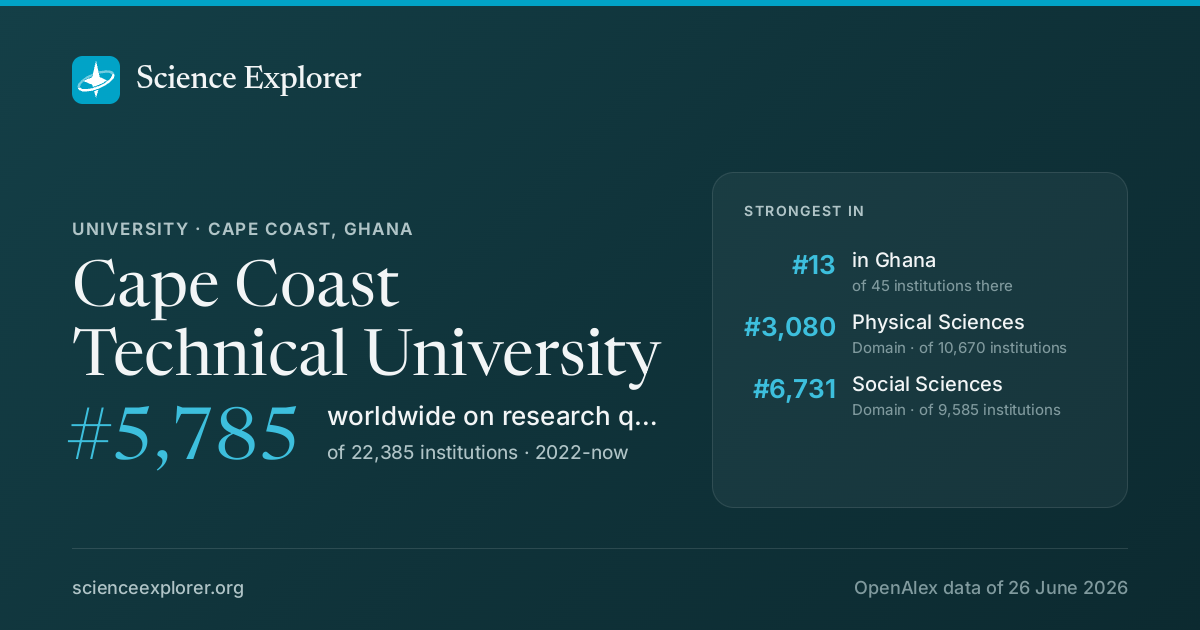
Cape Coast Technical University on Science Explorer

A card with Cape Coast Technical University's standing and the fields it leads in, for a post or a slide. A link to this page previews as the same card.

Download the card

1200 × 630 PNG, sized for social posts, drawn from the latest snapshot.

Badges for a website1Each links back here and updates with every snapshot

Research measures only: rankings here say nothing about teaching, admissions or student experience. Comparable institutions and collaboration partners have tabs of their own, above.

Discussion

Ask a question or share a note about Cape Coast Technical University. Posts are plain text and can be reported.