 Science in Peru
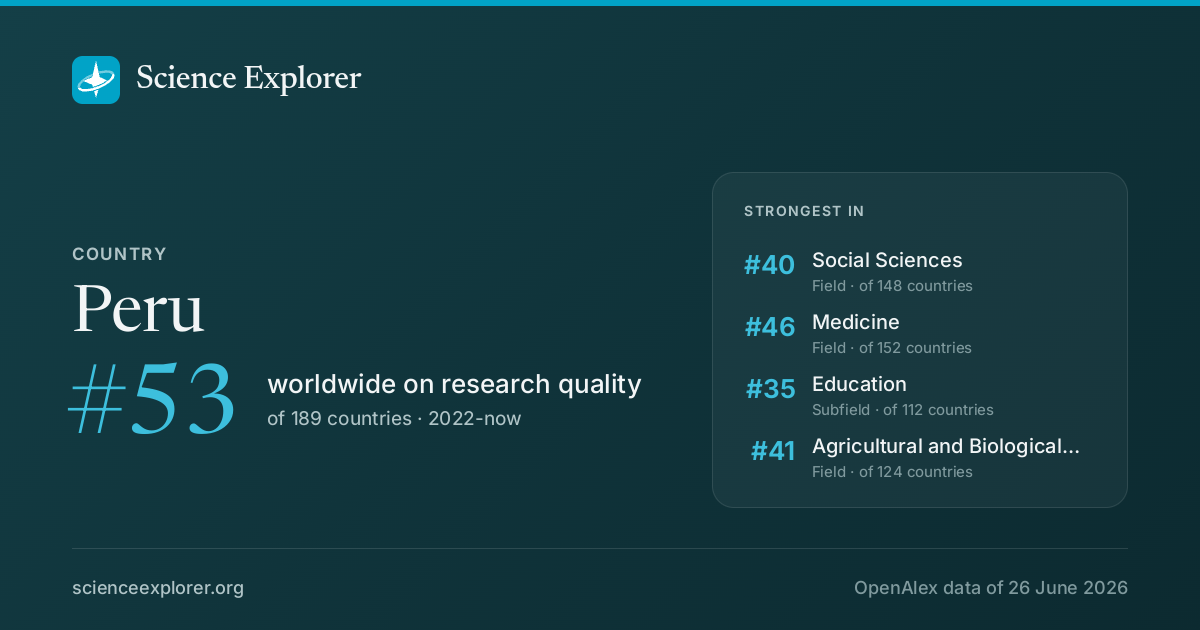
Peru ranks #53 of 189 countries on research quality in 2022-now (#44 all time), with 54k research works and 7.2% of them in the world's top 10%.
- World rank, 2022-now
- #53 of 189 · #44 all time
- Works, 2022-now
- 54k ▲ 35% vs 2018-21
- Citations
- 695k 4.2 per fractional work, all time
- Top-10% rate
- 7.2% all institutions 10.0%
- vs its own fields
- 0.65× 1.00× is exactly expected
- In the world top 100
- 0 0 in the top 1,000
- Open access
- 78% world 40%
- International
- 19% world 18%
PeruWhat is Peru strongest at in science?
On research quality in 2022-now, Peru ranks highest in Social Sciences (#40 of 148), Medicine (#46 of 152) and Education (#35 of 112). Relative to its size it is most specialised in Horticulture, Computer Science Applications and General Social Sciences.
| Field | World rank | Where that sits | Top-10% rate | Works | All time | Institutions |
|---|---|---|---|---|---|---|
| Social SciencesField | #40 of 148 | 9.5% | 13,785 | #37 | Institutions | |
| MedicineField | #46 of 152 | 4.9% | 6,553 | #42 | Institutions | |
| EducationSubfield | #35 of 112 | 10.9% | 4,245 | #31 | Institutions | |
| Agricultural and Biological SciencesField | #41 of 124 | 6.7% | 3,819 | #36 | Institutions | |
| Economics and EconometricsSubfield | #34 of 98 | 9.2% | 2,787 | #33 | Institutions | |
| Health ProfessionsField | #37 of 106 | 7.5% | 2,894 | #32 | Institutions | |
| Business, Management and AccountingField | #39 of 110 | 9.3% | 3,395 | #39 | Institutions | |
| Economics, Econometrics and FinanceField | #38 of 107 | 9.0% | 3,031 | #34 | Institutions | |
| Sociology and Political ScienceSubfield | #44 of 119 | 8.8% | 2,416 | #39 | Institutions | |
| PsychologyField | #40 of 106 | 7.4% | 2,696 | #36 | Institutions | |
| General Health ProfessionsSubfield | #34 of 84 | 7.9% | 1,817 | #31 | Institutions | |
| Political Science and International RelationsSubfield | #40 of 95 | 9.3% | 1,389 | #37 | Institutions |
Where its research is concentrated
Location quotient: how much more (or less) of each node it does than its size predicts. Drawn around 1×, where "twice the world share" and "half of it" are the same distance apart in opposite directions. A volume reading, which on a country axis is largely population and industrial structure.
- HorticultureSubfield · 67.6 works · #13 of 178 active here8.2×
- Computer Science ApplicationsSubfield · 1,164.4 works · #11 of 196 active here7.7×
- General Social SciencesSubfield · 506.6 works · #17 of 191 active here7.5×
- Life-span and Life-course StudiesSubfield · 52.2 works · #17 of 144 active here5.1×
- Organizational Behavior and Human Resource ManagementSubfield · 1,376.3 works · #18 of 220 active here4.7×
- Neuropsychology and Physiological PsychologySubfield · 91.4 works · #21 of 169 active here4.6×
- Occupational TherapySubfield · 442.1 works · #20 of 198 active here4.3×
- LawSubfield · 1,438.6 works · #18 of 212 active here4.0×
The whole field profile
All 26 fields at once. A specialist and a generalist produce the same ranked list and a completely different shape.
Rings at 0.5×, 1× and 2×. Widest outward: Economics, Econometrics and Finance, 2.4×. Every wedge is a field page.
All 26 fields, with their numbers
- Economics, Econometrics and Finance2.44×3,203 works
- Dentistry2.13×634 works
- Social Sciences2.00×16k works
- Business, Management and Accounting1.95×3,862 works
- Health Professions1.94×3,131 works
- Psychology1.64×3,058 works
- Agricultural and Biological Sciences1.51×4,389 works
- Environmental Science1.37×4,171 works
- Arts and Humanities1.27×2,250 works
- Veterinary1.14×95 works
- Computer Science1.05×5,024 works
- Nursing0.92×278 works
- Decision Sciences0.85×506 works
- Energy0.77×436 works
- Earth and Planetary Sciences0.66×635 works
- Immunology and Microbiology0.64×396 works
- Medicine0.63×7,478 works
- Pharmacology, Toxicology and Pharmaceutics0.60×130 works
- Mathematics0.42×305 works
- Biochemistry, Genetics and Molecular Biology0.37×1,221 works
- Engineering0.37×3,375 works
- Neuroscience0.35×348 works
- Chemistry0.23×218 works
- Materials Science0.18×389 works
- Chemical Engineering0.16×34 works
- Physics and Astronomy0.16×225 works
Which fields of science does Peru work in?
In 2022-now, 46% of research in Peru is in Social Sciences, 24% in Physical Sciences. Its largest fields are Social Sciences (25%), Medicine (12%), Computer Science (8%). It does 1.9× the world's share of Social Sciences.
Each ring splits the one inside it: the four domains of science, their fields, their subfields. Size is fractional works in 2022-now. Every slice is a page; the interactive view zooms down to single topics and colours each by how much more of it this country does than the world.
Its 4 domains and 26 fields, with their numbers
- Social Sciences28k46.3%
- Social Sciences16k25.3%
- Business, Management and Accounting3,8626.3%
- Economics, Econometrics and Finance3,2035.2%
- Psychology3,0585.0%
- Arts and Humanities2,2503.7%
- Decision Sciences5060.8%
- Physical Sciences15k24.2%
- Computer Science5,0248.2%
- Environmental Science4,1716.8%
- Engineering3,3755.5%
- Earth and Planetary Sciences6351.0%
- Energy4360.7%
- Materials Science3890.6%
- Mathematics3050.5%
- Physics and Astronomy2250.4%
- Chemistry2180.4%
- Chemical Engineering340.1%
- Health Sciences12k18.9%
- Medicine7,47812.2%
- Health Professions3,1315.1%
- Dentistry6341.0%
- Nursing2780.5%
- Veterinary950.2%
- Life Sciences6,48410.6%
Which keywords describe research in Peru?
By fractional works in 2022-now, weighted toward what it does more of than the world: Education, Innovation, Small and Medium Enterprises, Digital Marketing, Social Responsibility, Innovation Ecosystems, Urban Development and Competitiveness.
- Educational Leadership
- Curriculum Design
- Student Performance
- Virtual Teaching
- Digital Competence
- Online Education
- Organizational Culture
- Latin America
- Human Rights
- Educational Technology
- Sustainable Development
- City Branding
- Globalization Effects
- Competitiveness
- Knowledge Management
- E-Learning
- Social Responsibility
- Digital Marketing
- Globalization
- Sustainability
- Education
- Innovation
- Small and Medium Enterprises
- COVID-19
- Public Health
- Innovation Ecosystems
- Urban Development
- Economic Impact
- Tourism Management
- Psychopharmacology Education
- Pedagogy
- Teacher Training
- Distance Learning
- Health Promotion
- Digital Divide
- ICT
- Public Policy
- Nutrition
- Organizational Commitment
- Teacher Development
Size is fractional works in 2022-now in the topics tagged with each word; colour is the word's share of this country's work against its share of the world's. The 40 words are chosen for being large and distinctive. Each links to the topic it comes from most.
All 40 words, with their numbers
- Education6,030▲ 5.7×138 topics
- Sustainability3,629▲ 2.4×118 topics
- Innovation3,591▲ 5.7×82 topics
- Globalization3,303▲ 2.7×158 topics
- Small and Medium Enterprises3,036▲ 28×9 topics
- Digital Marketing3,015▲ 13×6 topics
- COVID-192,806▲ 3.5×31 topics
- Social Responsibility2,602▲ 18×12 topics
- Public Health2,593▲ 2.9×74 topics
- E-Learning2,578▲ 4.4×25 topics
- Innovation Ecosystems2,516▲ 40×4 topics
- Knowledge Management2,451▲ 7.2×40 topics
- Urban Development2,447▲ 11×19 topics
- Competitiveness2,442▲ 50×8 topics
- Economic Impact2,432▲ 7.4×12 topics
- Globalization Effects2,335▲ 55×3 topics
- Tourism Management2,309▲ 54×2 topics
- City Branding2,308▲ 61×1 topic
- Psychopharmacology Education2,308▲ 61×1 topic
- Sustainable Development2,265▲ 2.4×101 topics
- Pedagogy2,264▲ 7.4×29 topics
- Educational Technology2,072▲ 2.9×44 topics
- Teacher Training2,045▲ 5.4×29 topics
- Human Rights1,986▲ 3.2×84 topics
- Distance Learning1,945▲ 9.1×13 topics
- Latin America1,902▲ 16×23 topics
- Health Promotion1,893▲ 9.8×17 topics
- Organizational Culture1,860▲ 7.9×17 topics
- Digital Divide1,632▲ 10×8 topics
- Online Education1,589▲ 13×7 topics
- ICT1,544▲ 19×5 topics
- Digital Competence1,543▲ 29×4 topics
- Public Policy1,528▲ 5.3×27 topics
- Virtual Teaching1,522▲ 46×1 topic
- Nutrition1,492▲ 5.5×19 topics
- Student Performance1,275▲ 20×4 topics
- Organizational Commitment1,268▲ 11×5 topics
- Curriculum Design1,262▲ 30×3 topics
- Teacher Development1,258▲ 33×2 topics
- Educational Leadership1,253▲ 16×4 topics
Which research topics does Peru publish the most in?
Its largest topics in 2022-now are Business, Innovation, and Economy, Educational Innovations and Technology, Education and Teacher Training.
Area is fractional works in 2022-now; colour is the subfield each topic belongs to. Every tile is a topic page.
- 1 Business, Innovation, and Economy Economics and Econometrics 2.3k works
- 2 Educational Innovations and Technology Information Systems 1.5k works
- 3 Education and Teacher Training Education 1.2k works
- 4 Educational and Organizational Development Organizational Behavior and Human Resource Management 785 works
- 5 Health and Lifestyle Studies General Health Professions 743 works
- 6 Stress and Burnout Research Social Psychology 721 works
- 7 Public Health and Environmental Issues Health, Toxicology and Mutagenesis 684 works
- 8 E-Learning and Knowledge Management Computer Science Applications 675 works
- 9 Social Issues and Policies in Latin America Law 565 works
- 10 Diverse Applied Research Studies Sociology and Political Science 560 works
- 11 Business, Education, Mathematics Research Accounting 482 works
- 12 Social Skills and Education Education 470 works
Which universities in Peru lead research?
Universidad César Vallejo, Pontificia Universidad Católica del Perú and Universidad Peruana Cayetano Heredia rank highest in Peru on research quality in 2022-now.
One dot per institution in the list below. The upper left is the interesting corner.
- 1Universidad César VallejoUniversity · Lima · #1,100 worldwide12.0% top 10% · 5.7k works
- 2Pontificia Universidad Católica del PerúUniversity · Lima · #1,672 worldwide8.2% top 10% · 3.1k works
- 3Universidad Peruana Cayetano HerediaUniversity · Lima · #1,760 worldwide6.2% top 10% · 1.4k works
- 4National University of San MarcosUniversity · Lima · #1,846 worldwide5.7% top 10% · 5.2k works
- 5Universidad de LimaUniversity · Lima · #1,953 worldwide6.1% top 10% · 1.4k works
- 6Universidad Nacional de San MartínUniversity · Tarapoto · #2,181 worldwide8.2% top 10% · 984 works
- 7Private University of the NorthUniversity · Trujillo · #2,281 worldwide5.8% top 10% · 1.4k works
- 8Universidad Peruana UniónUniversity · Lima · #2,461 worldwide10.6% top 10% · 1k works
- 9Peruvian University of Applied SciencesUniversity · Lima · #2,532 worldwide5.5% top 10% · 1.8k works
- 10National University of TrujilloUniversity · Trujillo · #2,595 worldwide5.5% top 10% · 1.3k works
- 11Universidad Nacional de San Agustin de ArequipaUniversity · Arequipa · #2,724 worldwide8.5% top 10% · 1k works
- 12Universidad San Ignacio de LoyolaUniversity · Lima · #2,869 worldwide11.1% top 10% · 928 works
- 13Universidad Científica del SurUniversity · Lima · #2,910 worldwide8.5% top 10% · 1.4k works
- 14Universidad Ricardo PalmaUniversity · Lima · #2,966 worldwide6.1% top 10% · 776 works
- 15Universidad Nacional del AltiplanoUniversity · Puno · #2,981 worldwide6.7% top 10% · 1.3k works



The track on each row is its top-10% rate; the tick is the average of all institutions, 10.0% (how it is set): teal above it, red below.
All ranked institutions in PeruWho are the top researchers in Peru?
Abel Monteagudo Mendoza, Eurídice N. Honorio Coronado and Rodolfo Vásquez rank highest among researchers based in Peru.
- 1 Abel Monteagudo Mendoza #9,966 worldwide 6.2k citations · 101 works
- 2 Eurídice N. Honorio Coronado #10,182 worldwide 16k citations · 197 works
- 3 Rodolfo Vásquez #14,133 worldwide 16k citations · 148 works
- 4 Percy Núñez Vargas #30,849 worldwide 8.3k citations · 55 works
- 5 Norma Salinas #37,475 worldwide 9.9k citations · 177 works
- 6 Jhon del Águila Pasquel #47,105 worldwide 3.7k citations · 68 works
- 7 Freddy Ramírez Arévalo #56,193 worldwide 2k citations · 44 works
- 8 Gabriel Enrique De-la-Torre #68,111 worldwide 7.3k citations · 156 works
- 9 Mohamed Mousa #87,534 worldwide 2.2k citations · 129 works
- 10 Carla Gallo #96,571 worldwide 29k citations · 119 works
Which cities in Peru are research hubs?
How open and international is Peru's research?
78% of its research is openly available (world: 40%), and 19% is written with international co-authors (world: 18%).
World: 40% of research is openly available.
World: 18% is written across borders.
In 2022-now, 86% of its research is openly available (world 63%) and 18% is written with co-authors abroad (world 22%). Against what its own mix of topics predicts, that is 1.09× the expected open access and 0.93× the expected international share, which puts it #129 of 173 countries on openness.
How has Peru's research grown?
Output in 2022-2025 was 35% higher than in 2018-2021.
The same series as a ribbon: one cell per year, darker for more. The line above answers how much; this answers when.
Its share of all research
Growing output can still be a shrinking share: all of science grows. This is Peru as a percentage of every work published that year, 0.24% in 2024.
Fractional works of Peru over all fractional works that year. How the balance of science has shifted.
How much of it reaches the world top 10%
Over the whole record, 6.3% of its 164k works since 1950 reached the world top 10% for their field and year.
Of each year's output, the share that reached the world's 10% most cited for its field and year. Peak 8.1% in 2025.
Which countries have research most like Peru's?
Bolivia is Peru's closest research twin: of all countries, its research is spread across the fields most like Peru's, with both strong in Social Sciences.
- 1
 BoliviaBoth strong in Social Sciences, Economics, Econometrics and Finance, Health Professions
0.96 Compare
- 2
 EcuadorBoth strong in Economics, Econometrics and Finance, Dentistry, Social Sciences
0.96 Compare
- 3
 NicaraguaBoth strong in Social Sciences, Economics, Econometrics and Finance, Health Professions
0.93 Compare
- 4
 Costa RicaBoth strong in Social Sciences, Agricultural and Biological Sciences, Health Professions
0.91 Compare
- 5
 ColombiaBoth strong in Social Sciences, Health Professions, Agricultural and Biological Sciences
0.91 Compare
Similarity is the correlation of each side's location quotients across every field it publishes in, on a log scale: 1 is the same shape of research, 0 is unrelated. It ignores size. How it is measured.
Compare Peru with
 Croatia
 Malaysia
 Ethiopia
 Iceland
 Slovakia
Share Peru's ranking
Badges for a website1Each links back here and updates with every snapshot

Research fields in Peru
- Social Sciences
- Social Sciences
- Health Sciences
- Medicine
- Education
- Agricultural and Biological Sciences
- Economics and Econometrics
- Health Professions
- Business, Management and Accounting
- Economics, Econometrics and Finance
- Sociology and Political Science
- Psychology
- General Health Professions
- Political Science and International Relations
- Life Sciences
- Organizational Behavior and Human Resource Management
- Physical Sciences
- Arts and Humanities
- Computer Science
- General Agricultural and Biological Sciences
- Accounting
- Clinical Psychology
- Information Systems
- Engineering
- Environmental Science
- Social Psychology
- Food Science
- Cultural Studies
- Public Health, Environmental and Occupational Health
- Strategy and Management
- Literature and Literary Theory
- Safety Research
- Ecology
- Plant Science
- Biochemistry, Genetics and Molecular Biology
- Language and Linguistics
- Civil and Structural Engineering
- Computer Science Applications
- Earth and Planetary Sciences
- Dentistry
- Law
- Demography
- Management, Monitoring, Policy and Law
- Ecology, Evolution, Behavior and Systematics
- Management Information Systems
- Developmental and Educational Psychology
- Artificial Intelligence
- Health, Toxicology and Mutagenesis
- Occupational Therapy
Questions people ask
What is Peru strongest at in science?
On research quality in 2022-now, Peru ranks highest in Social Sciences (#40 of 148), Medicine (#46 of 152) and Education (#35 of 112). Relative to its size it is most specialised in Horticulture, Computer Science Applications and General Social Sciences.
See the full answerDiscussion
Ask a question or share a note about Peru. Keep it to the research: no personal attacks, advertising or links. Any reader can report a post, which collapses it for everyone until it is opened.