 Science in Ecuador
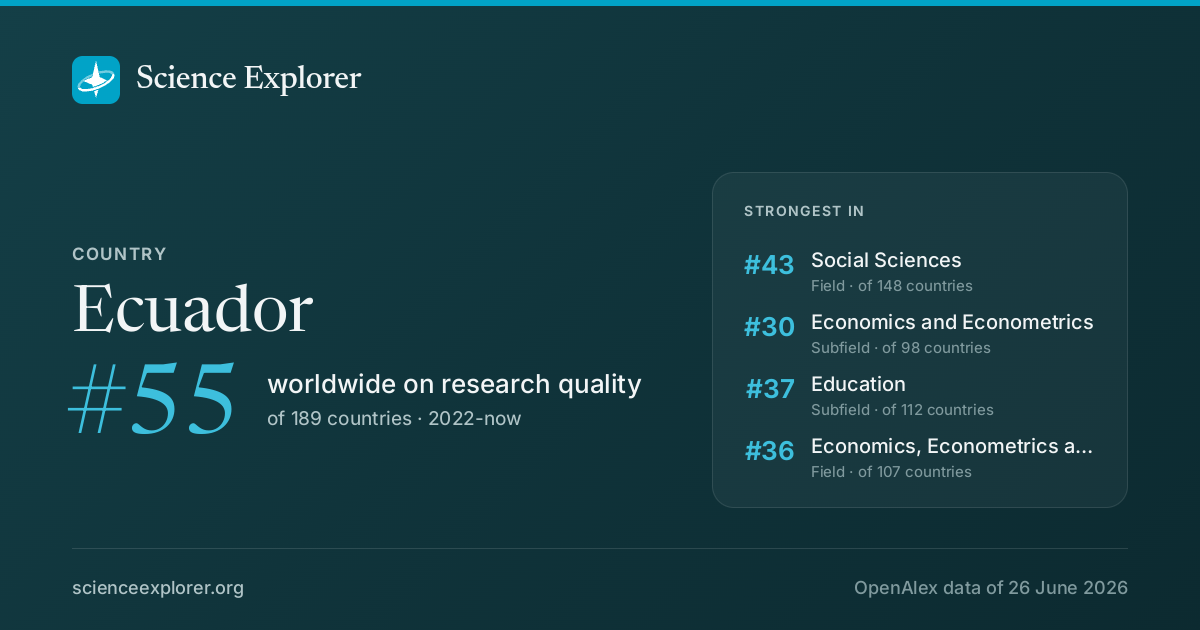
Ecuador ranks #55 of 189 countries on research quality in 2022-now (#54 all time), with 65k research works and 8.4% of them in the world's top 10%.
- World rank, 2022-now
- #55 of 189 · #54 all time
- Works, 2022-now
- 65k ▲ 59% vs 2018-21
- Citations
- 487k 3.4 per fractional work, all time
- Top-10% rate
- 8.4% all institutions 10.0%
- vs its own fields
- 0.74× 1.00× is exactly expected
- In the world top 100
- 0 0 in the top 1,000
- Open access
- 79% world 40%
- International
- 21% world 18%
EcuadorWhat is Ecuador strongest at in science?
On research quality in 2022-now, Ecuador ranks highest in Social Sciences (#43 of 148), Economics and Econometrics (#30 of 98) and Education (#37 of 112). Relative to its size it is most specialised in Neuropsychology and Physiological Psychology, Life-span and Life-course Studies and Horticulture.
| Field | World rank | Where that sits | Top-10% rate | Works | All time | Institutions |
|---|---|---|---|---|---|---|
| Social SciencesField | #43 of 148 | 11.7% | 16,410 | #41 | Institutions | |
| Economics and EconometricsSubfield | #30 of 98 | 10.6% | 4,610 | #30 | Institutions | |
| EducationSubfield | #37 of 112 | 11.6% | 5,310 | #36 | Institutions | |
| Economics, Econometrics and FinanceField | #36 of 107 | 10.5% | 4,803 | #36 | Institutions | |
| Health ProfessionsField | #38 of 106 | 6.8% | 4,448 | #40 | Institutions | |
| Computer ScienceField | #48 of 128 | 8.8% | 5,857 | #49 | Institutions | |
| LawSubfield | #18 of 46 | 12.9% | 2,656 | #17 | Institutions | |
| Information SystemsSubfield | #39 of 90 | 9.9% | 2,969 | #38 | Institutions | |
| AccountingSubfield | #28 of 64 | 12.8% | 1,366 | #28 | Institutions | |
| General Health ProfessionsSubfield | #37 of 84 | 6.8% | 2,523 | #34 | Institutions | |
| Agricultural and Biological SciencesField | #55 of 124 | 7.5% | 4,227 | #52 | Institutions | |
| Sociology and Political ScienceSubfield | #53 of 119 | 10.2% | 2,335 | #47 | Institutions |
Where its research is concentrated
Location quotient: how much more (or less) of each node it does than its size predicts. Drawn around 1×, where "twice the world share" and "half of it" are the same distance apart in opposite directions. A volume reading, which on a country axis is largely population and industrial structure.
- Neuropsychology and Physiological PsychologySubfield · 340.4 works · #5 of 169 active here14×
- Life-span and Life-course StudiesSubfield · 172.7 works · #7 of 144 active here14×
- HorticultureSubfield · 126.5 works · #7 of 178 active here12×
- Computer Science ApplicationsSubfield · 1,838.3 works · #7 of 196 active here9.8×
- General Social SciencesSubfield · 733.3 works · #12 of 191 active here8.8×
- LawSubfield · 2,927.4 works · #9 of 212 active here6.7×
- Occupational TherapySubfield · 833.3 works · #10 of 198 active here6.6×
- Medical Laboratory TechnologySubfield · 135.3 works · #13 of 174 active here5.8×
The whole field profile
All 26 fields at once. A specialist and a generalist produce the same ranked list and a completely different shape.
Rings at 0.5×, 1× and 2×. Widest outward: Economics, Econometrics and Finance, 3.2×. Every wedge is a field page.
All 26 fields, with their numbers
- Economics, Econometrics and Finance3.21×5,189 works
- Health Professions2.49×4,957 works
- Dentistry2.37×870 works
- Social Sciences2.05×20k works
- Business, Management and Accounting1.84×4,481 works
- Psychology1.64×3,776 works
- Agricultural and Biological Sciences1.39×4,998 works
- Veterinary1.33×136 works
- Computer Science1.22×7,170 works
- Environmental Science1.08×4,055 works
- Energy0.93×645 works
- Nursing0.81×302 works
- Medicine0.67×9,734 works
- Immunology and Microbiology0.59×451 works
- Arts and Humanities0.55×1,206 works
- Pharmacology, Toxicology and Pharmaceutics0.49×132 works
- Decision Sciences0.47×346 works
- Earth and Planetary Sciences0.41×490 works
- Neuroscience0.38×463 works
- Engineering0.36×4,096 works
- Biochemistry, Genetics and Molecular Biology0.34×1,355 works
- Mathematics0.29×260 works
- Chemical Engineering0.21×55 works
- Chemistry0.18×219 works
- Materials Science0.16×432 works
- Physics and Astronomy0.14×230 works
Which fields of science does Ecuador work in?
In 2022-now, 46% of research in Ecuador is in Social Sciences, 23% in Physical Sciences. Its largest fields are Social Sciences (26%), Medicine (13%), Computer Science (9%). It does 1.8× the world's share of Social Sciences.
Each ring splits the one inside it: the four domains of science, their fields, their subfields. Size is fractional works in 2022-now. Every slice is a page; the interactive view zooms down to single topics and colours each by how much more of it this country does than the world.
Its 4 domains and 26 fields, with their numbers
- Social Sciences35k45.7%
- Social Sciences20k25.9%
- Economics, Econometrics and Finance5,1896.9%
- Business, Management and Accounting4,4815.9%
- Psychology3,7765.0%
- Arts and Humanities1,2061.6%
- Decision Sciences3460.5%
- Physical Sciences18k23.3%
- Computer Science7,1709.5%
- Engineering4,0965.4%
- Environmental Science4,0555.4%
- Energy6450.9%
- Earth and Planetary Sciences4900.6%
- Materials Science4320.6%
- Mathematics2600.3%
- Physics and Astronomy2300.3%
- Chemistry2190.3%
- Chemical Engineering550.1%
- Health Sciences16k21.2%
- Medicine9,73412.9%
- Health Professions4,9576.6%
- Dentistry8701.2%
- Nursing3020.4%
- Veterinary1360.2%
- Life Sciences7,3999.8%
Which keywords describe research in Ecuador?
By fractional works in 2022-now, weighted toward what it does more of than the world: Education, Small and Medium Enterprises, Digital Marketing, Innovation, Social Responsibility, Innovation Ecosystems, Urban Development and Economic Impact.
- Occupational Health
- Communication
- University Students
- Virtual Teaching
- Digital Competence
- Digital Divide
- Nutrition
- Distance Learning
- Inclusive Education
- Health Promotion
- Public Health
- COVID-19
- E-Learning
- Sustainability
- City Branding
- Globalization Effects
- Urban Development
- Innovation Ecosystems
- Innovation
- Small and Medium Enterprises
- Education
- Digital Marketing
- Social Responsibility
- Globalization
- Economic Impact
- Tourism Management
- Psychopharmacology Education
- Competitiveness
- Educational Technology
- Knowledge Management
- Pedagogy
- Teacher Training
- Human Rights
- Social Impact
- Organizational Culture
- Online Education
- ICT
- Technology
- Research
- Educational Interventions
Size is fractional works in 2022-now in the topics tagged with each word; colour is the word's share of this country's work against its share of the world's. The 40 words are chosen for being large and distinctive. Each links to the topic it comes from most.
All 40 words, with their numbers
- Education9,461▲ 7.3×130 topics
- Small and Medium Enterprises5,412▲ 40×9 topics
- Digital Marketing5,405▲ 18×6 topics
- Innovation5,392▲ 6.9×75 topics
- Social Responsibility4,765▲ 27×11 topics
- Innovation Ecosystems4,591▲ 60×4 topics
- Globalization4,481▲ 3.0×149 topics
- Urban Development4,473▲ 17×18 topics
- Economic Impact4,467▲ 11×13 topics
- Globalization Effects4,443▲ 85×3 topics
- Tourism Management4,357▲ 83×2 topics
- City Branding4,355▲ 93×1 topic
- Psychopharmacology Education4,355▲ 93×1 topic
- Sustainability4,240▲ 2.3×119 topics
- Competitiveness4,214▲ 70×6 topics
- E-Learning4,007▲ 5.5×23 topics
- Educational Technology3,767▲ 4.2×44 topics
- COVID-193,624▲ 3.7×34 topics
- Knowledge Management3,605▲ 8.6×38 topics
- Public Health3,496▲ 3.2×73 topics
- Pedagogy3,380▲ 8.9×25 topics
- Health Promotion3,330▲ 14×17 topics
- Teacher Training3,107▲ 6.7×27 topics
- Inclusive Education3,012▲ 11×18 topics
- Human Rights2,977▲ 3.9×71 topics
- Distance Learning2,885▲ 11×13 topics
- Social Impact2,550▲ 8.6×24 topics
- Nutrition2,545▲ 7.6×17 topics
- Organizational Culture2,456▲ 8.4×16 topics
- Digital Divide2,405▲ 12×8 topics
- Online Education2,394▲ 16×7 topics
- Digital Competence2,368▲ 36×4 topics
- ICT2,345▲ 23×5 topics
- Virtual Teaching2,320▲ 57×1 topic
- Technology2,249▲ 5.7×40 topics
- University Students2,039▲ 48×2 topics
- Research1,884▲ 20×11 topics
- Communication1,828▲ 7.7×23 topics
- Educational Interventions1,766▲ 25×3 topics
- Occupational Health1,725▲ 20×8 topics
Which research topics does Ecuador publish the most in?
Its largest topics in 2022-now are Business, Innovation, and Economy, Educational Innovations and Technology, Health and Lifestyle Studies.
Area is fractional works in 2022-now; colour is the subfield each topic belongs to. Every tile is a topic page.
- 1 Business, Innovation, and Economy Economics and Econometrics 4.4k works
- 2 Educational Innovations and Technology Information Systems 2.3k works
- 3 Health and Lifestyle Studies General Health Professions 1.5k works
- 4 Social Issues and Policies in Latin America Law 1.4k works
- 5 Business, Education, Mathematics Research Accounting 1.1k works
- 6 Education and Teacher Training Education 1.1k works
- 7 E-Learning and Knowledge Management Computer Science Applications 1k works
- 8 Public Health and Environmental Issues Health, Toxicology and Mutagenesis 1k works
- 9 Educational and Organizational Development Organizational Behavior and Human Resource Management 933 works
- 10 Diverse Applied Research Studies Sociology and Political Science 894 works
- 11 Stress and Burnout Research Social Psychology 882 works
- 12 Occupational Health and Safety in Workplaces Occupational Therapy 720 works
Which universities in Ecuador lead research?
Universidad Católica de Cuenca, Universidad Técnica de Manabí and Universidad Estatal de Milagro rank highest in Ecuador on research quality in 2022-now.
One dot per institution in the list below. The upper left is the interesting corner.
- 1Universidad Católica de CuencaUniversity · Cuenca · #1,223 worldwide6.6% top 10% · 4.1k works
- 2Universidad Técnica de ManabíUniversity · Portoviejo · #1,511 worldwide9.1% top 10% · 3k works
- 3Universidad Estatal de MilagroUniversity · Guayaquil · #1,532 worldwide10.0% top 10% · 2.3k works
- 4University of GuayaquilUniversity · Guayaquil · #1,573 worldwide7.6% top 10% · 3.4k works
- 5Universidad Tecnica de MachalaUniversity · Machala · #1,696 worldwide9.9% top 10% · 1.8k works
- 6Universidad Estatal del Sur de ManabiUniversity · Jipijapa · #1,698 worldwide6.2% top 10% · 1.7k works
- 7Universidad Técnica Estatal de QuevedoUniversity · Quevedo · #1,714 worldwide10.3% top 10% · 1.5k works
- 8Universidad Regional Autónoma de Los AndesUniversity · Ambato · #1,732 worldwide3.5% top 10% · 4.2k works
- 9Universidad IndoaméricaUniversity · Ambato · #1,764 worldwide13.1% top 10% · 1.5k works
- 10Universidad Nacional de LojaUniversity · Loja · #1,819 worldwide8.6% top 10% · 1.2k works
- 11Pontificia Universidad Católica del EcuadorUniversity · Quito · #1,903 worldwide11.1% top 10% · 2.4k works
- 12Central University of EcuadorUniversity · Quito · #1,976 worldwide8.2% top 10% · 2.3k works
- 13Universidad Nacional de ChimborazoUniversity · Riobamba · #2,012 worldwide9.5% top 10% · 1.6k works
- 14University of CuencaUniversity · Cuenca · #2,034 worldwide7.7% top 10% · 1.7k works
- 15Universidad Estatal Península de Santa ElenaUniversity · La Libertad · #2,108 worldwide7.6% top 10% · 1.1k works



The track on each row is its top-10% rate; the tick is the average of all institutions, 10.0% (how it is set): teal above it, red below.
All ranked institutions in EcuadorWho are the top researchers in Ecuador?
Augusto Paolo Bernal Párraga, Rafael Alvarado and David Neill rank highest among researchers based in Ecuador.
- 1 Augusto Paolo Bernal Párraga #3,437 worldwide 2.1k citations · 77 works
- 2 Rafael Alvarado #8,280 worldwide 9.9k citations · 183 works
- 3 David Neill #17,836 worldwide 21k citations · 193 works
- 4 Renato Valencia #29,585 worldwide 16k citations · 186 works
- 5 César Iván Casanova-Villalba #45,087 worldwide 1.1k citations · 72 works
- 6 Maybelline Jaqueline Herrera-Sánchez #66,028 worldwide 882 citations · 66 works
- 7 Gonzalo Francisco Rivas‐Torres #67,446 worldwide 4k citations · 114 works
- 8 José Francisco López‐Gil #68,836 worldwide 11k citations · 385 works
- 9 María Cristina Peñuela Mora #72,990 worldwide 6.3k citations · 73 works
- 10 Vanessa Echeverría #84,903 worldwide 2.3k citations · 109 works
Which cities in Ecuador are research hubs?
How open and international is Ecuador's research?
79% of its research is openly available (world: 40%), and 21% is written with international co-authors (world: 18%).
World: 40% of research is openly available.
World: 18% is written across borders.
In 2022-now, 90% of its research is openly available (world 63%) and 18% is written with co-authors abroad (world 22%). Against what its own mix of topics predicts, that is 1.11× the expected open access and 0.92× the expected international share, which puts it #114 of 173 countries on openness.
How has Ecuador's research grown?
Output in 2022-2025 was 59% higher than in 2018-2021.
The same series as a ribbon: one cell per year, darker for more. The line above answers how much; this answers when.
Its share of all research
Growing output can still be a shrinking share: all of science grows. This is Ecuador as a percentage of every work published that year, 0.32% in 2024.
Fractional works of Ecuador over all fractional works that year. How the balance of science has shifted.
How much of it reaches the world top 10%
Over the whole record, 7.3% of its 143k works since 1950 reached the world top 10% for their field and year.
Of each year's output, the share that reached the world's 10% most cited for its field and year. Peak 9.7% in 2025.
Which countries have research most like Ecuador's?
Peru is Ecuador's closest research twin: of all countries, its research is spread across the fields most like Ecuador's, with both strong in Economics, Econometrics and Finance.
- 1
 PeruBoth strong in Economics, Econometrics and Finance, Dentistry, Social Sciences
0.96 Compare
- 2
 BoliviaBoth strong in Social Sciences, Economics, Econometrics and Finance, Health Professions
0.92 Compare
- 3
 ParaguayBoth strong in Health Professions, Social Sciences, Economics, Econometrics and Finance
0.90 Compare
- 4
 ColombiaBoth strong in Social Sciences, Health Professions, Economics, Econometrics and Finance
0.90 Compare
- 5
 CubaBoth strong in Health Professions, Social Sciences, Business, Management and Accounting
0.89 Compare
Similarity is the correlation of each side's location quotients across every field it publishes in, on a log scale: 1 is the same shape of research, 0 is unrelated. It ignores size. How it is measured.
Compare Ecuador with
 Malaysia
 Slovakia
 Kenya
 Croatia
 Ghana
Share Ecuador's ranking



Research fields in Ecuador
- Social Sciences
- Social Sciences
- Economics and Econometrics
- Education
- Economics, Econometrics and Finance
- Physical Sciences
- Health Professions
- Computer Science
- Law
- Information Systems
- Accounting
- General Health Professions
- Agricultural and Biological Sciences
- Sociology and Political Science
- Health Sciences
- Business, Management and Accounting
- Political Science and International Relations
- Engineering
- Life Sciences
- Environmental Science
- Psychology
- Medicine
- Computer Science Applications
- Organizational Behavior and Human Resource Management
- Arts and Humanities
- Public Health, Environmental and Occupational Health
- General Agricultural and Biological Sciences
- Social Psychology
- Food Science
- Surgery
- Biochemistry, Genetics and Molecular Biology
- Plant Science
- Occupational Therapy
- Developmental and Educational Psychology
- Health, Toxicology and Mutagenesis
- Electrical and Electronic Engineering
- Epidemiology
- Control and Systems Engineering
- Dentistry
- Periodontics
- Oral Surgery
- Pharmacy
Discussion
Ask a question or share a note about Ecuador. Posts are plain text and can be reported.