 Science in Colombia
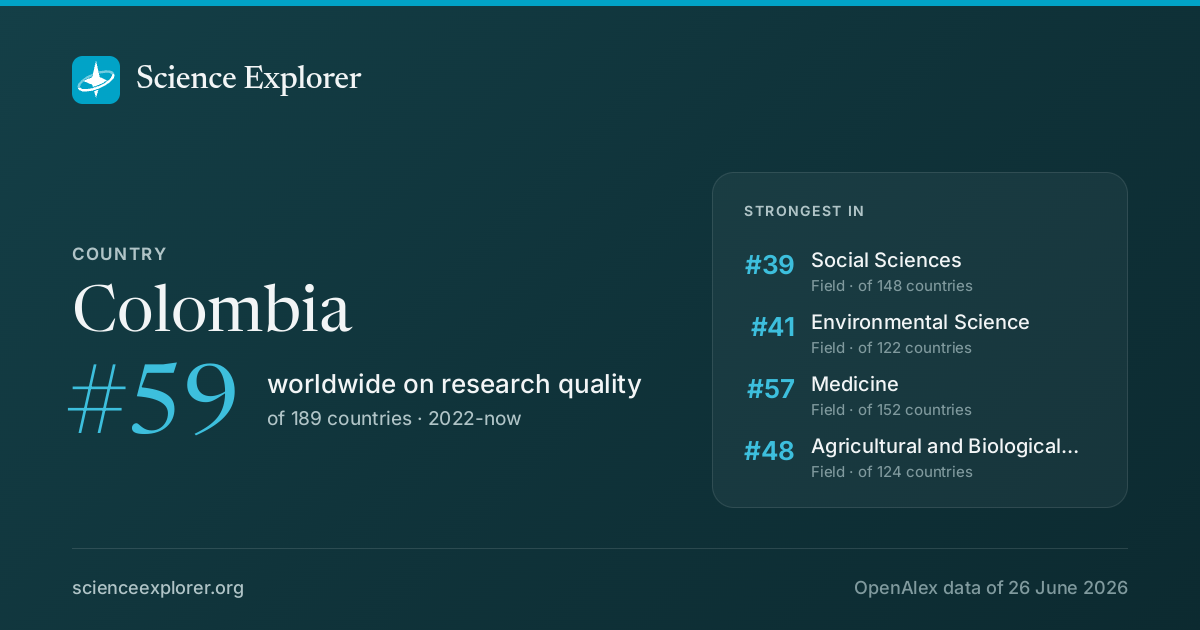
Colombia ranks #59 of 189 countries on research quality in 2022-now (#47 all time), with 87k research works and 7.4% of them in the world's top 10%.
- World rank, 2022-now
- #59 of 189 · #47 all time
- Works, 2022-now
- 87k ▼ 5% vs 2018-21
- Citations
- 2.2M 5.3 per fractional work, all time
- Top-10% rate
- 7.4% all institutions 10.0%
- vs its own fields
- 0.70× 1.00× is exactly expected
- In the world top 100
- 0 0 in the top 1,000
- Open access
- 72% world 40%
- International
- 18% world 18%
ColombiaWhat is Colombia strongest at in science?
On research quality in 2022-now, Colombia ranks highest in Social Sciences (#39 of 148), Environmental Science (#41 of 122) and Medicine (#57 of 152). Relative to its size it is most specialised in Life-span and Life-course Studies, Horticulture and General Social Sciences.
| Field | World rank | Where that sits | Top-10% rate | Works | All time | Institutions |
|---|---|---|---|---|---|---|
| Social SciencesField | #39 of 148 | 10.6% | 18,906 | #29 | Institutions | |
| Environmental ScienceField | #41 of 122 | 6.8% | 5,927 | #37 | Institutions | |
| MedicineField | #57 of 152 | 5.0% | 16,560 | #50 | Institutions | |
| Agricultural and Biological SciencesField | #48 of 124 | 7.6% | 6,410 | #40 | Institutions | |
| EducationSubfield | #47 of 112 | 9.8% | 4,588 | #37 | Institutions | |
| Sociology and Political ScienceSubfield | #52 of 119 | 10.2% | 4,022 | #42 | Institutions | |
| EngineeringField | #59 of 131 | 6.0% | 6,556 | #53 | Institutions | |
| Political Science and International RelationsSubfield | #45 of 95 | 12.5% | 2,110 | #40 | Institutions | |
| Business, Management and AccountingField | #53 of 110 | 9.5% | 3,594 | #41 | Institutions | |
| Computer ScienceField | #63 of 128 | 7.4% | 4,614 | #55 | Institutions | |
| Economics, Econometrics and FinanceField | #54 of 107 | 8.8% | 2,861 | #46 | Institutions | |
| Arts and HumanitiesField | #52 of 103 | 8.7% | 2,531 | #45 | Institutions |
Where its research is concentrated
Location quotient: how much more (or less) of each node it does than its size predicts. Drawn around 1×, where "twice the world share" and "half of it" are the same distance apart in opposite directions. A volume reading, which on a country axis is largely population and industrial structure.
- Life-span and Life-course StudiesSubfield · 179.6 works · #6 of 144 active here11×
- HorticultureSubfield · 125.2 works · #8 of 178 active here9.7×
- General Social SciencesSubfield · 775.4 works · #11 of 191 active here7.3×
- Neuropsychology and Physiological PsychologySubfield · 169.3 works · #13 of 169 active here5.4×
- DevelopmentSubfield · 489.7 works · #10 of 190 active here5.0×
- Computer Science ApplicationsSubfield · 1,106.0 works · #12 of 196 active here4.6×
- PaleontologySubfield · 494.2 works · #16 of 212 active here4.2×
- General Arts and HumanitiesSubfield · 74.8 works · #11 of 138 active here3.7×
The whole field profile
All 26 fields at once. A specialist and a generalist produce the same ranked list and a completely different shape.
Rings at 0.5×, 1× and 2×. Widest outward: Social Sciences, 1.7×. Every wedge is a field page.
All 26 fields, with their numbers
- Social Sciences1.71×21k works
- Health Professions1.59×4,044 works
- Agricultural and Biological Sciences1.55×7,149 works
- Economics, Econometrics and Finance1.46×3,019 works
- Environmental Science1.37×6,606 works
- Psychology1.32×3,881 works
- Business, Management and Accounting1.27×3,974 works
- Veterinary1.26×166 works
- Energy1.14×1,013 works
- Medicine1.01×19k works
- Dentistry1.00×470 works
- Arts and Humanities0.99×2,772 works
- Immunology and Microbiology0.96×936 works
- Nursing0.92×435 works
- Earth and Planetary Sciences0.88×1,332 works
- Decision Sciences0.74×689 works
- Mathematics0.70×799 works
- Computer Science0.68×5,132 works
- Pharmacology, Toxicology and Pharmaceutics0.67×229 works
- Biochemistry, Genetics and Molecular Biology0.61×3,132 works
- Neuroscience0.57×902 works
- Chemical Engineering0.50×169 works
- Engineering0.50×7,225 works
- Chemistry0.46×696 works
- Physics and Astronomy0.42×912 works
- Materials Science0.38×1,300 works
Which fields of science does Colombia work in?
In 2022-now, 36% of research in Colombia is in Social Sciences, 26% in Physical Sciences. Its largest fields are Social Sciences (22%), Medicine (19%), Engineering (7%). It does 1.5× the world's share of Social Sciences.
Each ring splits the one inside it: the four domains of science, their fields, their subfields. Size is fractional works in 2022-now. Every slice is a page; the interactive view zooms down to single topics and colours each by how much more of it this country does than the world.
Its 4 domains and 26 fields, with their numbers
- Social Sciences35k36.4%
- Social Sciences21k21.6%
- Business, Management and Accounting3,9744.1%
- Psychology3,8814.0%
- Economics, Econometrics and Finance3,0193.1%
- Arts and Humanities2,7722.9%
- Decision Sciences6890.7%
- Physical Sciences25k26.0%
- Engineering7,2257.5%
- Environmental Science6,6066.8%
- Computer Science5,1325.3%
- Earth and Planetary Sciences1,3321.4%
- Materials Science1,3001.3%
- Energy1,0131.0%
- Physics and Astronomy9120.9%
- Mathematics7990.8%
- Chemistry6960.7%
- Chemical Engineering1690.2%
- Health Sciences24k24.8%
- Medicine19k19.5%
- Health Professions4,0434.2%
- Dentistry4690.5%
- Nursing4350.4%
- Veterinary1650.2%
- Life Sciences12k12.8%
Which keywords describe research in Colombia?
By fractional works in 2022-now, weighted toward what it does more of than the world: Education, Latin America, Innovation, Globalization, Sustainability, Health Promotion, Social Responsibility and Digital Marketing.
- University Students
- Colombia
- Rural Development
- Community Participation
- Social Impact
- City Branding
- Globalization Effects
- Public Policy
- Economic Impact
- Urban Development
- E-Learning
- Small and Medium Enterprises
- Knowledge Management
- Digital Marketing
- Mental Health
- Latin America
- Human Rights
- Innovation
- Globalization
- Epidemiology
- Education
- Sustainability
- Climate Change
- Public Health
- Sustainable Development
- Educational Technology
- Health Promotion
- Teacher Training
- Social Responsibility
- Competitiveness
- Biodiversity
- Pedagogy
- Innovation Ecosystems
- Nutrition
- Tourism Management
- Psychopharmacology Education
- Communication
- Inclusive Education
- Distance Learning
- Violence
Size is fractional works in 2022-now in the topics tagged with each word; colour is the word's share of this country's work against its share of the world's. The 40 words are chosen for being large and distinctive. Each links to the topic it comes from most.
All 40 words, with their numbers
- Education7,314▲ 4.4×152 topics
- Epidemiology5,438▲ 1.41×138 topics
- Sustainability4,882▲ 2.1×130 topics
- Globalization4,810▲ 2.5×172 topics
- Climate Change4,049▲ 1.54×128 topics
- Innovation3,967▲ 4.0×82 topics
- Public Health3,428▲ 2.4×75 topics
- Human Rights3,308▲ 3.3×86 topics
- Sustainable Development2,983▲ 1.97×10⁷ topics
- Latin America2,901▲ 16×23 topics
- Educational Technology2,571▲ 2.2×47 topics
- Mental Health2,476▲ 1.79×48 topics
- Health Promotion2,470▲ 8.1×18 topics
- Digital Marketing2,451▲ 6.5×6 topics
- Teacher Training2,445▲ 4.1×28 topics
- Knowledge Management2,386▲ 4.4×42 topics
- Social Responsibility2,274▲ 10×13 topics
- Small and Medium Enterprises2,224▲ 13×10 topics
- Competitiveness2,221▲ 29×8 topics
- E-Learning2,139▲ 2.3×25 topics
- Biodiversity1,978▲ 2.7×37 topics
- Urban Development1,926▲ 5.6×21 topics
- Pedagogy1,924▲ 4.0×26 topics
- Economic Impact1,920▲ 3.7×13 topics
- Innovation Ecosystems1,883▲ 19×4 topics
- Public Policy1,847▲ 4.0×34 topics
- Nutrition1,794▲ 4.2×18 topics
- Globalization Effects1,727▲ 26×3 topics
- Tourism Management1,719▲ 25×2 topics
- City Branding1,716▲ 29×1 topic
- Psychopharmacology Education1,716▲ 29×1 topic
- Social Impact1,687▲ 4.5×24 topics
- Communication1,663▲ 5.5×23 topics
- Community Participation1,609▲ 4.7×16 topics
- Inclusive Education1,570▲ 4.5×19 topics
- Rural Development1,502▲ 4.5×22 topics
- Distance Learning1,493▲ 4.4×13 topics
- Colombia1,408▲ 86×2 topics
- Violence1,246▲ 8.8×14 topics
- University Students1,214▲ 22×2 topics
Which research topics does Colombia publish the most in?
Its largest topics in 2022-now are Business, Innovation, and Economy, Educational Innovations and Technology, Health and Lifestyle Studies.
Area is fractional works in 2022-now; colour is the subfield each topic belongs to. Every tile is a topic page.
- 1 Business, Innovation, and Economy Economics and Econometrics 1.7k works
- 2 Educational Innovations and Technology Information Systems 1.1k works
- 3 Health and Lifestyle Studies General Health Professions 810 works
- 4 Education and Teacher Training Education 722 works
- 5 E-Learning and Knowledge Management Computer Science Applications 715 works
- 6 Conflict, Peace, and Violence in Colombia Sociology and Political Science 709 works
- 7 History and Politics in Latin America Demography 699 works
- 8 Public Health and Environmental Issues Health, Toxicology and Mutagenesis 584 works
- 9 Business, Education, Mathematics Research Accounting 550 works
- 10 Plant and soil sciences General Agricultural and Biological Sciences 527 works
- 11 Water Resource Management and Quality Water Science and Technology 510 works
- 12 Stress and Burnout Research Social Psychology 510 works
Which universities in Colombia lead research?
Universidad de Antioquia, Universidad del Rosario and Universidad del Valle rank highest in Colombia on research quality in 2022-now.
One dot per institution in the list below. The upper left is the interesting corner.
- 1Universidad de AntioquiaUniversity · Medellín · #1,669 worldwide7.8% top 10% · 5k works
- 2Universidad del RosarioUniversity · Bogotá · #1,989 worldwide11.3% top 10% · 1.5k works
- 3Universidad del ValleUniversity · Santiago de Cali · #2,339 worldwide6.4% top 10% · 2.8k works
- 4Universidad de La SabanaUniversity · Chía · #2,384 worldwide10.4% top 10% · 1.2k works
- 5Universidad Distrital Francisco José de CaldasUniversity · Bogotá · #2,394 worldwide6.8% top 10% · 1.4k works
- 6Universidad de IbaguéUniversity · Ibagué · #2,412 worldwide0.7% top 10% · 1.8k works
- 7University of CaldasUniversity · Manizales · #2,422 worldwide7.6% top 10% · 1.1k works
- 8Universidad de Los AndesUniversity · Bogotá · #2,448 worldwide11.8% top 10% · 2.1k works
- 9Universidad del NorteUniversity · Barranquilla · #2,500 worldwide11.0% top 10% · 1k works
- 10National Training ServiceUniversity · Tunja · #2,512 worldwide5.0% top 10% · 696 works
- 11University of the CoastUniversity · Barranquilla · #2,514 worldwide14.3% top 10% · 937 works
- 12Universidad Pontificia BolivarianaUniversity · Medellín · #2,552 worldwide7.3% top 10% · 1.3k works
- 13Corporación Universitaria Minuto de DiosUniversity · Bogotá · #2,606 worldwide8.7% top 10% · 1.4k works
- 14Universidad Nacional de ColombiaUniversity · Bogotá · #2,636 worldwide6.8% top 10% · 7.3k works
- 15Industrial University of SantanderUniversity · Bucaramanga · #2,694 worldwide5.6% top 10% · 1.8k works



The track on each row is its top-10% rate; the tick is the average of all institutions, 10.0% (how it is set): teal above it, red below.
All ranked institutions in ColombiaWho are the top researchers in Colombia?
J. C. Sanabria, Carlos Andrés Castañeda-Orjuela and Stijn Hantson rank highest among researchers based in Colombia.
- 1 J. C. Sanabria #4,579 worldwide 63k citations · 605 works
- 2 Carlos Andrés Castañeda-Orjuela #12,642 worldwide 236k citations · 248 works
- 3 Stijn Hantson #16,049 worldwide 9.4k citations · 203 works
- 4 D. J. Karmgard #18,328 worldwide 23k citations · 315 works
- 5 Luis Felipe Reyes #26,576 worldwide 33k citations · 298 works
- 6 Olga Lucia Sarmiento #30,421 worldwide 18k citations · 364 works
- 7 Christophe Béné #30,476 worldwide 18k citations · 262 works
- 8 G. Petrillo #30,555 worldwide 29k citations · 345 works
- 9 Gustavo Adolfo Ospina-Tascón #32,523 worldwide 9.9k citations · 159 works
- 10 Liliana María Uribe Tirado #33,130 worldwide 5.8k citations · 124 works
Which cities in Colombia are research hubs?
How open and international is Colombia's research?
72% of its research is openly available (world: 40%), and 18% is written with international co-authors (world: 18%).
World: 40% of research is openly available.
World: 18% is written across borders.
In 2022-now, 84% of its research is openly available (world 63%) and 24% is written with co-authors abroad (world 22%). Against what its own mix of topics predicts, that is 1.13× the expected open access and 1.13× the expected international share, which puts it #91 of 173 countries on openness.
How has Colombia's research grown?
Output in 2022-2025 was 5% lower than in 2018-2021.
The same series as a ribbon: one cell per year, darker for more. The line above answers how much; this answers when.
Its share of all research
Growing output can still be a shrinking share: all of science grows. This is Colombia as a percentage of every work published that year, 0.39% in 2024.
Fractional works of Colombia over all fractional works that year. How the balance of science has shifted.
How much of it reaches the world top 10%
Over the whole record, 6.6% of its 407k works since 1950 reached the world top 10% for their field and year.
Of each year's output, the share that reached the world's 10% most cited for its field and year. Peak 7.9% in 2019.
Which countries have research most like Colombia's?
Bolivia is Colombia's closest research twin: of all countries, its research is spread across the fields most like Colombia's, with both strong in Social Sciences.
- 1
 BoliviaBoth strong in Social Sciences, Health Professions, Agricultural and Biological Sciences
0.93 Compare
- 2
 NicaraguaBoth strong in Social Sciences, Health Professions, Agricultural and Biological Sciences
0.93 Compare
- 3
 PeruBoth strong in Social Sciences, Health Professions, Agricultural and Biological Sciences
0.91 Compare
- 4
 PanamaBoth strong in Social Sciences, Health Professions, Agricultural and Biological Sciences
0.90 Compare
- 5
 CubaBoth strong in Social Sciences, Health Professions, Agricultural and Biological Sciences
0.90 Compare
Similarity is the correlation of each side's location quotients across every field it publishes in, on a log scale: 1 is the same shape of research, 0 is unrelated. It ignores size. How it is measured.
Compare Colombia with
 Ghana
 Ukraine
 Kenya
 Malawi
 Slovakia
 Puerto Rico
Share Colombia's ranking
Badges for a website1Each links back here and updates with every snapshot

Research fields in Colombia
- Social Sciences
- Social Sciences
- Environmental Science
- Physical Sciences
- Health Sciences
- Medicine
- Agricultural and Biological Sciences
- Education
- Sociology and Political Science
- Engineering
- Political Science and International Relations
- Business, Management and Accounting
- Computer Science
- Economics, Econometrics and Finance
- Arts and Humanities
- Life Sciences
- Psychology
- Health Professions
- Economics and Econometrics
- Earth and Planetary Sciences
- Surgery
- Public Health, Environmental and Occupational Health
- Plant Science
- Information Systems
- Ecology, Evolution, Behavior and Systematics
- General Health Professions
- Global and Planetary Change
- Social Psychology
- General Agricultural and Biological Sciences
- Pulmonary and Respiratory Medicine
- Infectious Diseases
- Management, Monitoring, Policy and Law
- Ecology
- Biochemistry, Genetics and Molecular Biology
- Epidemiology
- Food Science
- Demography
- Electrical and Electronic Engineering
- Building and Construction
- Physiology
- Physics and Astronomy
- Law
- Cultural Studies
- Biomedical Engineering
- Genetics
- Energy
- Neuroscience
- Mathematics
- Insect Science
- Immunology and Microbiology
- Urban Studies
- Artificial Intelligence
- Geophysics
- Control and Systems Engineering
- Civil and Structural Engineering
- Molecular Biology
- Water Science and Technology
- Renewable Energy, Sustainability and the Environment
- Chemistry
- Ocean Engineering
Questions people ask
What is Colombia strongest at in science?
On research quality in 2022-now, Colombia ranks highest in Social Sciences (#39 of 148), Environmental Science (#41 of 122) and Medicine (#57 of 152). Relative to its size it is most specialised in Life-span and Life-course Studies, Horticulture and General Social Sciences.
See the full answerDiscussion
Ask a question or share a note about Colombia. Keep it to the research: no personal attacks, advertising or links. Any reader can report a post, which collapses it for everyone until it is opened.