 Science in Panama
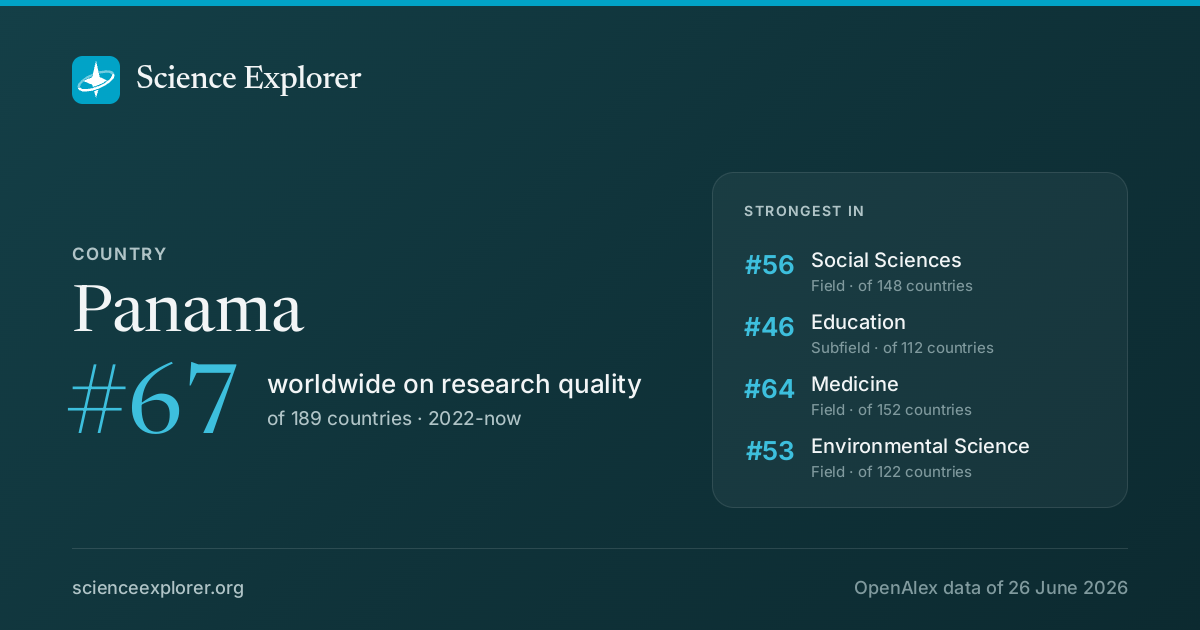
Panama ranks #67 of 189 countries on research quality in 2022-now (#65 all time), with 6.5k research works and 6.7% of them in the world's top 10%.
- World rank, 2022-now
- #67 of 189 · #65 all time
- Works, 2022-now
- 6.5k ▲ 92% vs 2018-21
- Citations
- 289k 13.9 per fractional work, all time
- Top-10% rate
- 6.7% all institutions 10.0%
- vs its own fields
- 0.82× 1.00× is exactly expected
- In the world top 100
- 0 0 in the top 1,000
- Open access
- 72% world 40%
- International
- 26% world 18%
PanamaWhat is Panama strongest at in science?
On research quality in 2022-now, Panama ranks highest in Social Sciences (#56 of 148), Education (#46 of 112) and Medicine (#64 of 152). Relative to its size it is most specialised in Neuropsychology and Physiological Psychology, Life-span and Life-course Studies and Computer Science Applications.
| Field | World rank | Where that sits | Top-10% rate | Works | All time | Institutions |
|---|---|---|---|---|---|---|
| Social SciencesField | #56 of 148 | 8.6% | 1,754 | #78 | Institutions | |
| EducationSubfield | #46 of 112 | 9.5% | 757 | #57 | Institutions | |
| MedicineField | #64 of 152 | 4.3% | 895 | #69 | Institutions | |
| Environmental ScienceField | #53 of 122 | 7.6% | 509 | #40 | Institutions | |
| Agricultural and Biological SciencesField | #61 of 124 | 6.5% | 526 | #51 | Institutions | |
| Health ProfessionsField | #56 of 106 | 4.9% | 288 | #75 | Institutions | |
| Sociology and Political ScienceSubfield | #64 of 119 | 8.6% | 237 | #82 | Institutions | |
| Biochemistry, Genetics and Molecular BiologyField | #59 of 105 | 7.0% | 217 | #49 | ||
| Information SystemsSubfield | #51 of 90 | 7.5% | 360 | #62 | Institutions | |
| EngineeringField | #76 of 131 | 4.6% | 234 | #82 | Institutions | |
| Economics and EconometricsSubfield | #58 of 98 | 6.1% | 249 | - | Institutions | |
| Economics, Econometrics and FinanceField | #67 of 107 | 5.9% | 271 | #95 | Institutions |
Where its research is concentrated
Location quotient: how much more (or less) of each node it does than its size predicts. Drawn around 1×, where "twice the world share" and "half of it" are the same distance apart in opposite directions. A volume reading, which on a country axis is largely population and industrial structure.
- Neuropsychology and Physiological PsychologySubfield · 31.9 works · #42 of 169 active here13×
- Life-span and Life-course StudiesSubfield · 14.4 works · #41 of 144 active here11×
- Computer Science ApplicationsSubfield · 187.9 works · #54 of 196 active here9.8×
- General Social SciencesSubfield · 68.3 works · #51 of 191 active here8.0×
- HorticultureSubfield · 6.3 works · #63 of 178 active here6.1×
- Developmental BiologySubfield · 8.7 works · #59 of 195 active here5.0×
- General Agricultural and Biological SciencesSubfield · 159.7 works · #61 of 206 active here4.7×
- AccountingSubfield · 211.2 works · #68 of 208 active here4.5×
The whole field profile
All 26 fields at once. A specialist and a generalist produce the same ranked list and a completely different shape.
Rings at 0.5×, 1× and 2×. Widest outward: Social Sciences, 2.1×. Every wedge is a field page.
All 26 fields, with their numbers
- Social Sciences2.13×2,091 works
- Economics, Econometrics and Finance1.95×323 works
- Business, Management and Accounting1.94×486 works
- Agricultural and Biological Sciences1.71×628 works
- Health Professions1.59×325 works
- Environmental Science1.52×584 works
- Psychology1.33×315 works
- Computer Science1.20×726 works
- Energy1.06×75 works
- Earth and Planetary Sciences0.90×110 works
- Arts and Humanities0.83×186 works
- Immunology and Microbiology0.74×58 works
- Veterinary0.74×8 works
- Medicine0.69×1,027 works
- Biochemistry, Genetics and Molecular Biology0.66×274 works
- Nursing0.60×23 works
- Dentistry0.49×18 works
- Neuroscience0.44×56 works
- Pharmacology, Toxicology and Pharmaceutics0.37×10 works
- Decision Sciences0.35×26 works
- Mathematics0.33×30 works
- Engineering0.25×296 works
- Chemistry0.16×20 works
- Materials Science0.15×40 works
- Chemical Engineering0.12×3 works
- Physics and Astronomy0.09×16 works
Which fields of science does Panama work in?
In 2022-now, 44% of research in Panama is in Social Sciences, 25% in Physical Sciences. Its largest fields are Social Sciences (27%), Medicine (13%), Computer Science (9%). It does 1.8× the world's share of Social Sciences.
Each ring splits the one inside it: the four domains of science, their fields, their subfields. Size is fractional works in 2022-now. Every slice is a page; the interactive view zooms down to single topics and colours each by how much more of it this country does than the world.
Its 4 domains and 26 fields, with their numbers
- Social Sciences3,42644.2%
- Social Sciences2,09127.0%
- Business, Management and Accounting4856.3%
- Economics, Econometrics and Finance3234.2%
- Psychology3154.1%
- Arts and Humanities1862.4%
- Decision Sciences260.3%
- Physical Sciences1,90124.5%
- Computer Science7269.4%
- Environmental Science5847.5%
- Engineering2963.8%
- Earth and Planetary Sciences1101.4%
- Energy751.0%
- Materials Science400.5%
- Mathematics300.4%
- Chemistry200.3%
- Physics and Astronomy160.2%
- Chemical Engineering30.0%
- Health Sciences1,40018.1%
- Medicine1,02713.2%
- Health Professions3254.2%
- Nursing230.3%
- Dentistry180.2%
- Veterinary80.1%
- Life Sciences1,02613.2%
Which keywords describe research in Panama?
By fractional works in 2022-now, weighted toward what it does more of than the world: Education, Innovation, E-Learning, Pedagogy, Competitiveness, Educational Technology, Teacher Training and Digital Marketing.
- Informal Learning
- Quality Education
- Organizational Commitment
- Educational Leadership
- Communication
- Technology
- City Branding
- Globalization Effects
- Urban Development
- Innovation Ecosystems
- ICT
- Digital Competence
- Social Responsibility
- Knowledge Management
- Digital Marketing
- Teacher Training
- Competitiveness
- Sustainability
- Educational Technology
- Innovation
- Education
- E-Learning
- Climate Change
- Pedagogy
- COVID-19
- Globalization
- Distance Learning
- Small and Medium Enterprises
- Digital Divide
- Online Education
- Virtual Teaching
- Inclusive Education
- Economic Impact
- Tourism Management
- Psychopharmacology Education
- Social Impact
- Teacher Development
- Student Performance
- Curriculum Design
- School Culture
Size is fractional works in 2022-now in the topics tagged with each word; colour is the word's share of this country's work against its share of the world's. The 40 words are chosen for being large and distinctive. Each links to the topic it comes from most.
All 40 words, with their numbers
- Education1,073▲ 8.1×78 topics
- Innovation593▲ 7.4×42 topics
- E-Learning508▲ 6.8×17 topics
- Educational Technology483▲ 5.3×36 topics
- Climate Change475▲ 2.2×100 topics
- Sustainability460▲ 2.4×91 topics
- Pedagogy438▲ 11×17 topics
- Competitiveness414▲ 67×6 topics
- COVID-19402▲ 4.0×28 topics
- Teacher Training400▲ 8.4×20 topics
- Globalization397▲ 2.6×85 topics
- Digital Marketing392▲ 13×6 topics
- Distance Learning361▲ 13×10 topics
- Knowledge Management357▲ 8.3×22 topics
- Small and Medium Enterprises329▲ 24×8 topics
- Social Responsibility329▲ 18×10 topics
- Digital Divide311▲ 16×8 topics
- Digital Competence308▲ 45×3 topics
- Online Education307▲ 20×4 topics
- ICT306▲ 29×4 topics
- Virtual Teaching304▲ 73×1 topic
- Innovation Ecosystems277▲ 35×2 topics
- Inclusive Education275▲ 9.8×15 topics
- Urban Development271▲ 9.9×15 topics
- Economic Impact269▲ 6.5×9 topics
- Globalization Effects252▲ 47×2 topics
- Tourism Management252▲ 47×2 topics
- City Branding250▲ 52×1 topic
- Psychopharmacology Education250▲ 52×1 topic
- Technology250▲ 6.2×20 topics
- Social Impact239▲ 7.9×14 topics
- Communication228▲ 9.3×16 topics
- Teacher Development221▲ 46×2 topics
- Educational Leadership218▲ 22×4 topics
- Student Performance216▲ 26×4 topics
- Organizational Commitment216▲ 14×5 topics
- Curriculum Design216▲ 40×2 topics
- Quality Education214▲ 77×1 topic
- School Culture214▲ 77×1 topic
- Informal Learning212▲ 21×5 topics
Which research topics does Panama publish the most in?
Its largest topics in 2022-now are Educational Innovations and Technology, Business, Innovation, and Economy, Education and Teacher Training.
Area is fractional works in 2022-now; colour is the subfield each topic belongs to. Every tile is a topic page.
- 1 Educational Innovations and Technology Information Systems 304 works
- 2 Business, Innovation, and Economy Economics and Econometrics 251 works
- 3 Education and Teacher Training Education 214 works
- 4 E-Learning and Knowledge Management Computer Science Applications 137 works
- 5 Business, Education, Mathematics Research Accounting 134 works
- 6 Educational and Organizational Development Organizational Behavior and Human Resource Management 86 works
- 7 Educational Research and Science Teaching General Agricultural and Biological Sciences 81 works
- 8 Health and Lifestyle Studies General Health Professions 74 works
- 9 Knowledge Societies in the 21st Century Demography 71 works
- 10 Literacy and Educational Practices Education 70 works
- 11 Educational methodologies and cognitive development Developmental and Educational Psychology 70 works
- 12 Public Health and Environmental Issues Health, Toxicology and Mutagenesis 68 works
Which universities in Panama lead research?
Universidad de Panamá, Universidad Metropolitana de Educación, Ciencia y Tecnología and Universidad Tecnológica de Panamá rank highest in Panama on research quality in 2022-now.
One dot per institution in the list below. The upper left is the interesting corner.
- 1Universidad de PanamáUniversity · Panama City · #1,347 worldwide5.7% top 10% · 2.2k works
- 2Universidad Metropolitana de Educación, Ciencia y TecnologíaUniversity · Panama City · #2,173 worldwide9.4% top 10% · 1.2k works
- 3Universidad Tecnológica de PanamáUniversity · Panama City · #4,981 worldwide5.0% top 10% · 451 works
- 4Universidad de SantanderUniversity · Panama City · #7,228 worldwide4.6% top 10% · 232 works
- 5Quality Leadership University PanamaUniversity · Panama City · #8,921 worldwide6.1% top 10% · 210 works
- 6Hospital del NiñoHospital / health system · Panama City · #9,103 worldwide4.4% top 10% · 245 works
- 7Secretaría Nacional de Ciencia, Tecnología e InnovaciónGovernment institution · Panama City · #9,516 worldwide8.9% top 10% · 140 works
- 8Universidad Especializada de las AméricasUniversity · Panama City · #11,122 worldwide2.7% top 10% · 140 works
- 9Universidad Autónoma de ChiriquíUniversity · David · #13,466 worldwide4.1% top 10% · 106 works
- 10City of KnowledgeArchive · Panama City · #13,527 worldwide10.6% top 10% · 112 works
- 11Stem Cell InstituteResearch facility · Panama City · #15,503 worldwide9.3% top 10% · 138 works
- 12National Oncologic InstituteHospital / health system · Panama City · #15,580 worldwide1.2% top 10% · 135 works
- 13Instituto de Investigaciones Científicas y Servicios de Alta TecnologíaResearch facility · Panama City · #15,977 worldwide7.3% top 10% · 89 works
- 14Latin American University of Science and TechnologyUniversity · Panama City · #18,341 worldwide2.3% top 10% · 71 works
- 15Instituto Conmemorativo Gorgas de Estudios de la SaludResearch facility · Panama City · #19,266 worldwide5.9% top 10% · 70 works
The track on each row is its top-10% rate; the tick is the average of all institutions, 10.0% (how it is set): teal above it, red below.
All ranked institutions in PanamaWho are the top researchers in Panama?
Stephen P. Hubbell, S. Joseph Wright and Dolores R. Piperno rank highest among researchers based in Panama.
- 1 Stephen P. Hubbell #1,469 worldwide 56k citations · 353 works
- 2 S. Joseph Wright #4,590 worldwide 58k citations · 585 works
- 3 Dolores R. Piperno #5,646 worldwide 16k citations · 174 works
- 4 Helene C. Muller‐Landau #10,654 worldwide 29k citations · 271 works
- 5 Richard Condit #11,184 worldwide 27k citations · 257 works
- 6 Benjamin L. Turner #15,118 worldwide 42k citations · 523 works
- 7 Michiel van Breugel #19,617 worldwide 13k citations · 133 works
- 8 Jefferson S. Hall #26,299 worldwide 15k citations · 208 works
- 9 Edward Allen Herre #41,990 worldwide 16k citations · 151 works
- 10 Martijn Slot #43,770 worldwide 6.5k citations · 117 works
Which cities in Panama are research hubs?
- 1
Panama CityPanama
20k works
How open and international is Panama's research?
72% of its research is openly available (world: 40%), and 26% is written with international co-authors (world: 18%).
World: 40% of research is openly available.
World: 18% is written across borders.
In 2022-now, 91% of its research is openly available (world 63%) and 26% is written with co-authors abroad (world 22%). Against what its own mix of topics predicts, that is 1.11× the expected open access and 1.30× the expected international share, which puts it #94 of 173 countries on openness.
How has Panama's research grown?
Output in 2022-2025 was 92% higher than in 2018-2021.
The same series as a ribbon: one cell per year, darker for more. The line above answers how much; this answers when.
Its share of all research
Growing output can still be a shrinking share: all of science grows. This is Panama as a percentage of every work published that year, 0.032% in 2024.
Fractional works of Panama over all fractional works that year. How the balance of science has shifted.
How much of it reaches the world top 10%
Over the whole record, 7.8% of its 21k works since 1950 reached the world top 10% for their field and year.
Of each year's output, the share that reached the world's 10% most cited for its field and year. Peak 13.5% in 1990.
Which countries have research most like Panama's?
Colombia is Panama's closest research twin: of all countries, its research is spread across the fields most like Panama's, with both strong in Social Sciences.
- 1
 ColombiaBoth strong in Social Sciences, Health Professions, Agricultural and Biological Sciences
0.90 Compare
- 2
 NicaraguaBoth strong in Social Sciences, Economics, Econometrics and Finance, Agricultural and Biological Sciences
0.89 Compare
- 3
 PeruBoth strong in Social Sciences, Economics, Econometrics and Finance, Business, Management and Accounting
0.89 Compare
- 4
 Costa RicaBoth strong in Social Sciences, Agricultural and Biological Sciences, Environmental Science
0.89 Compare
- 5
 BoliviaBoth strong in Social Sciences, Economics, Econometrics and Finance, Health Professions
0.88 Compare
Similarity is the correlation of each side's location quotients across every field it publishes in, on a log scale: 1 is the same shape of research, 0 is unrelated. It ignores size. How it is measured.
Compare Panama with
 Vietnam
 Philippines
 Indonesia
 Rwanda
 Tanzania
 Egypt
Share Panama's ranking
Badges for a website1Each links back here and updates with every snapshot

Research fields in Panama
- Social Sciences
- Social Sciences
- Life Sciences
- Education
- Health Sciences
- Medicine
- Environmental Science
- Physical Sciences
- Agricultural and Biological Sciences
- Health Professions
- Sociology and Political Science
- Information Systems
- Engineering
- Economics and Econometrics
- Economics, Econometrics and Finance
- Computer Science
- Psychology
- Business, Management and Accounting
Discussion
Ask a question or share a note about Panama. Posts are plain text and can be reported.