 Science in Cuba
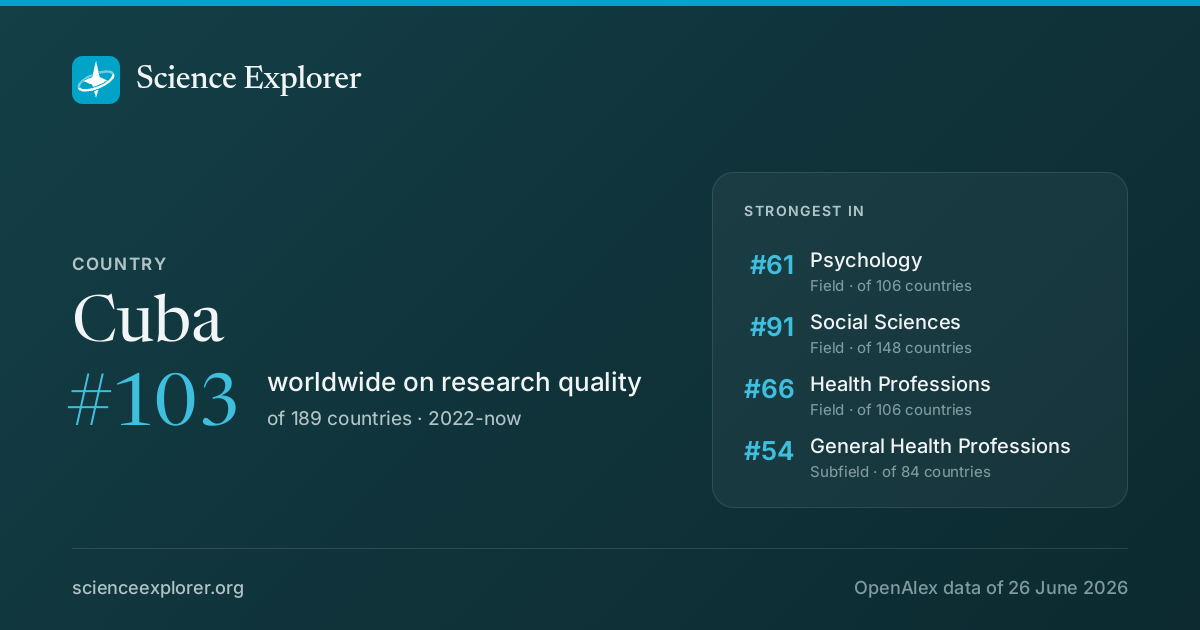
Cuba ranks #103 of 189 countries on research quality in 2022-now (#102 all time), with 9.1k research works and 5.7% of them in the world's top 10%.
- World rank, 2022-now
- #103 of 189 · #102 all time
- Works, 2022-now
- 9.1k ▼ 64% vs 2018-21
- Citations
- 424k 3.7 per fractional work, all time
- Top-10% rate
- 5.7% all institutions 10.0%
- vs its own fields
- 0.55× 1.00× is exactly expected
- In the world top 100
- 0 0 in the top 1,000
- Open access
- 41% world 40%
- International
- 19% world 18%
CubaWhat is Cuba strongest at in science?
On research quality in 2022-now, Cuba ranks highest in Psychology (#61 of 106), Social Sciences (#91 of 148) and Health Professions (#66 of 106). Relative to its size it is most specialised in Life-span and Life-course Studies, General Social Sciences and Neuropsychology and Physiological Psychology.
| Field | World rank | Where that sits | Top-10% rate | Works | All time | Institutions |
|---|---|---|---|---|---|---|
| PsychologyField | #61 of 106 | 6.3% | 327 | #87 | ||
| Social SciencesField | #91 of 148 | 6.7% | 2,136 | #112 | Institutions | |
| Health ProfessionsField | #66 of 106 | 14.3% | 630 | #91 | Institutions | |
| General Health ProfessionsSubfield | #54 of 84 | 18.5% | 427 | #77 | Institutions | |
| Agricultural and Biological SciencesField | #90 of 124 | 4.9% | 756 | #97 | Institutions | |
| Public Health, Environmental and Occupational HealthSubfield | #64 of 84 | 6.9% | 260 | #84 | ||
| Environmental ScienceField | #93 of 122 | 4.0% | 515 | #105 | Institutions | |
| Sociology and Political ScienceSubfield | #92 of 119 | 8.8% | 392 | #103 | Institutions | |
| Economics and EconometricsSubfield | #77 of 98 | 6.8% | 235 | - | ||
| MedicineField | #123 of 152 | 3.8% | 1,710 | #127 | Institutions | |
| EngineeringField | #107 of 131 | 4.5% | 433 | #98 | Institutions | |
| EducationSubfield | #92 of 112 | 4.7% | 715 | - | Institutions |
Where its research is concentrated
Location quotient: how much more (or less) of each node it does than its size predicts. Drawn around 1×, where "twice the world share" and "half of it" are the same distance apart in opposite directions. A volume reading, which on a country axis is largely population and industrial structure.
- Life-span and Life-course StudiesSubfield · 48.8 works · #22 of 144 active here28×
- General Social SciencesSubfield · 93.1 works · #40 of 191 active here8.2×
- Neuropsychology and Physiological PsychologySubfield · 26.7 works · #46 of 169 active here7.9×
- AnatomySubfield · 14.5 works · #50 of 159 active here5.9×
- Computer Science ApplicationsSubfield · 148.1 works · #61 of 196 active here5.8×
- DevelopmentSubfield · 53.5 works · #52 of 190 active here5.1×
- General Agricultural and Biological SciencesSubfield · 219.4 works · #50 of 206 active here4.8×
- PharmacySubfield · 44.1 works · #56 of 191 active here4.8×
The whole field profile
All 26 fields at once. A specialist and a generalist produce the same ranked list and a completely different shape.
Rings at 0.5×, 1× and 2×. Widest outward: Health Professions, 2.5×. Every wedge is a field page.
All 26 fields, with their numbers
- Health Professions2.54×692 works
- Social Sciences1.86×2,434 works
- Agricultural and Biological Sciences1.72×845 works
- Business, Management and Accounting1.58×526 works
- Dentistry1.40×70 works
- Economics, Econometrics and Finance1.26×279 works
- Psychology1.18×373 works
- Environmental Science1.15×589 works
- Immunology and Microbiology0.95×99 works
- Medicine0.95×1,891 works
- Arts and Humanities0.94×280 works
- Earth and Planetary Sciences0.87×141 works
- Nursing0.86×44 works
- Veterinary0.85×12 works
- Computer Science0.82×661 works
- Energy0.80×76 works
- Pharmacology, Toxicology and Pharmaceutics0.77×28 works
- Neuroscience0.74×125 works
- Biochemistry, Genetics and Molecular Biology0.58×320 works
- Decision Sciences0.58×58 works
- Physics and Astronomy0.42×97 works
- Chemistry0.34×55 works
- Engineering0.33×512 works
- Mathematics0.32×39 works
- Chemical Engineering0.28×10 works
- Materials Science0.26×93 works
Which fields of science does Cuba work in?
In 2022-now, 38% of research in Cuba is in Social Sciences, 26% in Health Sciences. Its largest fields are Social Sciences (24%), Medicine (18%), Agricultural and Biological Sciences (8%). It does 1.5× the world's share of Social Sciences.
Each ring splits the one inside it: the four domains of science, their fields, their subfields. Size is fractional works in 2022-now. Every slice is a page; the interactive view zooms down to single topics and colours each by how much more of it this country does than the world.
Its 4 domains and 26 fields, with their numbers
- Social Sciences3,95038.2%
- Social Sciences2,43423.5%
- Business, Management and Accounting5265.1%
- Psychology3733.6%
- Arts and Humanities2802.7%
- Economics, Econometrics and Finance2792.7%
- Decision Sciences580.6%
- Health Sciences2,70826.2%
- Medicine1,89118.3%
- Health Professions6926.7%
- Dentistry700.7%
- Nursing430.4%
- Veterinary120.1%
- Physical Sciences2,27322.0%
- Computer Science6616.4%
- Environmental Science5895.7%
- Engineering5124.9%
- Earth and Planetary Sciences1411.4%
- Physics and Astronomy970.9%
- Materials Science930.9%
- Energy760.7%
- Chemistry550.5%
- Mathematics390.4%
- Chemical Engineering100.1%
- Life Sciences1,41713.7%
Which keywords describe research in Cuba?
By fractional works in 2022-now, weighted toward what it does more of than the world: Education, Public Health, Competitiveness, Health Promotion, Innovation, Sustainability, Epidemiology and Knowledge Management.
- Healthcare Quality
- Community Health
- Productivity Indicators
- Financial Analysis
- Communication
- Rural Development
- Innovation Ecosystems
- Distance Learning
- Small and Medium Enterprises
- Gender
- Social Determinants of Health
- Digital Marketing
- Pedagogy
- Teacher Training
- Quality of Life
- Sustainable Development
- Competitiveness
- Climate Change
- Sustainability
- Epidemiology
- Education
- Public Health
- Innovation
- Globalization
- Health Promotion
- Educational Technology
- Knowledge Management
- E-Learning
- Risk Assessment
- Health Policy
- Medical Education
- Nutrition
- Social Responsibility
- Inclusive Education
- Decision Making
- Organizational Performance
- Financial Reporting
- Economic Impact Evaluation
- Healthcare Access
- Global Health
Size is fractional works in 2022-now in the topics tagged with each word; colour is the word's share of this country's work against its share of the world's. The 40 words are chosen for being large and distinctive. Each links to the topic it comes from most.
All 40 words, with their numbers
- Education916▲ 5.2×89 topics
- Epidemiology688▲ 1.67×135 topics
- Public Health687▲ 4.6×73 topics
- Sustainability596▲ 2.4×98 topics
- Innovation502▲ 4.7×55 topics
- Climate Change468▲ 1.67×10⁶ topics
- Globalization466▲ 2.3×10⁶ topics
- Competitiveness427▲ 52×7 topics
- Health Promotion418▲ 13×17 topics
- Sustainable Development409▲ 2.5×73 topics
- Educational Technology402▲ 3.3×39 topics
- Quality of Life388▲ 2.6×59 topics
- Knowledge Management341▲ 5.9×28 topics
- Teacher Training336▲ 5.3×23 topics
- E-Learning325▲ 3.3×21 topics
- Pedagogy310▲ 6.0×23 topics
- Risk Assessment296▲ 4.3×24 topics
- Digital Marketing281▲ 7.0×5 topics
- Health Policy272▲ 17×7 topics
- Social Determinants of Health271▲ 12×8 topics
- Medical Education264▲ 9.5×14 topics
- Gender257▲ 4.6×31 topics
- Nutrition251▲ 5.5×18 topics
- Small and Medium Enterprises250▲ 14×9 topics
- Social Responsibility250▲ 10×9 topics
- Distance Learning247▲ 6.9×12 topics
- Inclusive Education244▲ 6.5×16 topics
- Innovation Ecosystems243▲ 23×3 topics
- Decision Making240▲ 8.0×13 topics
- Rural Development233▲ 6.5×17 topics
- Organizational Performance228▲ 8.5×11 topics
- Communication226▲ 6.9×18 topics
- Financial Reporting224▲ 18×7 topics
- Financial Analysis222▲ 19×3 topics
- Economic Impact Evaluation221▲ 120×1 topic
- Productivity Indicators221▲ 120×1 topic
- Healthcare Access220▲ 7.8×12 topics
- Community Health216▲ 13×7 topics
- Global Health216▲ 13×9 topics
- Healthcare Quality201▲ 19×5 topics
Which research topics does Cuba publish the most in?
Its largest topics in 2022-now are Business, Education, Mathematics Research, Health and Medical Education, Business, Innovation, and Economy.
Area is fractional works in 2022-now; colour is the subfield each topic belongs to. Every tile is a topic page.
- 1 Business, Education, Mathematics Research Accounting 221 works
- 2 Health and Medical Education General Health Professions 189 works
- 3 Business, Innovation, and Economy Economics and Econometrics 189 works
- 4 Educational Innovations and Technology Information Systems 141 works
- 5 Cuban History and Society Sociology and Political Science 124 works
- 6 Plant and soil sciences General Agricultural and Biological Sciences 110 works
- 7 Education and Teacher Training Education 106 works
- 8 Public Health and Environmental Issues Health, Toxicology and Mutagenesis 95 works
- 9 Health and Lifestyle Studies General Health Professions 93 works
- 10 E-Learning and Knowledge Management Computer Science Applications 87 works
- 11 Educational Research and Science Teaching General Agricultural and Biological Sciences 86 works
- 12 Higher Education Teaching and Evaluation Education 80 works
Which universities in Cuba lead research?
University of Havana, Universidad Central "Marta Abreu" de las Villas (UCLV) and University of Holguín rank highest in Cuba on research quality in 2022-now.
One dot per institution in the list below. The upper left is the interesting corner.
- 1University of HavanaUniversity · Havana · #3,237 worldwide4.3% top 10% · 1.1k works
- 2Universidad Central "Marta Abreu" de las Villas (UCLV)University · Santa Clara · #3,767 worldwide4.8% top 10% · 619 works
- 3University of HolguínUniversity · Holguín · #4,990 worldwide4.9% top 10% · 478 works
- 4Instituto de Información Científica y TecnológicaResearch facility · Havana · #5,660 worldwide31.1% top 10% · 315 works
- 5Universidad de OrienteUniversity · Santiago de Cuba · #5,701 worldwide4.1% top 10% · 374 works
- 6Universidad de Ciencias Médicas de la HabanaUniversity · Havana · #5,957 worldwide6.3% top 10% · 452 works
- 7University of CamagüeyUniversity · Camagüey · #6,148 worldwide2.6% top 10% · 373 works
- 8University of Pinar del RíoUniversity · Pinar del Río · #6,259 worldwide5.5% top 10% · 395 works
- 9Polytechnic José Antonio EcheverríaUniversity · Havana · #6,538 worldwide3.1% top 10% · 239 works
- 10Universidad de Las TunasUniversity · Las Tunas · #6,555 worldwide4.8% top 10% · 295 works
- 11University of GranmaUniversity · Bayamo · #7,031 worldwide3.7% top 10% · 290 works
- 12Universidad de GuantánamoUniversity · Guantánamo · #7,456 worldwide5.5% top 10% · 251 works
- 13Universidad de Ciego de ÁvilaUniversity · Ciego de Ávila · #7,466 worldwide8.2% top 10% · 273 works
- 14Latin American School of MedicineUniversity · Havana · #8,597 worldwide7.5% top 10% · 220 works
- 15University of MatanzasUniversity · Matanzas · #8,695 worldwide6.6% top 10% · 206 works


The track on each row is its top-10% rate; the tick is the average of all institutions, 10.0% (how it is set): teal above it, red below.
All ranked institutions in CubaWho are the top researchers in Cuba?
Arian Abrahantes Quintana, Juan J. Llibre Rodríguez and Arturo Escobar rank highest among researchers based in Cuba.
- 1 Arian Abrahantes Quintana #137,417 worldwide 8k citations · 36 works
- 2 Juan J. Llibre Rodríguez #235,268 worldwide 9k citations · 236 works
- 3 Arturo Escobar #293,267 worldwide 29k citations · 386 works
- 4 Esteban Rodríguez Torres #315,225 worldwide 361 citations · 40 works
- 5 Pedro Antonio Valdes-Sosa #364,245 worldwide 15k citations · 440 works
- 6 Gonzalo González #367,482 worldwide 14k citations · 165 works
- 7 O. Ramos #502,013 worldwide 1.8k citations · 32 works
- 8 Mauricio Guzmán #526,815 worldwide 3.7k citations · 95 works
- 9 Patricia Varona-Pérez #531,730 worldwide 5.3k citations · 23 works
- 10 Raciel Yera #678,596 worldwide 1k citations · 55 works
Which cities in Cuba are research hubs?
How open and international is Cuba's research?
41% of its research is openly available (world: 40%), and 19% is written with international co-authors (world: 18%).
World: 40% of research is openly available.
World: 18% is written across borders.
In 2022-now, 87% of its research is openly available (world 63%) and 38% is written with co-authors abroad (world 22%). Against what its own mix of topics predicts, that is 1.10× the expected open access and 1.83× the expected international share, which puts it #75 of 173 countries on openness.
How has Cuba's research grown?
Output in 2022-2025 was 64% lower than in 2018-2021.
The same series as a ribbon: one cell per year, darker for more. The line above answers how much; this answers when.
Its share of all research
Growing output can still be a shrinking share: all of science grows. This is Cuba as a percentage of every work published that year, 0.033% in 2024.
Fractional works of Cuba over all fractional works that year. How the balance of science has shifted.
How much of it reaches the world top 10%
Over the whole record, 3.3% of its 116k works since 1950 reached the world top 10% for their field and year.
Of each year's output, the share that reached the world's 10% most cited for its field and year. Peak 9.0% in 2023.
Which countries have research most like Cuba's?
Bolivia is Cuba's closest research twin: of all countries, its research is spread across the fields most like Cuba's, with both strong in Health Professions.
- 1
 BoliviaBoth strong in Health Professions, Social Sciences, Agricultural and Biological Sciences
0.92 Compare
- 2
 ColombiaBoth strong in Social Sciences, Health Professions, Agricultural and Biological Sciences
0.90 Compare
- 3
 Costa RicaBoth strong in Social Sciences, Agricultural and Biological Sciences, Health Professions
0.90 Compare
- 4
 PeruBoth strong in Health Professions, Social Sciences, Business, Management and Accounting
0.89 Compare
- 5
 EcuadorBoth strong in Health Professions, Social Sciences, Business, Management and Accounting
0.89 Compare
Similarity is the correlation of each side's location quotients across every field it publishes in, on a log scale: 1 is the same shape of research, 0 is unrelated. It ignores size. How it is measured.
Compare Cuba with
 Fiji
 Kuwait
 Nigeria
 Yemen
 Malta
 Afghanistan
Share Cuba's ranking
Badges for a website1Each links back here and updates with every snapshot

Research fields in Cuba
- Social Sciences
- Physical Sciences
- Social Sciences
- Health Professions
- General Health Professions
- Agricultural and Biological Sciences
- Environmental Science
- Sociology and Political Science
- Medicine
- Health Sciences
- Engineering
- Education
- Computer Science
- Life Sciences
- Arts and Humanities
- Business, Management and Accounting
Discussion
Ask a question or share a note about Cuba. Posts are plain text and can be reported.