Science Explorer Back to mapMap
Discussion
University · Guantánamo · Cuba

Universidad de Guantánamo

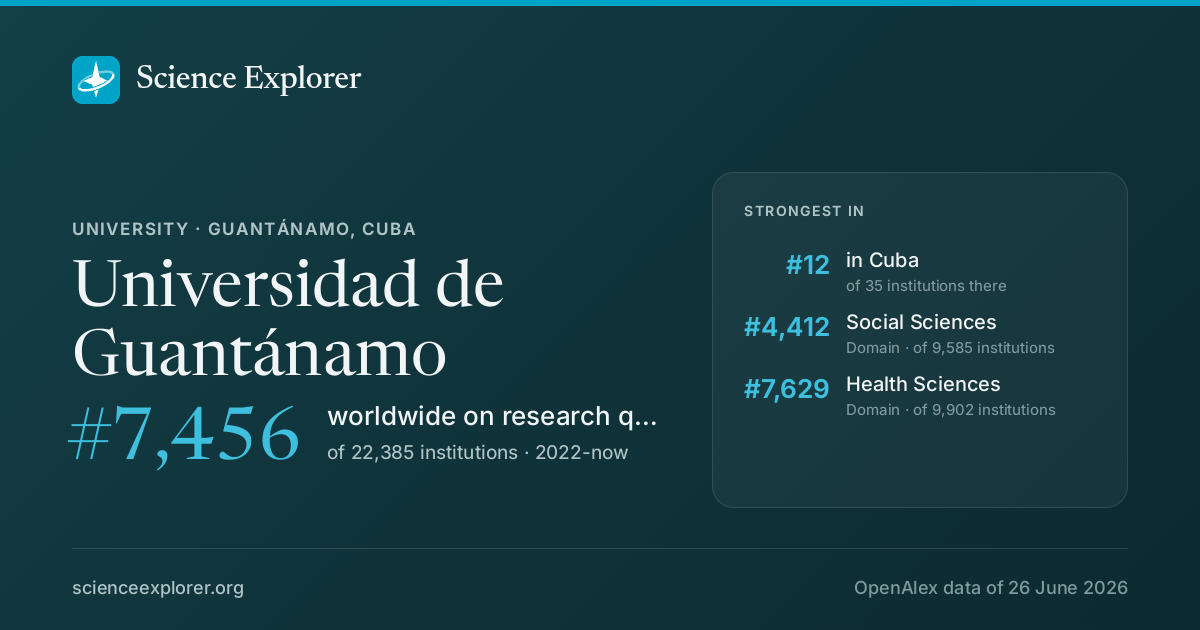
In research, Universidad de Guantánamo stands highest in Social Sciences (#4,412 of 9,585 worldwide), Social Sciences (#3,553 of 5,988 worldwide) and Health Sciences (#7,629 of 9,902 worldwide), 2022-now. Relative to its size it is most specialised in Education (Education is 5.0× its share of world research).

World rank, 2022-now
#7,456
of 22,385 · #7,794 all time
Rank in Cuba
#12
of 35
Research works
1.7k
▼ 60% vs 2018-21
Citations
1.6k
1.0 per fractional work
Top-10% rate
5.7%
all institutions 10.0%
vs its own fields
0.93×
1.00× is exactly expected
Open access
61%
world 40%
International
21%
world 18%

What is Universidad de Guantánamo known for in research?

The fields where it stands highest, 2022-now, ranked among every institution above the floor in each field.

FieldWorld rankWhere that sitsTop-10% rateWorksAll time
Social SciencesDomain #4,412 of 9,585 7.0%128 #5751
Social SciencesField #3,553 of 5,988 7.5%87 #5124
Health SciencesDomain #7,629 of 9,902 3.7%63 #10227

Each strip is that field's whole ranked pool, with the notch where Universidad de Guantánamo sits in it, in the colour of the band that rank falls in. The track under the rate is the rate itself: it carries no average mark, because the average differs by field (from about 6% in Dentistry to 21% in Economics).

Which of those standings moved

The same fields on both windows: where it stood over the whole record, and where it stands in 2022-now. The distance is the story, and it is the one thing the two rank columns above cannot show.

  1. Social Sciences#5,751 #4,412
  2. Social Sciences#5,124 #3,553
  3. Health Sciences#10,227 #7,629
all time2022-now, better2022-now, worse

A dot further right is a better standing. Fields it was not ranked in over the whole record are left out.

Which fields of science does Universidad de Guantánamo work in?

In 2022-now, 54% of research at Universidad de Guantánamo is in Social Sciences, 23% in Health Sciences. Its largest fields are Social Sciences (37%), Medicine (14%), Health Professions (8%). It does 2.1× the world's share of Social Sciences.

Social Sciences: 158 fractional works · 53.8% of its workSocial Sciences: 107 fractional works · 36.5% of its workEducation: 45 fractional works · 15.4% of its workSociology and Political Science: 18 fractional works · 6.3% of its workLaw: 9 fractional works · 3.1% of its workDemography: 6 fractional works · 2.1% of its workPolitical Science and International Relations: 6 fractional works · 1.9% of its workGeneral Social Sciences: 5 fractional works · 1.6% of its workCultural Studies: 5 fractional works · 1.5% of its workSafety Research: 4 fractional works · 1.5% of its workCommunication: 2 fractional works · 0.8% of its workHealth: 2 fractional works · 0.6% of its workDevelopment: 1 fractional works · 0.5% of its workGeography, Planning and Development: 1 fractional works · 0.5% of its workUrban Studies: 1 fractional works · 0.3% of its workLife-span and Life-course Studies: 1 fractional works · 0.2% of its workSmaller subfields together: 1 fractional works · 0.2% of its workBusiness, Management and Accounting: 15 fractional works · 5.0% of its workAccounting: 6 fractional works · 2.1% of its workStrategy and Management: 2 fractional works · 0.8% of its workOrganizational Behavior and Human Resource Management: 2 fractional works · 0.7% of its workManagement Information Systems: 2 fractional works · 0.7% of its workMarketing: 2 fractional works · 0.5% of its workSmaller subfields together: 1 fractional works · 0.2% of its workPsychology: 14 fractional works · 4.9% of its workSocial Psychology: 5 fractional works · 1.7% of its workDevelopmental and Educational Psychology: 4 fractional works · 1.3% of its workClinical Psychology: 3 fractional works · 0.9% of its workNeuropsychology and Physiological Psychology: 2 fractional works · 0.8% of its workSmaller subfields together: 1 fractional works · 0.2% of its workEconomics, Econometrics and Finance: 13 fractional works · 4.4% of its workEconomics and Econometrics: 11 fractional works · 3.8% of its workGeneral Economics, Econometrics and Finance: 1 fractional works · 0.4% of its workSmaller subfields together: 0 fractional works · 0.2% of its workArts and Humanities: 8 fractional works · 2.8% of its workLanguage and Linguistics: 2 fractional works · 0.6% of its workLiterature and Literary Theory: 1 fractional works · 0.4% of its workHistory: 1 fractional works · 0.4% of its workPhilosophy: 1 fractional works · 0.3% of its workArcheology: 1 fractional works · 0.3% of its workMusic: 1 fractional works · 0.3% of its workGeneral Arts and Humanities: 1 fractional works · 0.2% of its workReligious studies: 1 fractional works · 0.2% of its workSmaller subfields together: 0 fractional works · 0.1% of its workDecision Sciences: 1 fractional works · 0.3% of its workHealth Sciences: 67 fractional works · 22.8% of its workMedicine: 41 fractional works · 14.0% of its workPublic Health, Environmental and Occupational Health: 11 fractional works · 3.7% of its workSurgery: 4 fractional works · 1.5% of its workPediatrics, Perinatology and Child Health: 2 fractional works · 0.7% of its workEpidemiology: 2 fractional works · 0.7% of its workPhysiology: 2 fractional works · 0.6% of its workCardiology and Cardiovascular Medicine: 2 fractional works · 0.6% of its workNeurology: 2 fractional works · 0.5% of its workRadiology, Nuclear Medicine and Imaging: 1 fractional works · 0.5% of its workOncology: 1 fractional works · 0.5% of its workPulmonary and Respiratory Medicine: 1 fractional works · 0.5% of its workReproductive Medicine: 1 fractional works · 0.5% of its workAnatomy: 1 fractional works · 0.4% of its workPathology and Forensic Medicine: 1 fractional works · 0.4% of its workInfectious Diseases: 1 fractional works · 0.3% of its workFamily Practice: 1 fractional works · 0.2% of its workGeriatrics and Gerontology: 1 fractional works · 0.2% of its workComplementary and alternative medicine: 1 fractional works · 0.2% of its workSmaller subfields together: 6 fractional works · 1.9% of its workHealth Professions: 23 fractional works · 7.9% of its workGeneral Health Professions: 18 fractional works · 6.3% of its workHealth Information Management: 1 fractional works · 0.5% of its workSpeech and Hearing: 1 fractional works · 0.3% of its workPharmacy: 1 fractional works · 0.3% of its workOccupational Therapy: 1 fractional works · 0.2% of its workPhysical Therapy, Sports Therapy and Rehabilitation: 1 fractional works · 0.2% of its workSmaller subfields together: 1 fractional works · 0.2% of its workDentistry: 2 fractional works · 0.6% of its workPeriodontics: 1 fractional works · 0.4% of its workSmaller subfields together: 1 fractional works · 0.2% of its workNursing: 1 fractional works · 0.3% of its workNutrition and Dietetics: 1 fractional works · 0.2% of its workSmaller subfields together: 0 fractional works · 0.1% of its workPhysical Sciences: 44 fractional works · 15.0% of its workEnvironmental Science: 15 fractional works · 5.2% of its workHealth, Toxicology and Mutagenesis: 4 fractional works · 1.3% of its workManagement, Monitoring, Policy and Law: 4 fractional works · 1.2% of its workEcology: 3 fractional works · 1.0% of its workNature and Landscape Conservation: 2 fractional works · 0.6% of its workWater Science and Technology: 1 fractional works · 0.5% of its workPollution: 1 fractional works · 0.3% of its workGlobal and Planetary Change: 1 fractional works · 0.2% of its workSmaller subfields together: 0 fractional works · 0.1% of its workComputer Science: 15 fractional works · 5.2% of its workInformation Systems: 11 fractional works · 3.8% of its workComputer Science Applications: 2 fractional works · 0.7% of its workArtificial Intelligence: 1 fractional works · 0.3% of its workSoftware: 1 fractional works · 0.2% of its workSmaller subfields together: 1 fractional works · 0.2% of its workEngineering: 5 fractional works · 1.7% of its workMechanical Engineering: 1 fractional works · 0.5% of its workBiomedical Engineering: 1 fractional works · 0.4% of its workElectrical and Electronic Engineering: 1 fractional works · 0.2% of its workAutomotive Engineering: 1 fractional works · 0.2% of its workSmaller subfields together: 1 fractional works · 0.4% of its workPhysics and Astronomy: 3 fractional works · 1.2% of its workAstronomy and Astrophysics: 2 fractional works · 0.6% of its workNuclear and High Energy Physics: 1 fractional works · 0.2% of its workStatistical and Nonlinear Physics: 1 fractional works · 0.2% of its workSmaller subfields together: 0 fractional works · 0.1% of its workEarth and Planetary Sciences: 2 fractional works · 0.8% of its workGeophysics: 1 fractional works · 0.3% of its workPaleontology: 1 fractional works · 0.3% of its workSmaller subfields together: 0 fractional works · 0.1% of its workEnergy: 1 fractional works · 0.4% of its workRenewable Energy, Sustainability and the Environment: 1 fractional works · 0.4% of its workMaterials Science: 1 fractional works · 0.4% of its workMaterials Chemistry: 1 fractional works · 0.3% of its workSmaller subfields together: 0 fractional works · 0.1% of its workMathematics: 0 fractional works · 0.2% of its workChemical Engineering: 0 fractional works · 0.1% of its workLife Sciences: 24 fractional works · 8.3% of its workAgricultural and Biological Sciences: 18 fractional works · 6.1% of its workGeneral Agricultural and Biological Sciences: 6 fractional works · 1.9% of its workFood Science: 3 fractional works · 1.0% of its workPlant Science: 2 fractional works · 0.7% of its workAquatic Science: 2 fractional works · 0.6% of its workEcology, Evolution, Behavior and Systematics: 1 fractional works · 0.5% of its workHorticulture: 1 fractional works · 0.4% of its workSoil Science: 1 fractional works · 0.4% of its workAnimal Science and Zoology: 1 fractional works · 0.2% of its workSmaller subfields together: 1 fractional works · 0.3% of its workBiochemistry, Genetics and Molecular Biology: 3 fractional works · 1.0% of its workMolecular Biology: 2 fractional works · 0.6% of its workGenetics: 1 fractional works · 0.3% of its workSmaller subfields together: 1 fractional works · 0.2% of its workNeuroscience: 3 fractional works · 1.0% of its workDevelopmental Neuroscience: 2 fractional works · 0.7% of its workSmaller subfields together: 1 fractional works · 0.3% of its workPharmacology, Toxicology and Pharmaceutics: 1 fractional works · 0.2% of its workImmunology and Microbiology: 0 fractional works · 0.1% of its workALL ITS WORKUniversidad deGuantánamo293fractional works, 2022-now
Life Sciences8%Physical Sciences15%Health Sciences23%Social Sciences54%

Each ring splits the one inside it: the four domains of science, their fields, their subfields. Size is fractional works in 2022-now. Every slice is a page; the interactive view zooms down to single topics and colours each by how much more of it this institution does than the world.

Its 4 domains and 24 fields, with their numbers
    1. Social Sciences10736.5%
    2. Business, Management and Accounting155.0%
    3. Psychology144.9%
    4. Economics, Econometrics and Finance134.4%
    5. Arts and Humanities82.8%
    6. Decision Sciences10.3%
    1. Medicine4114.0%
    2. Health Professions237.9%
    3. Dentistry20.6%
    4. Nursing10.3%
    1. Environmental Science155.2%
    2. Computer Science155.2%
    3. Engineering51.7%
    4. Physics and Astronomy31.2%
    5. Earth and Planetary Sciences20.8%
    6. Energy10.4%
    7. Materials Science10.4%
    8. Mathematics00.2%
    9. Chemical Engineering00.1%
    1. Agricultural and Biological Sciences186.1%
    2. Biochemistry, Genetics and Molecular Biology31.0%
    3. Neuroscience31.0%
    4. Pharmacology, Toxicology and Pharmaceutics10.2%
    5. Immunology and Microbiology00.1%
All of science, and how each field's share has moved since 1950: the Science domain explorer

What does Universidad de Guantánamo specialise in?

Where its research is concentrated relative to its size: Education takes 5.0× the share of its output that it takes of world research.

  1. EducationSubfield · 45.3 works5.0×
← less than its size predicts1×more →

Location quotient, a volume reading rather than an impact one. It surfaces small, lopsided specialities.

Field profile

Location quotient across every field it publishes in: outside the ring is more than an institution of this size would be expected to publish, inside it is less.

Agricultural and Biological Sciences: 1.28× its world share, 18 worksAgricultural and Bio…Biochemistry, Genetics and Molecular Biology: 0.19× its world share, 3 worksBiochemistry, Geneti…Immunology and Microbiology: 0.06× its world share, 0 worksImmunology and Micro…Neuroscience: 0.60× its world share, 3 worksNeurosciencePharmacology, Toxicology and Pharmaceutics: 0.56× its world share, 1 worksPharmacology, Toxico…Chemical Engineering: 0.27× its world share, 0 worksChemical EngineeringComputer Science: 0.67× its world share, 15 worksComputer ScienceEarth and Planetary Sciences: 0.48× its world share, 2 worksEarth and Planetary …Energy: 0.41× its world share, 1 worksEnergyEngineering: 0.11× its world share, 5 worksEngineeringEnvironmental Science: 1.06× its world share, 15 worksEnvironmental ScienceMaterials Science: 0.10× its world share, 1 worksMaterials ScienceMathematics: 0.14× its world share, 0 worksMathematicsPhysics and Astronomy: 0.52× its world share, 3 worksPhysics and AstronomyDentistry: 1.27× its world share, 2 worksDentistryHealth Professions: 3.01× its world share, 23 worksHealth ProfessionsMedicine: 0.73× its world share, 41 worksMedicineNursing: 0.58× its world share, 1 worksNursingArts and Humanities: 0.99× its world share, 8 worksArts and HumanitiesBusiness, Management and Accounting: 1.54× its world share, 14 worksBusiness, Management…Decision Sciences: 0.26× its world share, 1 worksDecision SciencesEconomics, Econometrics and Finance: 2.04× its world share, 13 worksEconomics, Econometr…Psychology: 1.61× its world share, 14 worksPsychologySocial Sciences: 2.89× its world share, 107 worksSocial Sciences1×world share
more than its size predictsabout as predictedless

Rings at 0.5×, 1× and 2×. Widest outward: Health Professions, 3.0×. Every wedge is a field page.

All 24 fields, with their numbers
  1. Health Professions3.01×23 works
  2. Social Sciences2.89×107 works
  3. Economics, Econometrics and Finance2.04×13 works
  4. Psychology1.61×14 works
  5. Business, Management and Accounting1.54×14 works
  6. Agricultural and Biological Sciences1.28×18 works
  7. Dentistry1.27×2 works
  8. Environmental Science1.06×15 works
  9. Arts and Humanities0.99×8 works
  10. Medicine0.73×41 works
  11. Computer Science0.67×15 works
  12. Neuroscience0.60×3 works
  13. Nursing0.58×1 works
  14. Pharmacology, Toxicology and Pharmaceutics0.56×1 works
  15. Physics and Astronomy0.52×3 works
  16. Earth and Planetary Sciences0.48×2 works
  17. Energy0.41×1 works
  18. Chemical Engineering0.27×0 works
  19. Decision Sciences0.26×1 works
  20. Biochemistry, Genetics and Molecular Biology0.19×3 works
  21. Mathematics0.14×0 works
  22. Engineering0.11×5 works
  23. Materials Science0.10×1 works
  24. Immunology and Microbiology0.06×0 works

Who are the top researchers at Universidad de Guantánamo?

Ranked on the quality score, Eduardo Enrique Chibas-Muñoz, Lee Yang Díaz-Chieng and Juan Carlos Mendoza Pérez lead among researchers whose main affiliation is Universidad de Guantánamo.

  1. 1 Eduardo Enrique Chibas-Muñoz Cuba · #2,734,683 worldwide 65 citations · 17 works
  2. 2 Lee Yang Díaz-Chieng Cuba · #3,366,729 worldwide 95 citations · 51 works
  3. 3 Juan Carlos Mendoza Pérez Cuba · #3,567,824 worldwide 73 citations · 22 works
  4. 4 Raúl Hernández Heredia Cuba · #3,662,020 worldwide 33 citations · 17 works
  5. 5 Alfredo Pardo Fernández Cuba · #3,699,616 worldwide 66 citations · 31 works
  6. 6 Irayma Cazull Imbert Cuba · #4,121,350 worldwide 36 citations · 23 works
  7. 7 Carlos Moreira Carbonell Cuba · #4,580,274 worldwide 7 citations · 15 works
  8. 8 Yonger Tamayo Aguilar Cuba · #4,706,213 worldwide 37 citations · 15 works
  9. 9 Francisco Martínez Fernández Cuba · #4,708,076 worldwide 10 citations · 17 works
  10. 10 Emilio Martínez-Rodríguez Cuba · #4,756,266 worldwide 42 citations · 20 works
All ranked researchers at Universidad de Guantánamo

What are the most cited papers from Universidad de Guantánamo?

The most cited paper from Universidad de Guantánamo is "From the Archives of the AFIP" (Perry J. Pickhardt, Gael J. Lonergan, Charles J. Davis et al., 2000), with 175 citations. Next come "Community involvement in dengue vector control: cluster randomised trial" (167) and "Is salinity tolerance related to Na accumulation in Upland cotton (Gossypium hirsutum) seedlings?" (136).

Most cited papers
#PaperReleasedCitations
1 From the Archives of the AFIP Perry J. Pickhardt, Gael J. Lonergan, Charles J. Davis et al. · Radiographics 2000 175
2 Community involvement in dengue vector control: cluster randomised trial Veerle Vanlerberghe, María Eugenia Toledo, Magdalena Rodríguez et al. · BMJ Open access 9 Jun 2009 167
3 Is salinity tolerance related to Na accumulation in Upland cotton (Gossypium hirsutum) seedlings? Eduardo O. Leidi, J.F. Saiz · Plant and Soil Mar 1997 136
4 Immunostimulant activity of an enzymatic protein hydrolysate from green microalga Chlorella vulgaris on undernourished mice Humberto J. Morris, Olimpia V. Carrillo, Ángel Almarales et al. · Enzyme and Microbial Technology 13 Jul 2006 109
5 The environmental and intrinsic yeast diversity of Cuban cocoa bean heap fermentations Yurelkys Fernández Maura, Tom Balzarini, Pablo Clapé Borges et al. · International Journal of Food Microbiology 18 Jun 2016 49
All 63 most cited papers, with filters and sorting

Which keywords describe research at Universidad de Guantánamo?

By fractional works in 2022-now, weighted toward what it does more of than the world: Education, Public Health, Pedagogy, Innovation, Teacher Training, Globalization, Competitiveness and Inclusive Education.

▲ more of its work than of the world's◆ about the world's share▼ less than the world's

Size is fractional works in 2022-now in the topics tagged with each word; colour is the word's share of this institution's work against its share of the world's. The 40 words are chosen for being large and distinctive. Each links to the topic it comes from most.

All 40 words, with their numbers
  1. Education44▲ 8.8×26 topics
  2. Public Health26▲ 6.2×25 topics
  3. Globalization20▲ 3.5×28 topics
  4. Sustainability20▲ 2.8×24 topics
  5. Epidemiology19▲ 1.62×32 topics
  6. Innovation18▲ 5.8×13 topics
  7. Pedagogy18▲ 12×10 topics
  8. Educational Technology16▲ 4.6×16 topics
  9. Teacher Training15▲ 8.3×11 topics
  10. Quality of Life14▲ 3.3×23 topics
  11. Competitiveness14▲ 60×6 topics
  12. Inclusive Education14▲ 13×8 topics
  13. Health Promotion13▲ 14×8 topics
  14. E-Learning13▲ 4.6×8 topics
  15. Research13▲ 35×5 topics
  16. Human Rights12▲ 4.2×16 topics
  17. Social Impact12▲ 11×11 topics
  18. Healthcare12▲ 3.5×13 topics
  19. Knowledge Management12▲ 7.2×9 topics
  20. Social Determinants of Health11▲ 17×6 topics
  21. Health Policy11▲ 24×3 topics
  22. Distance Learning10▲ 10×5 topics
  23. Communication10▲ 11×8 topics
  24. Medical Education10▲ 13×7 topics
  25. Small and Medium Enterprises9▲ 17×4 topics
  26. Social Responsibility9▲ 13×3 topics
  27. Ethics9▲ 6.0×8 topics
  28. Global Health9▲ 19×2 topics
  29. Healthcare Access8▲ 11×7 topics
  30. Healthcare Quality8▲ 28×4 topics
  31. Online Education8▲ 15×2 topics
  32. Community Health8▲ 17×4 topics
  33. Digital Competence8▲ 31×2 topics
  34. Healthcare Systems8▲ 60×2 topics
  35. Digital Divide8▲ 10×2 topics
  36. Social Sciences8▲ 18×5 topics
  37. ICT8▲ 19×1 topic
  38. Virtual Teaching8▲ 48×1 topic
  39. Innovation Ecosystems7▲ 25×3 topics
  40. Teaching Methods7▲ 16×4 topics

Which research topics does Universidad de Guantánamo publish most on?

By volume in 2022-now: Health and Medical Education, Educational Innovations and Technology, Education and Teacher Training and Business, Innovation, and Economy.

  1. 1 Health and Medical Education General Health Professions 8 works
  2. 2 Educational Innovations and Technology Information Systems 8 works
  3. 3 Education and Teacher Training Education 6 works
  4. 4 Business, Innovation, and Economy Economics and Econometrics 6 works
  5. 5 Social Issues and Policies in Latin America Law 6 works
  6. 6 Business, Education, Mathematics Research Accounting 5 works
  7. 7 Social Skills and Education Education 5 works
  8. 8 Ethics and bioethics in healthcare Public Health, Environmental and Occupational Health 4 works
  9. 9 Public Health and Environmental Issues Health, Toxicology and Mutagenesis 4 works
  10. 10 Education, Innovation and Language Studies Education 4 works

How open and international is its research?

Against the world's own shares: the tick on each track. Both are shares of its output, so they sit on one scale and can be read against each other as well as against the world.

openly available60.8%not open39.2%

World: 40% of research is openly available.

with international co-authors20.6%domestic only79.4%

World: 18% is written across borders.

How has Universidad de Guantánamo's research output changed?

Output in 2022-2025 was 60% lower than in 2018-2021.

still counting1990200020102020
grewheldshrank

The same series as a ribbon: one cell per year, darker for more. The line above answers how much; this answers when.

Its share of all research

Growing output can still be a shrinking share: all of science grows. This is Universidad de Guantánamo as a percentage of every work published that year, 0.00069% in 2024.

still counting0.0020%0.0040%Universidad de Guantánamo0.0012% in 202519801990200020102020

Fractional works of Universidad de Guantánamo over all fractional works that year. How the balance of science has shifted.

How much of it reaches the world top 10%

Year by year, against all institutions in the same year.

still counting5%10%15%all institutions10.0% in 2025Universidad de Guantánamo7.9% in 20252020

Of each year's output, the share that reached the world's 10% most cited for its field and year. Peak 7.9% in 2025.

Share Universidad de Guantánamo's ranking
Universidad de Guantánamo on Science Explorer

A card with Universidad de Guantánamo's standing and the fields it leads in, for a post or a slide. A link to this page previews as the same card.

Download the card

1200 × 630 PNG, sized for social posts, drawn from the latest snapshot.

Badges for a website1Each links back here and updates with every snapshot

Research measures only: rankings here say nothing about teaching, admissions or student experience. Comparable institutions and collaboration partners have tabs of their own, above.

Discussion

Ask a question or share a note about Universidad de Guantánamo. Posts are plain text and can be reported.