Science Explorer Back to mapMap
Discussion
University · Bartın · Türkiye

Bartin University

In research, Bartin University stands highest in Social Sciences (#861 of 9,585 worldwide), Physical Sciences (#1,357 of 10,670 worldwide) and Arts and Humanities (#375 of 1,896 worldwide), 2022-now. Relative to its size it is most specialised in Museology, Religious studies and Philosophy (Museology is 16.1× its share of world research).

World rank, 2022-now
#1,518
of 22,385 · #1,801 all time
Rank in Türkiye
#6
of 297
Research works
4.6k
▲ 45% vs 2018-21
Citations
41k
8.8 per fractional work
Top-10% rate
9.7%
all institutions 10.0%
vs its own fields
1.01×
1.00× is exactly expected
Open access
74%
world 40%
International
11%
world 18%

What is Bartin University known for in research?

The fields where it stands highest, 2022-now, ranked among every institution above the floor in each field.

FieldWorld rankWhere that sitsTop-10% rateWorksAll time
Social SciencesDomain #861 of 9,585 9.1%1,058 #1016
Physical SciencesDomain #1,357 of 10,670 11.6%692 #1599
Arts and HumanitiesField #375 of 1,896 9.2%260 #669
Social SciencesField #1,222 of 5,988 10.4%471 #1338
EngineeringField #1,441 of 5,901 12.5%253 #1732
PsychologyField #631 of 2,121 6.5%174 #872
Health SciencesDomain #3,243 of 9,902 7.2%216 #4426
EducationSubfield #644 of 1,930 13.5%169 #575
Computer ScienceField #1,585 of 4,417 15.5%118 #2065
Environmental ScienceField #1,347 of 3,334 10.5%93 #2245

Each strip is that field's whole ranked pool, with the notch where Bartin University sits in it, in the colour of the band that rank falls in. The track under the rate is the rate itself: it carries no average mark, because the average differs by field (from about 6% in Dentistry to 21% in Economics).

Which of those standings moved

The same fields on both windows: where it stood over the whole record, and where it stands in 2022-now. The distance is the story, and it is the one thing the two rank columns above cannot show.

  1. Social Sciences#1,016 #861
  2. Physical Sciences#1,599 #1,357
  3. Arts and Humanities#669 #375
  4. Social Sciences#1,338 #1,222
  5. Engineering#1,732 #1,441
  6. Psychology#872 #631
  7. Health Sciences#4,426 #3,243
  8. Education#575 #644
  9. Computer Science#2,065 #1,585
  10. Environmental Science#2,245 #1,347
all time2022-now, better2022-now, worse

A dot further right is a better standing. Fields it was not ranked in over the whole record are left out.

Which fields of science does Bartin University work in?

In 2022-now, 50% of research at Bartin University is in Social Sciences, 33% in Physical Sciences. Its largest fields are Social Sciences (22%), Engineering (12%), Arts and Humanities (12%). It does 2.0× the world's share of Social Sciences.

Social Sciences: 1,153 fractional works · 50.0% of its workSocial Sciences: 511 fractional works · 22.2% of its workEducation: 183 fractional works · 8.0% of its workSociology and Political Science: 121 fractional works · 5.3% of its workPolitical Science and International Relations: 63 fractional works · 2.7% of its workGender Studies: 35 fractional works · 1.5% of its workUrban Studies: 16 fractional works · 0.7% of its workCultural Studies: 16 fractional works · 0.7% of its workDemography: 12 fractional works · 0.5% of its workHealth: 11 fractional works · 0.5% of its workSafety Research: 10 fractional works · 0.4% of its workCommunication: 10 fractional works · 0.4% of its workTransportation: 9 fractional works · 0.4% of its workAnthropology: 8 fractional works · 0.3% of its workSmaller subfields together: 17 fractional works · 0.7% of its workArts and Humanities: 276 fractional works · 12.0% of its workLiterature and Literary Theory: 57 fractional works · 2.5% of its workPhilosophy: 55 fractional works · 2.4% of its workLanguage and Linguistics: 47 fractional works · 2.0% of its workMuseology: 45 fractional works · 2.0% of its workReligious studies: 22 fractional works · 1.0% of its workHistory: 19 fractional works · 0.8% of its workArcheology: 15 fractional works · 0.6% of its workVisual Arts and Performing Arts: 9 fractional works · 0.4% of its workSmaller subfields together: 6 fractional works · 0.3% of its workPsychology: 196 fractional works · 8.5% of its workSocial Psychology: 85 fractional works · 3.7% of its workClinical Psychology: 59 fractional works · 2.6% of its workDevelopmental and Educational Psychology: 30 fractional works · 1.3% of its workExperimental and Cognitive Psychology: 14 fractional works · 0.6% of its workApplied Psychology: 7 fractional works · 0.3% of its workSmaller subfields together: 1 fractional works · 0.1% of its workBusiness, Management and Accounting: 86 fractional works · 3.7% of its workStrategy and Management: 29 fractional works · 1.2% of its workAccounting: 13 fractional works · 0.6% of its workMarketing: 12 fractional works · 0.5% of its workOrganizational Behavior and Human Resource Management: 12 fractional works · 0.5% of its workManagement Information Systems: 9 fractional works · 0.4% of its workManagement of Technology and Innovation: 8 fractional works · 0.3% of its workSmaller subfields together: 3 fractional works · 0.2% of its workEconomics, Econometrics and Finance: 50 fractional works · 2.2% of its workEconomics and Econometrics: 38 fractional works · 1.7% of its workFinance: 6 fractional works · 0.3% of its workGeneral Economics, Econometrics and Finance: 6 fractional works · 0.2% of its workDecision Sciences: 34 fractional works · 1.5% of its workManagement Science and Operations Research: 23 fractional works · 1.0% of its workInformation Systems and Management: 9 fractional works · 0.4% of its workSmaller subfields together: 2 fractional works · 0.1% of its workPhysical Sciences: 750 fractional works · 32.5% of its workEngineering: 277 fractional works · 12.0% of its workMechanical Engineering: 66 fractional works · 2.8% of its workBiomedical Engineering: 35 fractional works · 1.5% of its workBuilding and Construction: 34 fractional works · 1.5% of its workCivil and Structural Engineering: 31 fractional works · 1.4% of its workElectrical and Electronic Engineering: 30 fractional works · 1.3% of its workMechanics of Materials: 16 fractional works · 0.7% of its workIndustrial and Manufacturing Engineering: 16 fractional works · 0.7% of its workAerospace Engineering: 14 fractional works · 0.6% of its workAutomotive Engineering: 11 fractional works · 0.5% of its workControl and Systems Engineering: 6 fractional works · 0.2% of its workSafety, Risk, Reliability and Quality: 5 fractional works · 0.2% of its workComputational Mechanics: 5 fractional works · 0.2% of its workSmaller subfields together: 8 fractional works · 0.3% of its workComputer Science: 125 fractional works · 5.4% of its workInformation Systems: 32 fractional works · 1.4% of its workArtificial Intelligence: 31 fractional works · 1.4% of its workComputer Science Applications: 15 fractional works · 0.7% of its workHuman-Computer Interaction: 14 fractional works · 0.6% of its workComputer Networks and Communications: 12 fractional works · 0.5% of its workComputational Theory and Mathematics: 9 fractional works · 0.4% of its workComputer Vision and Pattern Recognition: 9 fractional works · 0.4% of its workSmaller subfields together: 3 fractional works · 0.1% of its workEnvironmental Science: 101 fractional works · 4.4% of its workGlobal and Planetary Change: 16 fractional works · 0.7% of its workEcology: 16 fractional works · 0.7% of its workManagement, Monitoring, Policy and Law: 15 fractional works · 0.7% of its workHealth, Toxicology and Mutagenesis: 14 fractional works · 0.6% of its workEnvironmental Engineering: 13 fractional works · 0.6% of its workWater Science and Technology: 8 fractional works · 0.3% of its workPollution: 7 fractional works · 0.3% of its workNature and Landscape Conservation: 6 fractional works · 0.3% of its workSmaller subfields together: 6 fractional works · 0.2% of its workMaterials Science: 89 fractional works · 3.9% of its workPolymers and Plastics: 36 fractional works · 1.6% of its workMaterials Chemistry: 31 fractional works · 1.4% of its workBiomaterials: 15 fractional works · 0.7% of its workSmaller subfields together: 7 fractional works · 0.3% of its workMathematics: 64 fractional works · 2.8% of its workStatistics and Probability: 22 fractional works · 0.9% of its workApplied Mathematics: 17 fractional works · 0.7% of its workGeometry and Topology: 12 fractional works · 0.5% of its workNumerical Analysis: 7 fractional works · 0.3% of its workSmaller subfields together: 7 fractional works · 0.3% of its workChemistry: 37 fractional works · 1.6% of its workOrganic Chemistry: 27 fractional works · 1.2% of its workSmaller subfields together: 10 fractional works · 0.4% of its workEnergy: 20 fractional works · 0.8% of its workRenewable Energy, Sustainability and the Environment: 17 fractional works · 0.8% of its workSmaller subfields together: 2 fractional works · 0.1% of its workPhysics and Astronomy: 19 fractional works · 0.8% of its workStatistical and Nonlinear Physics: 8 fractional works · 0.3% of its workAstronomy and Astrophysics: 6 fractional works · 0.3% of its workSmaller subfields together: 5 fractional works · 0.2% of its workEarth and Planetary Sciences: 13 fractional works · 0.5% of its workChemical Engineering: 5 fractional works · 0.2% of its workHealth Sciences: 240 fractional works · 10.4% of its workMedicine: 156 fractional works · 6.8% of its workPublic Health, Environmental and Occupational Health: 24 fractional works · 1.0% of its workPediatrics, Perinatology and Child Health: 15 fractional works · 0.6% of its workPharmacology: 10 fractional works · 0.4% of its workSurgery: 10 fractional works · 0.4% of its workPsychiatry and Mental health: 9 fractional works · 0.4% of its workOncology: 8 fractional works · 0.4% of its workPhysiology: 8 fractional works · 0.3% of its workOrthopedics and Sports Medicine: 7 fractional works · 0.3% of its workPulmonary and Respiratory Medicine: 7 fractional works · 0.3% of its workHealth Informatics: 6 fractional works · 0.3% of its workEndocrinology, Diabetes and Metabolism: 5 fractional works · 0.2% of its workEpidemiology: 5 fractional works · 0.2% of its workBiochemistry: 5 fractional works · 0.2% of its workSmaller subfields together: 36 fractional works · 1.6% of its workHealth Professions: 66 fractional works · 2.8% of its workGeneral Health Professions: 25 fractional works · 1.1% of its workSpeech and Hearing: 15 fractional works · 0.6% of its workPhysical Therapy, Sports Therapy and Rehabilitation: 8 fractional works · 0.3% of its workEmergency Medical Services: 8 fractional works · 0.3% of its workSmaller subfields together: 11 fractional works · 0.5% of its workNursing: 15 fractional works · 0.7% of its workNutrition and Dietetics: 9 fractional works · 0.4% of its workSmaller subfields together: 7 fractional works · 0.3% of its workDentistry: 3 fractional works · 0.1% of its workLife Sciences: 162 fractional works · 7.0% of its workAgricultural and Biological Sciences: 88 fractional works · 3.8% of its workPlant Science: 29 fractional works · 1.3% of its workFood Science: 16 fractional works · 0.7% of its workForestry: 16 fractional works · 0.7% of its workEcology, Evolution, Behavior and Systematics: 11 fractional works · 0.5% of its workInsect Science: 6 fractional works · 0.2% of its workSoil Science: 5 fractional works · 0.2% of its workSmaller subfields together: 6 fractional works · 0.3% of its workBiochemistry, Genetics and Molecular Biology: 44 fractional works · 1.9% of its workMolecular Biology: 26 fractional works · 1.1% of its workGenetics: 6 fractional works · 0.3% of its workSmaller subfields together: 12 fractional works · 0.5% of its workNeuroscience: 24 fractional works · 1.0% of its workCognitive Neuroscience: 21 fractional works · 0.9% of its workSmaller subfields together: 3 fractional works · 0.1% of its workImmunology and Microbiology: 3 fractional works · 0.1% of its workPharmacology, Toxicology and Pharmaceutics: 3 fractional works · 0.1% of its workALL ITS WORKBartin University2,305fractional works, 2022-now
Life Sciences7%Physical Sciences33%Health Sciences10%Social Sciences50%

Each ring splits the one inside it: the four domains of science, their fields, their subfields. Size is fractional works in 2022-now. Every slice is a page; the interactive view zooms down to single topics and colours each by how much more of it this institution does than the world.

Its 4 domains and 26 fields, with their numbers
  1. Social Sciences1,15350.0%
    1. Social Sciences51122.2%
    2. Arts and Humanities27612.0%
    3. Psychology1968.5%
    4. Business, Management and Accounting863.7%
    5. Economics, Econometrics and Finance502.2%
    6. Decision Sciences341.5%
    1. Engineering27712.0%
    2. Computer Science1255.4%
    3. Environmental Science1014.4%
    4. Materials Science893.9%
    5. Mathematics642.8%
    6. Chemistry371.6%
    7. Energy200.8%
    8. Physics and Astronomy190.8%
    9. Earth and Planetary Sciences130.5%
    10. Chemical Engineering50.2%
    1. Medicine1566.8%
    2. Health Professions662.8%
    3. Nursing150.7%
    4. Dentistry30.1%
    5. Veterinary00.0%
    1. Agricultural and Biological Sciences883.8%
    2. Biochemistry, Genetics and Molecular Biology441.9%
    3. Neuroscience241.0%
    4. Immunology and Microbiology30.1%
    5. Pharmacology, Toxicology and Pharmaceutics30.1%
All of science, and how each field's share has moved since 1950: the Science domain explorer

What does Bartin University specialise in?

Where its research is concentrated relative to its size: Museology takes 16.1× the share of its output that it takes of world research.

  1. MuseologySubfield · 45.5 works16×
  2. Religious studiesSubfield · 22.4 works5.8×
  3. PhilosophySubfield · 55.5 works5.6×
  4. Language and LinguisticsSubfield · 46.8 works4.6×
← less than its size predicts1×more →

Location quotient, a volume reading rather than an impact one. It surfaces small, lopsided specialities.

Field profile

Location quotient across every field it publishes in: outside the ring is more than an institution of this size would be expected to publish, inside it is less.

Agricultural and Biological Sciences: 0.80× its world share, 88 worksAgricultural and Bio…Biochemistry, Genetics and Molecular Biology: 0.36× its world share, 44 worksBiochemistry, Geneti…Immunology and Microbiology: 0.13× its world share, 3 worksImmunology and Micro…Neuroscience: 0.64× its world share, 24 worksNeurosciencePharmacology, Toxicology and Pharmaceutics: 0.33× its world share, 3 worksPharmacology, Toxico…Chemical Engineering: 0.68× its world share, 6 worksChemical EngineeringChemistry: 1.02× its world share, 37 worksChemistryComputer Science: 0.70× its world share, 125 worksComputer ScienceEarth and Planetary Sciences: 0.35× its world share, 13 worksEarth and Planetary …Energy: 0.92× its world share, 20 worksEnergyEngineering: 0.80× its world share, 277 worksEngineeringEnvironmental Science: 0.88× its world share, 100 worksEnvironmental ScienceMaterials Science: 1.11× its world share, 89 worksMaterials ScienceMathematics: 2.37× its world share, 64 worksMathematicsPhysics and Astronomy: 0.38× its world share, 19 worksPhysics and AstronomyDentistry: 0.23× its world share, 2 worksDentistryHealth Professions: 1.08× its world share, 66 worksHealth ProfessionsMedicine: 0.35× its world share, 156 worksMedicineNursing: 1.35× its world share, 15 worksNursingVeterinary: 0.04× its world share, 0 worksVeterinaryArts and Humanities: 4.15× its world share, 276 worksArts and HumanitiesBusiness, Management and Accounting: 1.16× its world share, 86 worksBusiness, Management…Decision Sciences: 1.54× its world share, 34 worksDecision SciencesEconomics, Econometrics and Finance: 1.00× its world share, 50 worksEconomics, Econometr…Psychology: 2.79× its world share, 196 worksPsychologySocial Sciences: 1.75× its world share, 511 worksSocial Sciences1×world share
more than its size predictsabout as predictedless

Rings at 0.5×, 1× and 2×. Widest outward: Arts and Humanities, 4.2×. Every wedge is a field page.

All 26 fields, with their numbers
  1. Arts and Humanities4.15×276 works
  2. Psychology2.79×196 works
  3. Mathematics2.37×64 works
  4. Social Sciences1.75×511 works
  5. Decision Sciences1.54×34 works
  6. Nursing1.35×15 works
  7. Business, Management and Accounting1.16×86 works
  8. Materials Science1.11×89 works
  9. Health Professions1.08×66 works
  10. Chemistry1.02×37 works
  11. Economics, Econometrics and Finance1.00×50 works
  12. Energy0.92×20 works
  13. Environmental Science0.88×100 works
  14. Agricultural and Biological Sciences0.80×88 works
  15. Engineering0.80×277 works
  16. Computer Science0.70×125 works
  17. Chemical Engineering0.68×6 works
  18. Neuroscience0.64×24 works
  19. Physics and Astronomy0.38×19 works
  20. Biochemistry, Genetics and Molecular Biology0.36×44 works
  21. Earth and Planetary Sciences0.35×13 works
  22. Medicine0.35×156 works
  23. Pharmacology, Toxicology and Pharmaceutics0.33×3 works
  24. Dentistry0.23×2 works
  25. Immunology and Microbiology0.13×3 works
  26. Veterinary0.04×0 works

Who are the top researchers at Bartin University?

Ranked on the quality score, Osman Gençel, Hatice Yıldız Durak and Ramazan Yılmaz lead among researchers whose main affiliation is Bartin University.

  1. 1 Osman Gençel Türkiye · #15,010 worldwide 13k citations · 294 works
  2. 2 Hatice Yıldız Durak Türkiye · #42,079 worldwide 3.4k citations · 166 works
  3. 3 Ramazan Yılmaz Türkiye · #65,375 worldwide 4.4k citations · 145 works
  4. 4 Fatma Gizem Karaoğlan Yılmaz Türkiye · #78,469 worldwide 3.8k citations · 144 works
  5. 5 Abid Ustaoğlu Türkiye · #147,045 worldwide 2.2k citations · 108 works
  6. 6 Yasin Ozgurluk Türkiye · #201,662 worldwide 2.1k citations · 55 works
  7. 7 Ertuğrul Erdoğmuş Türkiye · #202,166 worldwide 2.9k citations · 94 works
  8. 8 Kadir Mert Döleker Türkiye · #242,229 worldwide 2.8k citations · 63 works
  9. 9 Emre Altaş Türkiye · #294,913 worldwide 709 citations · 50 works
  10. 10 Abdullah Cahit Karaoğlanlı Türkiye · #424,593 worldwide 3.7k citations · 112 works
All ranked researchers at Bartin University

What are the most cited papers from Bartin University?

The most cited paper from Bartin University is "The effect of generative artificial intelligence (AI)-based tool use on students' computational thinking skills, programming self-efficacy and motivation" (Ramazan Yılmaz, Fatma Gizem Karaoğlan Yılmaz, 2023), with 726 citations. Next come "THE EFFECT OF SOCIAL MEDIA MARKETING ACTIVITIES ON BRAND AWARENESS, BRAND IMAGE AND BRAND LOYALTY" (556) and "Exploring the role of e-learning readiness on student satisfaction and motivation in flipped classroom" (516).

Most cited papers
#PaperReleasedCitations
1 The effect of generative artificial intelligence (AI)-based tool use on students' computational thinking skills, programming self-efficacy and motivation Ramazan Yılmaz, Fatma Gizem Karaoğlan Yılmaz · Computers and Education Artificial Intelligence Open access 2023 726
2 THE EFFECT OF SOCIAL MEDIA MARKETING ACTIVITIES ON BRAND AWARENESS, BRAND IMAGE AND BRAND LOYALTY Yusuf Bilgin · Business And Management Studies An International Journal Open access 25 Apr 2018 556
3 Exploring the role of e-learning readiness on student satisfaction and motivation in flipped classroom Ramazan Yılmaz · Computers in Human Behavior 4 Jan 2017 516
4 The extent of forest in dryland biomes Jean‐François Bastin et al. · Science Open access 11 May 2017 469
5 Integrating augmented reality into problem based learning: The effects on learning achievement and attitude in physics education Mustafa Fidan, Meriç Tuncel · Computers & Education 15 Jul 2019 461
All 60 most cited papers, with filters and sorting

Which keywords describe research at Bartin University?

By fractional works in 2022-now, weighted toward what it does more of than the world: Cultural Heritage, Mental Health, Education, Distance Education, Sufism, Professional Development, Student Perceptions and Teacher Training.

▲ more of its work than of the world's◆ about the world's share▼ less than the world's

Size is fractional works in 2022-now in the topics tagged with each word; colour is the word's share of this institution's work against its share of the world's. The 40 words are chosen for being large and distinctive. Each links to the topic it comes from most.

All 40 words, with their numbers
  1. Cultural Heritage139▲ 11×12 topics
  2. Mental Health108▲ 3.3×34 topics
  3. Education107▲ 2.7×46 topics
  4. Sustainability76▲ 1.36×49 topics
  5. Teacher Training72▲ 5.1×14 topics
  6. Qualitative Research69▲ 3.5×16 topics
  7. Mechanical Properties69▲ 3.0×31 topics
  8. Distance Education63▲ 14×3 topics
  9. Sufism62▲ 58×2 topics
  10. Professional Development61▲ 13×9 topics
  11. Student Perceptions60▲ 14×7 topics
  12. Meta-Analysis57▲ 4.2×16 topics
  13. Learning50▲ 7.4×6 topics
  14. Teaching50▲ 17×4 topics
  15. Well-being48▲ 5.3×12 topics
  16. 21st Century Skills48▲ 7.2×5 topics
  17. Language Teaching48▲ 7.8×6 topics
  18. Covid-19 Pandemic48▲ 15×1 topic
  19. Metaphors48▲ 64×1 topic
  20. Ethnography46▲ 12×4 topics
  21. Educational Research46▲ 15×5 topics
  22. Storytelling43▲ 39×3 topics
  23. Rituals43▲ 23×2 topics
  24. Content Analysis43▲ 15×7 topics
  25. Folklore43▲ 36×1 topic
  26. Turkish Culture43▲ 59×1 topic
  27. Public Policy42▲ 3.9×6 topics
  28. Student Engagement42▲ 4.6×12 topics
  29. Divan Poetry41▲ 70×1 topic
  30. Turkish Literature41▲ 70×1 topic
  31. Ottoman Empire40▲ 24×3 topics
  32. Psychological Functioning38▲ 20×2 topics
  33. Bibliometric Analysis36▲ 28×2 topics
  34. Curriculum Evaluation36▲ 83×1 topic
  35. Reading Habits36▲ 46×1 topic
  36. Social Systems32▲ 23×2 topics
  37. Therapy32▲ 7.1×4 topics
  38. Family Constellations31▲ 46×1 topic
  39. Genetic Processes31▲ 46×1 topic
  40. Morphology29▲ 7.2×7 topics

Which research topics does Bartin University publish most on?

By volume in 2022-now: Education Practices and Challenges, Cultural and Sociopolitical Studies, Turkish Literature and Culture and Educational Methods and Analysis.

  1. 1 Education Practices and Challenges Philosophy 48 works
  2. 2 Cultural and Sociopolitical Studies Museology 43 works
  3. 3 Turkish Literature and Culture Literature and Literary Theory 41 works
  4. 4 Educational Methods and Analysis Education 36 works
  5. 5 Families in Therapy and Culture Social Psychology 31 works
  6. 6 Linguistics and Cultural Studies Language and Linguistics 26 works
  7. 7 Islamic Thought and Society Studies Religious studies 21 works
  8. 8 Ottoman and Turkish Studies History 17 works
  9. 9 Impact of Technology on Adolescents Sociology and Political Science 16 works
  10. 10 Agricultural and Rural Development Research Forestry 14 works

How open and international is its research?

Against the world's own shares: the tick on each track. Both are shares of its output, so they sit on one scale and can be read against each other as well as against the world.

openly available74.0%not open26.0%

World: 40% of research is openly available.

with international co-authors11.0%domestic only89.0%

World: 18% is written across borders.

How has Bartin University's research output changed?

Output in 2022-2025 was 45% higher than in 2018-2021.

still counting200020102020
grewheldshrank

The same series as a ribbon: one cell per year, darker for more. The line above answers how much; this answers when.

Its share of all research

Growing output can still be a shrinking share: all of science grows. This is Bartin University as a percentage of every work published that year, 0.0093% in 2024.

still counting0.0050%0.010%0.015%Bartin University0.0086% in 2025200020102020

Fractional works of Bartin University over all fractional works that year. How the balance of science has shifted.

How much of it reaches the world top 10%

Year by year, against all institutions in the same year.

still counting10%20%30%all institutions10.0% in 2025Bartin University9.3% in 202520102020

Of each year's output, the share that reached the world's 10% most cited for its field and year. Peak 24.9% in 2009.

Share Bartin University's ranking
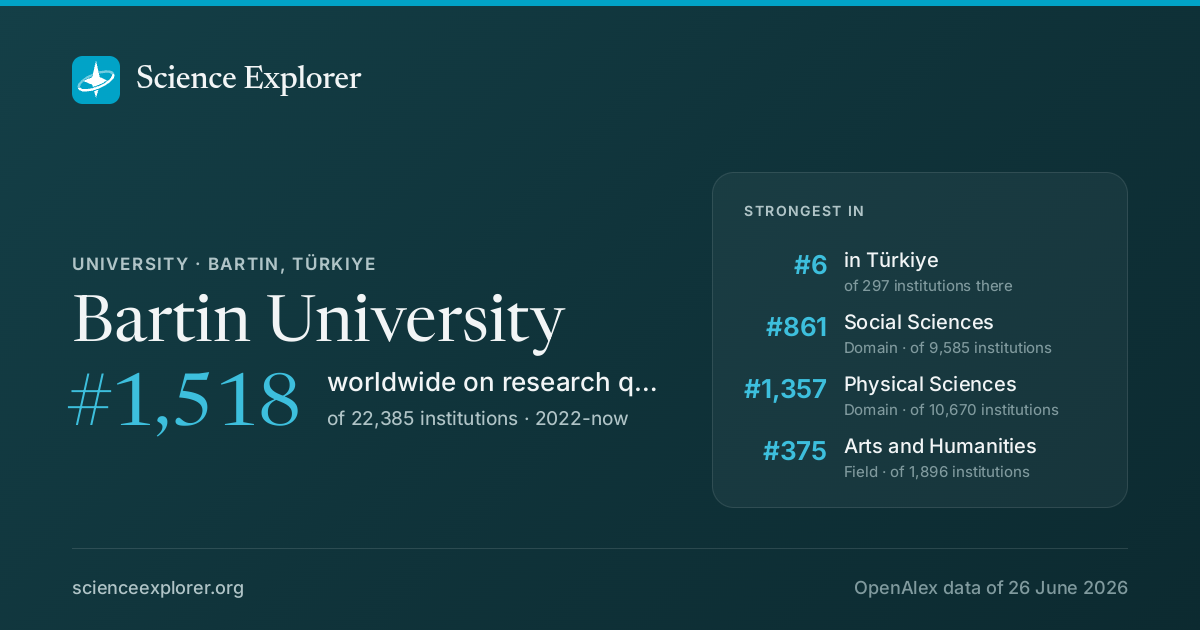
Bartin University on Science Explorer

A card with Bartin University's standing and the fields it leads in, for a post or a slide. A link to this page previews as the same card.

Download the card

1200 × 630 PNG, sized for social posts, drawn from the latest snapshot.

Badges for a website2Each links back here and updates with every snapshot

Its overall standing, then the domains, fields and subfields where Bartin University is in the world's top ten or its top 1%. Each has an image of its own.

Overall

Domains

Research measures only: rankings here say nothing about teaching, admissions or student experience. Comparable institutions and collaboration partners have tabs of their own, above.

Discussion

Ask a question or share a note about Bartin University. Posts are plain text and can be reported.