 Science in Lithuania
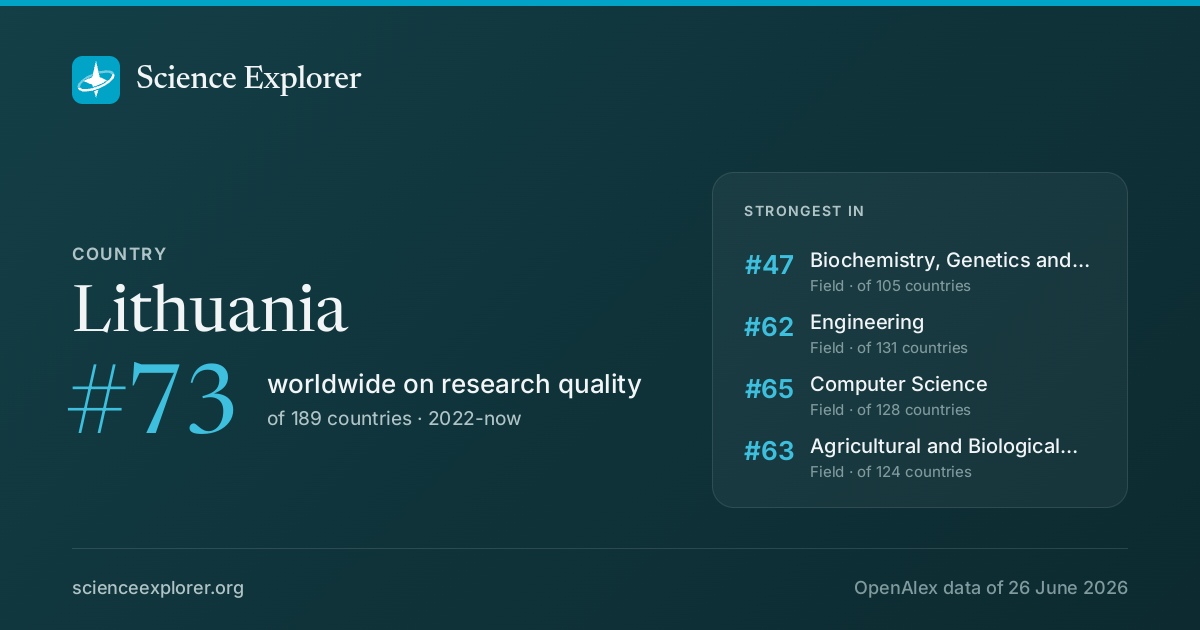
Lithuania ranks #73 of 189 countries on research quality in 2022-now (#71 all time), with 20k research works and 8.4% of them in the world's top 10%.
- World rank, 2022-now
- #73 of 189 · #71 all time
- Works, 2022-now
- 20k ▲ 6% vs 2018-21
- Citations
- 793k 8.7 per fractional work, all time
- Top-10% rate
- 8.4% all institutions 10.0%
- vs its own fields
- 0.71× 1.00× is exactly expected
- In the world top 100
- 0 0 in the top 1,000
- Open access
- 65% world 40%
- International
- 18% world 18%
LithuaniaWhat is Lithuania strongest at in science?
On research quality in 2022-now, Lithuania ranks highest in Biochemistry, Genetics and Molecular Biology (#47 of 105), Engineering (#62 of 131) and Computer Science (#65 of 128). Relative to its size it is most specialised in General Energy, Language and Linguistics and Algebra and Number Theory.
| Field | World rank | Where that sits | Top-10% rate | Works | All time | Institutions |
|---|---|---|---|---|---|---|
| Biochemistry, Genetics and Molecular BiologyField | #47 of 105 | 8.2% | 796 | #48 | Institutions | |
| EngineeringField | #62 of 131 | 7.2% | 2,718 | #57 | Institutions | |
| Computer ScienceField | #65 of 128 | 9.0% | 1,060 | #60 | Institutions | |
| Agricultural and Biological SciencesField | #63 of 124 | 12.2% | 1,062 | #79 | Institutions | |
| PsychologyField | #55 of 106 | 8.6% | 850 | #58 | Institutions | |
| Social SciencesField | #77 of 148 | 8.0% | 3,627 | #68 | Institutions | |
| MedicineField | #83 of 152 | 7.3% | 2,904 | #84 | Institutions | |
| Molecular BiologySubfield | #47 of 84 | 7.2% | 428 | #48 | Institutions | |
| Business, Management and AccountingField | #62 of 110 | 10.4% | 996 | #54 | Institutions | |
| Environmental ScienceField | #70 of 122 | 8.6% | 1,139 | #79 | Institutions | |
| Political Science and International RelationsSubfield | #56 of 95 | 9.3% | 804 | #57 | Institutions | |
| Health ProfessionsField | #63 of 106 | 8.3% | 479 | #74 | Institutions |
Where its research is concentrated
Location quotient: how much more (or less) of each node it does than its size predicts. Drawn around 1×, where "twice the world share" and "half of it" are the same distance apart in opposite directions. A volume reading, which on a country axis is largely population and industrial structure.
- General EnergySubfield · 28.4 works · #50 of 167 active here4.5×
- Language and LinguisticsSubfield · 324.6 works · #58 of 213 active here3.2×
- Algebra and Number TheorySubfield · 42.8 works · #53 of 162 active here2.9×
- Public AdministrationSubfield · 33.6 works · #51 of 186 active here2.7×
- Political Science and International RelationsSubfield · 898.1 works · #57 of 219 active here2.6×
- ParasitologySubfield · 60.4 works · #65 of 211 active here2.5×
- ArcheologySubfield · 168.8 works · #59 of 208 active here2.4×
- Urban StudiesSubfield · 154.0 works · #53 of 204 active here2.4×
The whole field profile
All 26 fields at once. A specialist and a generalist produce the same ranked list and a completely different shape.
Rings at 0.5×, 1× and 2×. Widest outward: Arts and Humanities, 1.9×. Every wedge is a field page.
All 26 fields, with their numbers
- Arts and Humanities1.94×1,304 works
- Economics, Econometrics and Finance1.58×785 works
- Business, Management and Accounting1.50×1,124 works
- Social Sciences1.41×4,131 works
- Psychology1.40×994 works
- Dentistry1.31×147 works
- Environmental Science1.16×1,335 works
- Agricultural and Biological Sciences1.09×1,198 works
- Decision Sciences1.08×242 works
- Mathematics1.05×286 works
- Veterinary1.02×32 works
- Energy0.96×205 works
- Chemical Engineering0.89×73 works
- Engineering0.89×3,100 works
- Materials Science0.88×718 works
- Health Professions0.88×542 works
- Nursing0.83×95 works
- Neuroscience0.81×306 works
- Physics and Astronomy0.79×410 works
- Immunology and Microbiology0.76×177 works
- Earth and Planetary Sciences0.76×279 works
- Biochemistry, Genetics and Molecular Biology0.74×912 works
- Medicine0.74×3,328 works
- Chemistry0.69×250 works
- Computer Science0.68×1,222 works
- Pharmacology, Toxicology and Pharmaceutics0.51×42 works
Which fields of science does Lithuania work in?
In 2022-now, 37% of research in Lithuania is in Social Sciences, 34% in Physical Sciences. Its largest fields are Social Sciences (18%), Medicine (14%), Engineering (13%). It does 1.5× the world's share of Social Sciences.
Each ring splits the one inside it: the four domains of science, their fields, their subfields. Size is fractional works in 2022-now. Every slice is a page; the interactive view zooms down to single topics and colours each by how much more of it this country does than the world.
Its 4 domains and 26 fields, with their numbers
- Social Sciences8,57936.9%
- Social Sciences4,13117.8%
- Arts and Humanities1,3045.6%
- Business, Management and Accounting1,1244.8%
- Psychology9944.3%
- Economics, Econometrics and Finance7853.4%
- Decision Sciences2421.0%
- Physical Sciences7,87733.9%
- Engineering3,10013.3%
- Environmental Science1,3355.7%
- Computer Science1,2225.3%
- Materials Science7183.1%
- Physics and Astronomy4101.8%
- Mathematics2861.2%
- Earth and Planetary Sciences2791.2%
- Chemistry2501.1%
- Energy2050.9%
- Chemical Engineering730.3%
- Health Sciences4,14417.8%
- Medicine3,32814.3%
- Health Professions5422.3%
- Dentistry1470.6%
- Nursing950.4%
- Veterinary320.1%
- Life Sciences2,63511.3%
Which keywords describe research in Lithuania?
By fractional works in 2022-now, weighted toward what it does more of than the world: Sustainability, Education, Sustainable Development, Globalization, Pedagogy, European Union, Higher Education and Climate Change.
- National Stereotypes
- Social Perception
- Australia
- Cold War
- Eastern Europe
- Social Competence
- Soviet Union
- Entrepreneurship
- Ethics
- International Relations
- Identity
- Economic Growth
- Energy Efficiency
- Higher Education
- Artificial Intelligence
- Innovation
- Human Rights
- Sustainable Development
- Education
- Climate Change
- Sustainability
- Epidemiology
- Globalization
- Environmental Impact
- Renewable Energy
- Mental Health
- Pedagogy
- Leadership
- Environmental Management
- European Union
- Literature
- Learning
- Professional Identity
- Digital Competence
- Feminist Research
- European Integration
- Diplomacy
- Postcolonial Theory
- Rhetoric
- Imagology
Size is fractional works in 2022-now in the topics tagged with each word; colour is the word's share of this country's work against its share of the world's. The 40 words are chosen for being large and distinctive. Each links to the topic it comes from most.
All 40 words, with their numbers
- Sustainability824▲ 1.45×121 topics
- Climate Change727◆ 1.15×118 topics
- Epidemiology724▼ 0.78×135 topics
- Education679▲ 1.70×124 topics
- Globalization673▲ 1.47×156 topics
- Sustainable Development616▲ 1.70×98 topics
- Environmental Impact523▲ 1.32×70 topics
- Human Rights478▲ 2.0×81 topics
- Renewable Energy472▲ 1.40×55 topics
- Innovation454▲ 1.89×74 topics
- Mental Health415▲ 1.25×46 topics
- Artificial Intelligence405▲ 1.22×63 topics
- Pedagogy400▲ 3.4×30 topics
- Higher Education392▲ 3.2×32 topics
- Leadership360▲ 3.2×35 topics
- Energy Efficiency334▲ 1.56×43 topics
- Environmental Management326▲ 3.5×19 topics
- Economic Growth325▲ 1.72×34 topics
- European Union302▲ 5.8×27 topics
- Identity292▲ 1.73×72 topics
- Literature263▲ 2.1×51 topics
- International Relations262▲ 4.7×28 topics
- Learning248▲ 3.6×14 topics
- Ethics247▲ 2.1×50 topics
- Professional Identity240▲ 12×5 topics
- Entrepreneurship232▲ 2.5×22 topics
- Digital Competence226▲ 11×3 topics
- Soviet Union217▲ 17×3 topics
- Feminist Research215▲ 165×1 topic
- Social Competence215▲ 165×1 topic
- European Integration209▲ 16×6 topics
- Eastern Europe202▲ 17×3 topics
- Diplomacy177▲ 8.2×8 topics
- Cold War168▲ 12×5 topics
- Postcolonial Theory156▲ 26×4 topics
- Australia155▲ 42×1 topic
- Rhetoric151▲ 6.4×6 topics
- Social Perception142▲ 15×5 topics
- Imagology132▲ 57×1 topic
- National Stereotypes132▲ 57×1 topic
Which research topics does Lithuania publish the most in?
Its largest topics in 2022-now are Education, Leadership, and Health Research, Historical Geopolitical and Social Dynamics, European Cultural and National Identity.
Area is fractional works in 2022-now; colour is the subfield each topic belongs to. Every tile is a topic page.
- 1 Education, Leadership, and Health Research Education 215 works
- 2 Historical Geopolitical and Social Dynamics Political Science and International Relations 155 works
- 3 European Cultural and National Identity Sociology and Political Science 132 works
- 4 European and International Law Studies Political Science and International Relations 97 works
- 5 Environmental Sustainability in Business Marketing 82 works
- 6 Sustainable Supply Chain Management Strategy and Management 81 works
- 7 Business and Economic Development Management, Monitoring, Policy and Law 68 works
- 8 Socio-economic Development and Sustainability Economics and Econometrics 58 works
- 9 Digital Marketing and Social Media Sociology and Political Science 56 works
- 10 Historical and Cultural Studies of Poland History 54 works
- 11 Concrete and Cement Materials Research Civil and Structural Engineering 54 works
- 12 Urban Development and Cultural Heritage Urban Studies 51 works
Which universities in Lithuania lead research?
Vytautas Magnus University, Vilnius University and Kaunas University of Technology rank highest in Lithuania on research quality in 2022-now.
One dot per institution in the list below. The upper left is the interesting corner.
- 1Vytautas Magnus UniversityUniversity · Kaunas · #1,431 worldwide9.8% top 10% · 1.7k works
- 2Vilnius UniversityUniversity · Vilnius · #1,787 worldwide7.0% top 10% · 5.1k works
- 3Kaunas University of TechnologyUniversity · Kaunas · #2,399 worldwide11.3% top 10% · 2.1k works
- 4Vilnius Gediminas Technical UniversityUniversity · Vilnius · #3,341 worldwide9.2% top 10% · 2.1k works
- 5Mykolas Romeris UniversityUniversity · Vilnius · #4,424 worldwide8.3% top 10% · 635 works
- 6Klaipėda UniversityUniversity · Klaipėda · #4,773 worldwide7.7% top 10% · 550 works
- 7Kauno kolegija Higher Education InstitutionUniversity · Kaunas · #6,726 worldwide6.2% top 10% · 256 works
- 8Lithuanian Sports UniversityUniversity · Kaunas · #6,799 worldwide9.8% top 10% · 307 works
- 9Department of Cultural HeritageInstitution · Vilnius · #6,962 worldwide8.7% top 10% · 247 works
- 10Lithuanian Energy InstituteNonprofit · Kaunas · #7,701 worldwide8.3% top 10% · 286 works
- 11Vilnius University of Applied SciencesUniversity · Vilnius · #7,865 worldwide6.2% top 10% · 258 works
- 12Police DepartmentGovernment institution · Vilnius · #8,448 worldwide6.9% top 10% · 346 works
- 13Lithuanian Social Research CentreInstitution · Vilnius · #9,035 worldwide16.2% top 10% · 200 works
- 14Lithuanian Research Centre for Agriculture and ForestryResearch facility · Kaunas · #10,744 worldwide14.1% top 10% · 360 works
- 15Klaipėdos valstybinė kolegija / Higher Education InstitutionUniversity · Klaipėda · #10,794 worldwide2.8% top 10% · 152 works


The track on each row is its top-10% rate; the tick is the average of all institutions, 10.0% (how it is set): teal above it, red below.
All ranked institutions in LithuaniaWho are the top researchers in Lithuania?
Morteza Ghobakhloo, Edmundas Kazimieras Zavadskas and Dalia Štreimikienė rank highest among researchers based in Lithuania.
- 1 Morteza Ghobakhloo #2,585 worldwide 15k citations · 136 works
- 2 Edmundas Kazimieras Zavadskas #8,332 worldwide 56k citations · 838 works
- 3 Dalia Štreimikienė #21,194 worldwide 25k citations · 825 works
- 4 Jelena Čelutkienė #36,225 worldwide 49k citations · 275 works
- 5 Tomas Baležentis #51,809 worldwide 12k citations · 422 works
- 6 I. Grigelionis #54,941 worldwide 29k citations · 392 works
- 7 Justas Štreimikis #55,886 worldwide 3.4k citations · 135 works
- 8 Genovaitė Liobikienė #58,793 worldwide 5.1k citations · 91 works
- 9 Sandra Andrušaitytė #72,227 worldwide 5.5k citations · 157 works
- 10 Zenonas Turskis #76,018 worldwide 24k citations · 247 works
Which cities in Lithuania are research hubs?
How open and international is Lithuania's research?
65% of its research is openly available (world: 40%), and 18% is written with international co-authors (world: 18%).
World: 40% of research is openly available.
World: 18% is written across borders.
In 2022-now, 77% of its research is openly available (world 63%) and 23% is written with co-authors abroad (world 22%). Against what its own mix of topics predicts, that is 1.22× the expected open access and 1.09× the expected international share, which puts it #53 of 173 countries on openness.
How has Lithuania's research grown?
Output in 2022-2025 was 6% higher than in 2018-2021.
The same series as a ribbon: one cell per year, darker for more. The line above answers how much; this answers when.
Its share of all research
Growing output can still be a shrinking share: all of science grows. This is Lithuania as a percentage of every work published that year, 0.089% in 2024.
Fractional works of Lithuania over all fractional works that year. How the balance of science has shifted.
How much of it reaches the world top 10%
Over the whole record, 6.6% of its 92k works since 1950 reached the world top 10% for their field and year.
Of each year's output, the share that reached the world's 10% most cited for its field and year. Peak 10.0% in 2025.
Which countries have research most like Lithuania's?
Moldova is Lithuania's closest research twin: of all countries, its research is spread across the fields most like Lithuania's, with both strong in Arts and Humanities.
- 1
 MoldovaBoth strong in Arts and Humanities, Economics, Econometrics and Finance, Business, Management and Accounting
0.75 Compare
- 2
 South SudanBoth strong in Arts and Humanities, Economics, Econometrics and Finance, Social Sciences
0.73 Compare
- 3
 CroatiaBoth strong in Arts and Humanities, Economics, Econometrics and Finance, Dentistry
0.73 Compare
- 4
 SloveniaBoth strong in Arts and Humanities, Economics, Econometrics and Finance, Psychology
0.71 Compare
- 5
 AlbaniaBoth strong in Arts and Humanities, Economics, Econometrics and Finance, Business, Management and Accounting
0.70 Compare
Similarity is the correlation of each side's location quotients across every field it publishes in, on a log scale: 1 is the same shape of research, 0 is unrelated. It ignores size. How it is measured.
Compare Lithuania with
 Pakistan
 Serbia
 Latvia
 Zimbabwe
 Egypt
 Lebanon
Share Lithuania's ranking
Badges for a website1Each links back here and updates with every snapshot

Research fields in Lithuania
- Life Sciences
- Social Sciences
- Biochemistry, Genetics and Molecular Biology
- Engineering
- Physical Sciences
- Computer Science
- Agricultural and Biological Sciences
- Psychology
- Social Sciences
- Health Sciences
- Medicine
- Molecular Biology
- Business, Management and Accounting
- Environmental Science
- Political Science and International Relations
- Health Professions
- Sociology and Political Science
- Economics, Econometrics and Finance
- Arts and Humanities
- Plant Science
- Materials Science
- Surgery
- Economics and Econometrics
- Biomedical Engineering
- Education
- Building and Construction
- Neuroscience
- Artificial Intelligence
- Language and Linguistics
- Clinical Psychology
- Pulmonary and Respiratory Medicine
- Social Psychology
- Electrical and Electronic Engineering
- Cardiology and Cardiovascular Medicine
- Strategy and Management
- Mechanical Engineering
- Materials Chemistry
- Physics and Astronomy
- Civil and Structural Engineering
- Mathematics
- Chemistry
Discussion
Ask a question or share a note about Lithuania. Posts are plain text and can be reported.