 Science in Moldova
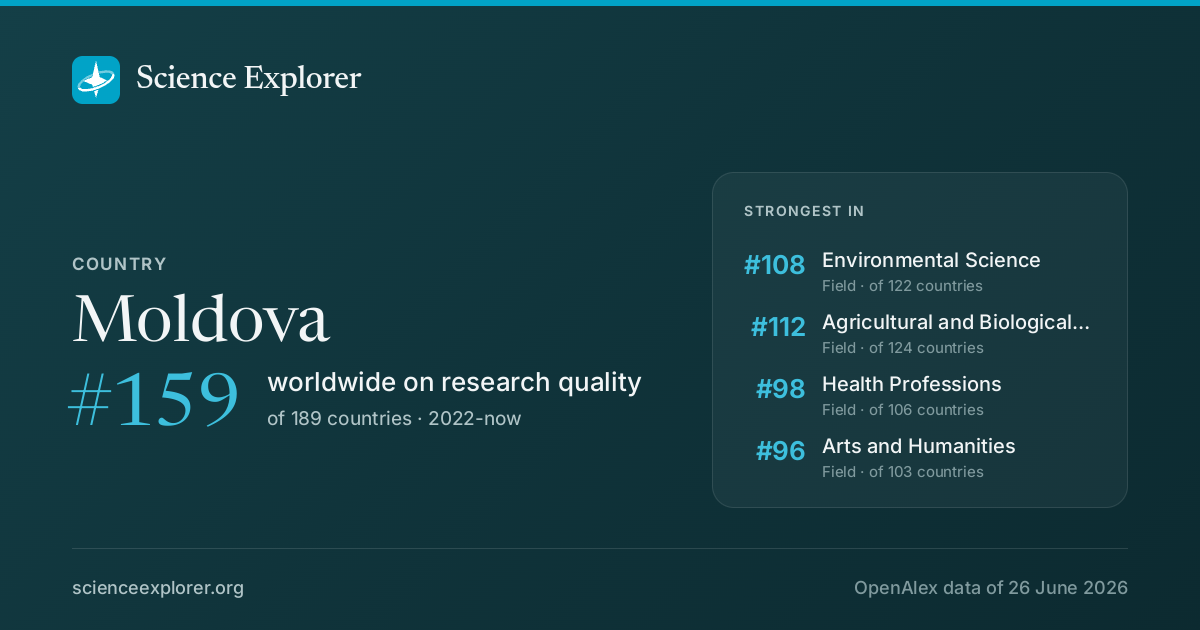
Moldova ranks #159 of 189 countries on research quality in 2022-now (#170 all time), with 7.3k research works and 2.6% of them in the world's top 10%.
- World rank, 2022-now
- #159 of 189 · #170 all time
- Works, 2022-now
- 7.3k ▲ 29% vs 2018-21
- Citations
- 96k 4.2 per fractional work, all time
- Top-10% rate
- 2.6% all institutions 10.0%
- vs its own fields
- 0.33× 1.00× is exactly expected
- In the world top 100
- 0 0 in the top 1,000
- Open access
- 79% world 40%
- International
- 24% world 18%
MoldovaWhat is Moldova strongest at in science?
On research quality in 2022-now, Moldova ranks highest in Environmental Science (#108 of 122), Agricultural and Biological Sciences (#112 of 124) and Health Professions (#98 of 106). Relative to its size it is most specialised in General Energy, Anatomy and Physical Therapy, Sports Therapy and Rehabilitation.
| Field | World rank | Where that sits | Top-10% rate | Works | All time | Institutions |
|---|---|---|---|---|---|---|
| Environmental ScienceField | #108 of 122 | 3.0% | 345 | #127 | Institutions | |
| Agricultural and Biological SciencesField | #112 of 124 | 3.3% | 423 | #140 | Institutions | |
| Health ProfessionsField | #98 of 106 | 2.7% | 257 | #121 | Institutions | |
| Arts and HumanitiesField | #96 of 103 | 3.5% | 343 | #119 | Institutions | |
| MedicineField | #142 of 152 | 2.2% | 1,154 | #149 | Institutions | |
| Political Science and International RelationsSubfield | #90 of 95 | 2.7% | 512 | #106 | Institutions | |
| Social SciencesField | #142 of 148 | 3.2% | 1,556 | #161 | Institutions | |
| Computer ScienceField | #123 of 128 | 2.8% | 478 | #128 | Institutions | |
| EngineeringField | #126 of 131 | 2.2% | 578 | #123 | Institutions | |
| Business, Management and AccountingField | #106 of 110 | 1.6% | 350 | #119 | Institutions | |
| EducationSubfield | #108 of 112 | 4.9% | 334 | #116 | Institutions | |
| Materials ScienceField | #84 of 87 | 1.8% | 204 | #87 |
Where its research is concentrated
Location quotient: how much more (or less) of each node it does than its size predicts. Drawn around 1×, where "twice the world share" and "half of it" are the same distance apart in opposite directions. A volume reading, which on a country axis is largely population and industrial structure.
- General EnergySubfield · 24.6 works · #55 of 167 active here11×
- AnatomySubfield · 21.3 works · #37 of 159 active here10×
- Physical Therapy, Sports Therapy and RehabilitationSubfield · 127.5 works · #47 of 193 active here8.2×
- Tourism, Leisure and Hospitality ManagementSubfield · 9.5 works · #68 of 165 active here4.9×
- General Economics, Econometrics and FinanceSubfield · 103.2 works · #72 of 211 active here4.8×
- Political Science and International RelationsSubfield · 572.7 works · #71 of 219 active here4.5×
- Nuclear Energy and EngineeringSubfield · 2.6 works · #50 of 121 active here4.5×
- MusicSubfield · 30.9 works · #62 of 174 active here4.4×
The whole field profile
All 26 fields at once. A specialist and a generalist produce the same ranked list and a completely different shape.
Rings at 0.5×, 1× and 2×. Widest outward: Economics, Econometrics and Finance, 2.5×. Every wedge is a field page.
All 26 fields, with their numbers
- Economics, Econometrics and Finance2.49×456 works
- Arts and Humanities1.72×425 works
- Social Sciences1.72×1,861 works
- Business, Management and Accounting1.58×436 works
- Psychology1.44×376 works
- Health Professions1.31×296 works
- Agricultural and Biological Sciences1.21×492 works
- Decision Sciences1.06×88 works
- Chemistry1.04×140 works
- Mathematics1.04×105 works
- Dentistry1.03×43 works
- Energy1.01×79 works
- Environmental Science0.97×412 works
- Computer Science0.82×547 works
- Medicine0.79×1,308 works
- Nursing0.77×32 works
- Materials Science0.76×226 works
- Earth and Planetary Sciences0.74×99 works
- Pharmacology, Toxicology and Pharmaceutics0.62×19 works
- Veterinary0.60×7 works
- Physics and Astronomy0.59×113 works
- Chemical Engineering0.53×16 works
- Immunology and Microbiology0.52×45 works
- Engineering0.52×662 works
- Biochemistry, Genetics and Molecular Biology0.48×219 works
- Neuroscience0.47×65 works
Which fields of science does Moldova work in?
In 2022-now, 43% of research in Moldova is in Social Sciences, 28% in Physical Sciences. Its largest fields are Social Sciences (22%), Medicine (15%), Engineering (8%). It does 1.7× the world's share of Social Sciences.
Each ring splits the one inside it: the four domains of science, their fields, their subfields. Size is fractional works in 2022-now. Every slice is a page; the interactive view zooms down to single topics and colours each by how much more of it this country does than the world.
Its 4 domains and 26 fields, with their numbers
- Social Sciences3,64142.5%
- Social Sciences1,86121.7%
- Economics, Econometrics and Finance4565.3%
- Business, Management and Accounting4365.1%
- Arts and Humanities4255.0%
- Psychology3764.4%
- Decision Sciences881.0%
- Physical Sciences2,40128.0%
- Engineering6627.7%
- Computer Science5476.4%
- Environmental Science4134.8%
- Materials Science2262.6%
- Chemistry1401.6%
- Physics and Astronomy1131.3%
- Mathematics1051.2%
- Earth and Planetary Sciences991.2%
- Energy790.9%
- Chemical Engineering160.2%
- Health Sciences1,68519.7%
- Medicine1,30815.3%
- Health Professions2963.5%
- Dentistry430.5%
- Nursing320.4%
- Veterinary70.1%
- Life Sciences8399.8%
Which keywords describe research in Moldova?
By fractional works in 2022-now, weighted toward what it does more of than the world: Sustainable Development, Human Rights, Globalization, Innovation, Education, Pedagogy, Climate Change and Economic Development.
- European Legal Systems
- Constitutionalism
- Fitness Technology
- Motor Skills Development
- Financial Security
- Physical Education
- Judicial Review
- Global Governance
- Health Promotion
- Regional Development
- Environmental Management
- Higher Education
- E-Learning
- Mental Health
- Renewable Energy
- Educational Technology
- Sustainability
- Innovation
- Human Rights
- Globalization
- Sustainable Development
- Education
- Climate Change
- Epidemiology
- Artificial Intelligence
- Economic Development
- Pedagogy
- Digital Transformation
- Teacher Training
- Leadership
- International Law
- Digital Economy
- European Union
- Legal Regulation
- Athletic Training
- Digitalization
- Economic Security
- Biomechanical Analysis
- Sports Science
- ECHR
Size is fractional works in 2022-now in the topics tagged with each word; colour is the word's share of this country's work against its share of the world's. The 40 words are chosen for being large and distinctive. Each links to the topic it comes from most.
All 40 words, with their numbers
- Sustainable Development524▲ 3.9×87 topics
- Globalization458▲ 2.7×111 topics
- Education415▲ 2.8×116 topics
- Human Rights413▲ 4.7×69 topics
- Climate Change381▲ 1.64×10⁸ topics
- Innovation361▲ 4.1×71 topics
- Epidemiology318◆ 0.93×126 topics
- Sustainability308▲ 1.47×100 topics
- Artificial Intelligence277▲ 2.3×55 topics
- Educational Technology249▲ 2.5×44 topics
- Economic Development237▲ 3.5×34 topics
- Renewable Energy220▲ 1.78×55 topics
- Pedagogy210▲ 4.9×26 topics
- Mental Health205▲ 1.68×40 topics
- Digital Transformation185▲ 4.0×28 topics
- E-Learning185▲ 2.2×24 topics
- Teacher Training171▲ 3.3×27 topics
- Higher Education159▲ 3.5×26 topics
- Leadership154▲ 3.7×31 topics
- Environmental Management153▲ 4.4×19 topics
- International Law139▲ 5.2×29 topics
- Regional Development135▲ 4.6×16 topics
- Digital Economy130▲ 7.6×19 topics
- Health Promotion126▲ 4.7×12 topics
- European Union125▲ 6.5×23 topics
- Global Governance119▲ 5.8×21 topics
- Legal Regulation116▲ 6.0×8 topics
- Judicial Review112▲ 15×6 topics
- Athletic Training110▲ 14×3 topics
- Physical Education109▲ 10×7 topics
- Digitalization108▲ 6.1×9 topics
- Financial Security105▲ 12×3 topics
- Economic Security102▲ 5.6×7 topics
- Motor Skills Development94▲ 12×2 topics
- Biomechanical Analysis93▲ 17×2 topics
- Fitness Technology92▲ 46×1 topic
- Sports Science92▲ 46×1 topic
- Constitutionalism91▲ 12×4 topics
- ECHR87▲ 29×1 topic
- European Legal Systems87▲ 29×1 topic
Which research topics does Moldova publish the most in?
Its largest topics in 2022-now are Physical Education and Training Studies, European and International Law Studies, European Criminal Justice and Data Protection.
Area is fractional works in 2022-now; colour is the subfield each topic belongs to. Every tile is a topic page.
- 1 Physical Education and Training Studies Physical Therapy, Sports Therapy and Rehabilitation 92 works
- 2 European and International Law Studies Political Science and International Relations 87 works
- 3 European Criminal Justice and Data Protection Political Science and International Relations 64 works
- 4 Educational Innovations and Challenges Information Systems 60 works
- 5 Economic and Business Development Strategies Economics and Econometrics 57 works
- 6 Business and Economic Development Management, Monitoring, Policy and Law 51 works
- 7 Appreciative Inquiry and Organizational Change Organizational Behavior and Human Resource Management 50 works
- 8 Economic Issues in Ukraine General Economics, Econometrics and Finance 47 works
- 9 Educational Methods and Teacher Development Information Systems 45 works
- 10 Marine and environmental studies Oceanography 44 works
- 11 Education, Innovation and Language Studies Education 41 works
- 12 Global Socioeconomic and Political Dynamics Economics and Econometrics 38 works
Which universities in Moldova lead research?
Moldova State University, Technical University of Moldova and Institute of Mathematics and Computer Science rank highest in Moldova on research quality in 2022-now.
One dot per institution in the list below. The upper left is the interesting corner.
- 1Moldova State UniversityUniversity · Chisinau · #6,508 worldwide1.6% top 10% · 1.5k works
- 2Technical University of MoldovaUniversity · Chisinau · #6,866 worldwide3.1% top 10% · 928 works
- 3Institute of Mathematics and Computer ScienceResearch facility · Chisinau · #6,931 worldwide5.5% top 10% · 320 works
- 4State University of Physical Education and SportUniversity · Chisinau · #8,361 worldwide3.4% top 10% · 386 works
- 5Institute of Educational SciencesUniversity · Chisinau · #9,883 worldwide8.2% top 10% · 216 works
- 6Academy of Economic Studies of MoldovaUniversity · Chisinau · #10,729 worldwide1.8% top 10% · 672 works
- 7Ion Creangă Pedagogical State UniversityUniversity · Chisinau · #11,417 worldwide1.3% top 10% · 467 works
- 8Free International University of MoldovaUniversity · Chisinau · #13,194 worldwide1.4% top 10% · 221 works
- 9Ştefan cel Mare Police AcademyGovernment institution · Chisinau · #14,716 worldwide0.7% top 10% · 189 works
- 10Institute of Ecology and GeographyResearch facility · Chisinau · #15,174 worldwide8.0% top 10% · 129 works
- 11Nicolae Testemițanu State University of Medicine and PharmacyUniversity · Chisinau · #16,045 worldwide1.9% top 10% · 1k works
- 12Academy of Sciences of MoldovaGovernment institution · Chisinau · #18,028 worldwide3.0% top 10% · 180 works
- 13Institute of Applied PhysicsResearch facility · Chisinau · #18,662 worldwide3.8% top 10% · 139 works
- 14Alecu Russo State University of BălțiUniversity · Bălţi · #19,071 worldwide2.2% top 10% · 95 works
- 15Shevchenko Transnistria State UniversityUniversity · Tiraspol · #19,380 worldwide1.7% top 10% · 108 works
The track on each row is its top-10% rate; the tick is the average of all institutions, 10.0% (how it is set): teal above it, red below.
All ranked institutions in MoldovaWho are the top researchers in Moldova?
Valeriu Crudu, Denis L. Nika and Dumitru Chesov rank highest among researchers based in Moldova.
- 1 Valeriu Crudu #140,526 worldwide 4.5k citations · 157 works
- 2 Denis L. Nika #196,481 worldwide 9.6k citations · 101 works
- 3 Dumitru Chesov #439,970 worldwide 1.8k citations · 83 works
- 4 Oleg I. Lupan #601,694 worldwide 14k citations · 252 works
- 5 Eleonora Vataman #611,941 worldwide 11k citations · 37 works
- 6 Nelly Ciobanu #705,783 worldwide 443 citations · 80 works
- 7 Alexandru Codreanu #848,189 worldwide 199 citations · 33 works
- 8 Vasile Postica #907,294 worldwide 3.9k citations · 80 works
- 9 Sofia Alexandru #918,401 worldwide 1.2k citations · 51 works
- 10 Aurel Grosu #1,096,724 worldwide 18k citations · 33 works
Which cities in Moldova are research hubs?
How open and international is Moldova's research?
79% of its research is openly available (world: 40%), and 24% is written with international co-authors (world: 18%).
World: 40% of research is openly available.
World: 18% is written across borders.
In 2022-now, 90% of its research is openly available (world 63%) and 20% is written with co-authors abroad (world 22%). Against what its own mix of topics predicts, that is 1.31× the expected open access and 1.05× the expected international share, which puts it #27 of 173 countries on openness.
How has Moldova's research grown?
Output in 2022-2025 was 29% higher than in 2018-2021.
The same series as a ribbon: one cell per year, darker for more. The line above answers how much; this answers when.
Its share of all research
Growing output can still be a shrinking share: all of science grows. This is Moldova as a percentage of every work published that year, 0.023% in 2024.
Fractional works of Moldova over all fractional works that year. How the balance of science has shifted.
How much of it reaches the world top 10%
Over the whole record, 3.0% of its 23k works since 1951 reached the world top 10% for their field and year.
Of each year's output, the share that reached the world's 10% most cited for its field and year. Peak 6.9% in 2004.
Which countries have research most like Moldova's?
Uzbekistan is Moldova's closest research twin: of all countries, its research is spread across the fields most like Moldova's, with both strong in Economics, Econometrics and Finance.
- 1
 UzbekistanBoth strong in Economics, Econometrics and Finance, Arts and Humanities, Social Sciences
0.79 Compare
- 2
 KosovoBoth strong in Economics, Econometrics and Finance, Social Sciences, Arts and Humanities
0.79 Compare
- 3
 AlbaniaBoth strong in Economics, Econometrics and Finance, Arts and Humanities, Social Sciences
0.79 Compare
- 4
 North MacedoniaBoth strong in Economics, Econometrics and Finance, Arts and Humanities, Business, Management and Accounting
0.77 Compare
- 5
 IndonesiaBoth strong in Social Sciences, Business, Management and Accounting, Health Professions
0.76 Compare
Similarity is the correlation of each side's location quotients across every field it publishes in, on a log scale: 1 is the same shape of research, 0 is unrelated. It ignores size. How it is measured.
Compare Moldova with
 Eswatini
 Cayman Islands
 Azerbaijan
 Haiti
 Togo
 Timor-Leste
Share Moldova's ranking
Badges for a website1Each links back here and updates with every snapshot

Research fields in Moldova
- Physical Sciences
- Environmental Science
- Agricultural and Biological Sciences
- Life Sciences
- Health Professions
- Health Sciences
- Arts and Humanities
- Medicine
- Political Science and International Relations
- Social Sciences
- Computer Science
- Engineering
- Social Sciences
- Business, Management and Accounting
- Education
- Economics and Econometrics
- Psychology
- Economics, Econometrics and Finance
- Sociology and Political Science
Discussion
Ask a question or share a note about Moldova. Posts are plain text and can be reported.