 Science in Indonesia
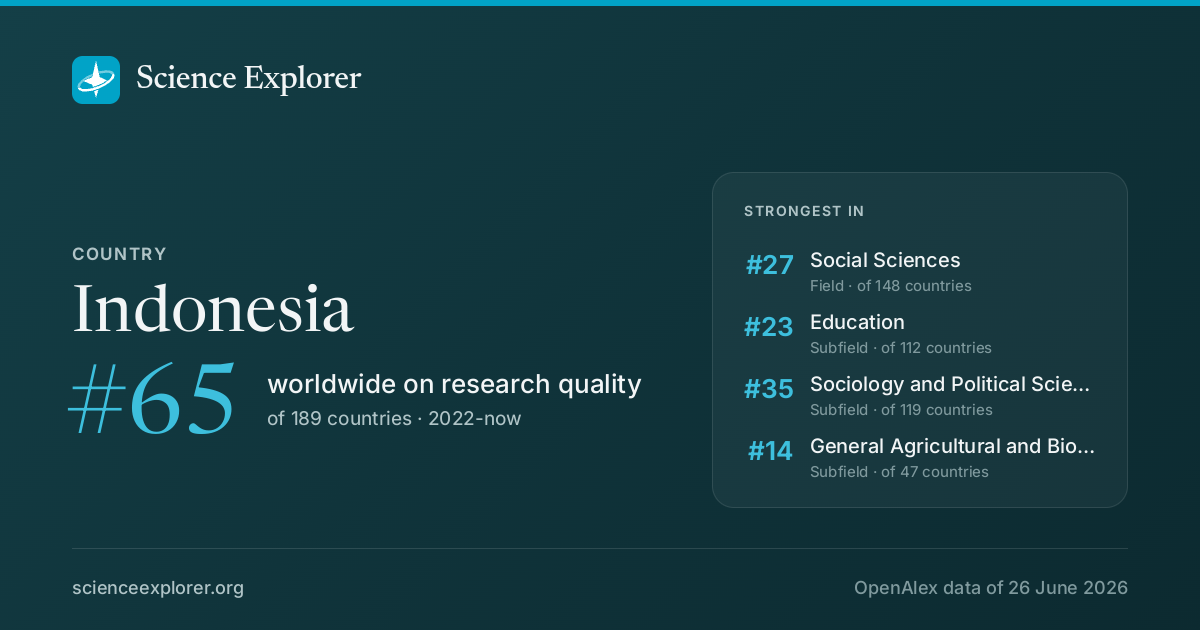
Indonesia ranks #65 of 189 countries on research quality in 2022-now (#66 all time), with 1.6M research works and 7.4% of them in the world's top 10%.
- World rank, 2022-now
- #65 of 189 · #66 all time
- Works, 2022-now
- 1.6M ▲ 65% vs 2018-21
- Citations
- 8.1M 2.6 per fractional work, all time
- Top-10% rate
- 7.4% all institutions 10.0%
- vs its own fields
- 0.48× 1.00× is exactly expected
- In the world top 100
- 0 14 in the top 1,000
- Open access
- 86% world 40%
- International
- 4% world 18%
IndonesiaWhat is Indonesia strongest at in science?
On research quality in 2022-now, Indonesia ranks highest in Social Sciences (#27 of 148), Education (#23 of 112) and Sociology and Political Science (#35 of 119). Relative to its size it is most specialised in Human Factors and Ergonomics, General Agricultural and Biological Sciences and Demography.
| Field | World rank | Where that sits | Top-10% rate | Works | All time | Institutions |
|---|---|---|---|---|---|---|
| Social SciencesField | #27 of 148 | 8.8% | 612,817 | #33 | Institutions | |
| EducationSubfield | #23 of 112 | 8.9% | 265,503 | #23 | Institutions | |
| Sociology and Political ScienceSubfield | #35 of 119 | 8.2% | 115,550 | #38 | Institutions | |
| General Agricultural and Biological SciencesSubfield | #14 of 47 | 9.1% | 43,977 | #14 | Institutions | |
| Business, Management and AccountingField | #33 of 110 | 7.6% | 182,434 | #33 | Institutions | |
| Information SystemsSubfield | #28 of 90 | 8.8% | 122,949 | #28 | Institutions | |
| DemographySubfield | #22 of 55 | 9.2% | 69,255 | #18 | Institutions | |
| Political Science and International RelationsSubfield | #41 of 95 | 9.0% | 36,559 | #41 | Institutions | |
| Strategy and ManagementSubfield | #34 of 77 | 8.1% | 50,526 | #36 | Institutions | |
| Agricultural and Biological SciencesField | #59 of 124 | 6.7% | 125,224 | #61 | Institutions | |
| Health ProfessionsField | #51 of 106 | 7.9% | 68,008 | #54 | Institutions | |
| Pediatrics, Perinatology and Child HealthSubfield | #32 of 65 | 9.3% | 41,587 | #28 | Institutions |
Where its research is concentrated
Location quotient: how much more (or less) of each node it does than its size predicts. Drawn around 1×, where "twice the world share" and "half of it" are the same distance apart in opposite directions. A volume reading, which on a country axis is largely population and industrial structure.
- Human Factors and ErgonomicsSubfield · 19,432.7 works · #1 of 181 active here10×
- General Agricultural and Biological SciencesSubfield · 47,468.4 works · #1 of 206 active here6.2×
- DemographySubfield · 71,658.5 works · #1 of 221 active here6.1×
- EducationSubfield · 289,523.1 works · #1 of 222 active here5.5×
- LawSubfield · 54,865.9 works · #1 of 212 active here5.4×
- AccountingSubfield · 52,324.6 works · #1 of 208 active here5.0×
- Health Information ManagementSubfield · 20,452.6 works · #1 of 202 active here4.6×
- Occupational TherapySubfield · 12,539.8 works · #1 of 198 active here4.3×
The whole field profile
All 26 fields at once. A specialist and a generalist produce the same ranked list and a completely different shape.
Rings at 0.5×, 1× and 2×. Widest outward: Business, Management and Accounting, 3.6×. Every wedge is a field page.
All 26 fields, with their numbers
- Business, Management and Accounting3.59×201k works
- Social Sciences3.06×670k works
- Health Professions1.69×77k works
- Agricultural and Biological Sciences1.64×135k works
- Computer Science1.39×187k works
- Economics, Econometrics and Finance1.14×42k works
- Mathematics0.87×18k works
- Arts and Humanities0.82×41k works
- Decision Sciences0.79×13k works
- Nursing0.76×6,418 works
- Environmental Science0.72×62k works
- Psychology0.70×37k works
- Pharmacology, Toxicology and Pharmaceutics0.54×3,266 works
- Dentistry0.36×3,047 works
- Engineering0.31×81k works
- Medicine0.31×104k works
- Earth and Planetary Sciences0.30×8,074 works
- Energy0.24×3,839 works
- Chemistry0.19×5,035 works
- Immunology and Microbiology0.17×2,939 works
- Materials Science0.17×10k works
- Biochemistry, Genetics and Molecular Biology0.16×15k works
- Veterinary0.15×361 works
- Chemical Engineering0.13×788 works
- Neuroscience0.10×2,938 works
- Physics and Astronomy0.05×1,864 works
Which fields of science does Indonesia work in?
In 2022-now, 58% of research in Indonesia is in Social Sciences, 22% in Physical Sciences. Its largest fields are Social Sciences (39%), Business, Management and Accounting (12%), Computer Science (11%). It does 2.3× the world's share of Social Sciences.
Each ring splits the one inside it: the four domains of science, their fields, their subfields. Size is fractional works in 2022-now. Every slice is a page; the interactive view zooms down to single topics and colours each by how much more of it this country does than the world.
Its 4 domains and 26 fields, with their numbers
- Social Sciences1.0M58.0%
- Social Sciences670k38.7%
- Business, Management and Accounting201k11.6%
- Economics, Econometrics and Finance42k2.4%
- Arts and Humanities41k2.4%
- Psychology37k2.1%
- Decision Sciences13k0.8%
- Physical Sciences378k21.8%
- Computer Science187k10.8%
- Engineering81k4.7%
- Environmental Science62k3.6%
- Mathematics18k1.0%
- Materials Science10k0.6%
- Earth and Planetary Sciences8,0750.5%
- Chemistry5,0350.3%
- Energy3,8390.2%
- Physics and Astronomy1,8640.1%
- Chemical Engineering7880.0%
- Health Sciences191k11.0%
- Medicine104k6.0%
- Health Professions77k4.4%
- Nursing6,4180.4%
- Dentistry3,0470.2%
- Veterinary3610.0%
- Life Sciences159k9.2%
- Agricultural and Biological Sciences135k7.8%
- Biochemistry, Genetics and Molecular Biology15k0.8%
- Pharmacology, Toxicology and Pharmaceutics3,2660.2%
- Immunology and Microbiology2,9390.2%
- Neuroscience2,9380.2%
Which keywords describe research in Indonesia?
By fractional works in 2022-now, weighted toward what it does more of than the world: Community Empowerment, Character Education, Media Literacy, Local Wisdom, E-Learning, Indonesia, Curriculum Development and Social Media.
- Breastfeeding
- Community Participation
- School Literacy Movement
- Information Literacy
- Learning Outcomes
- Health Education
- UMKM
- STEM Education
- SMEs
- Islamic Banking
- Corporate Governance
- Pandemic
- COVID-19
- Digital Learning
- Education
- E-commerce
- Indonesia
- Media Literacy
- Character Education
- Social Media
- Community Empowerment
- E-Learning
- Educational Technology
- Local Wisdom
- Curriculum Development
- Digital Literacy
- Financial Performance
- Sustainable Development
- Qualitative Research
- Online Learning
- Economic Impact
- Supply Chain Management
- Islamic Education
- Digital Marketing
- Mobile Learning
- Information Technology
- Pandemic Response
- Reading Interest
- Customer Satisfaction
- Public Health Policy
Size is fractional works in 2022-now in the topics tagged with each word; colour is the word's share of this country's work against its share of the world's. The 40 words are chosen for being large and distinctive. Each links to the topic it comes from most.
All 40 words, with their numbers
- Community Empowerment148k▲ 12×16 topics
- Social Media117k▲ 4.9×41 topics
- E-Learning112k▲ 6.7×27 topics
- Character Education108k▲ 13×6 topics
- Educational Technology107k▲ 5.2×48 topics
- Media Literacy106k▲ 12×6 topics
- Local Wisdom105k▲ 13×9 topics
- Indonesia97k▲ 13×5 topics
- Curriculum Development95k▲ 8.1×20 topics
- E-commerce94k▲ 9.6×11 topics
- Digital Literacy90k▲ 9.1×13 topics
- Education88k▲ 3.0×161 topics
- Financial Performance86k▲ 8.8×16 topics
- Digital Learning84k▲ 9.6×13 topics
- Sustainable Development84k▲ 3.1×113 topics
- COVID-1983k▲ 3.7×34 topics
- Qualitative Research83k▲ 5.6×45 topics
- Pandemic81k▲ 4.7×14 topics
- Online Learning80k▲ 5.6×27 topics
- Corporate Governance79k▲ 6.2×32 topics
- Economic Impact76k▲ 8.2×13 topics
- Islamic Banking71k▲ 11×3 topics
- Supply Chain Management65k▲ 4.2×27 topics
- SMEs64k▲ 11×5 topics
- Islamic Education64k▲ 11×4 topics
- STEM Education64k▲ 8.1×16 topics
- Digital Marketing63k▲ 9.4×6 topics
- UMKM62k▲ 13×1 topic
- Mobile Learning61k▲ 10×6 topics
- Health Education61k▲ 8.1×11 topics
- Information Technology53k▲ 6.4×32 topics
- Learning Outcomes52k▲ 7.2×9 topics
- Pandemic Response47k▲ 12×3 topics
- Information Literacy46k▲ 10×4 topics
- Reading Interest45k▲ 13×1 topic
- School Literacy Movement45k▲ 13×1 topic
- Customer Satisfaction45k▲ 8.1×10 topics
- Community Participation44k▲ 7.2×19 topics
- Public Health Policy42k▲ 9.3×4 topics
- Breastfeeding42k▲ 11×3 topics
Which research topics does Indonesia publish the most in?
Its largest topics in 2022-now are SMEs Development and Digital Marketing, Educational Methods and Media Use, Education and Character Development.
Area is fractional works in 2022-now; colour is the subfield each topic belongs to. Every tile is a topic page.
- 1 SMEs Development and Digital Marketing Demography 62k works
- 2 Educational Methods and Media Use Information Systems 45k works
- 3 Education and Character Development Education 41k works
- 4 Public Health and Nutrition Pediatrics, Perinatology and Child Health 41k works
- 5 Islamic Finance and Communication Sociology and Political Science 33k works
- 6 Educational Curriculum and Learning Methods Education 32k works
- 7 Management and Optimization Techniques Strategy and Management 31k works
- 8 Educational Methods and Impacts Education 26k works
- 9 Legal Studies and Policies Law 25k works
- 10 STEM Education Education 22k works
- 11 Educational Methods and Outcomes Education 21k works
- 12 Edcuational Technology Systems Artificial Intelligence 21k works
How many world-class institutions does Indonesia hold?
Average quality and elite capacity disagree by construction, and both are worth knowing: the first is decided by a country's whole institution population, the second counts the institutions it holds at the top. One square per institution.
| Standing among countries | 2022-now | Where that sits | All time |
|---|---|---|---|
| Average qualityits whole institution population | #65 of 189 | #66 of 203 | |
| Elite capacitythe institutions it holds at the top | #19 of 204 | #42 of 216 |
Elite capacity counts a country's institutions by their worldwide rank, weighted so a place at #1 counts for more than one at #480. Countries under 100 fractional works are left out.
Bands are exclusive, so the squares add up to 14 (the institutions it holds in the world top 1,000), not to four times it.
Which universities in Indonesia lead research?
Institut Agama Islam Negeri Bengkulu, Universitas Islam Negeri Sumatera Utara and Institut Sains dan Teknologi Terpadu Surabaya rank highest in Indonesia on research quality in 2022-now.
One dot per institution in the list below. The upper left is the interesting corner.
- 1Institut Agama Islam Negeri BengkuluUniversity · Bengkulu · #368 worldwide8.9% top 10% · 29k works
- 2Universitas Islam Negeri Sumatera UtaraUniversity · Medan · #630 worldwide8.2% top 10% · 21k works
- 3Institut Sains dan Teknologi Terpadu SurabayaUniversity · Surabaya · #670 worldwide7.0% top 10% · 5.7k works
- 4Universitas Patria ArthaUniversity · Makassar · #706 worldwide7.2% top 10% · 16k works
- 5Indonesia University of EducationUniversity · Bandung · #714 worldwide10.9% top 10% · 21k works
- 6State University of PadangUniversity · Padang · #717 worldwide8.1% top 10% · 22k works
- 7Universitas Pendidikan GaneshaUniversity · Singaraja · #735 worldwide12.1% top 10% · 8.3k works
- 8Sunan Kalijaga State Islamic University YogyakartaUniversity · Yogyakarta · #814 worldwide9.8% top 10% · 10k works
- 9Universitas Islam Negeri Raden Intan LampungUniversity · Bandar Lampung · #816 worldwide10.2% top 10% · 7.6k works
- 10Universitas PGRI SemarangUniversity · Semarang · #848 worldwide7.7% top 10% · 9.6k works
- 11Universitas Sains Al-Qur'anUniversity · Wonosobo · #854 worldwide6.2% top 10% · 2.7k works
- 12Universitas Muhammadiyah Tapanuli SelatanUniversity · Padangsidempuan · #864 worldwide8.2% top 10% · 9k works
- 13UIN Sunan Ampel SurabayaUniversity · Surabaya · #894 worldwide9.2% top 10% · 6.6k works
- 14Universitas Nusa BangsaUniversity · Bogor · #931 worldwide8.6% top 10% · 9.2k works
- 15State University of MakassarUniversity · Makassar · #1,002 worldwide6.3% top 10% · 17k works
The track on each row is its top-10% rate; the tick is the average of all institutions, 10.0% (how it is set): teal above it, red below.
All ranked institutions in IndonesiaWho are the top researchers in Indonesia?
Dian Palupi Kusuma, Sven Wunder and Opan Arifudin rank highest among researchers based in Indonesia.
- 1 Dian Palupi Kusuma #10,218 worldwide 82k citations · 164 works
- 2 Sven Wunder #14,885 worldwide 26k citations · 307 works
- 3 Opan Arifudin #18,342 worldwide 4.1k citations · 70 works
- 4 Dina Nur Anggraini Ningrum #20,874 worldwide 95k citations · 117 works
- 5 David Gaveau #22,682 worldwide 8.7k citations · 115 works
- 6 Abu Muna Almaududi Ausat #27,730 worldwide 2.2k citations · 95 works
- 7 Douglas Sheil #33,406 worldwide 32k citations · 517 works
- 8 Rani Darmayanti #39,513 worldwide 1.6k citations · 148 works
- 9 Rahmad Solling Hamid #41,414 worldwide 1.4k citations · 82 works
- 10 Qorinah Estiningtyas Sakilah Adnani #46,068 worldwide 40k citations · 205 works
Which cities in Indonesia are research hubs?
- 1
JakartaIndonesia
341k works
- 2
BandungIndonesia
245k works
- 3
SurabayaIndonesia
202k works
- 4
YogyakartaIndonesia
182k works
- 5
SemarangIndonesia
167k works
- 6
MedanIndonesia
155k works
- 7
MalangIndonesia
136k works
- 8
MakassarIndonesia
133k works
- 9
PadangIndonesia
86k works
- 10
SurakartaIndonesia
84k works
- 11
DepokIndonesia
84k works
- 12
BengkuluIndonesia
76k works
How much of it is in the largest
The same cities as shares of everything these twelve account for.
Shares of the rows listed above, not of the whole node.
How open and international is Indonesia's research?
86% of its research is openly available (world: 40%), and 4% is written with international co-authors (world: 18%).
World: 40% of research is openly available.
World: 18% is written across borders.
In 2022-now, 95% of its research is openly available (world 63%) and 4% is written with co-authors abroad (world 22%). Against what its own mix of topics predicts, that is 1.07× the expected open access and 0.48× the expected international share, which puts it #144 of 173 countries on openness.
How has Indonesia's research grown?
Output in 2022-2025 was 65% higher than in 2018-2021.
The same series as a ribbon: one cell per year, darker for more. The line above answers how much; this answers when.
Its share of all research
Growing output can still be a shrinking share: all of science grows. This is Indonesia as a percentage of every work published that year, 7.5% in 2024.
Fractional works of Indonesia over all fractional works that year. How the balance of science has shifted.
How much of it reaches the world top 10%
Over the whole record, 7.5% of its 3.1M works since 1950 reached the world top 10% for their field and year.
Of each year's output, the share that reached the world's 10% most cited for its field and year. Peak 8.0% in 2022.
Which countries have research most like Indonesia's?
Philippines is Indonesia's closest research twin: of all countries, its research is spread across the fields most like Indonesia's, with both strong in Social Sciences.
- 1
 PhilippinesBoth strong in Social Sciences, Business, Management and Accounting, Agricultural and Biological Sciences
0.87 Compare
- 2
 Timor-LesteBoth strong in Business, Management and Accounting, Social Sciences, Health Professions
0.80 Compare
- 3
 GhanaBoth strong in Business, Management and Accounting, Agricultural and Biological Sciences, Health Professions
0.79 Compare
- 4
 KenyaBoth strong in Business, Management and Accounting, Agricultural and Biological Sciences, Social Sciences
0.78 Compare
- 5
 AlbaniaBoth strong in Business, Management and Accounting, Social Sciences, Health Professions
0.78 Compare
Similarity is the correlation of each side's location quotients across every field it publishes in, on a log scale: 1 is the same shape of research, 0 is unrelated. It ignores size. How it is measured.
Compare Indonesia with
 Tanzania
 Vietnam
 Montenegro
 Panama
 Puerto Rico
Share Indonesia's ranking



Research fields in Indonesia
- Social Sciences
- Education
- Social Sciences
- Sociology and Political Science
- General Agricultural and Biological Sciences
- Business, Management and Accounting
- Information Systems
- Physical Sciences
- Demography
- Political Science and International Relations
- Strategy and Management
- Agricultural and Biological Sciences
- Health Professions
- Pediatrics, Perinatology and Child Health
- Computer Science
- Cultural Studies
- Arts and Humanities
- Accounting
- Organizational Behavior and Human Resource Management
- Law
- Economics and Econometrics
- Applied Mathematics
- Economics, Econometrics and Finance
- Marketing
- Soil Science
- Management, Monitoring, Policy and Law
- Management Information Systems
- Language and Linguistics
- Environmental Science
- Artificial Intelligence
- General Health Professions
- Health Information Management
- Physical Therapy, Sports Therapy and Rehabilitation
- Engineering
- Management of Technology and Innovation
- Ecology
- Developmental and Educational Psychology
- Food Science
- Human Factors and Ergonomics
- Industrial and Manufacturing Engineering
- Civil and Structural Engineering
- Conservation
- Geography, Planning and Development
- Health Sciences
- Life Sciences
- Occupational Therapy
- Earth and Planetary Sciences
- Agronomy and Crop Science
- Literature and Literary Theory
- Plant Science
- Physics and Astronomy
- Mathematics
- Materials Science
- Decision Sciences
- Communication
- Chemistry
- Medicine
- Gender Studies
- Organic Chemistry
- Computer Science Applications
Questions people ask
Who are the top scientists in Indonesia?
Dian Palupi Kusuma, Sven Wunder and Opan Arifudin rank highest among researchers based in Indonesia.
Also asked as
- Ilmuwan terbaik di Indonesia?
What is Indonesia strongest at in science?
On research quality in 2022-now, Indonesia ranks highest in Social Sciences (#27 of 148), Education (#23 of 112) and Sociology and Political Science (#35 of 119). Relative to its size it is most specialised in Human Factors and Ergonomics, General Agricultural and Biological Sciences and Demography.
See the full answerHow fast is research in Indonesia growing?
Output in 2022-2025 was 65% higher than in 2018-2021.
How has Indonesia's research grown?Discussion
Ask a question or share a note about Indonesia. Keep it to the research: no personal attacks, advertising or links. Any reader can report a post, which collapses it for everyone until it is opened.