 Science in Timor-Leste
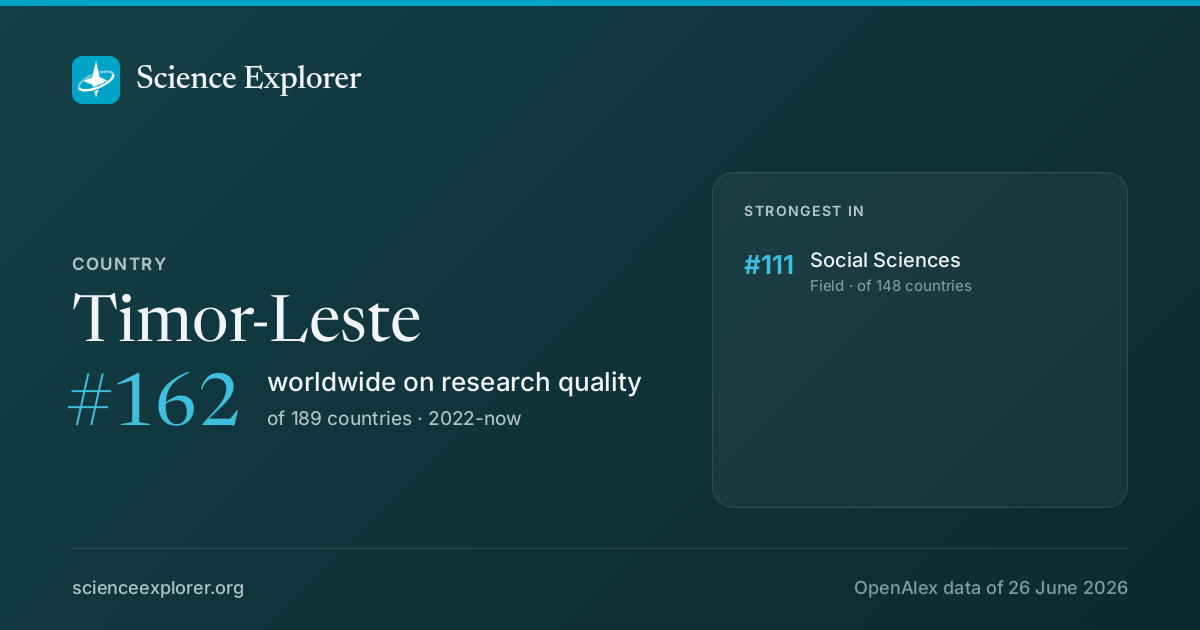
Timor-Leste ranks #162 of 189 countries on research quality in 2022-now (#182 all time), with 673 research works and 5.1% of them in the world's top 10%.
- World rank, 2022-now
- #162 of 189 · #182 all time
- Works, 2022-now
- 673 ▲ 194% vs 2018-21
- Citations
- 3k 2.7 per fractional work, all time
- Top-10% rate
- 5.1% all institutions 10.0%
- vs its own fields
- 0.66× 1.00× is exactly expected
- In the world top 100
- 0 0 in the top 1,000
- Open access
- 83% world 40%
- International
- 46% world 18%
Timor-LesteWhat is Timor-Leste strongest at in science?
On research quality in 2022-now, Timor-Leste ranks highest in Social Sciences (#111 of 148). Relative to its size it is most specialised in Linguistics and Language, Law and Human Factors and Ergonomics.
| Field | World rank | Where that sits | Top-10% rate | Works | All time | Institutions |
|---|---|---|---|---|---|---|
| Social SciencesField | #111 of 148 | 6.6% | 258 | #125 | Institutions |
Where its research is concentrated
Location quotient: how much more (or less) of each node it does than its size predicts. Drawn around 1×, where "twice the world share" and "half of it" are the same distance apart in opposite directions. A volume reading, which on a country axis is largely population and industrial structure.
- Linguistics and LanguageSubfield · 8.1 works · #127 of 194 active here9.2×
- LawSubfield · 32.7 works · #107 of 212 active here7.3×
- Human Factors and ErgonomicsSubfield · 6.2 works · #93 of 181 active here7.2×
- DevelopmentSubfield · 5.5 works · #129 of 190 active here7.1×
- Pediatrics, Perinatology and Child HealthSubfield · 30.4 works · #135 of 220 active here5.3×
- General Arts and HumanitiesSubfield · 0.8 works · #93 of 138 active here4.8×
- DemographySubfield · 24.1 works · #125 of 221 active here4.6×
- AccountingSubfield · 19.9 works · #133 of 208 active here4.2×
The whole field profile
All 26 fields at once. A specialist and a generalist produce the same ranked list and a completely different shape.
Rings at 0.5×, 1× and 2×. Widest outward: Nursing, 3.5×. Every wedge is a field page.
All 26 fields, with their numbers
- Nursing3.48×13 works
- Business, Management and Accounting3.10×77 works
- Social Sciences3.05×298 works
- Health Professions2.02×41 works
- Agricultural and Biological Sciences1.56×57 works
- Veterinary1.49×2 works
- Economics, Econometrics and Finance1.35×22 works
- Arts and Humanities1.29×29 works
- Decision Sciences1.07×8 works
- Psychology0.92×22 works
- Environmental Science0.64×25 works
- Immunology and Microbiology0.58×4 works
- Computer Science0.56×34 works
- Mathematics0.55×5 works
- Medicine0.53×79 works
- Earth and Planetary Sciences0.51×6 works
- Dentistry0.36×1 works
- Chemistry0.30×4 works
- Chemical Engineering0.26×1 works
- Engineering0.25×28 works
- Pharmacology, Toxicology and Pharmaceutics0.24×1 works
- Biochemistry, Genetics and Molecular Biology0.21×9 works
- Energy0.20×1 works
- Materials Science0.11×3 works
- Neuroscience0.08×1 works
- Physics and Astronomy0.08×1 works
Which fields of science does Timor-Leste work in?
In 2022-now, 59% of research in Timor-Leste is in Social Sciences, 18% in Health Sciences. Its largest fields are Social Sciences (39%), Medicine (10%), Business, Management and Accounting (10%). It does 2.4× the world's share of Social Sciences.
Each ring splits the one inside it: the four domains of science, their fields, their subfields. Size is fractional works in 2022-now. Every slice is a page; the interactive view zooms down to single topics and colours each by how much more of it this country does than the world.
Its 4 domains and 26 fields, with their numbers
- Social Sciences45659.0%
- Social Sciences29838.6%
- Business, Management and Accounting7710.0%
- Arts and Humanities293.7%
- Economics, Econometrics and Finance222.9%
- Psychology222.8%
- Decision Sciences81.0%
- Health Sciences13617.7%
- Medicine7910.3%
- Health Professions415.3%
- Nursing131.7%
- Veterinary20.2%
- Dentistry10.2%
- Physical Sciences10814.0%
- Computer Science344.3%
- Engineering283.7%
- Environmental Science253.2%
- Earth and Planetary Sciences60.8%
- Mathematics50.7%
- Chemistry40.5%
- Materials Science30.4%
- Energy10.2%
- Physics and Astronomy10.2%
- Chemical Engineering10.1%
- Life Sciences729.3%
Which keywords describe research in Timor-Leste?
By fractional works in 2022-now, weighted toward what it does more of than the world: Community Empowerment, Health Education, Neoliberalism, Globalization, Non-Communicable Diseases, Maternal Health, Social Justice and Environmental Law.
- Legal Pluralism
- Corruption
- Restorative Justice
- Governance
- Islamic Banking
- Child Development
- Colonialism
- Resilience Governance
- Criminal Justice
- Indonesia
- Child Nutrition
- Public Health Policy
- Social Media
- COVID-19
- Maternal Health
- Social Justice
- Education
- Human Rights
- Health Education
- Community Empowerment
- Globalization
- Sustainability
- Sustainable Development
- Neoliberalism
- Corporate Governance
- Non-Communicable Diseases
- Environmental Law
- Educational Technology
- Breastfeeding
- Peacebuilding
- Stunting
- Economic Development
- Local Turn
- Community Participation
- Economic Impact
- International Law
- Healthcare Access
- Patient Satisfaction
- Patient Experience
- Organizational Behavior
Size is fractional works in 2022-now in the topics tagged with each word; colour is the word's share of this country's work against its share of the world's. The 40 words are chosen for being large and distinctive. Each links to the topic it comes from most.
All 40 words, with their numbers
- Globalization46▲ 3.0×53 topics
- Community Empowerment46▲ 8.2×12 topics
- Sustainability38▲ 2.0×54 topics
- Health Education36▲ 11×10 topics
- Sustainable Development32▲ 2.7×34 topics
- Human Rights31▲ 4.0×26 topics
- Neoliberalism30▲ 11×11 topics
- Education29▲ 2.2×49 topics
- Corporate Governance29▲ 5.1×14 topics
- Social Justice28▲ 6.0×22 topics
- Non-Communicable Diseases25▲ 12×3 topics
- Maternal Health24▲ 12×4 topics
- Environmental Law24▲ 15×6 topics
- COVID-1924▲ 2.4×18 topics
- Educational Technology24▲ 2.6×24 topics
- Social Media24▲ 2.2×19 topics
- Breastfeeding24▲ 13×2 topics
- Public Health Policy23▲ 12×2 topics
- Peacebuilding23▲ 44×4 topics
- Child Nutrition23▲ 16×1 topic
- Stunting23▲ 16×1 topic
- Indonesia22▲ 6.6×5 topics
- Economic Development22▲ 3.6×19 topics
- Criminal Justice22▲ 13×6 topics
- Local Turn21▲ 180×1 topic
- Resilience Governance21▲ 180×1 topic
- Community Participation21▲ 7.8×8 topics
- Colonialism19▲ 5.1×14 topics
- Economic Impact18▲ 4.3×7 topics
- Child Development18▲ 5.5×8 topics
- International Law17▲ 6.9×9 topics
- Islamic Banking16▲ 5.6×3 topics
- Healthcare Access15▲ 7.0×7 topics
- Governance14▲ 5.7×8 topics
- Patient Satisfaction14▲ 5.8×6 topics
- Restorative Justice14▲ 13×3 topics
- Patient Experience13▲ 16×3 topics
- Corruption13▲ 10×5 topics
- Organizational Behavior13▲ 11×2 topics
- Legal Pluralism12▲ 20×3 topics
Which research topics does Timor-Leste publish the most in?
Its largest topics in 2022-now are Public Health and Nutrition, Peacebuilding and International Security, Child Nutrition and Water Access.
Area is fractional works in 2022-now; colour is the subfield each topic belongs to. Every tile is a topic page.
- 1 Public Health and Nutrition Pediatrics, Perinatology and Child Health 23 works
- 2 Peacebuilding and International Security Sociology and Political Science 21 works
- 3 Child Nutrition and Water Access Nutrition and Dietetics 11 works
- 4 Healthcare Quality and Satisfaction General Health Professions 11 works
- 5 Indonesian Legal and Regulatory Studies Political Science and International Relations 11 works
- 6 Legal Studies and Policies Law 10 works
- 7 SMEs Development and Digital Marketing Demography 10 works
- 8 Legal and Policy Analysis in Indonesia Law 9 works
- 9 Employee Performance and Management Human Factors and Ergonomics 6 works
- 10 Global Maternal and Child Health Pediatrics, Perinatology and Child Health 6 works
- 11 Island Studies and Pacific Affairs Demography 6 works
- 12 COVID-19 Prevention and Impact Sociology and Political Science 6 works
Which universities in Timor-Leste lead research?
Universidade da Paz and National University of East Timor rank highest in Timor-Leste on research quality in 2022-now.
- 1Universidade da PazUniversity · Dili · #8,151 worldwide6.1% top 10% · 342 works
- 2National University of East TimorUniversity · Dili · #8,418 worldwide4.0% top 10% · 330 works
The track on each row is its top-10% rate; the tick is the average of all institutions, 10.0% (how it is set): teal above it, red below.
All ranked institutions in Timor-LesteWho are the top researchers in Timor-Leste?
João Soares Martins, Seguito Monteiro and Salvador Amaral rank highest among researchers based in Timor-Leste.
- 1 João Soares Martins #225,608 worldwide 3.1k citations · 53 works
- 2 Seguito Monteiro #2,276,815 worldwide 36 citations · 24 works
- 3 Salvador Amaral #2,597,992 worldwide 499 citations · 46 works
- 4 Juvinal Ximenes Guterres #2,767,071 worldwide 24 citations · 14 works
- 5 Joanita Bendita da Costa Jong #2,958,778 worldwide 368 citations · 23 works
- 6 Nelson Martins #3,019,365 worldwide 550 citations · 46 works
- 7 Acáçio Cardoso Amaral #3,163,510 worldwide 105 citations · 15 works
- 8 Domingos Soares #3,284,876 worldwide 20 citations · 39 works
- 9 Antonio A. B. Ximenes #3,288,386 worldwide 181 citations · 17 works
- 10 Ilídio Ximenes Moreira #3,382,502 worldwide 13 citations · 17 works
How open and international is Timor-Leste's research?
83% of its research is openly available (world: 40%), and 46% is written with international co-authors (world: 18%).
World: 40% of research is openly available.
World: 18% is written across borders.
In 2022-now, 95% of its research is openly available (world 63%) and 43% is written with co-authors abroad (world 22%). Against what its own mix of topics predicts, that is 1.14× the expected open access and 1.95× the expected international share, which puts it #39 of 173 countries on openness.
How has Timor-Leste's research grown?
Output in 2022-2025 was 194% higher than in 2018-2021.
The same series as a ribbon: one cell per year, darker for more. The line above answers how much; this answers when.
Its share of all research
Growing output can still be a shrinking share: all of science grows. This is Timor-Leste as a percentage of every work published that year, 0.0034% in 2024.
Fractional works of Timor-Leste over all fractional works that year. How the balance of science has shifted.
How much of it reaches the world top 10%
Over the whole record, 5.8% of its 1.1k works since 1979 reached the world top 10% for their field and year.
Of each year's output, the share that reached the world's 10% most cited for its field and year. Peak 7.9% in 2021.
Which countries have research most like Timor-Leste's?
Tanzania is Timor-Leste's closest research twin: of all countries, its research is spread across the fields most like Timor-Leste's, with both strong in Nursing.
- 1
 TanzaniaBoth strong in Nursing, Business, Management and Accounting, Social Sciences
0.88 Compare
- 2
 KenyaBoth strong in Business, Management and Accounting, Nursing, Social Sciences
0.88 Compare
- 3
 Sierra LeoneBoth strong in Nursing, Business, Management and Accounting, Health Professions
0.87 Compare
- 4
 GhanaBoth strong in Nursing, Business, Management and Accounting, Health Professions
0.86 Compare
- 5
 MozambiqueBoth strong in Social Sciences, Agricultural and Biological Sciences, Nursing
0.86 Compare
Similarity is the correlation of each side's location quotients across every field it publishes in, on a log scale: 1 is the same shape of research, 0 is unrelated. It ignores size. How it is measured.
Compare Timor-Leste with
 Haiti
 Guinea-Bissau
 Cayman Islands
 Lesotho
 Moldova
 Côte d'Ivoire
Share Timor-Leste's ranking
Badges for a website1Each links back here and updates with every snapshot

Research fields in Timor-Leste
Discussion
Ask a question or share a note about Timor-Leste. Posts are plain text and can be reported.