 Science in Mozambique
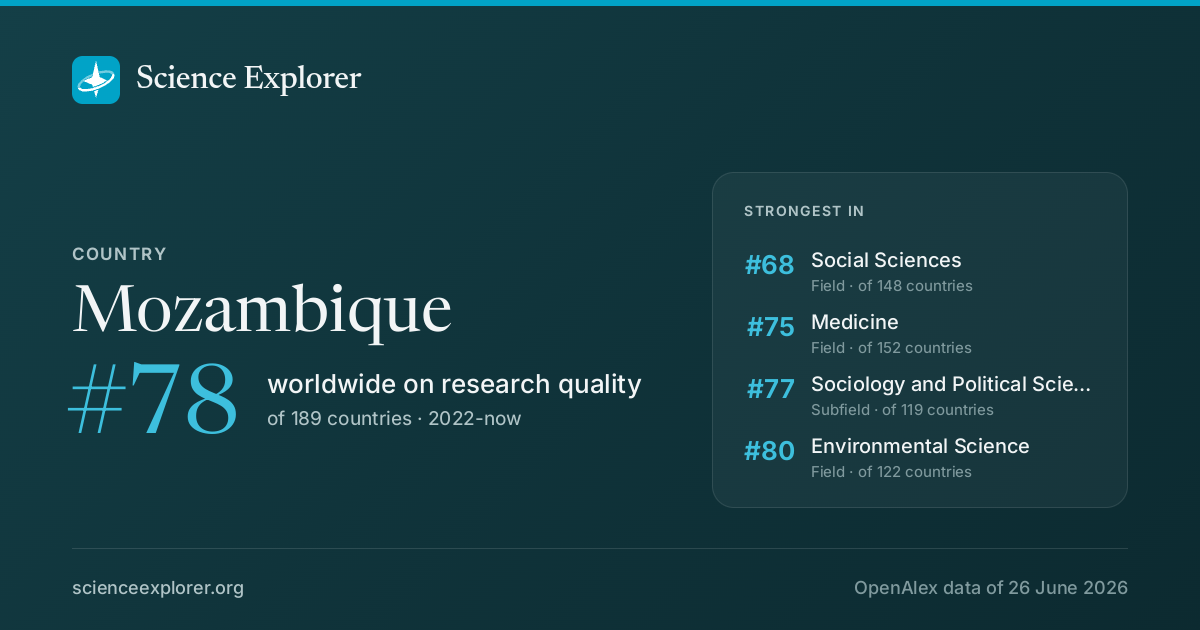
Mozambique ranks #78 of 189 countries on research quality in 2022-now (#90 all time), with 4.5k research works and 6.2% of them in the world's top 10%.
- World rank, 2022-now
- #78 of 189 · #90 all time
- Works, 2022-now
- 4.5k ▲ 23% vs 2018-21
- Citations
- 96k 6.4 per fractional work, all time
- Top-10% rate
- 6.2% all institutions 10.0%
- vs its own fields
- 0.80× 1.00× is exactly expected
- In the world top 100
- 0 0 in the top 1,000
- Open access
- 73% world 40%
- International
- 54% world 18%
MozambiqueWhat is Mozambique strongest at in science?
On research quality in 2022-now, Mozambique ranks highest in Social Sciences (#68 of 148), Medicine (#75 of 152) and Sociology and Political Science (#77 of 119). Relative to its size it is most specialised in Anatomy, Forestry and Transportation.
| Field | World rank | Where that sits | Top-10% rate | Works | All time | Institutions |
|---|---|---|---|---|---|---|
| Social SciencesField | #68 of 148 | 6.6% | 1,559 | #81 | Institutions | |
| MedicineField | #75 of 152 | 7.8% | 493 | #70 | Institutions | |
| Sociology and Political ScienceSubfield | #77 of 119 | 7.4% | 369 | #85 | Institutions | |
| Environmental ScienceField | #80 of 122 | 5.8% | 325 | #103 | Institutions | |
| EducationSubfield | #74 of 112 | 5.5% | 519 | #86 | Institutions | |
| Agricultural and Biological SciencesField | #85 of 124 | 7.2% | 288 | #102 | Institutions | |
| EngineeringField | #98 of 131 | 5.8% | 292 | #108 | Institutions | |
| Information SystemsSubfield | #69 of 90 | 3.9% | 308 | #78 | Institutions | |
| Computer ScienceField | #104 of 128 | 4.0% | 378 | #102 | Institutions |
Where its research is concentrated
Location quotient: how much more (or less) of each node it does than its size predicts. Drawn around 1×, where "twice the world share" and "half of it" are the same distance apart in opposite directions. A volume reading, which on a country axis is largely population and industrial structure.
- AnatomySubfield · 9.3 works · #62 of 159 active here7.3×
- ForestrySubfield · 40.1 works · #64 of 204 active here7.2×
- TransportationSubfield · 123.4 works · #68 of 205 active here7.0×
- Urban StudiesSubfield · 72.7 works · #75 of 204 active here5.0×
- Developmental and Educational PsychologySubfield · 103.0 works · #78 of 214 active here4.2×
- Management, Monitoring, Policy and LawSubfield · 129.2 works · #80 of 223 active here4.2×
- EducationSubfield · 654.9 works · #79 of 222 active here4.0×
- Information SystemsSubfield · 358.9 works · #80 of 221 active here3.8×
The whole field profile
All 26 fields at once. A specialist and a generalist produce the same ranked list and a completely different shape.
Rings at 0.5×, 1× and 2×. Widest outward: Social Sciences, 2.7×. Every wedge is a field page.
All 26 fields, with their numbers
- Social Sciences2.73×1,839 works
- Arts and Humanities1.48×227 works
- Decision Sciences1.47×76 works
- Economics, Econometrics and Finance1.45×165 works
- Environmental Science1.43×379 works
- Psychology1.43×232 works
- Agricultural and Biological Sciences1.37×345 works
- Nursing1.36×36 works
- Health Professions1.35×189 works
- Computer Science1.09×450 works
- Immunology and Microbiology0.88×47 works
- Business, Management and Accounting0.78×134 works
- Veterinary0.72×5 works
- Mathematics0.58×36 works
- Medicine0.57×587 works
- Engineering0.42×331 works
- Dentistry0.42×11 works
- Earth and Planetary Sciences0.40×34 works
- Energy0.40×19 works
- Chemical Engineering0.32×6 works
- Biochemistry, Genetics and Molecular Biology0.29×81 works
- Neuroscience0.23×20 works
- Pharmacology, Toxicology and Pharmaceutics0.22×4 works
- Physics and Astronomy0.22×26 works
- Chemistry0.21×18 works
- Materials Science0.13×25 works
Which fields of science does Mozambique work in?
In 2022-now, 50% of research in Mozambique is in Social Sciences, 25% in Physical Sciences. Its largest fields are Social Sciences (35%), Medicine (11%), Computer Science (8%). It does 2.0× the world's share of Social Sciences.
Each ring splits the one inside it: the four domains of science, their fields, their subfields. Size is fractional works in 2022-now. Every slice is a page; the interactive view zooms down to single topics and colours each by how much more of it this country does than the world.
Its 4 domains and 26 fields, with their numbers
- Social Sciences2,67350.2%
- Social Sciences1,83934.5%
- Psychology2324.4%
- Arts and Humanities2274.3%
- Economics, Econometrics and Finance1653.1%
- Business, Management and Accounting1342.5%
- Decision Sciences761.4%
- Physical Sciences1,32524.9%
- Computer Science4508.5%
- Environmental Science3797.1%
- Engineering3316.2%
- Mathematics360.7%
- Earth and Planetary Sciences340.6%
- Physics and Astronomy260.5%
- Materials Science250.5%
- Energy190.4%
- Chemistry180.3%
- Chemical Engineering60.1%
- Health Sciences82815.6%
- Medicine58711.0%
- Health Professions1893.6%
- Nursing350.7%
- Dentistry110.2%
- Veterinary50.1%
- Life Sciences4989.3%
Which keywords describe research in Mozambique?
By fractional works in 2022-now, weighted toward what it does more of than the world: Educational Technology, Pedagogy, Teacher Training, Online Learning, Sustainable Development, E-Learning, Education and Innovation.
- Design
- Public Oversight
- International Trade Law
- Sharia Law
- Modernization
- Islam
- Teaching Methods
- Entrepreneurship
- Legal Regulation
- Digital Education
- Digital Transformation
- Literature
- Culture
- History
- Higher Education
- Innovation
- Online Learning
- Sustainability
- Pedagogy
- Education
- Educational Technology
- Sustainable Development
- Globalization
- Teacher Training
- E-Learning
- Distance Learning
- Digital Literacy
- Digitalization
- Ethnicity
- Inclusive Education
- Public Policy
- Economic Security
- Language Teaching
- Foresight
- Science
- Social Influence
- Malay Language
- Educational Technologies
- Strategic Planning
- Transport Policy
Size is fractional works in 2022-now in the topics tagged with each word; colour is the word's share of this country's work against its share of the world's. The 40 words are chosen for being large and distinctive. Each links to the topic it comes from most.
All 40 words, with their numbers
- Educational Technology437▲ 7.0×44 topics
- Education396▲ 4.3×118 topics
- Sustainable Development388▲ 4.7×85 topics
- Pedagogy386▲ 14×28 topics
- Globalization372▲ 3.6×116 topics
- Sustainability358▲ 2.8×100 topics
- Teacher Training350▲ 11×27 topics
- Online Learning337▲ 7.6×25 topics
- E-Learning334▲ 6.5×21 topics
- Innovation311▲ 5.7×71 topics
- Distance Learning226▲ 12×13 topics
- Higher Education186▲ 6.6×26 topics
- Digital Literacy183▲ 6.0×11 topics
- History174▲ 4.7×39 topics
- Digitalization172▲ 16×13 topics
- Culture160▲ 5.7×25 topics
- Ethnicity158▲ 7.9×16 topics
- Literature157▲ 5.4×37 topics
- Inclusive Education154▲ 8.0×19 topics
- Digital Transformation154▲ 5.3×23 topics
- Public Policy149▲ 5.9×24 topics
- Digital Education140▲ 18×7 topics
- Economic Security138▲ 12×7 topics
- Legal Regulation138▲ 12×8 topics
- Language Teaching136▲ 9.5×8 topics
- Entrepreneurship130▲ 6.2×22 topics
- Foresight124▲ 18×2 topics
- Teaching Methods123▲ 14×11 topics
- Science122▲ 9.3×8 topics
- Islam120▲ 11×4 topics
- Social Influence118▲ 10×3 topics
- Modernization118▲ 12×3 topics
- Malay Language118▲ 16×1 topic
- Sharia Law118▲ 15×1 topic
- Educational Technologies117▲ 24×2 topics
- International Trade Law117▲ 17×2 topics
- Strategic Planning117▲ 15×3 topics
- Public Oversight116▲ 18×1 topic
- Transport Policy116▲ 18×1 topic
- Design116▲ 13×4 topics
Which research topics does Mozambique publish the most in?
Its largest topics in 2022-now are Linguistic, Cultural, and Literary Studies, Legal and Regulatory Analysis, Military Technology and Strategies.
Area is fractional works in 2022-now; colour is the subfield each topic belongs to. Every tile is a topic page.
- 1 Linguistic, Cultural, and Literary Studies Sociology and Political Science 118 works
- 2 Legal and Regulatory Analysis Transportation 116 works
- 3 Military Technology and Strategies Aerospace Engineering 115 works
- 4 Education, Innovation and Language Studies Education 108 works
- 5 Educational Innovations and Challenges Information Systems 99 works
- 6 Educational Methods and Teacher Development Information Systems 94 works
- 7 Foreign Language Teaching Methods Education 79 works
- 8 Psychology of Development and Education Developmental and Educational Psychology 58 works
- 9 Education and Professional Development Education 57 works
- 10 Innovative Educational Technologies Information Systems 51 works
- 11 Business and Management Studies Information Systems and Management 48 works
- 12 Environmental Sustainability and Education Management, Monitoring, Policy and Law 46 works
Which universities in Mozambique lead research?
Eduardo Mondlane University, Pedagogical University and Instituto Nacional de Saúde rank highest in Mozambique on research quality in 2022-now.
One dot per institution in the list below. The upper left is the interesting corner.
- 1Eduardo Mondlane UniversityUniversity · Maputo · #4,046 worldwide6.6% top 10% · 653 works
- 2Pedagogical UniversityUniversity · Maputo · #4,780 worldwide4.8% top 10% · 2.1k works
- 3Instituto Nacional de SaúdeGovernment institution · Maputo · #5,514 worldwide7.9% top 10% · 306 works
- 4Universidade PolitecnicaUniversity · Maputo · #7,595 worldwide4.9% top 10% · 259 works
- 5Lúrio UniversityUniversity · Nampula · #9,433 worldwide8.1% top 10% · 197 works
- 6Catholic University of MozambiqueUniversity · Beira · #13,919 worldwide4.3% top 10% · 133 works
- 7Universidade ZambezeUniversity · Beira · #16,170 worldwide6.4% top 10% · 93 works
- 8National Directorate of GeologyGovernment institution · Maputo · #16,824 worldwide11.7% top 10% · 66 works
- 9Ministry of HealthGovernment institution · Maputo · #18,560 worldwide9.8% top 10% · 75 works
The track on each row is its top-10% rate; the tick is the average of all institutions, 10.0% (how it is set): teal above it, red below.
All ranked institutions in MozambiqueWho are the top researchers in Mozambique?
Albertino Antonio Moura Damasceno, Inácio Mandomando and Ana Olga Mocumbi rank highest among researchers based in Mozambique.
- 1 Albertino Antonio Moura Damasceno #33,973 worldwide 64k citations · 338 works
- 2 Inácio Mandomando #104,696 worldwide 17k citations · 290 works
- 3 Ana Olga Mocumbi #117,838 worldwide 42k citations · 274 works
- 4 Albertino Damasceno #155,059 worldwide 14k citations · 29 works
- 5 Eusébio Macete #174,962 worldwide 7.4k citations · 120 works
- 6 Pedro Aíde #203,166 worldwide 5.8k citations · 137 works
- 7 Francisco Saúte #214,202 worldwide 2.9k citations · 158 works
- 8 Harith M. Farooq #221,953 worldwide 2.7k citations · 72 works
- 9 Khátia Munguambe #263,683 worldwide 4.5k citations · 186 works
- 10 Albertino Damasceno #265,083 worldwide 2.7k citations · 65 works
How open and international is Mozambique's research?
73% of its research is openly available (world: 40%), and 54% is written with international co-authors (world: 18%).
World: 40% of research is openly available.
World: 18% is written across borders.
In 2022-now, 89% of its research is openly available (world 63%) and 62% is written with co-authors abroad (world 22%). Against what its own mix of topics predicts, that is 1.13× the expected open access and 3.13× the expected international share, which puts it #34 of 173 countries on openness.
How has Mozambique's research grown?
Output in 2022-2025 was 23% higher than in 2018-2021.
The same series as a ribbon: one cell per year, darker for more. The line above answers how much; this answers when.
Its share of all research
Growing output can still be a shrinking share: all of science grows. This is Mozambique as a percentage of every work published that year, 0.019% in 2024.
Fractional works of Mozambique over all fractional works that year. How the balance of science has shifted.
How much of it reaches the world top 10%
Over the whole record, 6.4% of its 15k works since 1950 reached the world top 10% for their field and year.
Of each year's output, the share that reached the world's 10% most cited for its field and year. Peak 9.3% in 2016.
Which countries have research most like Mozambique's?
Timor-Leste is Mozambique's closest research twin: of all countries, its research is spread across the fields most like Mozambique's, with both strong in Social Sciences.
- 1
 Timor-LesteBoth strong in Social Sciences, Agricultural and Biological Sciences, Nursing
0.86 Compare
- 2
 PhilippinesBoth strong in Social Sciences, Decision Sciences, Psychology
0.86 Compare
- 3
 Guinea-BissauBoth strong in Social Sciences, Arts and Humanities, Decision Sciences
0.83 Compare
- 4
 KenyaBoth strong in Social Sciences, Decision Sciences, Economics, Econometrics and Finance
0.83 Compare
- 5
 NicaraguaBoth strong in Social Sciences, Arts and Humanities, Economics, Econometrics and Finance
0.83 Compare
Similarity is the correlation of each side's location quotients across every field it publishes in, on a log scale: 1 is the same shape of research, 0 is unrelated. It ignores size. How it is measured.
Compare Mozambique with
 Bulgaria
 Laos
 Lebanon
 Uruguay
 Zimbabwe
 Zambia
Share Mozambique's ranking
Badges for a website1Each links back here and updates with every snapshot

Research fields in Mozambique
Discussion
Ask a question or share a note about Mozambique. Posts are plain text and can be reported.