 Science in Guinea-Bissau
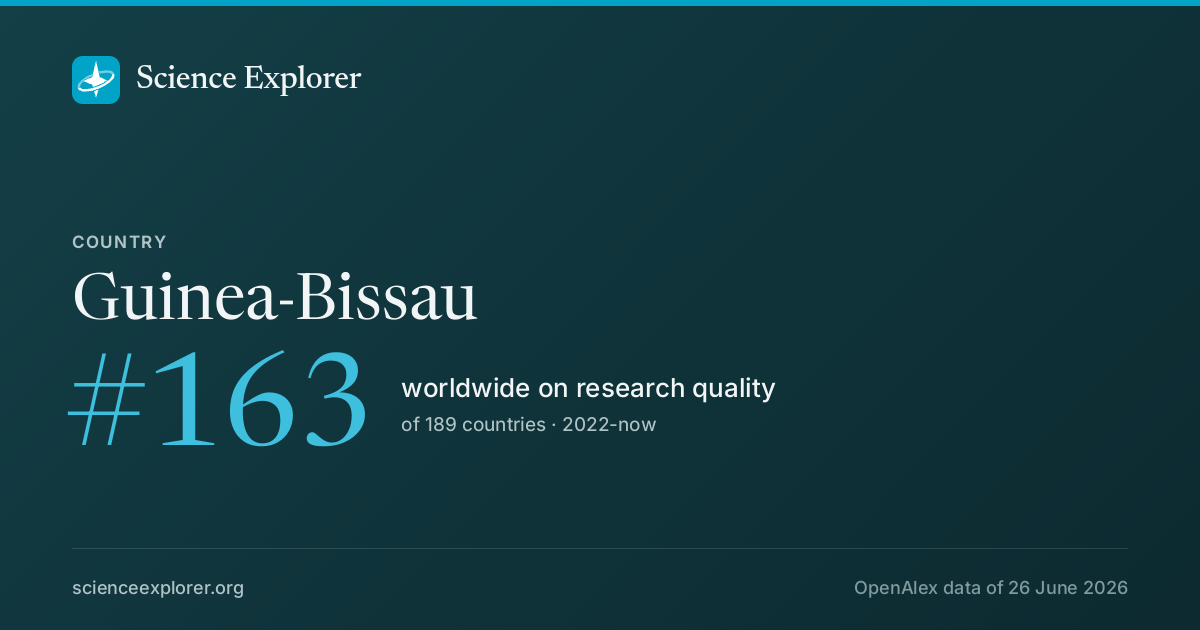
Guinea-Bissau ranks #163 of 189 countries on research quality in 2022-now (#131 all time), with 282 research works and 11.5% of them in the world's top 10%.
- World rank, 2022-now
- #163 of 189 · #131 all time
- Works, 2022-now
- 282 ▲ 10% vs 2018-21
- Citations
- 43k 30.4 per fractional work, all time
- Top-10% rate
- 11.5% all institutions 10.0%
- vs its own fields
- 0.94× 1.00× is exactly expected
- In the world top 100
- 0 0 in the top 1,000
- Open access
- 63% world 40%
- International
- 59% world 18%
Guinea-BissauWhich fields of science does Guinea-Bissau work in?
In 2022-now, 58% of research in Guinea-Bissau is in Social Sciences, 18% in Health Sciences. Its largest fields are Social Sciences (44%), Medicine (13%), Environmental Science (9%). It does 2.3× the world's share of Social Sciences.
Each ring splits the one inside it: the four domains of science, their fields, their subfields. Size is fractional works in 2022-now. Every slice is a page; the interactive view zooms down to single topics and colours each by how much more of it this country does than the world.
Its 4 domains and 25 fields, with their numbers
- Social Sciences18958.3%
- Social Sciences14243.8%
- Arts and Humanities175.2%
- Decision Sciences92.7%
- Psychology82.5%
- Economics, Econometrics and Finance72.1%
- Business, Management and Accounting72.1%
- Health Sciences5817.9%
- Medicine4212.9%
- Health Professions134.1%
- Nursing20.6%
- Dentistry10.3%
- Veterinary00.0%
- Physical Sciences5316.4%
- Environmental Science288.6%
- Computer Science133.9%
- Engineering61.9%
- Earth and Planetary Sciences30.9%
- Physics and Astronomy20.7%
- Mathematics10.3%
- Materials Science00.1%
- Chemistry00.1%
- Energy00.0%
- Life Sciences247.4%
Which keywords describe research in Guinea-Bissau?
By fractional works in 2022-now, weighted toward what it does more of than the world: Qualitative Research, Public Policy, Teacher Training, Social Inequality, Curriculum Development, Higher Education, Educational Policies and Pedagogical Practices.
- Remote Education
- Organizational Management
- Data Analysis
- Research
- Training
- Inclusion
- Educational Policy
- COVID-19
- SINAES
- Science Communication
- Sustainability
- Online Learning
- Educational Technology
- Educational Reform
- Inclusive Education
- Social Impact
- Educational Policies
- Epidemiology
- Social Inequality
- Public Policy
- Qualitative Research
- Teacher Training
- Curriculum Development
- Higher Education
- Pedagogical Practices
- Distance Learning
- Critical Pedagogy
- Healthcare
- Innovation
- Globalization
- Quality Assurance
- Evaluation
- Public Health
- Pandemic
- E-Learning
- Legislation
- Distance Education
- Agroecology
- Brazil
- Research Methods
Size is fractional works in 2022-now in the topics tagged with each word; colour is the word's share of this country's work against its share of the world's. The 40 words are chosen for being large and distinctive. Each links to the topic it comes from most.
All 40 words, with their numbers
- Qualitative Research35▲ 13×11 topics
- Public Policy32▲ 20×12 topics
- Teacher Training31▲ 16×8 topics
- Social Inequality28▲ 32×7 topics
- Curriculum Development24▲ 11×4 topics
- Epidemiology24▲ 1.83×50 topics
- Higher Education21▲ 12×7 topics
- Educational Policies20▲ 56×2 topics
- Pedagogical Practices20▲ 68×2 topics
- Social Impact20▲ 15×7 topics
- Distance Learning20▲ 17×3 topics
- Inclusive Education20▲ 17×3 topics
- Critical Pedagogy19▲ 71×1 topic
- Educational Reform19▲ 48×1 topic
- Healthcare19▲ 5.1×12 topics
- Educational Technology18▲ 4.8×11 topics
- Innovation18▲ 5.5×11 topics
- Online Learning18▲ 6.8×6 topics
- Globalization16▲ 2.6×36 topics
- Sustainability16▲ 2.1×26 topics
- Quality Assurance16▲ 29×6 topics
- Science Communication15▲ 57×2 topics
- Evaluation15▲ 89×1 topic
- SINAES15▲ 180×1 topic
- Public Health14▲ 2.9×28 topics
- COVID-1912▲ 3.0×18 topics
- Pandemic11▲ 3.5×10 topics
- Educational Policy11▲ 13×3 topics
- E-Learning10▲ 3.4×4 topics
- Inclusion10▲ 22×2 topics
- Legislation10▲ 19×3 topics
- Training10▲ 15×5 topics
- Distance Education10▲ 16×1 topic
- Research10▲ 24×1 topic
- Agroecology8▲ 17×4 topics
- Data Analysis8▲ 9.1×2 topics
- Brazil8▲ 25×5 topics
- Organizational Management8▲ 39×1 topic
- Research Methods8▲ 15×1 topic
- Remote Education7▲ 69×1 topic
Which research topics does Guinea-Bissau publish the most in?
Its largest topics in 2022-now are Education Pedagogy and Practices, Education and Public Policy, Academic Research in Diverse Fields.
Area is fractional works in 2022-now; colour is the subfield each topic belongs to. Every tile is a topic page.
- 1 Education Pedagogy and Practices Education 19 works
- 2 Education and Public Policy Political Science and International Relations 15 works
- 3 Academic Research in Diverse Fields Education 10 works
- 4 Business and Management Studies Information Systems and Management 8 works
- 5 Education during COVID-19 pandemic Education 7 works
- 6 Healthcare during COVID-19 Pandemic Information Systems 5 works
- 7 Immune responses and vaccinations Immunology 5 works
- 8 Evasion and Academic Success Factors Demography 5 works
- 9 Social and Economic Solidarity Sociology and Political Science 5 works
- 10 Vaccine Coverage and Hesitancy Health 4 works
- 11 Science and Education Research Education 4 works
- 12 Environmental Sustainability and Education Management, Monitoring, Policy and Law 4 works
Which universities in Guinea-Bissau lead research?
Instituto Nacional de Estudos e Pesquisa rank highest in Guinea-Bissau on research quality in 2022-now.
- 1Instituto Nacional de Estudos e PesquisaResearch facility · Bissau · #10,323 worldwide13.1% top 10% · 192 works
The track on each row is its top-10% rate; the tick is the average of all institutions, 10.0% (how it is set): teal above it, red below.
All ranked institutions in Guinea-BissauWho are the top researchers in Guinea-Bissau?
Per Gustafson, Peter Aaby and Christine Stabell Benn rank highest among researchers based in Guinea-Bissau.
- 1 Per Gustafson #77,276 worldwide 8.8k citations · 148 works
- 2 Peter Aaby #411,001 worldwide 37k citations · 788 works
- 3 Christine Stabell Benn #438,263 worldwide 20k citations · 455 works
- 4 Sofie Reumert Biering-Sørensen #470,096 worldwide 3.3k citations · 66 works
- 5 Morten Bjerregaard-Andersen #900,465 worldwide 2.7k citations · 86 works
- 6 Sandra Valborg Løfberg #1,004,080 worldwide 823 citations · 16 works
- 7 Najaaraq Lund #1,127,221 worldwide 1.7k citations · 24 works
- 8 Paulo Rabna #1,214,810 worldwide 1.3k citations · 24 works
- 9 Amabélia Rodrigues #1,347,260 worldwide 8.1k citations · 229 works
- 10 Adriano Souza Senkevics #1,364,285 worldwide 335 citations · 54 works
How open and international is Guinea-Bissau's research?
63% of its research is openly available (world: 40%), and 59% is written with international co-authors (world: 18%).
World: 40% of research is openly available.
World: 18% is written across borders.
How has Guinea-Bissau's research grown?
Output in 2022-2025 was 10% higher than in 2018-2021.
The same series as a ribbon: one cell per year, darker for more. The line above answers how much; this answers when.
Its share of all research
Growing output can still be a shrinking share: all of science grows. This is Guinea-Bissau as a percentage of every work published that year, 0.0011% in 2024.
Fractional works of Guinea-Bissau over all fractional works that year. How the balance of science has shifted.
How much of it reaches the world top 10%
Over the whole record, 12.8% of its 1.4k works since 1952 reached the world top 10% for their field and year.
Of each year's output, the share that reached the world's 10% most cited for its field and year. Peak 25.3% in 2018.
Which countries have research most like Guinea-Bissau's?
Mozambique is Guinea-Bissau's closest research twin: of all countries, its research is spread across the fields most like Guinea-Bissau's, with both strong in Social Sciences.
- 1
 MozambiqueBoth strong in Social Sciences, Arts and Humanities, Decision Sciences
0.83 Compare
- 2
 MartiniqueBoth strong in Social Sciences, Arts and Humanities, Immunology and Microbiology
0.77 Compare
- 3
 GuatemalaBoth strong in Social Sciences, Health Professions, Nursing
0.77 Compare
- 4
 São Tomé and PríncipeBoth strong in Social Sciences, Immunology and Microbiology, Decision Sciences
0.77 Compare
- 5
 HaitiBoth strong in Social Sciences, Arts and Humanities, Health Professions
0.73 Compare
Similarity is the correlation of each side's location quotients across every field it publishes in, on a log scale: 1 is the same shape of research, 0 is unrelated. It ignores size. How it is measured.
Compare Guinea-Bissau with
 Timor-Leste
 Lesotho
 Côte d'Ivoire
 Cayman Islands
 Benin
Share Guinea-Bissau's ranking
Badges for a website1Each links back here and updates with every snapshot

Discussion
Ask a question or share a note about Guinea-Bissau. Posts are plain text and can be reported.