 Science in Martinique
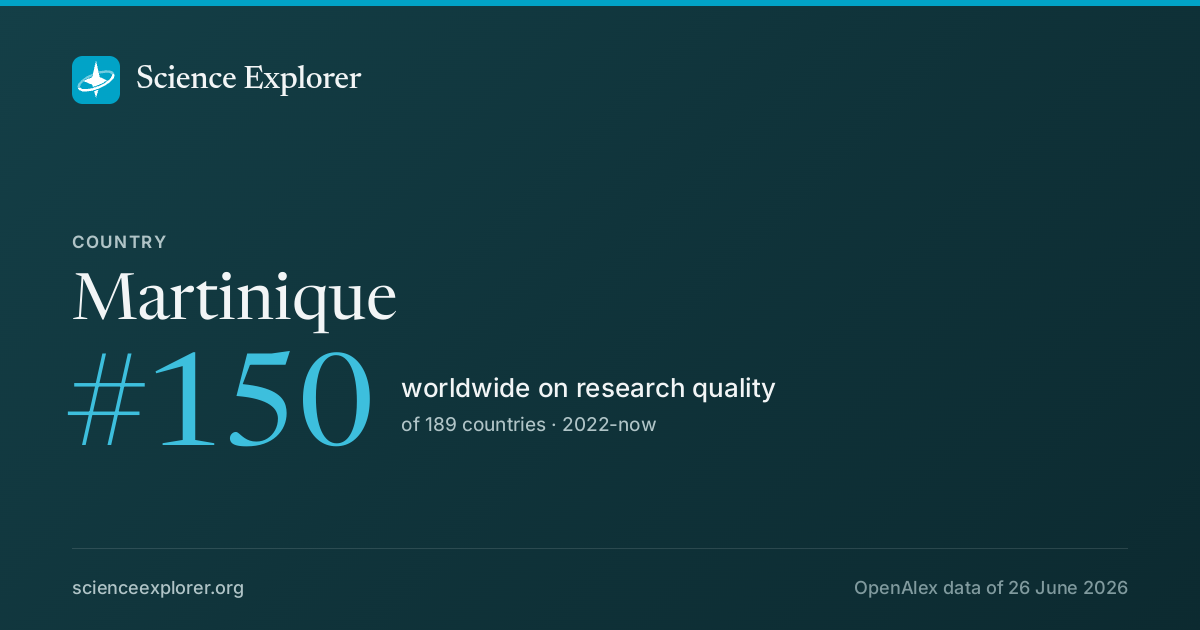
Martinique ranks #150 of 189 countries on research quality in 2022-now (#148 all time), with 471 research works and 4.5% of them in the world's top 10%.
- World rank, 2022-now
- #150 of 189 · #148 all time
- Works, 2022-now
- 471 ▲ 36% vs 2018-21
- Citations
- 24k 11.7 per fractional work, all time
- Top-10% rate
- 4.5% all institutions 10.0%
- vs its own fields
- 0.90× 1.00× is exactly expected
- In the world top 100
- 0 0 in the top 1,000
- Open access
- 31% world 40%
- International
- 38% world 18%
MartiniqueWhich fields of science does Martinique work in?
In 2022-now, 43% of research in Martinique is in Social Sciences, 36% in Health Sciences. Its largest fields are Medicine (31%), Social Sciences (29%), Arts and Humanities (8%). It does 1.7× the world's share of Social Sciences.
Each ring splits the one inside it: the four domains of science, their fields, their subfields. Size is fractional works in 2022-now. Every slice is a page; the interactive view zooms down to single topics and colours each by how much more of it this country does than the world.
Its 4 domains and 26 fields, with their numbers
- Social Sciences21943.3%
- Social Sciences14628.8%
- Arts and Humanities397.7%
- Business, Management and Accounting183.5%
- Psychology91.9%
- Economics, Econometrics and Finance61.2%
- Decision Sciences10.3%
- Health Sciences18236.0%
- Medicine15831.3%
- Health Professions214.2%
- Dentistry10.2%
- Nursing10.2%
- Veterinary00.1%
- Life Sciences6011.9%
- Physical Sciences458.8%
- Environmental Science163.2%
- Computer Science91.7%
- Engineering71.4%
- Earth and Planetary Sciences71.3%
- Mathematics30.6%
- Materials Science10.2%
- Chemical Engineering10.2%
- Physics and Astronomy10.1%
- Chemistry00.1%
- Energy00.0%
Which keywords describe research in Martinique?
By fractional works in 2022-now, weighted toward what it does more of than the world: Identity, Migration, Globalization, Public Health, Territorial Governance, Cultural Diversity, Community Engagement and Healthcare Access.
- Vodou
- Decolonization
- Gender Studies
- Sociopolitical
- Literature
- Governance
- Nationalism
- Environmental Participation
- Race
- Diagnosis
- French Territories
- Social Inequality
- Economic Development
- Public Policy
- Local Development
- Healthcare Access
- Community Engagement
- Territorial Governance
- Identity
- Globalization
- Epidemiology
- Public Health
- Migration
- Cultural Diversity
- Colonialism
- Sociolinguistics
- Ethnicity
- Sustainable Development
- Discrimination
- Social Justice
- Migrant Workers
- Postcolonialism
- Citizen Participation
- Caribbean
- Culture
- Politics
- Vulnerability
- Resilience
- Diaspora
- Haiti
Size is fractional works in 2022-now in the topics tagged with each word; colour is the word's share of this country's work against its share of the world's. The 40 words are chosen for being large and distinctive. Each links to the topic it comes from most.
All 40 words, with their numbers
- Epidemiology42▲ 2.1×99 topics
- Globalization37▲ 3.8×46 topics
- Public Health34▲ 4.6×32 topics
- Identity29▲ 8.0×17 topics
- Migration28▲ 16×8 topics
- Territorial Governance24▲ 42×3 topics
- Cultural Diversity24▲ 21×8 topics
- Community Engagement24▲ 15×6 topics
- Colonialism24▲ 9.9×9 topics
- Healthcare Access24▲ 17×6 topics
- Sociolinguistics24▲ 25×4 topics
- Local Development24▲ 45×2 topics
- Ethnicity22▲ 12×3 topics
- Public Policy20▲ 8.3×5 topics
- Sustainable Development19▲ 2.4×12 topics
- Economic Development19▲ 4.7×9 topics
- Discrimination19▲ 18×2 topics
- Social Inequality19▲ 14×3 topics
- Social Justice19▲ 6.3×8 topics
- French Territories19▲ 385×1 topic
- Migrant Workers19▲ 385×1 topic
- Diagnosis16▲ 3.4×33 topics
- Postcolonialism16▲ 22×4 topics
- Race16▲ 26×3 topics
- Citizen Participation15▲ 26×1 topic
- Environmental Participation15▲ 42×1 topic
- Caribbean15▲ 159×3 topics
- Nationalism14▲ 6.2×5 topics
- Culture14▲ 5.2×6 topics
- Governance14▲ 8.4×5 topics
- Politics14▲ 10×5 topics
- Literature13▲ 4.8×8 topics
- Vulnerability12▲ 10×4 topics
- Sociopolitical12▲ 71×3 topics
- Resilience12▲ 4.8×6 topics
- Gender Studies12▲ 15×6 topics
- Diaspora11▲ 38×2 topics
- Decolonization11▲ 26×3 topics
- Haiti10▲ 274×1 topic
- Vodou10▲ 274×1 topic
Which research topics does Martinique publish the most in?
Its largest topics in 2022-now are Migration, Identity, and Health, French Urban and Social Studies, Caribbean and African Literature and Culture.
Area is fractional works in 2022-now; colour is the subfield each topic belongs to. Every tile is a topic page.
- 1 Migration, Identity, and Health Sociology and Political Science 19 works
- 2 French Urban and Social Studies Sociology and Political Science 15 works
- 3 Caribbean and African Literature and Culture Religious studies 10 works
- 4 Island Studies and Pacific Affairs Demography 9 works
- 5 Social Sciences and Governance Urban Studies 8 works
- 6 Education, sociology, and vocational training Sociology and Political Science 8 works
- 7 Cultural Identity and Heritage Archeology 7 works
- 8 Health, Medicine and Society General Health Professions 5 works
- 9 Autoimmune and Inflammatory Disorders Research Hematology 5 works
- 10 Colonialism, slavery, and trade Anthropology 5 works
- 11 Social Policies and Family Sociology and Political Science 4 works
- 12 Caribbean history, culture, and politics Cultural Studies 4 works
Which universities in Martinique lead research?
Centre Hospitalier Universitaire de Martinique rank highest in Martinique on research quality in 2022-now.
- 1Centre Hospitalier Universitaire de MartiniqueHospital / health system · Fort-de-France · #6,224 worldwide5.2% top 10% · 361 works
The track on each row is its top-10% rate; the tick is the average of all institutions, 10.0% (how it is set): teal above it, red below.
All ranked institutions in MartiniqueWho are the top researchers in Martinique?
Philippe Cabre, Didier Smadja and André Cabie rank highest among researchers based in Martinique.
- 1 Philippe Cabre #214,462 worldwide 11k citations · 146 works
- 2 Didier Smadja #524,502 worldwide 6.9k citations · 219 works
- 3 André Cabie #599,788 worldwide 9.2k citations · 403 works
- 4 Ruddy Valentino #672,607 worldwide 2.5k citations · 68 works
- 5 Bruno Schaub #747,582 worldwide 1.8k citations · 42 works
- 6 Christophe Deligny #766,209 worldwide 4.3k citations · 196 works
- 7 Jonathan Florentin #833,301 worldwide 1.6k citations · 81 works
- 8 Aïssatou Signaté #887,506 worldwide 2k citations · 80 works
- 9 Yves Hatchuel #890,722 worldwide 1.1k citations · 46 works
- 10 Jonathan Macni #939,116 worldwide 6.9k citations · 40 works
How open and international is Martinique's research?
31% of its research is openly available (world: 40%), and 38% is written with international co-authors (world: 18%).
World: 40% of research is openly available.
World: 18% is written across borders.
In 2022-now, 41% of its research is openly available (world 63%) and 41% is written with co-authors abroad (world 22%). Against what its own mix of topics predicts, that is 0.77× the expected open access and 1.53× the expected international share, which puts it #161 of 173 countries on openness.
How has Martinique's research grown?
Output in 2022-2025 was 36% higher than in 2018-2021.
The same series as a ribbon: one cell per year, darker for more. The line above answers how much; this answers when.
Its share of all research
Growing output can still be a shrinking share: all of science grows. This is Martinique as a percentage of every work published that year, 0.0026% in 2024.
Fractional works of Martinique over all fractional works that year. How the balance of science has shifted.
How much of it reaches the world top 10%
Over the whole record, 5.7% of its 2k works since 1951 reached the world top 10% for their field and year.
Of each year's output, the share that reached the world's 10% most cited for its field and year. Peak 18.0% in 1997.
Which countries have research most like Martinique's?
São Tomé and Príncipe is Martinique's closest research twin: of all countries, its research is spread across the fields most like Martinique's, with both strong in Social Sciences.
- 1
 São Tomé and PríncipeBoth strong in Social Sciences, Immunology and Microbiology, Health Professions
0.81 Compare
- 2
 CuraçaoBoth strong in Immunology and Microbiology, Medicine, Health Professions
0.78 Compare
- 3
 Guinea-BissauBoth strong in Social Sciences, Arts and Humanities, Immunology and Microbiology
0.77 Compare
- 4
 HaitiBoth strong in Arts and Humanities, Social Sciences, Health Professions
0.75 Compare
- 5
 French GuianaBoth strong in Immunology and Microbiology, Medicine, Health Professions
0.72 Compare
Similarity is the correlation of each side's location quotients across every field it publishes in, on a log scale: 1 is the same shape of research, 0 is unrelated. It ignores size. How it is measured.
Compare Martinique with
 Turkmenistan
 Senegal
 Algeria
 French Polynesia
 Niger
 Armenia
Share Martinique's ranking
Badges for a website1Each links back here and updates with every snapshot

Research fields in Martinique
Discussion
Ask a question or share a note about Martinique. Posts are plain text and can be reported.