 Science in Qatar
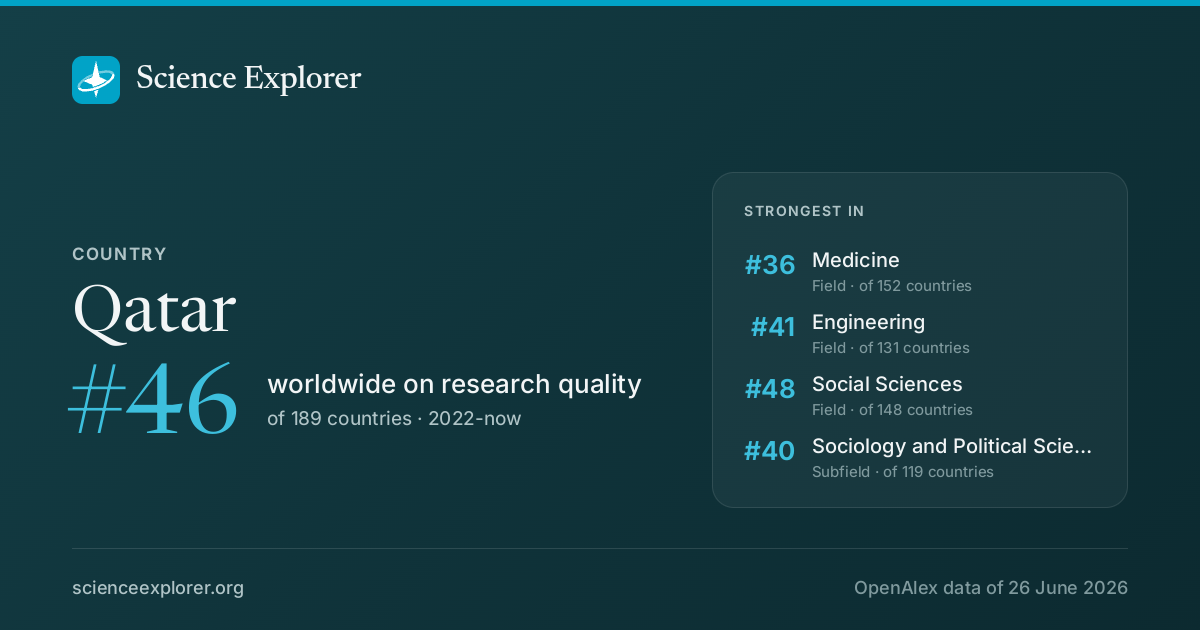
Qatar ranks #46 of 189 countries on research quality in 2022-now (#48 all time), with 18k research works and 15.0% of them in the world's top 10%.
- World rank, 2022-now
- #46 of 189 · #48 all time
- Works, 2022-now
- 18k ▲ 25% vs 2018-21
- Citations
- 1M 18.1 per fractional work, all time
- Top-10% rate
- 15.0% all institutions 10.0%
- vs its own fields
- 1.17× 1.00× is exactly expected
- In the world top 100
- 0 2 in the top 1,000
- Open access
- 55% world 40%
- International
- 44% world 18%
QatarWhat is Qatar strongest at in science?
On research quality in 2022-now, Qatar ranks highest in Medicine (#36 of 152), Engineering (#41 of 131) and Social Sciences (#48 of 148). Relative to its size it is most specialised in Microbiology, General Energy and Issues, ethics and legal aspects.
| Field | World rank | Where that sits | Top-10% rate | Works | All time | Institutions |
|---|---|---|---|---|---|---|
| MedicineField | #36 of 152 | 10.8% | 5,259 | #41 | Institutions | |
| EngineeringField | #41 of 131 | 15.6% | 2,739 | #43 | Institutions | |
| Social SciencesField | #48 of 148 | 19.4% | 1,979 | #52 | Institutions | |
| Sociology and Political ScienceSubfield | #40 of 119 | 18.8% | 767 | #48 | Institutions | |
| Computer ScienceField | #44 of 128 | 18.5% | 1,389 | #44 | Institutions | |
| Environmental ScienceField | #47 of 122 | 17.9% | 839 | #65 | Institutions | |
| Health ProfessionsField | #44 of 106 | 15.1% | 589 | #47 | Institutions | |
| Infectious DiseasesSubfield | #30 of 70 | 10.7% | 254 | #37 | Institutions | |
| Electrical and Electronic EngineeringSubfield | #38 of 86 | 17.0% | 704 | #38 | Institutions | |
| Business, Management and AccountingField | #49 of 110 | 22.6% | 600 | #51 | Institutions | |
| PsychologyField | #48 of 106 | 15.4% | 538 | #49 | Institutions | |
| SurgerySubfield | #39 of 86 | 11.2% | 696 | #40 | Institutions |
Where its research is concentrated
Location quotient: how much more (or less) of each node it does than its size predicts. Drawn around 1×, where "twice the world share" and "half of it" are the same distance apart in opposite directions. A volume reading, which on a country axis is largely population and industrial structure.
- MicrobiologySubfield · 5.6 works · #37 of 137 active here4.7×
- General EnergySubfield · 25.6 works · #53 of 167 active here4.6×
- Issues, ethics and legal aspectsSubfield · 17.4 works · #43 of 172 active here4.1×
- Research and TheorySubfield · 20.9 works · #46 of 183 active here3.9×
- Family PracticeSubfield · 37.4 works · #48 of 191 active here3.8×
- Geriatrics and GerontologySubfield · 81.7 works · #46 of 202 active here3.7×
- Health InformaticsSubfield · 81.6 works · #56 of 205 active here3.3×
- Applied Microbiology and BiotechnologySubfield · 31.1 works · #59 of 202 active here3.0×
The whole field profile
All 26 fields at once. A specialist and a generalist produce the same ranked list and a completely different shape.
Rings at 0.5×, 1× and 2×. Widest outward: Energy, 2.0×. Every wedge is a field page.
All 26 fields, with their numbers
- Energy1.96×370 works
- Dentistry1.56×156 works
- Medicine1.54×6,070 works
- Chemical Engineering1.31×94 works
- Health Professions1.25×675 works
- Nursing1.22×123 works
- Decision Sciences1.13×224 works
- Economics, Econometrics and Finance1.04×458 works
- Psychology1.02×640 works
- Immunology and Microbiology1.00×206 works
- Business, Management and Accounting1.00×660 works
- Pharmacology, Toxicology and Pharmaceutics0.99×72 works
- Engineering0.98×3,022 works
- Computer Science0.97×1,559 works
- Environmental Science0.93×952 works
- Biochemistry, Genetics and Molecular Biology0.89×978 works
- Social Sciences0.86×2,249 works
- Neuroscience0.81×270 works
- Materials Science0.73×524 works
- Veterinary0.73×20 works
- Chemistry0.50×163 works
- Mathematics0.50×120 works
- Arts and Humanities0.47×282 works
- Agricultural and Biological Sciences0.43×423 works
- Earth and Planetary Sciences0.37×121 works
- Physics and Astronomy0.29×130 works
Which fields of science does Qatar work in?
In 2022-now, 34% of research in Qatar is in Physical Sciences, 34% in Health Sciences. Its largest fields are Medicine (30%), Engineering (15%), Social Sciences (11%). It does 1.5× the world's share of Health Sciences.
Each ring splits the one inside it: the four domains of science, their fields, their subfields. Size is fractional works in 2022-now. Every slice is a page; the interactive view zooms down to single topics and colours each by how much more of it this country does than the world.
Its 4 domains and 26 fields, with their numbers
- Physical Sciences7,05734.3%
- Engineering3,02214.7%
- Computer Science1,5597.6%
- Environmental Science9524.6%
- Materials Science5242.5%
- Energy3701.8%
- Chemistry1630.8%
- Physics and Astronomy1310.6%
- Earth and Planetary Sciences1210.6%
- Mathematics1210.6%
- Chemical Engineering940.5%
- Health Sciences7,04534.3%
- Medicine6,07029.5%
- Health Professions6753.3%
- Dentistry1560.8%
- Nursing1230.6%
- Veterinary210.1%
- Social Sciences4,51421.9%
- Social Sciences2,24910.9%
- Business, Management and Accounting6603.2%
- Psychology6403.1%
- Economics, Econometrics and Finance4582.2%
- Arts and Humanities2821.4%
- Decision Sciences2241.1%
- Life Sciences1,9499.5%
Which keywords describe research in Qatar?
By fractional works in 2022-now, weighted toward what it does more of than the world: Epidemiology, Machine Learning, Deep Learning, Renewable Energy, Sustainability, Inflammation, Healthcare and Cardiovascular Disease.
- Genocide
- Guanxi
- Human Resource Management
- Middle East
- Social Networks
- SARS-CoV-2
- Complications
- Mortality
- Energy Efficiency
- Depression
- Pandemic
- Risk Factors
- Mental Health
- Oxidative Stress
- COVID-19
- Environmental Impact
- Cardiovascular Disease
- Inflammation
- Sustainability
- Machine Learning
- Epidemiology
- Deep Learning
- Renewable Energy
- Healthcare
- Quality of Life
- Treatment
- Public Health
- Diagnosis
- Metabolic Syndrome
- Neural Networks
- Supply Chain Management
- Management
- Security
- Risk Management
- Diabetes
- Smart Grid
- Renewable Energy Integration
- ACE2 Receptor
- Localization
- Wasta
Size is fractional works in 2022-now in the topics tagged with each word; colour is the word's share of this country's work against its share of the world's. The 40 words are chosen for being large and distinctive. Each links to the topic it comes from most.
All 40 words, with their numbers
- Epidemiology1,225▲ 1.49×137 topics
- Machine Learning896▲ 1.31×94 topics
- Deep Learning792◆ 1.12×84 topics
- Sustainability571◆ 1.14×101 topics
- Renewable Energy557▲ 1.87×50 topics
- Inflammation538▲ 1.23×83 topics
- Healthcare412▲ 1.75×38 topics
- Cardiovascular Disease411▲ 1.75×39 topics
- Quality of Life389▲ 1.31×58 topics
- Environmental Impact386◆ 1.10×65 topics
- Treatment380▲ 1.52×52 topics
- COVID-19377▲ 1.41×34 topics
- Public Health361▲ 1.20×66 topics
- Oxidative Stress348◆ 1.03×63 topics
- Diagnosis344▲ 1.79×41 topics
- Mental Health319◆ 1.08×47 topics
- Metabolic Syndrome316▲ 1.90×24 topics
- Risk Factors316▲ 1.40×37 topics
- Neural Networks315◆ 0.99×41 topics
- Pandemic306▲ 1.50×14 topics
- Supply Chain Management286▲ 1.55×25 topics
- Depression283▲ 1.57×26 topics
- Management257▲ 1.57×38 topics
- Energy Efficiency250▲ 1.32×39 topics
- Security233▲ 1.69×27 topics
- Mortality230▲ 1.97×13 topics
- Risk Management221▲ 2.3×18 topics
- Complications208▲ 2.0×17 topics
- Diabetes195▲ 1.89×22 topics
- SARS-CoV-2186▲ 3.0×6 topics
- Smart Grid185▲ 2.5×10 topics
- Social Networks181▲ 3.2×12 topics
- Renewable Energy Integration174▲ 2.6×5 topics
- Middle East154▲ 12×2 topics
- ACE2 Receptor147▲ 3.2×3 topics
- Human Resource Management145▲ 4.6×6 topics
- Localization140▲ 5.7×4 topics
- Guanxi127▲ 29×1 topic
- Wasta127▲ 29×1 topic
- Genocide103▲ 9.5×3 topics
Which research topics does Qatar publish the most in?
Its largest topics in 2022-now are Socioeconomic Development in MENA, Islamic Finance and Banking Studies, Artificial Intelligence in Healthcare and Education.
Area is fractional works in 2022-now; colour is the subfield each topic belongs to. Every tile is a topic page.
- 1 Socioeconomic Development in MENA Sociology and Political Science 127 works
- 2 Islamic Finance and Banking Studies Accounting 91 works
- 3 Artificial Intelligence in Healthcare and Education Health Informatics 82 works
- 4 Middle East and Rwanda Conflicts Sociology and Political Science 81 works
- 5 Blockchain Technology Applications and Security Information Systems 75 works
- 6 Islamic Studies and History Political Science and International Relations 73 works
- 7 COVID-19 Clinical Research Studies Infectious Diseases 70 works
- 8 COVID-19 and Mental Health Clinical Psychology 67 works
- 9 Pharmaceutical Practices and Patient Outcomes Geriatrics and Gerontology 66 works
- 10 SARS-CoV-2 and COVID-19 Research Infectious Diseases 66 works
- 11 Membrane Separation Technologies Water Science and Technology 65 works
- 12 Smart Grid Energy Management Electrical and Electronic Engineering 60 works
How many world-class institutions does Qatar hold?
Average quality and elite capacity disagree by construction, and both are worth knowing: the first is decided by a country's whole institution population, the second counts the institutions it holds at the top. One square per institution.
| Standing among countries | 2022-now | Where that sits | All time |
|---|---|---|---|
| Average qualityits whole institution population | #46 of 189 | #48 of 203 | |
| Elite capacitythe institutions it holds at the top | #36 of 204 | #45 of 216 |
Elite capacity counts a country's institutions by their worldwide rank, weighted so a place at #1 counts for more than one at #480. Countries under 100 fractional works are left out.
Bands are exclusive, so the squares add up to 2 (the institutions it holds in the world top 1,000), not to four times it.
Which universities in Qatar lead research?
Qatar University, Hamad bin Khalifa University and Qatar Foundation rank highest in Qatar on research quality in 2022-now.
One dot per institution in the list below. The upper left is the interesting corner.
- 1Qatar UniversityUniversity · Doha · #767 worldwide19.2% top 10% · 6k works
- 2Hamad bin Khalifa UniversityUniversity · Doha · #876 worldwide18.5% top 10% · 2.4k works
- 3Qatar FoundationFunder · Doha · #1,975 worldwide22.2% top 10% · 667 works
- 4Primary Health CareGovernment institution · Doha · #5,332 worldwide6.4% top 10% · 961 works
- 5Qatar Science and Technology ParkArchive · Doha · #5,375 worldwide20.0% top 10% · 359 works
- 6Doha Institute for Graduate StudiesUniversity · Doha · #5,400 worldwide24.6% top 10% · 321 works
- 7Qatar Airways (Qatar)Company · Doha · #5,692 worldwide11.3% top 10% · 431 works
- 8Hamad Medical CorporationNonprofit · Doha · #5,767 worldwide8.1% top 10% · 2.5k works
- 9Al Azhar UniversityUniversity · Doha · #8,387 worldwide4.0% top 10% · 504 works
- 10Qatar Orthopaedic and Sports Medicine HospitalHospital / health system · Doha · #9,840 worldwide19.4% top 10% · 147 works
- 11Hamad General HospitalHospital / health system · Doha · #11,338 worldwide8.2% top 10% · 425 works
- 12Ministry of Public HealthGovernment institution · Doha · #14,951 worldwide11.7% top 10% · 72 works
- 13Child Development CenterInstitution · Doha · #15,691 worldwide6.1% top 10% · 128 works
- 14Construction Development (Qatar)Company · Doha · #16,701 worldwide6.8% top 10% · 111 works
- 15National Center for Cancer Care and ResearchHospital / health system · Doha · #17,148 worldwide8.2% top 10% · 158 works
The track on each row is its top-10% rate; the tick is the average of all institutions, 10.0% (how it is set): teal above it, red below.
All ranked institutions in QatarWho are the top researchers in Qatar?
Mowafa Said Househ, Alaa Ali Abd-Alrazaq and Hamzeh Adel Al Amosh rank highest among researchers based in Qatar.
- 1 Mowafa Said Househ #3,730 worldwide 72k citations · 395 works
- 2 Alaa Ali Abd-Alrazaq #3,958 worldwide 8.1k citations · 190 works
- 3 Hamzeh Adel Al Amosh #7,255 worldwide 2.4k citations · 81 works
- 4 Laith Jamal Abu-Raddad #12,545 worldwide 139k citations · 614 works
- 5 Riyazuddin Mohammad Shaik #14,987 worldwide 5.8k citations · 105 works
- 6 Anvar Hassan Kaleeckal #15,121 worldwide 6.6k citations · 136 works
- 7 Zaina Al Kanaani #15,356 worldwide 6.8k citations · 118 works
- 8 Arfan Ahmed #15,417 worldwide 3.8k citations · 122 works
- 9 Khaled Elsaid #15,623 worldwide 11k citations · 129 works
- 10 Hussam Al Halbusi #16,321 worldwide 4.2k citations · 126 works
Which cities in Qatar are research hubs?
How open and international is Qatar's research?
55% of its research is openly available (world: 40%), and 44% is written with international co-authors (world: 18%).
World: 40% of research is openly available.
World: 18% is written across borders.
In 2022-now, 70% of its research is openly available (world 63%) and 48% is written with co-authors abroad (world 22%). Against what its own mix of topics predicts, that is 1.14× the expected open access and 2.08× the expected international share, which puts it #38 of 173 countries on openness.
How has Qatar's research grown?
Output in 2022-2025 was 25% higher than in 2018-2021.
The same series as a ribbon: one cell per year, darker for more. The line above answers how much; this answers when.
Its share of all research
Growing output can still be a shrinking share: all of science grows. This is Qatar as a percentage of every work published that year, 0.080% in 2024.
Fractional works of Qatar over all fractional works that year. How the balance of science has shifted.
How much of it reaches the world top 10%
Over the whole record, 12.6% of its 57k works since 1950 reached the world top 10% for their field and year.
Of each year's output, the share that reached the world's 10% most cited for its field and year. Peak 15.9% in 2024.
Which countries have research most like Qatar's?
United Arab Emirates is Qatar's closest research twin: of all countries, its research is spread across the fields most like Qatar's, with both strong in Energy.
- 1
 United Arab EmiratesBoth strong in Energy, Dentistry, Decision Sciences
0.64 Compare
- 2
 LebanonBoth strong in Dentistry, Medicine, Energy
0.62 Compare
- 3
 KuwaitBoth strong in Energy, Dentistry, Medicine
0.62 Compare
- 4
 BahrainBoth strong in Medicine, Decision Sciences, Energy
0.60 Compare
- 5
 MalaysiaBoth strong in Energy, Dentistry, Decision Sciences
0.53 Compare
Similarity is the correlation of each side's location quotients across every field it publishes in, on a log scale: 1 is the same shape of research, 0 is unrelated. It ignores size. How it is measured.
Compare Qatar with
 Iran
 Uganda
 Estonia
 Cyprus
 Türkiye
 Russia
Share Qatar's ranking
Badges for a website1Each links back here and updates with every snapshot

Research fields in Qatar
- Health Sciences
- Medicine
- Physical Sciences
- Engineering
- Social Sciences
- Social Sciences
- Sociology and Political Science
- Computer Science
- Environmental Science
- Life Sciences
- Health Professions
- Infectious Diseases
- Electrical and Electronic Engineering
- Business, Management and Accounting
- Psychology
- Surgery
- Artificial Intelligence
- Biochemistry, Genetics and Molecular Biology
- Political Science and International Relations
- Economics, Econometrics and Finance
- Biomedical Engineering
- Computer Networks and Communications
- Energy
- Education
- Control and Systems Engineering
- Molecular Biology
- Pulmonary and Respiratory Medicine
- Epidemiology
- Neuroscience
- Agricultural and Biological Sciences
- Cardiology and Cardiovascular Medicine
- Physiology
- Oncology
- Materials Science
- Information Systems
- Mechanical Engineering
- Economics and Econometrics
- General Health Professions
- Renewable Energy, Sustainability and the Environment
- Public Health, Environmental and Occupational Health
- Materials Chemistry
- Endocrinology, Diabetes and Metabolism
- Arts and Humanities
Questions people ask
What is Qatar strongest at in science?
On research quality in 2022-now, Qatar ranks highest in Medicine (#36 of 152), Engineering (#41 of 131) and Social Sciences (#48 of 148). Relative to its size it is most specialised in Microbiology, General Energy and Issues, ethics and legal aspects.
See the full answerDiscussion
Ask a question or share a note about Qatar. Posts are plain text and can be reported.