 Science in Kuwait
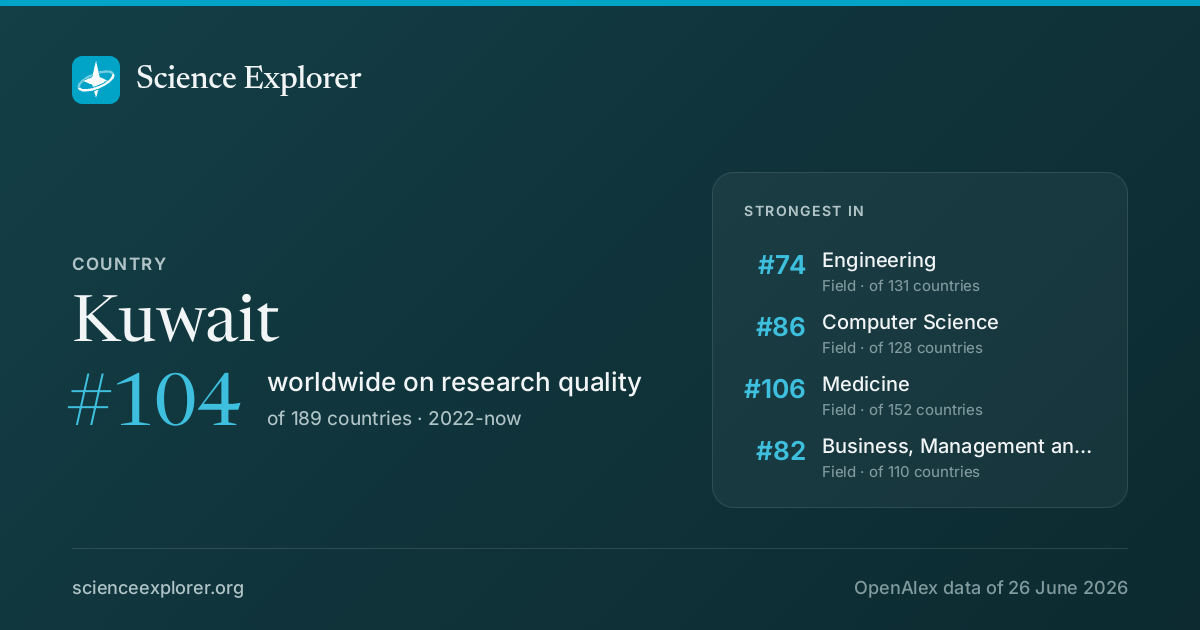
Kuwait ranks #104 of 189 countries on research quality in 2022-now (#137 all time), with 9.9k research works and 10.3% of them in the world's top 10%.
- World rank, 2022-now
- #104 of 189 · #137 all time
- Works, 2022-now
- 9.9k ▲ 33% vs 2018-21
- Citations
- 591k 14.4 per fractional work, all time
- Top-10% rate
- 10.3% all institutions 10.0%
- vs its own fields
- 0.82× 1.00× is exactly expected
- In the world top 100
- 0 0 in the top 1,000
- Open access
- 40% world 40%
- International
- 32% world 18%
KuwaitWhat is Kuwait strongest at in science?
On research quality in 2022-now, Kuwait ranks highest in Engineering (#74 of 131), Computer Science (#86 of 128) and Medicine (#106 of 152). Relative to its size it is most specialised in Ocean Engineering, Microbiology and Numerical Analysis.
| Field | World rank | Where that sits | Top-10% rate | Works | All time | Institutions |
|---|---|---|---|---|---|---|
| EngineeringField | #74 of 131 | 9.7% | 1,951 | #83 | Institutions | |
| Computer ScienceField | #86 of 128 | 14.0% | 812 | #91 | Institutions | |
| MedicineField | #106 of 152 | 7.2% | 2,196 | #135 | Institutions | |
| Business, Management and AccountingField | #82 of 110 | 17.1% | 408 | #100 | Institutions | |
| SurgerySubfield | #65 of 86 | 7.8% | 331 | #86 | Institutions | |
| Electrical and Electronic EngineeringSubfield | #67 of 86 | 11.9% | 319 | #83 | Institutions | |
| Materials ScienceField | #68 of 87 | 9.9% | 277 | #91 | Institutions | |
| Environmental ScienceField | #96 of 122 | 9.2% | 492 | #113 | Institutions | |
| Mechanical EngineeringSubfield | #60 of 74 | 8.4% | 334 | #78 | Institutions | |
| EducationSubfield | #91 of 112 | 11.9% | 405 | #101 | Institutions | |
| Biochemistry, Genetics and Molecular BiologyField | #86 of 105 | 7.9% | 375 | #108 | Institutions | |
| Health ProfessionsField | #87 of 106 | 11.5% | 214 | #104 | Institutions |
Where its research is concentrated
Location quotient: how much more (or less) of each node it does than its size predicts. Drawn around 1×, where "twice the world share" and "half of it" are the same distance apart in opposite directions. A volume reading, which on a country axis is largely population and industrial structure.
- Ocean EngineeringSubfield · 327.5 works · #48 of 213 active here5.5×
- MicrobiologySubfield · 2.1 works · #65 of 137 active here3.1×
- Numerical AnalysisSubfield · 28.0 works · #70 of 173 active here2.9×
- Health InformaticsSubfield · 36.5 works · #77 of 205 active here2.6×
- General EnergySubfield · 8.0 works · #81 of 167 active here2.6×
- PeriodonticsSubfield · 39.5 works · #72 of 194 active here2.5×
- Earth-Surface ProcessesSubfield · 29.4 works · #70 of 212 active here2.1×
- Modeling and SimulationSubfield · 33.9 works · #80 of 206 active here2.1×
The whole field profile
All 26 fields at once. A specialist and a generalist produce the same ranked list and a completely different shape.
Rings at 0.5×, 1× and 2×. Widest outward: Dentistry, 2.1×. Every wedge is a field page.
All 26 fields, with their numbers
- Dentistry2.09×116 works
- Energy1.67×176 works
- Mathematics1.35×182 works
- Engineering1.31×2,256 works
- Decision Sciences1.28×142 works
- Business, Management and Accounting1.25×461 works
- Medicine1.17×2,590 works
- Economics, Econometrics and Finance1.09×268 works
- Computer Science1.07×955 works
- Chemical Engineering1.01×40 works
- Earth and Planetary Sciences0.98×176 works
- Environmental Science0.98×560 works
- Immunology and Microbiology0.94×109 works
- Psychology0.87×304 works
- Social Sciences0.86×1,252 works
- Nursing0.82×46 works
- Health Professions0.81×246 works
- Materials Science0.79×317 works
- Chemistry0.76×136 works
- Biochemistry, Genetics and Molecular Biology0.70×426 works
- Neuroscience0.70×129 works
- Pharmacology, Toxicology and Pharmaceutics0.62×25 works
- Arts and Humanities0.56×186 works
- Veterinary0.54×8 works
- Physics and Astronomy0.50×127 works
- Agricultural and Biological Sciences0.43×235 works
Which fields of science does Kuwait work in?
In 2022-now, 43% of research in Kuwait is in Physical Sciences, 26% in Health Sciences. Its largest fields are Medicine (23%), Engineering (20%), Social Sciences (11%).
Each ring splits the one inside it: the four domains of science, their fields, their subfields. Size is fractional works in 2022-now. Every slice is a page; the interactive view zooms down to single topics and colours each by how much more of it this country does than the world.
Its 4 domains and 26 fields, with their numbers
- Physical Sciences4,92643.0%
- Engineering2,25619.7%
- Computer Science9558.3%
- Environmental Science5604.9%
- Materials Science3172.8%
- Mathematics1821.6%
- Earth and Planetary Sciences1771.5%
- Energy1761.5%
- Chemistry1361.2%
- Physics and Astronomy1271.1%
- Chemical Engineering400.4%
- Health Sciences3,00626.2%
- Medicine2,58922.6%
- Health Professions2462.1%
- Dentistry1161.0%
- Nursing460.4%
- Veterinary80.1%
- Social Sciences2,61222.8%
- Social Sciences1,25210.9%
- Business, Management and Accounting4614.0%
- Psychology3052.7%
- Economics, Econometrics and Finance2682.3%
- Arts and Humanities1861.6%
- Decision Sciences1421.2%
- Life Sciences9258.1%
Which keywords describe research in Kuwait?
By fractional works in 2022-now, weighted toward what it does more of than the world: Machine Learning, Epidemiology, Heat Transfer, Data Assimilation, Deep Learning, Ensemble Kalman Filter, Uncertainty Quantification and Hydraulic Fracturing.
- Viscosity
- Drilling Fluids
- Thermal Conductivity
- Rheological Properties
- Shale Gas Reservoirs
- Experimental Investigation
- Closed-Loop Control
- Hydraulic Fracturing
- Ensemble Kalman Filter
- Data Assimilation
- Online Learning
- Energy Efficiency
- Optimization
- COVID-19
- Nanoparticles
- Heat Transfer
- Environmental Impact
- Inflammation
- Sustainability
- Machine Learning
- Epidemiology
- Deep Learning
- Renewable Energy
- Education
- Treatment
- Healthcare
- Diagnosis
- Cardiovascular Disease
- Supply Chain Management
- Risk Management
- Corporate Governance
- Islamic Education
- Uncertainty Quantification
- Vibration Analysis
- Well Placement
- Fracture Propagation
- Nanofluids
- CO2 Sequestration
- Review
- Well Integrity
Size is fractional works in 2022-now in the topics tagged with each word; colour is the word's share of this country's work against its share of the world's. The 40 words are chosen for being large and distinctive. Each links to the topic it comes from most.
All 40 words, with their numbers
- Epidemiology571▲ 1.25×135 topics
- Machine Learning541▲ 1.42×94 topics
- Deep Learning396◆ 1.00×82 topics
- Sustainability275◆ 0.98×91 topics
- Renewable Energy266▲ 1.60×49 topics
- Inflammation250◆ 1.03×83 topics
- Education215◆ 1.09×74 topics
- Environmental Impact214◆ 1.09×58 topics
- Treatment212▲ 1.52×51 topics
- Heat Transfer211▲ 3.8×19 topics
- Healthcare208▲ 1.59×26 topics
- Nanoparticles202▲ 1.39×43 topics
- Diagnosis194▲ 1.82×41 topics
- COVID-19184▲ 1.23×32 topics
- Cardiovascular Disease180▲ 1.38×38 topics
- Optimization174▲ 3.4×26 topics
- Supply Chain Management171▲ 1.66×23 topics
- Energy Efficiency168▲ 1.58×42 topics
- Risk Management165▲ 3.0×17 topics
- Online Learning160▲ 1.68×24 topics
- Corporate Governance149▲ 1.77×24 topics
- Data Assimilation133▲ 7.1×4 topics
- Islamic Education128▲ 3.4×4 topics
- Ensemble Kalman Filter125▲ 11×2 topics
- Uncertainty Quantification121▲ 13×2 topics
- Hydraulic Fracturing118▲ 9.6×2 topics
- Vibration Analysis118▲ 3.8×9 topics
- Closed-Loop Control116▲ 23×1 topic
- Well Placement116▲ 23×1 topic
- Experimental Investigation113▲ 9.5×5 topics
- Fracture Propagation111▲ 16×1 topic
- Shale Gas Reservoirs111▲ 16×1 topic
- Nanofluids108▲ 11×2 topics
- Rheological Properties102▲ 5.0×6 topics
- CO2 Sequestration101▲ 4.5×4 topics
- Thermal Conductivity90▲ 4.9×8 topics
- Review90▲ 6.5×4 topics
- Drilling Fluids83▲ 14×1 topic
- Well Integrity83▲ 14×1 topic
- Viscosity70▲ 8.7×3 topics
Which research topics does Kuwait publish the most in?
Its largest topics in 2022-now are Reservoir Engineering and Simulation Methods, Hydraulic Fracturing and Reservoir Analysis, Drilling and Well Engineering.
Area is fractional works in 2022-now; colour is the subfield each topic belongs to. Every tile is a topic page.
- 1 Reservoir Engineering and Simulation Methods Ocean Engineering 116 works
- 2 Hydraulic Fracturing and Reservoir Analysis Mechanical Engineering 111 works
- 3 Drilling and Well Engineering Ocean Engineering 83 works
- 4 Nanofluid Flow and Heat Transfer Biomedical Engineering 66 works
- 5 Islamic Finance and Banking Studies Accounting 63 works
- 6 Education and Character Development Education 60 works
- 7 Socioeconomic Development in MENA Sociology and Political Science 57 works
- 8 Oil and Gas Production Techniques Ocean Engineering 53 works
- 9 Hydrocarbon exploration and reservoir analysis Mechanics of Materials 50 works
- 10 Enhanced Oil Recovery Techniques Ocean Engineering 42 works
- 11 Organizational and Employee Performance Artificial Intelligence 40 works
- 12 Heat Transfer Mechanisms Mechanical Engineering 40 works
Which universities in Kuwait lead research?
American University of the Middle East, Gulf University for Science & Technology and Kuwait College of Science and Technology rank highest in Kuwait on research quality in 2022-now.
One dot per institution in the list below. The upper left is the interesting corner.
- 1American University of the Middle EastUniversity · Al ‘Uqaylah · #2,212 worldwide18.6% top 10% · 1.3k works
- 2Gulf University for Science & TechnologyUniversity · Kuwait City · #2,989 worldwide22.2% top 10% · 693 works
- 3Kuwait College of Science and TechnologyUniversity · Kuwait City · #4,080 worldwide15.0% top 10% · 434 works
- 4Kuwait UniversityUniversity · Kuwait City · #5,216 worldwide8.7% top 10% · 2.3k works
- 5Public Authority for Applied Education and TrainingUniversity · Kuwait City · #5,485 worldwide7.1% top 10% · 658 works
- 6Dar al Athar al IslamiyyahArchive · Kuwait City · #6,816 worldwide7.1% top 10% · 435 works
- 7Kuwait Petroleum Corporation (Kuwait)Company · Kuwait City · #7,779 worldwide3.5% top 10% · 584 works
- 8Australian University, KuwaitUniversity · Kuwait City · #8,081 worldwide10.6% top 10% · 238 works
- 9Kuwait Institute for Scientific ResearchFunder · Kuwait City · #8,405 worldwide7.4% top 10% · 665 works
- 10American University of KuwaitUniversity · Kuwait City · #9,000 worldwide10.0% top 10% · 252 works
- 11Ministry of HealthGovernment institution · Kuwait City · #10,156 worldwide8.2% top 10% · 331 works
- 12Arab Open UniversityUniversity · Al Farwānīyah · #12,931 worldwide18.0% top 10% · 107 works
- 13Dasman Diabetes InstituteUniversity · Kuwait City · #12,953 worldwide12.1% top 10% · 186 works
- 14Al-Sabah HospitalHospital / health system · Kuwait City · #13,234 worldwide9.0% top 10% · 163 works
- 15Ibn Sina HospitalHospital / health system · Kuwait City · #14,175 worldwide2.7% top 10% · 572 works
The track on each row is its top-10% rate; the tick is the average of all institutions, 10.0% (how it is set): teal above it, red below.
All ranked institutions in KuwaitWho are the top researchers in Kuwait?
Orhan Dönmez, Yehia Ibrahim Alzoubi and Waleed Al–Herz rank highest among researchers based in Kuwait.
- 1 Orhan Dönmez #35,990 worldwide 1.6k citations · 161 works
- 2 Yehia Ibrahim Alzoubi #65,602 worldwide 1.8k citations · 78 works
- 3 Waleed Al–Herz #102,870 worldwide 16k citations · 185 works
- 4 Ali M. Al-Hemoud #132,210 worldwide 2.4k citations · 82 works
- 5 Ismaeel Al Ridhawi #148,327 worldwide 3.3k citations · 97 works
- 6 Yvette Reisinger #149,583 worldwide 9.5k citations · 137 works
- 7 Moustafa Houda #214,049 worldwide 969 citations · 40 works
- 8 Muhammad Tajammal Munir #220,869 worldwide 4.8k citations · 145 works
- 9 Fahd Al‐Mulla #235,390 worldwide 26k citations · 593 works
- 10 Mona Sulaiman Al-Ahmad #237,786 worldwide 4.6k citations · 212 works
Which cities in Kuwait are research hubs?
- 1
Kuwait CityKuwait
37k works
How open and international is Kuwait's research?
40% of its research is openly available (world: 40%), and 32% is written with international co-authors (world: 18%).
World: 40% of research is openly available.
World: 18% is written across borders.
In 2022-now, 62% of its research is openly available (world 63%) and 45% is written with co-authors abroad (world 22%). Against what its own mix of topics predicts, that is 1.01× the expected open access and 1.97× the expected international share, which puts it #105 of 173 countries on openness.
How has Kuwait's research grown?
Output in 2022-2025 was 33% higher than in 2018-2021.
The same series as a ribbon: one cell per year, darker for more. The line above answers how much; this answers when.
Its share of all research
Growing output can still be a shrinking share: all of science grows. This is Kuwait as a percentage of every work published that year, 0.048% in 2024.
Fractional works of Kuwait over all fractional works that year. How the balance of science has shifted.
How much of it reaches the world top 10%
Over the whole record, 8.2% of its 41k works since 1950 reached the world top 10% for their field and year.
Of each year's output, the share that reached the world's 10% most cited for its field and year. Peak 11.4% in 2025.
Which countries have research most like Kuwait's?
United Arab Emirates is Kuwait's closest research twin: of all countries, its research is spread across the fields most like Kuwait's, with both strong in Dentistry.
- 1
 United Arab EmiratesBoth strong in Dentistry, Energy, Engineering
0.77 Compare
- 2
 LebanonBoth strong in Dentistry, Mathematics, Business, Management and Accounting
0.65 Compare
- 3
 QatarBoth strong in Energy, Dentistry, Medicine
0.62 Compare
- 4
 RomaniaBoth strong in Dentistry, Mathematics, Business, Management and Accounting
0.55 Compare
- 5
 KosovoBoth strong in Dentistry, Mathematics, Decision Sciences
0.51 Compare
Similarity is the correlation of each side's location quotients across every field it publishes in, on a log scale: 1 is the same shape of research, 0 is unrelated. It ignores size. How it is measured.
Compare Kuwait with
 Cuba
 Yemen
 Fiji
 Afghanistan
 Nigeria
 Mongolia
Share Kuwait's ranking
Badges for a website1Each links back here and updates with every snapshot

Research fields in Kuwait
- Engineering
- Physical Sciences
- Computer Science
- Medicine
- Health Sciences
- Social Sciences
- Business, Management and Accounting
- Surgery
- Electrical and Electronic Engineering
- Materials Science
- Environmental Science
- Mechanical Engineering
- Education
- Biochemistry, Genetics and Molecular Biology
- Health Professions
- Artificial Intelligence
- Sociology and Political Science
- Psychology
- Social Sciences
- Economics, Econometrics and Finance
- Life Sciences
- Ocean Engineering
Discussion
Ask a question or share a note about Kuwait. Posts are plain text and can be reported.