 Science in Malaysia
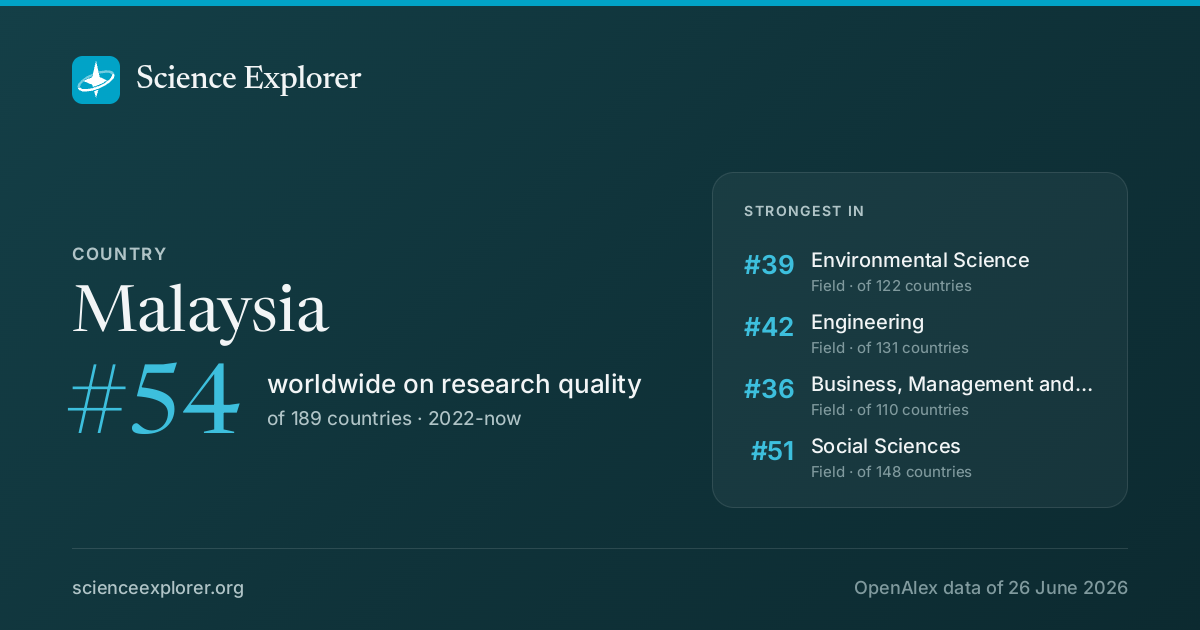
Malaysia ranks #54 of 189 countries on research quality in 2022-now (#57 all time), with 176k research works and 8.9% of them in the world's top 10%.
- World rank, 2022-now
- #54 of 189 · #57 all time
- Works, 2022-now
- 176k ▲ 18% vs 2018-21
- Citations
- 7.9M 13.5 per fractional work, all time
- Top-10% rate
- 8.9% all institutions 10.0%
- vs its own fields
- 0.81× 1.00× is exactly expected
- In the world top 100
- 0 0 in the top 1,000
- Open access
- 56% world 40%
- International
- 23% world 18%
MalaysiaWhat is Malaysia strongest at in science?
On research quality in 2022-now, Malaysia ranks highest in Environmental Science (#39 of 122), Engineering (#42 of 131) and Business, Management and Accounting (#36 of 110). Relative to its size it is most specialised in Accounting, Information Systems and Management and Marketing.
| Field | World rank | Where that sits | Top-10% rate | Works | All time | Institutions |
|---|---|---|---|---|---|---|
| Environmental ScienceField | #39 of 122 | 8.3% | 9,875 | #43 | Institutions | |
| EngineeringField | #42 of 131 | 7.6% | 29,094 | #36 | Institutions | |
| Business, Management and AccountingField | #36 of 110 | 10.1% | 13,843 | #34 | Institutions | |
| Social SciencesField | #51 of 148 | 10.6% | 30,648 | #54 | Institutions | |
| EducationSubfield | #40 of 112 | 10.6% | 12,398 | #40 | Institutions | |
| Computer ScienceField | #47 of 128 | 10.1% | 17,564 | #42 | Institutions | |
| MedicineField | #63 of 152 | 7.1% | 18,703 | #65 | Institutions | |
| Sociology and Political ScienceSubfield | #51 of 119 | 10.6% | 9,700 | #51 | Institutions | |
| PsychologyField | #46 of 106 | 7.4% | 7,109 | #46 | Institutions | |
| EnergyField | #32 of 71 | 9.5% | 2,277 | #30 | Institutions | |
| Information SystemsSubfield | #43 of 90 | 12.0% | 5,823 | #40 | Institutions | |
| Agricultural and Biological SciencesField | #62 of 124 | 9.8% | 7,345 | #63 | Institutions |
Where its research is concentrated
Location quotient: how much more (or less) of each node it does than its size predicts. Drawn around 1×, where "twice the world share" and "half of it" are the same distance apart in opposite directions. A volume reading, which on a country axis is largely population and industrial structure.
- AccountingSubfield · 4,682.4 works · #5 of 208 active here3.9×
- Information Systems and ManagementSubfield · 1,616.7 works · #8 of 213 active here2.9×
- MarketingSubfield · 2,247.3 works · #8 of 204 active here2.7×
- Chemical Health and SafetySubfield · 34.3 works · #14 of 139 active here2.7×
- Computer Graphics and Computer-Aided DesignSubfield · 428.5 works · #10 of 159 active here2.7×
- Business, Management and AccountingField · 15,324.4 works · #8 of 222 active here2.4×
- EducationSubfield · 13,698.6 works · #8 of 222 active here2.3×
- Business and International ManagementSubfield · 469.0 works2.3×
The whole field profile
All 26 fields at once. A specialist and a generalist produce the same ranked list and a completely different shape.
Rings at 0.5×, 1× and 2×. Widest outward: Business, Management and Accounting, 2.4×. Every wedge is a field page.
All 26 fields, with their numbers
- Business, Management and Accounting2.43×15k works
- Decision Sciences1.98×3,744 works
- Energy1.40×2,518 works
- Social Sciences1.38×34k works
- Psychology1.37×8,168 works
- Computer Science1.27×19k works
- Economics, Econometrics and Finance1.24×5,210 works
- Pharmacology, Toxicology and Pharmaceutics1.14×784 works
- Dentistry1.14×1,082 works
- Environmental Science1.13×11k works
- Chemical Engineering1.10×750 works
- Engineering1.08×32k works
- Materials Science1.04×7,079 works
- Nursing0.94×897 works
- Health Professions0.91×4,703 works
- Agricultural and Biological Sciences0.87×8,117 works
- Arts and Humanities0.83×4,665 works
- Chemistry0.72×2,217 works
- Mathematics0.58×1,332 works
- Earth and Planetary Sciences0.57×1,760 works
- Medicine0.57×21k works
- Biochemistry, Genetics and Molecular Biology0.54×5,627 works
- Neuroscience0.54×1,708 works
- Immunology and Microbiology0.53×1,042 works
- Veterinary0.43×113 works
- Physics and Astronomy0.29×1,245 works
Which fields of science does Malaysia work in?
In 2022-now, 40% of research in Malaysia is in Physical Sciences, 36% in Social Sciences. Its largest fields are Social Sciences (17%), Engineering (16%), Medicine (11%). It does 1.5× the world's share of Social Sciences.
Each ring splits the one inside it: the four domains of science, their fields, their subfields. Size is fractional works in 2022-now. Every slice is a page; the interactive view zooms down to single topics and colours each by how much more of it this country does than the world.
Its 4 domains and 26 fields, with their numbers
- Physical Sciences79k40.4%
- Engineering32k16.3%
- Computer Science19k9.9%
- Environmental Science11k5.6%
- Materials Science7,0793.6%
- Energy2,5181.3%
- Chemistry2,2171.1%
- Earth and Planetary Sciences1,7600.9%
- Mathematics1,3320.7%
- Physics and Astronomy1,2450.6%
- Chemical Engineering7500.4%
- Social Sciences71k36.4%
- Social Sciences34k17.4%
- Business, Management and Accounting15k7.8%
- Psychology8,1684.2%
- Economics, Econometrics and Finance5,2102.7%
- Arts and Humanities4,6652.4%
- Decision Sciences3,7441.9%
- Health Sciences28k14.3%
- Medicine21k10.9%
- Health Professions4,7032.4%
- Dentistry1,0820.6%
- Nursing8970.5%
- Veterinary1130.1%
- Life Sciences17k8.8%
- Agricultural and Biological Sciences8,1174.2%
- Biochemistry, Genetics and Molecular Biology5,6272.9%
- Neuroscience1,7080.9%
- Immunology and Microbiology1,0420.5%
- Pharmacology, Toxicology and Pharmaceutics7840.4%
Which keywords describe research in Malaysia?
By fractional works in 2022-now, weighted toward what it does more of than the world: Islamic Education, Risk Management, Machine Learning, Religious Education, Ethical Values, Madrasa, Muslim Students and Curriculum Development.
- Student Satisfaction
- Student Engagement
- Mobile Learning
- Social Capital
- Ethical Identity
- Internet of Things
- Finance
- Healthcare
- Madrasa
- Religious Education
- Consumer Behavior
- Islamic Banking
- Renewable Energy
- Islamic Education
- Teacher Training
- Social Media
- Supply Chain Management
- Educational Technology
- Globalization
- Deep Learning
- Machine Learning
- Sustainability
- Environmental Impact
- Curriculum Development
- Risk Management
- Corporate Governance
- E-Learning
- Education
- Pedagogy
- Online Learning
- Artificial Intelligence
- Ethical Values
- Muslim Students
- Performance Analysis
- Financial Stability
- Global Financial Crisis
- Shariah Supervision
- Technology Integration
- IoT
- Customer Satisfaction
Size is fractional works in 2022-now in the topics tagged with each word; colour is the word's share of this country's work against its share of the world's. The 40 words are chosen for being large and distinctive. Each links to the topic it comes from most.
All 40 words, with their numbers
- Machine Learning9,301▲ 1.43×97 topics
- Deep Learning7,912▲ 1.17×85 topics
- Sustainability6,955▲ 1.46×131 topics
- Globalization6,549▲ 1.70×161 topics
- Environmental Impact5,458▲ 1.64×73 topics
- Educational Technology5,158▲ 2.2×47 topics
- Curriculum Development4,948▲ 3.7×19 topics
- Supply Chain Management4,899▲ 2.8×27 topics
- Risk Management4,842▲ 5.2×19 topics
- Social Media4,822▲ 1.78×40 topics
- Corporate Governance4,726▲ 3.3×31 topics
- Teacher Training4,552▲ 3.8×26 topics
- E-Learning4,527▲ 2.4×26 topics
- Islamic Education4,397▲ 6.8×4 topics
- Education4,374▲ 1.30×135 topics
- Renewable Energy4,324▲ 1.53×61 topics
- Pedagogy4,225▲ 4.3×27 topics
- Islamic Banking3,891▲ 5.3×3 topics
- Online Learning3,862▲ 2.4×27 topics
- Consumer Behavior3,721▲ 3.1×20 topics
- Artificial Intelligence3,704▲ 1.33×65 topics
- Religious Education3,668▲ 12×5 topics
- Ethical Values3,514▲ 19×2 topics
- Madrasa3,513▲ 26×1 topic
- Muslim Students3,513▲ 26×1 topic
- Healthcare3,343▲ 1.50×38 topics
- Performance Analysis3,223▲ 8.0×5 topics
- Finance3,169▲ 8.8×4 topics
- Financial Stability3,143▲ 8.4×8 topics
- Internet of Things3,017▲ 1.80×33 topics
- Global Financial Crisis2,999▲ 12×3 topics
- Ethical Identity2,979▲ 13×1 topic
- Shariah Supervision2,979▲ 13×1 topic
- Social Capital2,937▲ 2.9×20 topics
- Technology Integration2,628▲ 4.3×11 topics
- Mobile Learning2,540▲ 3.8×6 topics
- IoT2,519▲ 3.4×19 topics
- Student Engagement2,391▲ 3.1×17 topics
- Customer Satisfaction2,232▲ 3.6×10 topics
- Student Satisfaction1,789▲ 5.0×4 topics
Which research topics does Malaysia publish the most in?
Its largest topics in 2022-now are Education and Islamic Studies, Islamic Finance and Banking Studies, Technology Adoption and User Behaviour.
Area is fractional works in 2022-now; colour is the subfield each topic belongs to. Every tile is a topic page.
- 1 Education and Islamic Studies Education 3.5k works
- 2 Islamic Finance and Banking Studies Accounting 3k works
- 3 Technology Adoption and User Behaviour Information Systems and Management 1.4k works
- 4 Linguistic, Cultural, and Literary Studies Sociology and Political Science 1.3k works
- 5 Technology-Enhanced Education Studies Education 1.2k works
- 6 Digital Marketing and Social Media Sociology and Political Science 1.1k works
- 7 Organizational and Employee Performance Artificial Intelligence 947 works
- 8 Halal products and consumer behavior Sociology and Political Science 862 works
- 9 Environmental Sustainability in Business Marketing 751 works
- 10 COVID-19 Pandemic Impacts Economics and Econometrics 678 works
- 11 Entrepreneurship Studies and Influences Management of Technology and Innovation 677 works
- 12 Islamic Finance and Communication Sociology and Political Science 675 works
Which universities in Malaysia lead research?
Northern University of Malaysia, University of Technology Malaysia and Multimedia University rank highest in Malaysia on research quality in 2022-now.
One dot per institution in the list below. The upper left is the interesting corner.
- 1Northern University of MalaysiaUniversity · Jitra · #1,234 worldwide9.8% top 10% · 3.7k works
- 2University of Technology MalaysiaUniversity · Johor Bahru · #1,480 worldwide8.7% top 10% · 9.8k works
- 3Multimedia UniversityUniversity · Malacca · #1,570 worldwide11.9% top 10% · 2.8k works
- 4Universiti Tenaga NasionalUniversity · Kuala Selangor · #1,767 worldwide13.7% top 10% · 1.7k works
- 5Sultan Idris Education UniversityUniversity · Kuala Lumpur · #1,774 worldwide9.0% top 10% · 4.2k works
- 6Taylor's UniversityUniversity · Subang Jaya · #1,905 worldwide12.9% top 10% · 1.8k works
- 7Sunway UniversityUniversity · Petaling Jaya · #1,908 worldwide19.1% top 10% · 1.9k works
- 8Universiti Malaysia TerengganuUniversity · Kuala Terengganu · #1,912 worldwide9.3% top 10% · 2.9k works
- 9UCSI UniversityUniversity · Kuala Lumpur · #1,994 worldwide13.0% top 10% · 1.9k works
- 10National University of MalaysiaUniversity · Bangi · #2,054 worldwide11.8% top 10% · 14k works
- 11Universiti Sains MalaysiaUniversity · George Town · #2,081 worldwide11.1% top 10% · 14k works
- 12Monash University MalaysiaUniversity · Subang Jaya · #2,103 worldwide15.0% top 10% · 2.1k works
- 13Universiti Putra MalaysiaUniversity · Seri Kembangan · #2,142 worldwide10.0% top 10% · 11k works
- 14University of MalayaUniversity · Kuala Lumpur · #2,211 worldwide11.5% top 10% · 12k works
- 15City University MalaysiaUniversity · Kuala Selangor · #2,296 worldwide5.9% top 10% · 844 works
The track on each row is its top-10% rate; the tick is the average of all institutions, 10.0% (how it is set): teal above it, red below.
All ranked institutions in MalaysiaWho are the top researchers in Malaysia?
Arshian Sharif, Keng‐Boon Ooi and Mohammad Iranmanesh rank highest among researchers based in Malaysia.
- 1 Arshian Sharif #112 worldwide 23k citations · 262 works
- 2 Keng‐Boon Ooi #311 worldwide 27k citations · 262 works
- 3 Mohammad Iranmanesh #458 worldwide 17k citations · 224 works
- 4 Hesam Kamyab #791 worldwide 20k citations · 370 works
- 5 Bassim H. Hameed #1,891 worldwide 63k citations · 395 works
- 6 Su Shiung Lam #3,371 worldwide 38k citations · 627 works
- 7 Abbas Mardani #3,784 worldwide 25k citations · 272 works
- 8 Hwai Chyuan Ong #4,232 worldwide 39k citations · 426 works
- 9 Pau Loke Show #4,766 worldwide 60k citations · 935 works
- 10 Ahmed Shihab Albahri #5,301 worldwide 12k citations · 200 works
Which cities in Malaysia are research hubs?
- 1
Kuala LumpurMalaysia
181k works
- 2
Shah AlamMalaysia
51k works
- 3
Johor BahruMalaysia
46k works
- 4
George TownMalaysia
46k works
- 5
Seri KembanganMalaysia
42k works
- 6
MalaccaMalaysia
20k works
How much of it is in the largest
The same cities as shares of everything these twelve account for.
Shares of the rows listed above, not of the whole node.
How open and international is Malaysia's research?
56% of its research is openly available (world: 40%), and 23% is written with international co-authors (world: 18%).
World: 40% of research is openly available.
World: 18% is written across borders.
In 2022-now, 69% of its research is openly available (world 63%) and 30% is written with co-authors abroad (world 22%). Against what its own mix of topics predicts, that is 1.07× the expected open access and 1.45× the expected international share, which puts it #111 of 173 countries on openness.
How has Malaysia's research grown?
Output in 2022-2025 was 18% higher than in 2018-2021.
The same series as a ribbon: one cell per year, darker for more. The line above answers how much; this answers when.
Its share of all research
Growing output can still be a shrinking share: all of science grows. This is Malaysia as a percentage of every work published that year, 0.80% in 2024.
Fractional works of Malaysia over all fractional works that year. How the balance of science has shifted.
How much of it reaches the world top 10%
Over the whole record, 8.8% of its 587k works since 1950 reached the world top 10% for their field and year.
Of each year's output, the share that reached the world's 10% most cited for its field and year. Peak 9.7% in 2012.
Which countries have research most like Malaysia's?
Brunei is Malaysia's closest research twin: of all countries, its research is spread across the fields most like Malaysia's, with both strong in Business, Management and Accounting.
- 1
 BruneiBoth strong in Business, Management and Accounting, Energy, Social Sciences
0.83 Compare
- 2
 OmanBoth strong in Business, Management and Accounting, Decision Sciences, Energy
0.74 Compare
- 3
 LatviaBoth strong in Business, Management and Accounting, Decision Sciences, Energy
0.74 Compare
- 4
 MauritiusBoth strong in Business, Management and Accounting, Decision Sciences, Energy
0.72 Compare
- 5
 United Arab EmiratesBoth strong in Decision Sciences, Business, Management and Accounting, Energy
0.71 Compare
Similarity is the correlation of each side's location quotients across every field it publishes in, on a log scale: 1 is the same shape of research, 0 is unrelated. It ignores size. How it is measured.
Compare Malaysia with
 Peru
 Ecuador
 Croatia
 Slovakia
 Ethiopia
 Kenya
Share Malaysia's ranking



Research fields in Malaysia
- Social Sciences
- Physical Sciences
- Environmental Science
- Engineering
- Business, Management and Accounting
- Social Sciences
- Education
- Computer Science
- Health Sciences
- Medicine
- Sociology and Political Science
- Psychology
- Energy
- Information Systems
- Life Sciences
- Agricultural and Biological Sciences
- Health Professions
- Economics, Econometrics and Finance
- Decision Sciences
- Artificial Intelligence
- Accounting
- Biomedical Engineering
- Electrical and Electronic Engineering
- Economics and Econometrics
- Building and Construction
- Arts and Humanities
- Civil and Structural Engineering
- Materials Science
- Biochemistry, Genetics and Molecular Biology
- Mechanical Engineering
- Strategy and Management
- Renewable Energy, Sustainability and the Environment
- Management Information Systems
- Control and Systems Engineering
- Computer Networks and Communications
- Materials Chemistry
- Water Science and Technology
- Environmental Engineering
- Computer Vision and Pattern Recognition
- Earth and Planetary Sciences
- Aerospace Engineering
- Global and Planetary Change
- Social Psychology
- Automotive Engineering
- Political Science and International Relations
- Molecular Biology
- Plant Science
- Chemistry
- Oncology
- Industrial and Manufacturing Engineering
- Media Technology
- General Health Professions
- Polymers and Plastics
- Surgery
- Marketing
- Management Science and Operations Research
- Pharmacology, Toxicology and Pharmaceutics
- Pollution
- Pulmonary and Respiratory Medicine
- Dentistry
Questions people ask
What is Malaysia strongest at in science?
On research quality in 2022-now, Malaysia ranks highest in Environmental Science (#39 of 122), Engineering (#42 of 131) and Business, Management and Accounting (#36 of 110). Relative to its size it is most specialised in Accounting, Information Systems and Management and Marketing.
See the full answerWho are the top scientists in Malaysia?
Arshian Sharif, Keng‐Boon Ooi and Mohammad Iranmanesh rank highest among researchers based in Malaysia.
Who are the top researchers in Malaysia?Discussion
Ask a question or share a note about Malaysia. Keep it to the research: no personal attacks, advertising or links. Any reader can report a post, which collapses it for everyone until it is opened.