 Science in Brunei
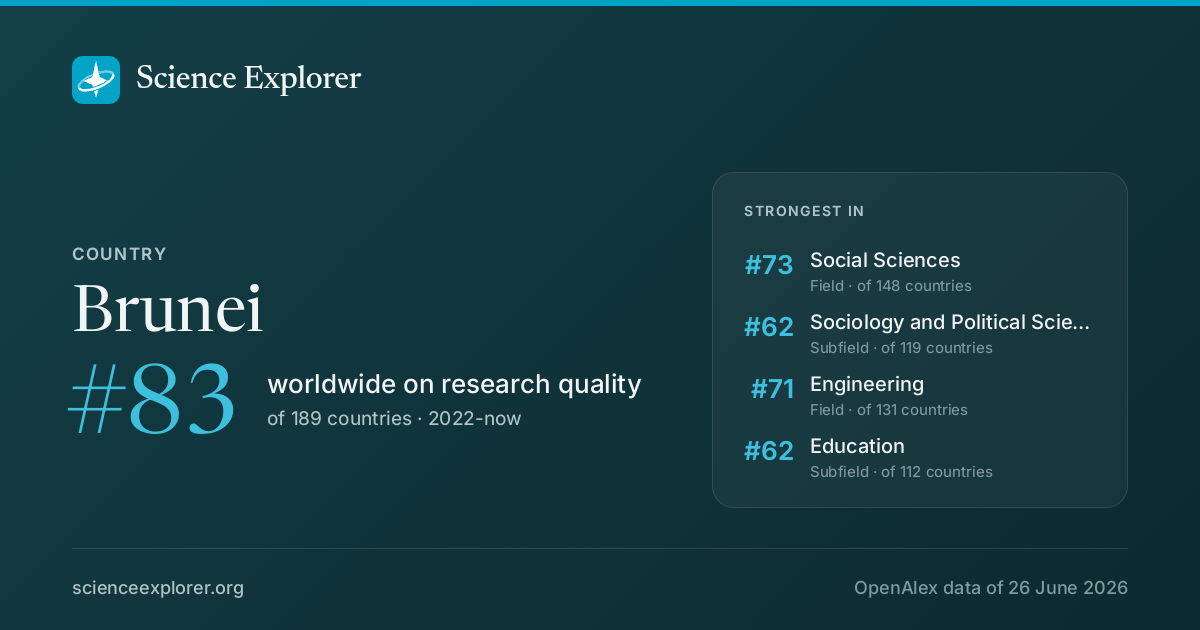
Brunei ranks #83 of 189 countries on research quality in 2022-now (#95 all time), with 3.8k research works and 14.2% of them in the world's top 10%.
- World rank, 2022-now
- #83 of 189 · #95 all time
- Works, 2022-now
- 3.8k ▲ 69% vs 2018-21
- Citations
- 131k 13.0 per fractional work, all time
- Top-10% rate
- 14.2% all institutions 10.0%
- vs its own fields
- 1.11× 1.00× is exactly expected
- In the world top 100
- 0 0 in the top 1,000
- Open access
- 45% world 40%
- International
- 40% world 18%
BruneiWhat is Brunei strongest at in science?
On research quality in 2022-now, Brunei ranks highest in Social Sciences (#73 of 148), Sociology and Political Science (#62 of 119) and Engineering (#71 of 131). Relative to its size it is most specialised in Research and Theory, Accounting and Linguistics and Language.
| Field | World rank | Where that sits | Top-10% rate | Works | All time | Institutions |
|---|---|---|---|---|---|---|
| Social SciencesField | #73 of 148 | 16.0% | 930 | #79 | Institutions | |
| Sociology and Political ScienceSubfield | #62 of 119 | 15.0% | 374 | #71 | Institutions | |
| EngineeringField | #71 of 131 | 12.1% | 480 | #76 | Institutions | |
| EducationSubfield | #62 of 112 | 17.5% | 257 | #65 | Institutions | |
| Computer ScienceField | #77 of 128 | 17.5% | 318 | #80 | Institutions | |
| Environmental ScienceField | #76 of 122 | 12.8% | 263 | #86 | Institutions | |
| Business, Management and AccountingField | #71 of 110 | 17.2% | 284 | #75 | Institutions | |
| MedicineField | #112 of 152 | 9.5% | 276 | #139 | Institutions |
Where its research is concentrated
Location quotient: how much more (or less) of each node it does than its size predicts. Drawn around 1×, where "twice the world share" and "half of it" are the same distance apart in opposite directions. A volume reading, which on a country axis is largely population and industrial structure.
- Research and TheorySubfield · 5.5 works · #75 of 183 active here5.1×
- AccountingSubfield · 109.0 works · #90 of 208 active here4.3×
- Linguistics and LanguageSubfield · 20.0 works · #94 of 194 active here4.2×
- Chemical Health and SafetySubfield · 1.0 works · #96 of 139 active here3.7×
- Business and International ManagementSubfield · 15.0 works · #87 of 192 active here3.4×
- Aquatic ScienceSubfield · 24.4 works · #92 of 214 active here3.2×
- Health InformaticsSubfield · 14.8 works · #96 of 205 active here2.9×
- Sociology and Political ScienceSubfield · 412.2 works · #103 of 224 active here2.7×
The whole field profile
All 26 fields at once. A specialist and a generalist produce the same ranked list and a completely different shape.
Rings at 0.5×, 1× and 2×. Widest outward: Business, Management and Accounting, 2.3×. Every wedge is a field page.
All 26 fields, with their numbers
- Business, Management and Accounting2.29×309 works
- Energy2.06×79 works
- Social Sciences1.96×1,038 works
- Economics, Econometrics and Finance1.65×148 works
- Environmental Science1.42×296 works
- Materials Science1.38×202 works
- Decision Sciences1.11×45 works
- Arts and Humanities1.08×131 works
- Computer Science1.07×349 works
- Chemical Engineering1.06×16 works
- Nursing1.04×21 works
- Agricultural and Biological Sciences0.98×195 works
- Psychology0.96×123 works
- Earth and Planetary Sciences0.91×60 works
- Health Professions0.86×94 works
- Engineering0.84×526 works
- Chemistry0.78×51 works
- Pharmacology, Toxicology and Pharmaceutics0.67×10 works
- Mathematics0.57×28 works
- Dentistry0.55×11 works
- Veterinary0.46×3 works
- Biochemistry, Genetics and Molecular Biology0.41×90 works
- Medicine0.39×311 works
- Neuroscience0.29×20 works
- Immunology and Microbiology0.28×12 works
- Physics and Astronomy0.21×19 works
Which fields of science does Brunei work in?
In 2022-now, 43% of research in Brunei is in Social Sciences, 39% in Physical Sciences. Its largest fields are Social Sciences (25%), Engineering (13%), Computer Science (8%). It does 1.7× the world's share of Social Sciences.
Each ring splits the one inside it: the four domains of science, their fields, their subfields. Size is fractional works in 2022-now. Every slice is a page; the interactive view zooms down to single topics and colours each by how much more of it this country does than the world.
Its 4 domains and 26 fields, with their numbers
- Social Sciences1,79442.8%
- Social Sciences1,03824.8%
- Business, Management and Accounting3097.4%
- Economics, Econometrics and Finance1483.5%
- Arts and Humanities1313.1%
- Psychology1232.9%
- Decision Sciences451.1%
- Physical Sciences1,62638.8%
- Engineering52612.6%
- Computer Science3498.3%
- Environmental Science2967.1%
- Materials Science2024.8%
- Energy791.9%
- Earth and Planetary Sciences601.4%
- Chemistry511.2%
- Mathematics280.7%
- Physics and Astronomy190.5%
- Chemical Engineering160.4%
- Health Sciences44110.5%
- Medicine3117.4%
- Health Professions942.3%
- Nursing210.5%
- Dentistry110.3%
- Veterinary30.1%
- Life Sciences3277.8%
Which keywords describe research in Brunei?
By fractional works in 2022-now, weighted toward what it does more of than the world: Globalization, Islamic Banking, Islamic Education, Finance, Financial Stability, Risk Management, Sustainability and Global Financial Crisis.
- Civil Society
- Halal Tourism
- Decentralization
- Tourist Satisfaction
- Muslim Students
- Cultural Identity
- Indonesia
- Social Capital
- Shariah Supervision
- Performance Analysis
- Ethnicity
- Financial Stability
- Economic Development
- Educational Technology
- Teacher Training
- Education
- Curriculum Development
- Corporate Governance
- Environmental Impact
- Machine Learning
- Globalization
- Sustainability
- Islamic Banking
- Supply Chain Management
- Consumer Behavior
- Islamic Education
- Risk Management
- Social Media
- Finance
- Human Rights
- Global Financial Crisis
- Ethical Identity
- Pedagogy
- Religious Education
- Gender Equality
- Madrasa
- Food Safety
- Religiosity
- Halal Products
- Corruption
Size is fractional works in 2022-now in the topics tagged with each word; colour is the word's share of this country's work against its share of the world's. The 40 words are chosen for being large and distinctive. Each links to the topic it comes from most.
All 40 words, with their numbers
- Globalization232▲ 2.8×78 topics
- Machine Learning189▲ 1.36×81 topics
- Sustainability185▲ 1.81×81 topics
- Environmental Impact130▲ 1.82×53 topics
- Islamic Banking122▲ 7.8×3 topics
- Corporate Governance118▲ 3.9×22 topics
- Supply Chain Management118▲ 3.1×22 topics
- Curriculum Development114▲ 4.0×13 topics
- Consumer Behavior112▲ 4.3×15 topics
- Education111▲ 1.55×66 topics
- Islamic Education108▲ 7.8×4 topics
- Teacher Training107▲ 4.2×10 topics
- Risk Management105▲ 5.2×13 topics
- Educational Technology103▲ 2.1×29 topics
- Social Media98▲ 1.70×28 topics
- Economic Development96▲ 2.9×33 topics
- Finance92▲ 12×4 topics
- Financial Stability91▲ 11×4 topics
- Human Rights88▲ 2.0×48 topics
- Ethnicity87▲ 5.6×13 topics
- Global Financial Crisis87▲ 16×3 topics
- Performance Analysis86▲ 10×4 topics
- Ethical Identity85▲ 18×1 topic
- Shariah Supervision85▲ 18×1 topic
- Pedagogy85▲ 4.0×12 topics
- Social Capital77▲ 3.5×17 topics
- Religious Education75▲ 11×4 topics
- Indonesia73▲ 4.0×5 topics
- Gender Equality70▲ 5.9×11 topics
- Cultural Identity68▲ 3.3×13 topics
- Madrasa67▲ 23×1 topic
- Muslim Students67▲ 23×1 topic
- Food Safety65▲ 5.5×12 topics
- Tourist Satisfaction65▲ 15×2 topics
- Religiosity60▲ 31×2 topics
- Decentralization60▲ 6.9×4 topics
- Halal Products58▲ 44×1 topic
- Halal Tourism58▲ 44×1 topic
- Corruption51▲ 7.8×7 topics
- Civil Society51▲ 11×5 topics
Which research topics does Brunei publish the most in?
Its largest topics in 2022-now are Islamic Finance and Banking Studies, Education and Islamic Studies, Halal products and consumer behavior.
Area is fractional works in 2022-now; colour is the subfield each topic belongs to. Every tile is a topic page.
- 1 Islamic Finance and Banking Studies Accounting 85 works
- 2 Education and Islamic Studies Education 67 works
- 3 Halal products and consumer behavior Sociology and Political Science 58 works
- 4 Asian Studies and History Sociology and Political Science 38 works
- 5 Linguistic, Cultural, and Literary Studies Sociology and Political Science 38 works
- 6 Islamic Finance and Communication Sociology and Political Science 25 works
- 7 Advanced Photocatalysis Techniques Renewable Energy, Sustainability and the Environment 24 works
- 8 Socioeconomic Development in Asia Sociology and Political Science 23 works
- 9 COVID-19 Pandemic Impacts Economics and Econometrics 22 works
- 10 Islamic Studies and Radicalism Sociology and Political Science 21 works
- 11 Education and Character Development Education 20 works
- 12 Technology-Enhanced Education Studies Education 20 works
Which universities in Brunei lead research?
Universiti Brunei Darussalam, Universiti Teknologi Brunei and Sultan Sharif Ali Islamic University rank highest in Brunei on research quality in 2022-now.
One dot per institution in the list below. The upper left is the interesting corner.
- 1Universiti Brunei DarussalamUniversity · Bandar Seri Begawan · #1,984 worldwide16.8% top 10% · 2.2k works
- 2Universiti Teknologi BruneiUniversity · Bandar Seri Begawan · #3,187 worldwide10.5% top 10% · 681 works
- 3Sultan Sharif Ali Islamic UniversityUniversity · Bandar Seri Begawan · #5,359 worldwide11.7% top 10% · 414 works
- 4Ministry of EducationGovernment institution · Bandar Seri Begawan · #9,563 worldwide15.2% top 10% · 112 works
- 5Prime Minister's OfficeGovernment institution · Bandar Seri Begawan · #11,777 worldwide8.1% top 10% · 134 works
- 6Ministry of HealthGovernment institution · Bandar Seri Begawan · #18,077 worldwide9.4% top 10% · 72 works
- 7Raja Isteri Pengiran Anak Saleha HospitalHospital / health system · Bandar Seri Begawan · #21,654 worldwide2.9% top 10% · 80 works
The track on each row is its top-10% rate; the tick is the average of all institutions, 10.0% (how it is set): teal above it, red below.
All ranked institutions in BruneiWho are the top researchers in Brunei?
Rama Rao Karri, Sok King Ong and Nabisab Mujawar Mubarak rank highest among researchers based in Brunei.
- 1 Rama Rao Karri #8,520 worldwide 11k citations · 318 works
- 2 Sok King Ong #9,311 worldwide 144k citations · 101 works
- 3 Nabisab Mujawar Mubarak #18,001 worldwide 23k citations · 535 works
- 4 M. Muzamil Naqshbandi #20,911 worldwide 3.1k citations · 75 works
- 5 Ferry J.W. Slik #34,574 worldwide 7.4k citations · 134 works
- 6 Atika Qazi #54,169 worldwide 4k citations · 80 works
- 7 Wasswa Shafik #126,610 worldwide 3.7k citations · 386 works
- 8 Shaista Wasiuzzaman #202,776 worldwide 2.7k citations · 77 works
- 9 Sivakumar Manickam #229,848 worldwide 15k citations · 453 works
- 10 Kamariah Abu Salim #235,682 worldwide 5.5k citations · 70 works
How open and international is Brunei's research?
45% of its research is openly available (world: 40%), and 40% is written with international co-authors (world: 18%).
World: 40% of research is openly available.
World: 18% is written across borders.
In 2022-now, 57% of its research is openly available (world 63%) and 46% is written with co-authors abroad (world 22%). Against what its own mix of topics predicts, that is 0.88× the expected open access and 2.11× the expected international share, which puts it #133 of 173 countries on openness.
How has Brunei's research grown?
Output in 2022-2025 was 69% higher than in 2018-2021.
The same series as a ribbon: one cell per year, darker for more. The line above answers how much; this answers when.
Its share of all research
Growing output can still be a shrinking share: all of science grows. This is Brunei as a percentage of every work published that year, 0.018% in 2024.
Fractional works of Brunei over all fractional works that year. How the balance of science has shifted.
How much of it reaches the world top 10%
Over the whole record, 11.4% of its 10k works since 1951 reached the world top 10% for their field and year.
Of each year's output, the share that reached the world's 10% most cited for its field and year. Peak 14.7% in 1990.
Which countries have research most like Brunei's?
Malaysia is Brunei's closest research twin: of all countries, its research is spread across the fields most like Brunei's, with both strong in Business, Management and Accounting.
- 1
 MalaysiaBoth strong in Business, Management and Accounting, Energy, Social Sciences
0.83 Compare
- 2
 LatviaBoth strong in Business, Management and Accounting, Economics, Econometrics and Finance, Energy
0.82 Compare
- 3
 MauritiusBoth strong in Business, Management and Accounting, Energy, Economics, Econometrics and Finance
0.76 Compare
- 4
 OmanBoth strong in Business, Management and Accounting, Energy, Economics, Econometrics and Finance
0.71 Compare
- 5
 IndonesiaBoth strong in Business, Management and Accounting, Social Sciences, Economics, Econometrics and Finance
0.67 Compare
Similarity is the correlation of each side's location quotients across every field it publishes in, on a log scale: 1 is the same shape of research, 0 is unrelated. It ignores size. How it is measured.
Compare Brunei with
 Nicaragua
 Costa Rica
 Zambia
 Jordan
 Uruguay
 Palestine
Share Brunei's ranking
Badges for a website1Each links back here and updates with every snapshot

Research fields in Brunei
Discussion
Ask a question or share a note about Brunei. Posts are plain text and can be reported.