 Science in Latvia
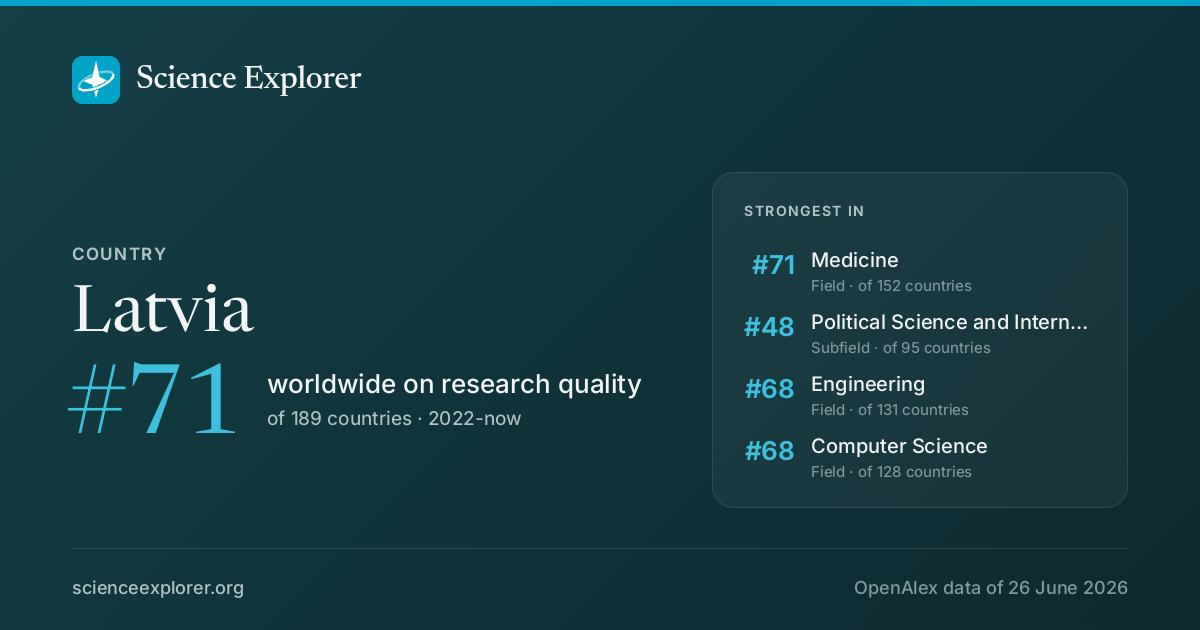
Latvia ranks #71 of 189 countries on research quality in 2022-now (#97 all time), with 13k research works and 6.8% of them in the world's top 10%.
- World rank, 2022-now
- #71 of 189 · #97 all time
- Works, 2022-now
- 13k ▲ 3% vs 2018-21
- Citations
- 554k 9.4 per fractional work, all time
- Top-10% rate
- 6.8% all institutions 10.0%
- vs its own fields
- 0.66× 1.00× is exactly expected
- In the world top 100
- 0 0 in the top 1,000
- Open access
- 57% world 40%
- International
- 30% world 18%
LatviaWhat is Latvia strongest at in science?
On research quality in 2022-now, Latvia ranks highest in Medicine (#71 of 152), Political Science and International Relations (#48 of 95) and Engineering (#68 of 131). Relative to its size it is most specialised in General Energy, Political Science and International Relations and General Economics, Econometrics and Finance.
| Field | World rank | Where that sits | Top-10% rate | Works | All time | Institutions |
|---|---|---|---|---|---|---|
| MedicineField | #71 of 152 | 7.8% | 1,371 | #105 | Institutions | |
| Political Science and International RelationsSubfield | #48 of 95 | 8.3% | 687 | #55 | Institutions | |
| EngineeringField | #68 of 131 | 5.4% | 1,862 | #74 | Institutions | |
| Computer ScienceField | #68 of 128 | 6.9% | 828 | #77 | Institutions | |
| Social SciencesField | #81 of 148 | 7.7% | 2,433 | #87 | Institutions | |
| Business, Management and AccountingField | #65 of 110 | 8.1% | 924 | #63 | Institutions | |
| Arts and HumanitiesField | #61 of 103 | 8.9% | 458 | #85 | Institutions | |
| Agricultural and Biological SciencesField | #75 of 124 | 7.0% | 829 | #103 | Institutions | |
| Sociology and Political ScienceSubfield | #76 of 119 | 7.1% | 588 | #88 | Institutions | |
| EducationSubfield | #73 of 112 | 9.8% | 320 | #90 | Institutions | |
| Economics, Econometrics and FinanceField | #72 of 107 | 7.6% | 626 | #71 | Institutions | |
| Biochemistry, Genetics and Molecular BiologyField | #71 of 105 | 5.3% | 487 | #82 | Institutions |
Where its research is concentrated
Location quotient: how much more (or less) of each node it does than its size predicts. Drawn around 1×, where "twice the world share" and "half of it" are the same distance apart in opposite directions. A volume reading, which on a country axis is largely population and industrial structure.
- General EnergySubfield · 19.1 works · #59 of 167 active here4.8×
- Political Science and International RelationsSubfield · 750.6 works · #63 of 219 active here3.4×
- General Economics, Econometrics and FinanceSubfield · 118.9 works · #66 of 211 active here3.2×
- Management of Technology and InnovationSubfield · 140.7 works · #67 of 208 active here3.1×
- LawSubfield · 259.0 works · #42 of 212 active here3.0×
- Life-span and Life-course StudiesSubfield · 6.6 works · #62 of 144 active here2.7×
- Urban StudiesSubfield · 109.1 works · #66 of 204 active here2.7×
- Strategy and ManagementSubfield · 332.0 works · #70 of 213 active here2.6×
The whole field profile
All 26 fields at once. A specialist and a generalist produce the same ranked list and a completely different shape.
Rings at 0.5×, 1× and 2×. Widest outward: Business, Management and Accounting, 2.2×. Every wedge is a field page.
All 26 fields, with their numbers
- Business, Management and Accounting2.19×1,036 works
- Economics, Econometrics and Finance2.18×685 works
- Energy1.49×202 works
- Decision Sciences1.48×211 works
- Social Sciences1.46×2,709 works
- Environmental Science1.34×982 works
- Agricultural and Biological Sciences1.31×915 works
- Arts and Humanities1.20×512 works
- Psychology1.02×456 works
- Materials Science0.97×498 works
- Engineering0.94×2,084 works
- Chemistry0.88×203 works
- Computer Science0.82×936 works
- Pharmacology, Toxicology and Pharmaceutics0.81×42 works
- Nursing0.79×57 works
- Veterinary0.76×15 works
- Chemical Engineering0.75×38 works
- Dentistry0.75×54 works
- Health Professions0.75×292 works
- Biochemistry, Genetics and Molecular Biology0.71×555 works
- Earth and Planetary Sciences0.70×161 works
- Physics and Astronomy0.67×220 works
- Medicine0.56×1,578 works
- Immunology and Microbiology0.52×77 works
- Neuroscience0.48×114 works
- Mathematics0.44×76 works
Which fields of science does Latvia work in?
In 2022-now, 38% of research in Latvia is in Social Sciences, 37% in Physical Sciences. Its largest fields are Social Sciences (18%), Engineering (14%), Medicine (11%). It does 1.5× the world's share of Social Sciences.
Each ring splits the one inside it: the four domains of science, their fields, their subfields. Size is fractional works in 2022-now. Every slice is a page; the interactive view zooms down to single topics and colours each by how much more of it this country does than the world.
Its 4 domains and 26 fields, with their numbers
- Social Sciences5,60838.1%
- Social Sciences2,70918.4%
- Business, Management and Accounting1,0367.0%
- Economics, Econometrics and Finance6854.7%
- Arts and Humanities5123.5%
- Psychology4563.1%
- Decision Sciences2111.4%
- Physical Sciences5,40036.7%
- Engineering2,08414.2%
- Environmental Science9826.7%
- Computer Science9366.4%
- Materials Science4983.4%
- Physics and Astronomy2201.5%
- Chemistry2031.4%
- Energy2021.4%
- Earth and Planetary Sciences1611.1%
- Mathematics760.5%
- Chemical Engineering380.3%
- Health Sciences1,99513.6%
- Medicine1,57810.7%
- Health Professions2922.0%
- Nursing570.4%
- Dentistry540.4%
- Veterinary150.1%
- Life Sciences1,70311.6%
Which keywords describe research in Latvia?
By fractional works in 2022-now, weighted toward what it does more of than the world: Sustainability, Human Rights, Sustainable Development, Renewable Energy, Innovation, Climate Change, Globalization and Environmental Management.
- Environmental Protection
- Resource Efficiency
- Postcolonial Theory
- Cold War
- Life Cycle Assessment
- Soviet Union
- Global Governance
- European Integration
- Digital Transformation
- European Union
- Corporate Governance
- Big Data
- Environmental Management
- Education
- Energy Efficiency
- Innovation
- Artificial Intelligence
- Renewable Energy
- Human Rights
- Sustainable Development
- Sustainability
- Climate Change
- Globalization
- Environmental Impact
- Machine Learning
- Epidemiology
- Economic Development
- Supply Chain Management
- Economic Growth
- International Law
- Social Capital
- International Relations
- Entrepreneurship
- Legal Regulation
- Criminal Justice
- Diplomacy
- Eastern Europe
- Cultural Integration
- Australia
- Financial Security
Size is fractional works in 2022-now in the topics tagged with each word; colour is the word's share of this country's work against its share of the world's. The 40 words are chosen for being large and distinctive. Each links to the topic it comes from most.
All 40 words, with their numbers
- Sustainability717▲ 2.0×112 topics
- Sustainable Development539▲ 2.3×96 topics
- Climate Change538▲ 1.35×116 topics
- Human Rights509▲ 3.4×76 topics
- Globalization452▲ 1.56×140 topics
- Renewable Energy451▲ 2.1×56 topics
- Environmental Impact389▲ 1.55×69 topics
- Artificial Intelligence388▲ 1.85×60 topics
- Machine Learning385▼ 0.79×87 topics
- Innovation379▲ 2.5×75 topics
- Epidemiology361▼ 0.62×133 topics
- Energy Efficiency304▲ 2.2×43 topics
- Economic Development288▲ 2.5×46 topics
- Education281◆ 1.11×120 topics
- Supply Chain Management260▲ 1.97×24 topics
- Environmental Management254▲ 4.2×19 topics
- Economic Growth238▲ 1.99×33 topics
- Big Data228▲ 1.62×31 topics
- International Law208▲ 4.5×31 topics
- Corporate Governance206▲ 1.90×28 topics
- Social Capital203▲ 2.7×18 topics
- European Union198▲ 6.0×25 topics
- International Relations187▲ 5.2×25 topics
- Digital Transformation182▲ 2.3×28 topics
- Entrepreneurship176▲ 3.0×21 topics
- European Integration149▲ 18×5 topics
- Legal Regulation137▲ 4.2×8 topics
- Global Governance136▲ 3.9×25 topics
- Criminal Justice135▲ 4.1×8 topics
- Soviet Union129▲ 16×3 topics
- Diplomacy127▲ 9.3×7 topics
- Life Cycle Assessment122▲ 3.0×8 topics
- Eastern Europe118▲ 15×3 topics
- Cold War118▲ 13×5 topics
- Cultural Integration114▲ 3.6×3 topics
- Postcolonial Theory108▲ 28×3 topics
- Australia106▲ 45×1 topic
- Resource Efficiency100▲ 5.0×3 topics
- Financial Security98▲ 6.3×3 topics
- Environmental Protection93▲ 13×10 topics
Which research topics does Latvia publish the most in?
Its largest topics in 2022-now are Historical Geopolitical and Social Dynamics, Legal Studies and Reforms, Business and Economic Development.
Area is fractional works in 2022-now; colour is the subfield each topic belongs to. Every tile is a topic page.
- 1 Historical Geopolitical and Social Dynamics Political Science and International Relations 106 works
- 2 Legal Studies and Reforms Political Science and International Relations 58 works
- 3 Business and Economic Development Management, Monitoring, Policy and Law 57 works
- 4 European and International Law Studies Political Science and International Relations 56 works
- 5 Entrepreneurship Studies and Influences Management of Technology and Innovation 54 works
- 6 European Linguistics and Anthropology Anthropology 48 works
- 7 Sustainable Supply Chain Management Strategy and Management 47 works
- 8 Integrated Energy Systems Optimization Electrical and Electronic Engineering 46 works
- 9 Environmental Sustainability in Business Marketing 45 works
- 10 Economic and Business Development Strategies Economics and Econometrics 45 works
- 11 Digital Marketing and Social Media Sociology and Political Science 45 works
- 12 Building Energy and Comfort Optimization Building and Construction 45 works
Which universities in Latvia lead research?
Riga Technical University, University of Latvia and College of Business Administration rank highest in Latvia on research quality in 2022-now.
One dot per institution in the list below. The upper left is the interesting corner.
- 1Riga Technical UniversityUniversity · Riga · #2,639 worldwide5.8% top 10% · 2.3k works
- 2University of LatviaUniversity · Riga · #4,278 worldwide6.1% top 10% · 2.9k works
- 3College of Business AdministrationUniversity · Riga · #4,376 worldwide14.5% top 10% · 444 works
- 4College of LawUniversity · Riga · #4,792 worldwide5.7% top 10% · 1k works
- 5Riga Stradiņš UniversityUniversity · Riga · #5,243 worldwide9.9% top 10% · 1k works
- 6Latvia University of Life Sciences and TechnologiesUniversity · Jelgava · #7,073 worldwide3.9% top 10% · 844 works
- 7Transport and Telecommunication InstituteUniversity · Riga · #7,168 worldwide12.8% top 10% · 238 works
- 8Latvian Academy of CultureUniversity · Riga · #7,283 worldwide8.7% top 10% · 244 works
- 9Daugavpils UniversityUniversity · Daugavpils · #8,244 worldwide7.2% top 10% · 434 works
- 10Rezekne Academy of TechnologiesUniversity · Rēzekne · #9,689 worldwide3.0% top 10% · 358 works
- 11Latvian Maritime AcademyUniversity · Riga · #11,784 worldwide5.6% top 10% · 150 works
- 12Turība UniversityUniversity · Riga · #11,892 worldwide5.4% top 10% · 179 works
- 13ISMA UniversityUniversity · Riga · #13,977 worldwide3.3% top 10% · 147 works
- 14University of LiepājaUniversity · Liepāja · #14,035 worldwide5.3% top 10% · 142 works
- 15Vidzeme University of Applied SciencesUniversity · Valmiera · #14,148 worldwide5.9% top 10% · 112 works
The track on each row is its top-10% rate; the tick is the average of all institutions, 10.0% (how it is set): teal above it, red below.
All ranked institutions in LatviaWho are the top researchers in Latvia?
Andrejs Ērglis, Kristaps Klavins and Laima Tihomirova rank highest among researchers based in Latvia.
- 1 Andrejs Ērglis #117,746 worldwide 36k citations · 513 works
- 2 Kristaps Klavins #165,683 worldwide 3.6k citations · 104 works
- 3 Laima Tihomirova #186,734 worldwide 4.7k citations · 46 works
- 4 Liene Ņikitina-Zaķe #227,666 worldwide 18k citations · 108 works
- 5 Oskar Faix #233,046 worldwide 11k citations · 135 works
- 6 Sandra Šūmane #261,380 worldwide 1.9k citations · 27 works
- 7 Juris Vīksna #294,848 worldwide 18k citations · 148 works
- 8 Mārcis Leja #321,477 worldwide 11k citations · 374 works
- 9 Dace Zavadska #341,398 worldwide 2.2k citations · 146 works
- 10 Andris Zeltiņš #351,568 worldwide 2.3k citations · 66 works
Which cities in Latvia are research hubs?
How open and international is Latvia's research?
57% of its research is openly available (world: 40%), and 30% is written with international co-authors (world: 18%).
World: 40% of research is openly available.
World: 18% is written across borders.
In 2022-now, 77% of its research is openly available (world 63%) and 28% is written with co-authors abroad (world 22%). Against what its own mix of topics predicts, that is 1.20× the expected open access and 1.33× the expected international share, which puts it #40 of 173 countries on openness.
How has Latvia's research grown?
Output in 2022-2025 was 3% higher than in 2018-2021.
The same series as a ribbon: one cell per year, darker for more. The line above answers how much; this answers when.
Its share of all research
Growing output can still be a shrinking share: all of science grows. This is Latvia as a percentage of every work published that year, 0.055% in 2024.
Fractional works of Latvia over all fractional works that year. How the balance of science has shifted.
How much of it reaches the world top 10%
Over the whole record, 5.9% of its 59k works since 1950 reached the world top 10% for their field and year.
Of each year's output, the share that reached the world's 10% most cited for its field and year. Peak 8.3% in 1998.
Which countries have research most like Latvia's?
Brunei is Latvia's closest research twin: of all countries, its research is spread across the fields most like Latvia's, with both strong in Business, Management and Accounting.
- 1
 BruneiBoth strong in Business, Management and Accounting, Economics, Econometrics and Finance, Energy
0.82 Compare
- 2
 MalaysiaBoth strong in Business, Management and Accounting, Decision Sciences, Energy
0.74 Compare
- 3
 MauritiusBoth strong in Business, Management and Accounting, Economics, Econometrics and Finance, Energy
0.73 Compare
- 4
 MoldovaBoth strong in Economics, Econometrics and Finance, Business, Management and Accounting, Social Sciences
0.70 Compare
- 5
 South AfricaBoth strong in Economics, Econometrics and Finance, Business, Management and Accounting, Decision Sciences
0.69 Compare
Similarity is the correlation of each side's location quotients across every field it publishes in, on a log scale: 1 is the same shape of research, 0 is unrelated. It ignores size. How it is measured.
Compare Latvia with
 Egypt
 Pakistan
 Rwanda
 Lithuania
 Philippines
 Serbia
Share Latvia's ranking
Badges for a website1Each links back here and updates with every snapshot

Research fields in Latvia
- Physical Sciences
- Social Sciences
- Medicine
- Health Sciences
- Political Science and International Relations
- Engineering
- Computer Science
- Life Sciences
- Social Sciences
- Business, Management and Accounting
- Arts and Humanities
- Agricultural and Biological Sciences
- Sociology and Political Science
- Education
- Economics, Econometrics and Finance
- Biochemistry, Genetics and Molecular Biology
- Psychology
- Materials Science
- Electrical and Electronic Engineering
- Plant Science
- Environmental Science
- Biomedical Engineering
- Materials Chemistry
- Building and Construction
- Law
Discussion
Ask a question or share a note about Latvia. Posts are plain text and can be reported.