 Science in Mauritius
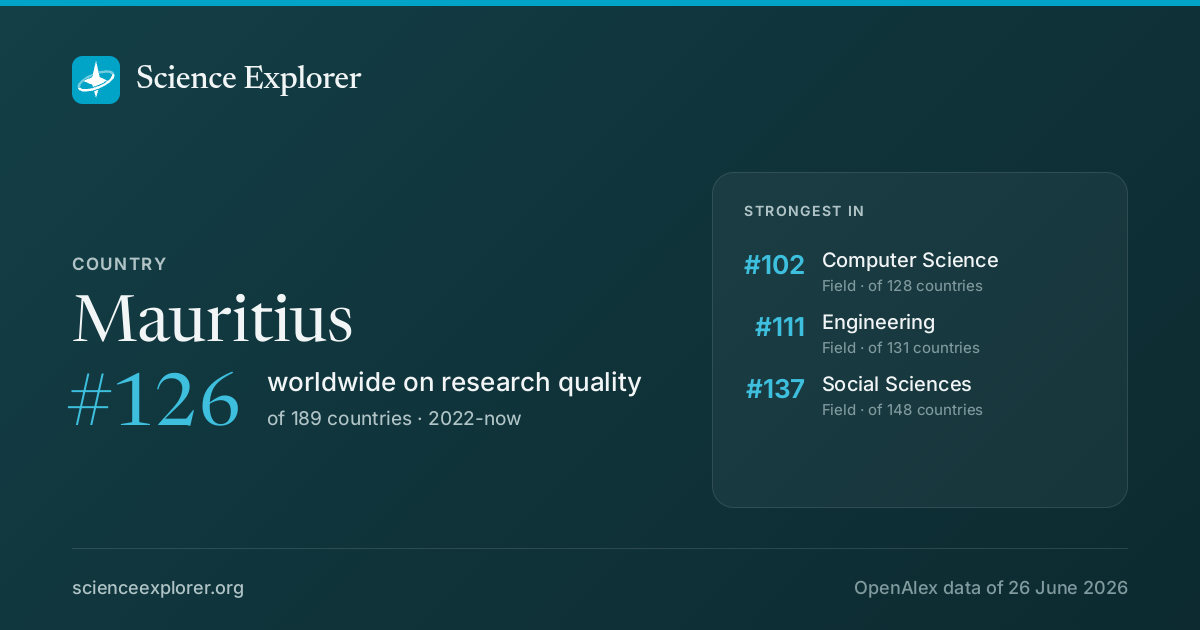
Mauritius ranks #126 of 189 countries on research quality in 2022-now (#143 all time), with 1.7k research works and 6.2% of them in the world's top 10%.
- World rank, 2022-now
- #126 of 189 · #143 all time
- Works, 2022-now
- 1.7k ▲ 23% vs 2018-21
- Citations
- 84k 13.5 per fractional work, all time
- Top-10% rate
- 6.2% all institutions 10.0%
- vs its own fields
- 0.78× 1.00× is exactly expected
- In the world top 100
- 0 0 in the top 1,000
- Open access
- 37% world 40%
- International
- 26% world 18%
MauritiusWhat is Mauritius strongest at in science?
On research quality in 2022-now, Mauritius ranks highest in Computer Science (#102 of 128), Engineering (#111 of 131) and Social Sciences (#137 of 148). Relative to its size it is most specialised in General Economics, Econometrics and Finance, Theoretical Computer Science and Computer Science Applications.
| Field | World rank | Where that sits | Top-10% rate | Works | All time | Institutions |
|---|---|---|---|---|---|---|
| Computer ScienceField | #102 of 128 | 5.6% | 229 | #107 | Institutions | |
| EngineeringField | #111 of 131 | 3.6% | 244 | #119 | Institutions | |
| Social SciencesField | #137 of 148 | 8.3% | 242 | #155 | Institutions |
Where its research is concentrated
Location quotient: how much more (or less) of each node it does than its size predicts. Drawn around 1×, where "twice the world share" and "half of it" are the same distance apart in opposite directions. A volume reading, which on a country axis is largely population and industrial structure.
- General Economics, Econometrics and FinanceSubfield · 28.4 works · #106 of 211 active here6.0×
- Theoretical Computer ScienceSubfield · 1.6 works · #97 of 143 active here4.8×
- Computer Science ApplicationsSubfield · 19.7 works · #110 of 196 active here4.2×
- FinanceSubfield · 23.5 works · #113 of 210 active here4.1×
- DevelopmentSubfield · 6.7 works · #124 of 190 active here3.5×
- AccountingSubfield · 38.5 works · #113 of 208 active here3.3×
- Economics, Econometrics and FinanceField · 130.5 works · #113 of 220 active here3.2×
- Energy Engineering and Power TechnologySubfield · 6.4 works · #100 of 187 active here3.1×
The whole field profile
All 26 fields at once. A specialist and a generalist produce the same ranked list and a completely different shape.
Rings at 0.5×, 1× and 2×. Widest outward: Economics, Econometrics and Finance, 3.2×. Every wedge is a field page.
All 26 fields, with their numbers
- Economics, Econometrics and Finance3.22×130 works
- Business, Management and Accounting2.32×142 works
- Decision Sciences2.02×37 works
- Computer Science1.80×266 works
- Energy1.76×31 works
- Environmental Science1.68×158 works
- Agricultural and Biological Sciences1.23×110 works
- Social Sciences1.12×269 works
- Engineering1.02×289 works
- Earth and Planetary Sciences0.91×27 works
- Psychology0.88×51 works
- Mathematics0.86×19 works
- Pharmacology, Toxicology and Pharmaceutics0.84×6 works
- Nursing0.76×7 works
- Health Professions0.75×38 works
- Materials Science0.69×46 works
- Chemistry0.56×17 works
- Biochemistry, Genetics and Molecular Biology0.55×56 works
- Neuroscience0.48×15 works
- Arts and Humanities0.46×25 works
- Chemical Engineering0.41×3 works
- Medicine0.37×134 works
- Immunology and Microbiology0.36×7 works
- Physics and Astronomy0.28×12 works
- Dentistry0.28×3 works
- Veterinary0.27×1 works
Which fields of science does Mauritius work in?
In 2022-now, 46% of research in Mauritius is in Physical Sciences, 35% in Social Sciences. Its largest fields are Engineering (15%), Social Sciences (14%), Computer Science (14%). It does 1.4× the world's share of Social Sciences.
Each ring splits the one inside it: the four domains of science, their fields, their subfields. Size is fractional works in 2022-now. Every slice is a page; the interactive view zooms down to single topics and colours each by how much more of it this country does than the world.
Its 4 domains and 26 fields, with their numbers
- Physical Sciences86645.7%
- Engineering28915.3%
- Computer Science26614.0%
- Environmental Science1588.3%
- Materials Science462.4%
- Energy311.6%
- Earth and Planetary Sciences271.4%
- Mathematics191.0%
- Chemistry170.9%
- Physics and Astronomy120.6%
- Chemical Engineering30.1%
- Social Sciences65434.5%
- Social Sciences26914.2%
- Business, Management and Accounting1427.5%
- Economics, Econometrics and Finance1306.9%
- Psychology512.7%
- Decision Sciences372.0%
- Arts and Humanities251.3%
- Life Sciences19310.2%
- Health Sciences1829.6%
- Medicine1347.1%
- Health Professions382.0%
- Nursing70.4%
- Dentistry30.1%
- Veterinary10.0%
Which keywords describe research in Mauritius?
By fractional works in 2022-now, weighted toward what it does more of than the world: Machine Learning, Deep Learning, Renewable Energy, Sustainability, Economic Growth, Climate Change, Internet of Things and IoT.
- Coral Reefs
- Ethnic Diversity
- Firm Performance
- Poverty Reduction
- Regional Development
- Global Trade
- Image Processing
- Student Engagement
- Risk Management
- Environmental Monitoring
- Security
- Energy Efficiency
- Big Data
- Supply Chain Management
- Economic Development
- Neural Networks
- Globalization
- Environmental Impact
- Renewable Energy
- Deep Learning
- Machine Learning
- Sustainability
- Climate Change
- Economic Growth
- Internet of Things
- Sustainable Development
- Artificial Intelligence
- Healthcare
- IoT
- Corporate Governance
- Consumer Behavior
- Governance
- Social Capital
- Wireless Sensor Networks
- Solar Energy
- Ocean Acidification
- Smart Cities
- Forecasting
- Marine Ecosystems
- Bleaching
Size is fractional works in 2022-now in the topics tagged with each word; colour is the word's share of this country's work against its share of the world's. The 40 words are chosen for being large and distinctive. Each links to the topic it comes from most.
All 40 words, with their numbers
- Machine Learning136▲ 2.2×75 topics
- Deep Learning131▲ 2.0×74 topics
- Sustainability89▲ 1.93×60 topics
- Renewable Energy82▲ 3.0×41 topics
- Climate Change79▲ 1.53×70 topics
- Environmental Impact57▲ 1.75×45 topics
- Economic Growth56▲ 3.6×23 topics
- Globalization54▲ 1.46×49 topics
- Internet of Things49▲ 3.0×19 topics
- Neural Networks48▲ 1.62×29 topics
- Sustainable Development45▲ 1.52×47 topics
- Economic Development43▲ 2.9×23 topics
- Artificial Intelligence43▲ 1.58×33 topics
- Supply Chain Management42▲ 2.5×20 topics
- Healthcare41▲ 1.88×21 topics
- Big Data38▲ 2.1×22 topics
- IoT37▲ 5.2×15 topics
- Energy Efficiency36▲ 2.0×25 topics
- Corporate Governance34▲ 2.4×20 topics
- Security33▲ 2.6×20 topics
- Consumer Behavior30▲ 2.5×13 topics
- Environmental Monitoring29▲ 3.9×12 topics
- Governance28▲ 4.5×12 topics
- Risk Management28▲ 3.1×12 topics
- Social Capital27▲ 2.8×12 topics
- Student Engagement24▲ 3.2×12 topics
- Wireless Sensor Networks24▲ 2.8×13 topics
- Image Processing24▲ 2.9×11 topics
- Solar Energy24▲ 4.0×5 topics
- Global Trade23▲ 6.2×6 topics
- Ocean Acidification23▲ 16×3 topics
- Regional Development22▲ 3.4×6 topics
- Smart Cities21▲ 4.2×7 topics
- Poverty Reduction21▲ 8.5×5 topics
- Forecasting21▲ 5.7×5 topics
- Firm Performance18▲ 5.3×2 topics
- Marine Ecosystems16▲ 15×2 topics
- Ethnic Diversity16▲ 13×3 topics
- Bleaching15▲ 24×1 topic
- Coral Reefs15▲ 24×1 topic
Which research topics does Mauritius publish the most in?
Its largest topics in 2022-now are Coral and Marine Ecosystems Studies, Economic Zones and Regional Development, Smart Agriculture and AI.
Area is fractional works in 2022-now; colour is the subfield each topic belongs to. Every tile is a topic page.
- 1 Coral and Marine Ecosystems Studies Ecology 15 works
- 2 Economic Zones and Regional Development General Economics, Econometrics and Finance 14 works
- 3 Smart Agriculture and AI Plant Science 13 works
- 4 Online Learning and Analytics Computer Science Applications 11 works
- 5 Environmental Sustainability in Business Marketing 11 works
- 6 Microfinance and Financial Inclusion Economics and Econometrics 11 works
- 7 Blockchain Technology Applications and Security Information Systems 11 works
- 8 Plant Pathogens and Fungal Diseases Cell Biology 11 works
- 9 Corporate Finance and Governance Accounting 10 works
- 10 Solar Radiation and Photovoltaics Artificial Intelligence 10 works
- 11 COVID-19 Pandemic Impacts Economics and Econometrics 9 works
- 12 IoT and Edge/Fog Computing Computer Networks and Communications 9 works
Which universities in Mauritius lead research?
University of Mauritius, University of Technology, Mauritius and Mahatma Gandhi Institute rank highest in Mauritius on research quality in 2022-now.
One dot per institution in the list below. The upper left is the interesting corner.
- 1University of MauritiusUniversity · Moka · #3,496 worldwide6.2% top 10% · 965 works
- 2University of Technology, MauritiusUniversity · Port Louis · #9,587 worldwide5.7% top 10% · 224 works
- 3Mahatma Gandhi InstituteUniversity · Moka · #13,970 worldwide5.1% top 10% · 135 works
- 4Mauritius Institute of EducationUniversity · Moka · #14,906 worldwide8.0% top 10% · 105 works
- 5Flex (Mauritius)Company · Port Louis · #19,825 worldwide6.9% top 10% · 61 works
The track on each row is its top-10% rate; the tick is the average of all institutions, 10.0% (how it is set): teal above it, red below.
All ranked institutions in MauritiusWho are the top researchers in Mauritius?
Robin Nunkoo, Cláudia Baider and Vikash Tatayah rank highest among researchers based in Mauritius.
- 1 Robin Nunkoo #53,731 worldwide 14k citations · 174 works
- 2 Cláudia Baider #288,426 worldwide 6.1k citations · 158 works
- 3 Vikash Tatayah #459,511 worldwide 1.8k citations · 105 works
- 4 Ackmez Mudhoo #474,044 worldwide 6.5k citations · 159 works
- 5 Viraiyan Teeroovengadum #542,767 worldwide 2.1k citations · 36 works
- 6 Noorjehan Joonas #654,000 worldwide 1.6k citations · 36 works
- 7 Carl G. Jones #739,049 worldwide 4.8k citations · 137 works
- 8 Shakuntala Baichoo #776,806 worldwide 868 citations · 101 works
- 9 Chandradeo Bokhoree #791,849 worldwide 968 citations · 59 works
- 10 Ramesh Durbarry #797,221 worldwide 1.8k citations · 46 works
How open and international is Mauritius's research?
37% of its research is openly available (world: 40%), and 26% is written with international co-authors (world: 18%).
World: 40% of research is openly available.
World: 18% is written across borders.
In 2022-now, 41% of its research is openly available (world 63%) and 28% is written with co-authors abroad (world 22%). Against what its own mix of topics predicts, that is 0.73× the expected open access and 1.19× the expected international share, which puts it #171 of 173 countries on openness.
How has Mauritius's research grown?
Output in 2022-2025 was 23% higher than in 2018-2021.
The same series as a ribbon: one cell per year, darker for more. The line above answers how much; this answers when.
Its share of all research
Growing output can still be a shrinking share: all of science grows. This is Mauritius as a percentage of every work published that year, 0.0081% in 2024.
Fractional works of Mauritius over all fractional works that year. How the balance of science has shifted.
How much of it reaches the world top 10%
Over the whole record, 7.2% of its 6.2k works since 1950 reached the world top 10% for their field and year.
Of each year's output, the share that reached the world's 10% most cited for its field and year. Peak 12.3% in 2011.
Which countries have research most like Mauritius'?
Oman is Mauritius' closest research twin: of all countries, its research is spread across the fields most like Mauritius', with both strong in Business, Management and Accounting.
- 1
 OmanBoth strong in Business, Management and Accounting, Decision Sciences, Energy
0.81 Compare
- 2
 BruneiBoth strong in Business, Management and Accounting, Energy, Economics, Econometrics and Finance
0.76 Compare
- 3
 LatviaBoth strong in Business, Management and Accounting, Economics, Econometrics and Finance, Energy
0.73 Compare
- 4
 VietnamBoth strong in Business, Management and Accounting, Economics, Econometrics and Finance, Environmental Science
0.73 Compare
- 5
 MalaysiaBoth strong in Business, Management and Accounting, Decision Sciences, Energy
0.72 Compare
Similarity is the correlation of each side's location quotients across every field it publishes in, on a log scale: 1 is the same shape of research, 0 is unrelated. It ignores size. How it is measured.
Compare Mauritius with
 Papua New Guinea
 Liechtenstein
 Bahrain
 Kosovo
 Maldives
 Myanmar
Share Mauritius's ranking
Badges for a website1Each links back here and updates with every snapshot

Research fields in Mauritius
Discussion
Ask a question or share a note about Mauritius. Posts are plain text and can be reported.