 Science in Taiwan
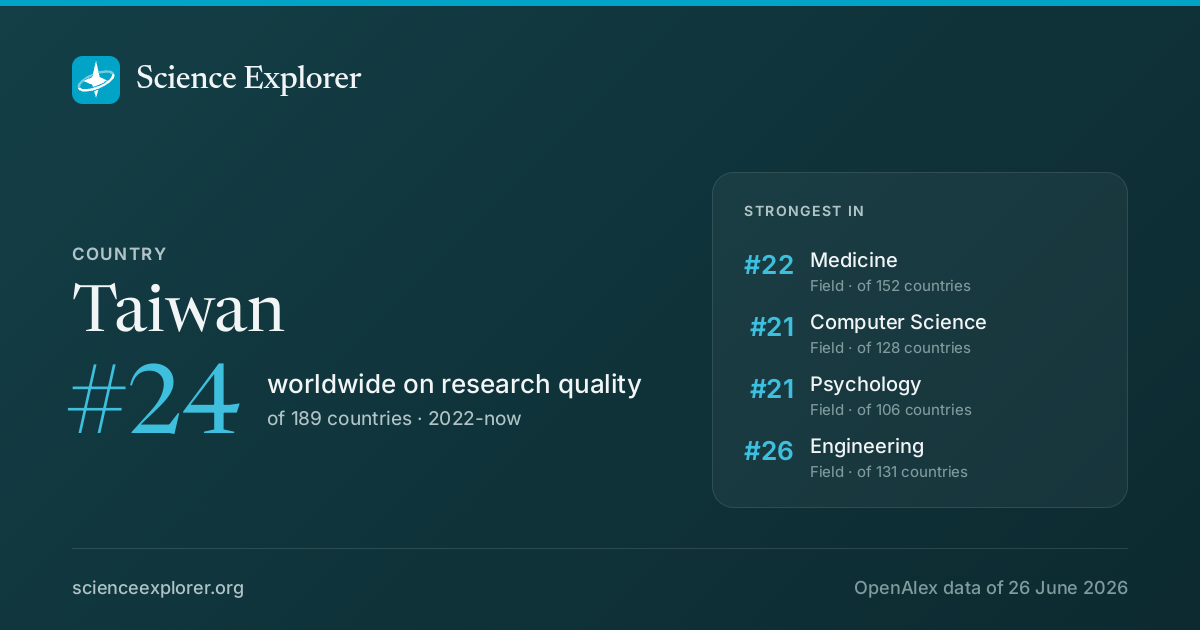
Taiwan ranks #24 of 189 countries on research quality in 2022-now (#24 all time), with 143k research works and 9.7% of them in the world's top 10%.
- World rank, 2022-now
- #24 of 189 · #24 all time
- Works, 2022-now
- 143k ▲ 8% vs 2018-21
- Citations
- 17.8M 18.9 per fractional work, all time
- Top-10% rate
- 9.7% all institutions 10.0%
- vs its own fields
- 0.88× 1.00× is exactly expected
- In the world top 100
- 0 5 in the top 1,000
- Open access
- 29% world 40%
- International
- 17% world 18%
TaiwanWhat is Taiwan strongest at in science?
On research quality in 2022-now, Taiwan ranks highest in Medicine (#22 of 152), Computer Science (#21 of 128) and Psychology (#21 of 106). Relative to its size it is most specialised in Bioengineering, Hardware and Architecture and Otorhinolaryngology.
| Field | World rank | Where that sits | Top-10% rate | Works | All time | Institutions |
|---|---|---|---|---|---|---|
| MedicineField | #22 of 152 | 10.5% | 35,520 | #22 | Institutions | |
| Computer ScienceField | #21 of 128 | 9.8% | 13,156 | #19 | Institutions | |
| PsychologyField | #21 of 106 | 13.4% | 4,210 | #20 | Institutions | |
| EngineeringField | #26 of 131 | 8.1% | 28,382 | #27 | Institutions | |
| Business, Management and AccountingField | #22 of 110 | 13.0% | 3,582 | #22 | Institutions | |
| Environmental ScienceField | #25 of 122 | 8.0% | 5,664 | #27 | Institutions | |
| Social SciencesField | #33 of 148 | 13.7% | 6,845 | #35 | Institutions | |
| Biochemistry, Genetics and Molecular BiologyField | #24 of 105 | 7.8% | 9,213 | #24 | Institutions | |
| EducationSubfield | #26 of 112 | 19.6% | 1,344 | #27 | Institutions | |
| Electrical and Electronic EngineeringSubfield | #20 of 86 | 7.4% | 10,861 | #20 | Institutions | |
| Information SystemsSubfield | #21 of 90 | 14.5% | 1,487 | #16 | Institutions | |
| Sociology and Political ScienceSubfield | #28 of 119 | 12.9% | 2,622 | #28 | Institutions |
Where its research is concentrated
Location quotient: how much more (or less) of each node it does than its size predicts. Drawn around 1×, where "twice the world share" and "half of it" are the same distance apart in opposite directions. A volume reading, which on a country axis is largely population and industrial structure.
- BioengineeringSubfield · 276.9 works · #12 of 160 active here2.6×
- Hardware and ArchitectureSubfield · 434.6 works · #12 of 169 active here2.4×
- OtorhinolaryngologySubfield · 383.1 works · #16 of 196 active here2.4×
- NephrologySubfield · 813.7 works · #15 of 205 active here2.3×
- HepatologySubfield · 721.7 works · #14 of 204 active here2.3×
- Research and TheorySubfield · 93.7 works · #20 of 183 active here2.2×
- Human-Computer InteractionSubfield · 710.6 works · #18 of 193 active here2.1×
- Electrical and Electronic EngineeringSubfield · 11,948.8 works · #12 of 217 active here2.1×
The whole field profile
All 26 fields at once. A specialist and a generalist produce the same ranked list and a completely different shape.
Rings at 0.5×, 1× and 2×. Widest outward: Materials Science, 1.4×. Every wedge is a field page.
All 26 fields, with their numbers
- Materials Science1.40×7,929 works
- Chemical Engineering1.39×786 works
- Medicine1.31×41k works
- Neuroscience1.30×3,416 works
- Engineering1.30×31k works
- Energy1.29×1,912 works
- Immunology and Microbiology1.24×2,019 works
- Biochemistry, Genetics and Molecular Biology1.22×11k works
- Computer Science1.17×15k works
- Decision Sciences1.16×1,818 works
- Dentistry1.10×864 works
- Physics and Astronomy1.04×3,744 works
- Pharmacology, Toxicology and Pharmaceutics1.00×569 works
- Psychology0.99×4,863 works
- Nursing0.95×754 works
- Chemistry0.94×2,395 works
- Mathematics0.87×1,653 works
- Earth and Planetary Sciences0.83×2,107 works
- Environmental Science0.80×6,452 works
- Business, Management and Accounting0.77×3,994 works
- Health Professions0.69×2,937 works
- Economics, Econometrics and Finance0.67×2,328 works
- Veterinary0.65×143 works
- Agricultural and Biological Sciences0.54×4,133 works
- Social Sciences0.38×7,853 works
- Arts and Humanities0.33×1,543 works
Which fields of science does Taiwan work in?
In 2022-now, 45% of research in Taiwan is in Physical Sciences, 28% in Health Sciences. Its largest fields are Medicine (25%), Engineering (19%), Computer Science (9%).
Each ring splits the one inside it: the four domains of science, their fields, their subfields. Size is fractional works in 2022-now. Every slice is a page; the interactive view zooms down to single topics and colours each by how much more of it this country does than the world.
Its 4 domains and 26 fields, with their numbers
- Physical Sciences73k45.2%
- Engineering31k19.5%
- Computer Science15k9.1%
- Materials Science7,9294.9%
- Environmental Science6,4524.0%
- Physics and Astronomy3,7442.3%
- Chemistry2,3951.5%
- Earth and Planetary Sciences2,1071.3%
- Energy1,9121.2%
- Mathematics1,6531.0%
- Chemical Engineering7870.5%
- Health Sciences46k28.1%
- Medicine41k25.2%
- Health Professions2,9371.8%
- Dentistry8640.5%
- Nursing7540.5%
- Veterinary1430.1%
- Social Sciences22k13.8%
- Social Sciences7,8534.9%
- Psychology4,8633.0%
- Business, Management and Accounting3,9942.5%
- Economics, Econometrics and Finance2,3281.4%
- Decision Sciences1,8181.1%
- Arts and Humanities1,5431.0%
- Life Sciences21k12.8%
- Biochemistry, Genetics and Molecular Biology11k6.5%
- Agricultural and Biological Sciences4,1332.6%
- Neuroscience3,4152.1%
- Immunology and Microbiology2,0191.2%
- Pharmacology, Toxicology and Pharmaceutics5690.4%
Which keywords describe research in Taiwan?
By fractional works in 2022-now, weighted toward what it does more of than the world: Deep Learning, Epidemiology, Inflammation, Machine Learning, Neural Networks, Oxidative Stress, Nanomaterials and Cardiovascular Disease.
- Nanowires
- Field-Effect Transistors
- Thermal Management
- Clinical Practice Guidelines
- Nanostructures
- Aging
- Mortality
- Tissue Engineering
- Biomarkers
- Energy Efficiency
- Risk Factors
- Convolutional Neural Networks
- Chemotherapy
- Nanoparticles
- Climate Change
- Quality of Life
- Cardiovascular Disease
- Oxidative Stress
- Machine Learning
- Epidemiology
- Deep Learning
- Inflammation
- Neural Networks
- Cancer
- Nanomaterials
- Biomedical Applications
- Treatment
- Graphene
- Diagnosis
- Metabolic Syndrome
- Nanocomposites
- Management
- Biosensors
- Energy Storage
- Immunotherapy
- Semiconductors
- Immune Response
- Semiconductor
- Thin Films
- Solar Cells
Size is fractional works in 2022-now in the topics tagged with each word; colour is the word's share of this country's work against its share of the world's. The 40 words are chosen for being large and distinctive. Each links to the topic it comes from most.
All 40 words, with their numbers
- Deep Learning7,865▲ 1.41×85 topics
- Epidemiology7,791▲ 1.21×140 topics
- Inflammation5,362▲ 1.56×83 topics
- Machine Learning5,144◆ 0.95×97 topics
- Neural Networks3,546▲ 1.42×42 topics
- Oxidative Stress3,466▲ 1.30×63 topics
- Cancer3,041▲ 1.40×59 topics
- Cardiovascular Disease2,938▲ 1.59×39 topics
- Nanomaterials2,863▲ 1.69×21 topics
- Quality of Life2,852▲ 1.22×59 topics
- Biomedical Applications2,838▲ 1.48×36 topics
- Climate Change2,619▼ 0.60×126 topics
- Treatment2,563▲ 1.30×52 topics
- Nanoparticles2,557▲ 1.25×44 topics
- Graphene2,017▲ 1.85×12 topics
- Chemotherapy1,962▲ 1.71×25 topics
- Diagnosis1,924▲ 1.28×41 topics
- Convolutional Neural Networks1,880▲ 1.60×14 topics
- Metabolic Syndrome1,835▲ 1.40×24 topics
- Risk Factors1,826◆ 1.03×37 topics
- Nanocomposites1,805▲ 1.41×22 topics
- Energy Efficiency1,738▲ 1.16×44 topics
- Management1,711▲ 1.32×39 topics
- Biomarkers1,678▲ 1.49×18 topics
- Biosensors1,644▲ 2.1×12 topics
- Tissue Engineering1,615▲ 1.65×13 topics
- Energy Storage1,546▲ 1.47×12 topics
- Mortality1,483▲ 1.61×13 topics
- Immunotherapy1,478▲ 1.26×19 topics
- Aging1,473▲ 1.67×19 topics
- Semiconductors1,435▲ 3.0×6 topics
- Nanostructures1,432▲ 2.2×17 topics
- Immune Response1,407▲ 1.53×23 topics
- Clinical Practice Guidelines1,381▲ 1.55×14 topics
- Semiconductor1,171▲ 2.2×7 topics
- Thermal Management1,093▲ 2.1×8 topics
- Thin Films959▲ 3.1×10 topics
- Field-Effect Transistors920▲ 3.6×4 topics
- Solar Cells919▲ 2.8×7 topics
- Nanowires874▲ 3.8×5 topics
Which research topics does Taiwan publish the most in?
Its largest topics in 2022-now are Advanced Photocatalysis Techniques, Semiconductor materials and devices, Conducting polymers and applications.
Area is fractional works in 2022-now; colour is the subfield each topic belongs to. Every tile is a topic page.
- 1 Advanced Photocatalysis Techniques Renewable Energy, Sustainability and the Environment 551 works
- 2 Semiconductor materials and devices Electrical and Electronic Engineering 543 works
- 3 Conducting polymers and applications Polymers and Plastics 482 works
- 4 Advancements in Battery Materials Electrical and Electronic Engineering 476 works
- 5 Digital Marketing and Social Media Sociology and Political Science 455 works
- 6 Perovskite Materials and Applications Electrical and Electronic Engineering 432 works
- 7 Advanced Sensor and Energy Harvesting Materials Biomedical Engineering 420 works
- 8 Advanced Memory and Neural Computing Electrical and Electronic Engineering 411 works
- 9 Gas Sensing Nanomaterials and Sensors Electrical and Electronic Engineering 410 works
- 10 Industrial Vision Systems and Defect Detection Industrial and Manufacturing Engineering 401 works
- 11 Advanced Neural Network Applications Computer Vision and Pattern Recognition 386 works
- 12 Electrocatalysts for Energy Conversion Renewable Energy, Sustainability and the Environment 383 works
How many world-class institutions does Taiwan hold?
Average quality and elite capacity disagree by construction, and both are worth knowing: the first is decided by a country's whole institution population, the second counts the institutions it holds at the top. One square per institution.
| Standing among countries | 2022-now | Where that sits | All time |
|---|---|---|---|
| Average qualityits whole institution population | #24 of 189 | #24 of 203 | |
| Elite capacitythe institutions it holds at the top | #27 of 204 | #25 of 216 |
Elite capacity counts a country's institutions by their worldwide rank, weighted so a place at #1 counts for more than one at #480. Countries under 100 fractional works are left out.
Bands are exclusive, so the squares add up to 5 (the institutions it holds in the world top 1,000), not to four times it.
Which universities in Taiwan lead research?
National Taiwan University, Academia Sinica and National Cheng Kung University rank highest in Taiwan on research quality in 2022-now.
One dot per institution in the list below. The upper left is the interesting corner.
- 1National Taiwan UniversityUniversity · Taipei · #332 worldwide9.0% top 10% · 14k works
- 2Academia SinicaResearch facility · Taipei · #484 worldwide9.7% top 10% · 4.1k works
- 3National Cheng Kung UniversityUniversity · Tainan City · #533 worldwide9.1% top 10% · 8.4k works
- 4National Yang Ming Chiao Tung UniversityUniversity · Hsinchu · #681 worldwide9.3% top 10% · 8.4k works
- 5National Tsing Hua UniversityUniversity · Hsinchu · #742 worldwide9.3% top 10% · 5k works
- 6National Sun Yat-sen UniversityUniversity · Kaohsiung City · #1,152 worldwide9.4% top 10% · 3.2k works
- 7China Medical UniversityUniversity · Taichung · #1,300 worldwide15.2% top 10% · 2.9k works
- 8National Taiwan Normal UniversityUniversity · Taipei · #1,490 worldwide11.0% top 10% · 2.3k works
- 9National Taiwan University of Science and TechnologyUniversity · Taipei · #1,608 worldwide10.9% top 10% · 4k works
- 10Asia UniversityUniversity · Taichung · #1,635 worldwide13.7% top 10% · 1.3k works
- 11National Chung Hsing UniversityUniversity · Taichung · #1,652 worldwide8.3% top 10% · 3.2k works
- 12Taipei Medical UniversityUniversity · Taipei · #1,662 worldwide12.7% top 10% · 4.1k works
- 13Kaohsiung Medical UniversityUniversity · Kaohsiung City · #1,681 worldwide9.1% top 10% · 3k works
- 14National Yunlin University of Science and TechnologyUniversity · Douliu · #1,711 worldwide14.5% top 10% · 1.9k works
- 15China Medical University HospitalHospital / health system · Taichung · #1,957 worldwide15.0% top 10% · 1.7k works


The track on each row is its top-10% rate; the tick is the average of all institutions, 10.0% (how it is set): teal above it, red below.
All ranked institutions in TaiwanWho are the top researchers in Taiwan?
Gwo‐Jen Hwang, Ming‐Lang Tseng and Sung‐Fu Hung rank highest among researchers based in Taiwan.
- 1 Gwo‐Jen Hwang #196 worldwide 39k citations · 649 works
- 2 Ming‐Lang Tseng #3,104 worldwide 30k citations · 538 works
- 3 Sung‐Fu Hung #3,573 worldwide 30k citations · 198 works
- 4 Jien‐Wei Yeh #3,654 worldwide 43k citations · 279 works
- 5 Chin‐Chung Tsai #5,063 worldwide 38k citations · 549 works
- 6 Behzad Foroughi #6,646 worldwide 5k citations · 110 works
- 7 Shiuh Chao #7,459 worldwide 72k citations · 275 works
- 8 Jo‐Shu Chang #9,317 worldwide 78k citations · 1,045 works
- 9 Zong‐Hong Lin #10,386 worldwide 20k citations · 320 works
- 10 Hao Ming Chen #12,233 worldwide 41k citations · 301 works
Which cities in Taiwan are research hubs?
- 1
TaipeiTaiwan
346k works
- 2
HsinchuTaiwan
134k works
- 3
TaichungTaiwan
98k works
- 4
Kaohsiung CityTaiwan
85k works
- 5
Tainan CityTaiwan
83k works
- 6
Taoyuan CityTaiwan
79k works
- 7
Chiayi CityTaiwan
20k works
- 8
Taoyuan DistrictTaiwan
18k works
How much of it is in the largest
The same cities as shares of everything these twelve account for.
Shares of the rows listed above, not of the whole node.
How open and international is Taiwan's research?
29% of its research is openly available (world: 40%), and 17% is written with international co-authors (world: 18%).
World: 40% of research is openly available.
World: 18% is written across borders.
In 2022-now, 53% of its research is openly available (world 63%) and 26% is written with co-authors abroad (world 22%). Against what its own mix of topics predicts, that is 0.93× the expected open access and 1.11× the expected international share, which puts it #164 of 173 countries on openness.
How has Taiwan's research grown?
Output in 2022-2025 was 8% higher than in 2018-2021.
The same series as a ribbon: one cell per year, darker for more. The line above answers how much; this answers when.
Its share of all research
Growing output can still be a shrinking share: all of science grows. This is Taiwan as a percentage of every work published that year, 0.61% in 2024.
Fractional works of Taiwan over all fractional works that year. How the balance of science has shifted.
How much of it reaches the world top 10%
Over the whole record, 8.8% of its 943k works since 1950 reached the world top 10% for their field and year.
Of each year's output, the share that reached the world's 10% most cited for its field and year. Peak 10.0% in 2025.
Which countries have research most like Taiwan's?
South Korea is Taiwan's closest research twin: of all countries, its research is spread across the fields most like Taiwan's, with both strong in Materials Science.
- 1
 South KoreaBoth strong in Materials Science, Chemical Engineering, Neuroscience
0.86 Compare
- 2
 ChinaBoth strong in Materials Science, Chemical Engineering, Engineering
0.77 Compare
- 3
 SingaporeBoth strong in Chemical Engineering, Engineering, Energy
0.74 Compare
- 4
 JapanBoth strong in Materials Science, Medicine, Neuroscience
0.71 Compare
- 5
 IranBoth strong in Materials Science, Chemical Engineering, Energy
0.64 Compare
Similarity is the correlation of each side's location quotients across every field it publishes in, on a log scale: 1 is the same shape of research, 0 is unrelated. It ignores size. How it is measured.
Compare Taiwan with
 Poland
 New Zealand
 Finland
 Czechia
 Norway
 Portugal
Share Taiwan's ranking



Research fields in Taiwan
- Medicine
- Health Sciences
- Physical Sciences
- Computer Science
- Social Sciences
- Life Sciences
- Psychology
- Engineering
- Business, Management and Accounting
- Environmental Science
- Social Sciences
- Biochemistry, Genetics and Molecular Biology
- Education
- Electrical and Electronic Engineering
- Information Systems
- Sociology and Political Science
- Health Professions
- Artificial Intelligence
- Dentistry
- Agricultural and Biological Sciences
- Surgery
- Economics, Econometrics and Finance
- Decision Sciences
- Materials Science
- Biomedical Engineering
- Renewable Energy, Sustainability and the Environment
- Economics and Econometrics
- Pulmonary and Respiratory Medicine
- Radiology, Nuclear Medicine and Imaging
- Molecular Biology
- Developmental and Educational Psychology
- Control and Systems Engineering
- Materials Chemistry
- Public Health, Environmental and Occupational Health
- Epidemiology
- Industrial and Manufacturing Engineering
- Computer Vision and Pattern Recognition
- Neuroscience
- Mechanical Engineering
- Mathematics
- Cardiology and Cardiovascular Medicine
- Physiology
- Arts and Humanities
- General Health Professions
- Plant Science
- Endocrinology, Diabetes and Metabolism
- Chemistry
- Social Psychology
- Clinical Psychology
- Oncology
- Earth and Planetary Sciences
- Environmental Engineering
- Immunology and Microbiology
- Computer Networks and Communications
- Organic Chemistry
- Energy
- Water Science and Technology
- Physics and Astronomy
- Infectious Diseases
- Health, Toxicology and Mutagenesis
Questions people ask
What is Taiwan strongest at in science?
On research quality in 2022-now, Taiwan ranks highest in Medicine (#22 of 152), Computer Science (#21 of 128) and Psychology (#21 of 106). Relative to its size it is most specialised in Bioengineering, Hardware and Architecture and Otorhinolaryngology.
See the full answerDiscussion
Ask a question or share a note about Taiwan. Keep it to the research: no personal attacks, advertising or links. Any reader can report a post, which collapses it for everyone until it is opened.