Hunan University
In research, Hunan University stands highest in Engineering (#15 of 5,901 worldwide), Physical Sciences (#39 of 10,670 worldwide) and Renewable Energy, Sustainability and the Environment (#4 of 582 worldwide), 2022-now. Relative to its size it is most specialised in Civil and Structural Engineering, Energy Engineering and Power Technology and Renewable Energy, Sustainability and the Environment (Civil and Structural Engineering is 4.3× its share of world research).
- World rank, 2022-now
- #71 of 22,385 · #93 all time
- Rank in China
- #21 of 2,481
- Research works
- 55k ▲ 43% vs 2018-21
- Citations
- 1.2M 22.7 per fractional work
- Top-10% rate
- 18.1% all institutions 10.0%
- vs its own fields
- 1.47× 1.00× is exactly expected
- Open access
- 19% world 40%
- International
- 14% world 18%
What is Hunan University known for in research?
The fields where it stands highest, 2022-now, ranked among every institution above the floor in each field.
| Field | World rank | Where that sits | Top-10% rate | Works | All time |
|---|---|---|---|---|---|
| EngineeringField | #15 of 5,901 | 19.2% | 6,130 | #19 | |
| Physical SciencesDomain | #39 of 10,670 | 18.7% | 11,710 | #69 | |
| Renewable Energy, Sustainability and the EnvironmentSubfield | #4 of 582 | 19.7% | 427 | #5 | |
| Electrical and Electronic EngineeringSubfield | #15 of 2,176 | 17.9% | 1,797 | #27 | |
| Civil and Structural EngineeringSubfield | #7 of 908 | 21.9% | 749 | #7 | |
| Computer ScienceField | #40 of 4,417 | 17.9% | 1,694 | #59 | |
| Materials ChemistrySubfield | #14 of 1,473 | 17.0% | 916 | #25 | |
| Mechanical EngineeringSubfield | #13 of 1,319 | 18.2% | 813 | #16 | |
| EnergyField | #7 of 707 | 19.6% | 500 | #12 | |
| Materials ScienceField | #24 of 2,276 | 17.0% | 1,381 | #49 |
Each strip is that field's whole ranked pool, with the notch where Hunan University sits in it, in the colour of the band that rank falls in. The track under the rate is the rate itself: it carries no average mark, because the average differs by field (from about 6% in Dentistry to 21% in Economics).
Which of those standings moved
The same fields on both windows: where it stood over the whole record, and where it stands in 2022-now. The distance is the story, and it is the one thing the two rank columns above cannot show.
- Engineering#19 #15
- Physical Sciences#69 #39
- Renewable Energy, Sustainability and the Environment#5 #4
- Electrical and Electronic Engineering#27 #15
- Civil and Structural Engineering#7 #7
- Computer Science#59 #40
- Materials Chemistry#25 #14
- Mechanical Engineering#16 #13
- Energy#12 #7
- Materials Science#49 #24
A dot further right is a better standing. Fields it was not ranked in over the whole record are left out.
Which fields of science does Hunan University work in?
In 2022-now, 79% of research at Hunan University is in Physical Sciences, 9% in Social Sciences. Its largest fields are Engineering (41%), Computer Science (12%), Materials Science (9%). It does 2.0× the world's share of Physical Sciences.
Each ring splits the one inside it: the four domains of science, their fields, their subfields. Size is fractional works in 2022-now. Every slice is a page; the interactive view zooms down to single topics and colours each by how much more of it this institution does than the world.
Its 4 domains and 26 fields, with their numbers
- Physical Sciences13k79.1%
- Engineering6,80541.2%
- Computer Science1,91711.6%
- Materials Science1,5429.3%
- Environmental Science7854.7%
- Energy5583.4%
- Chemistry5163.1%
- Physics and Astronomy4672.8%
- Mathematics2111.3%
- Chemical Engineering1570.9%
- Earth and Planetary Sciences1220.7%
- Social Sciences1,5059.1%
- Social Sciences3972.4%
- Economics, Econometrics and Finance3622.2%
- Business, Management and Accounting3252.0%
- Psychology1901.1%
- Decision Sciences1510.9%
- Arts and Humanities800.5%
- Life Sciences1,2607.6%
- Health Sciences6834.1%
- Medicine6033.6%
- Health Professions590.4%
- Nursing110.1%
- Dentistry90.1%
- Veterinary20.0%
What does Hunan University specialise in?
Where its research is concentrated relative to its size: Civil and Structural Engineering takes 4.3× the share of its output that it takes of world research.
- Civil and Structural EngineeringSubfield · 838.9 works4.3×
- Energy Engineering and Power TechnologySubfield · 74.6 works4.2×
- Renewable Energy, Sustainability and the EnvironmentSubfield · 479.8 works3.8×
- EnergyField · 558.0 works3.7×
- CatalysisSubfield · 85.0 works3.5×
Location quotient, a volume reading rather than an impact one. It surfaces small, lopsided specialities.
Field profile
Location quotient across every field it publishes in: outside the ring is more than an institution of this size would be expected to publish, inside it is less.
Rings at 0.5×, 1× and 2×. Widest outward: Energy, 3.7×. Every wedge is a field page.
All 26 fields, with their numbers
- Energy3.67×558 works
- Engineering2.74×6,805 works
- Chemical Engineering2.71×157 works
- Materials Science2.67×1,542 works
- Chemistry1.99×516 works
- Computer Science1.49×1,917 works
- Physics and Astronomy1.27×467 works
- Mathematics1.08×211 works
- Economics, Econometrics and Finance1.02×362 works
- Environmental Science0.96×785 works
- Decision Sciences0.95×152 works
- Biochemistry, Genetics and Molecular Biology0.93×824 works
- Pharmacology, Toxicology and Pharmaceutics0.61×35 works
- Business, Management and Accounting0.61×325 works
- Earth and Planetary Sciences0.47×122 works
- Neuroscience0.46×123 works
- Immunology and Microbiology0.39×64 works
- Psychology0.38×190 works
- Agricultural and Biological Sciences0.27×214 works
- Medicine0.19×603 works
- Social Sciences0.19×397 works
- Arts and Humanities0.17×80 works
- Nursing0.14×11 works
- Health Professions0.13×59 works
- Dentistry0.11×9 works
- Veterinary0.07×2 works
- Energy 3.7×
- Engineering 2.7×
- Chemical Engineering 2.7×
- Materials Science 2.7×
- Chemistry 2.0×
- Computer Science 1.5×
- Physics and Astronomy 1.3×
- Mathematics 1.1×
- Economics, Econometrics and Finance 1.0×
- Environmental Science 1.0×
- Decision Sciences 0.9×
- Biochemistry, Genetics and Molecular Biology 0.9×
- Pharmacology, Toxicology and Pharmaceutics 0.6×
- Business, Management and Accounting 0.6×
- Earth and Planetary Sciences 0.5×
- Neuroscience 0.5×
- Immunology and Microbiology 0.4×
- Psychology 0.4×
- Agricultural and Biological Sciences 0.3×
- Medicine 0.2×
- Social Sciences 0.2×
- Arts and Humanities 0.2×
- Nursing 0.1×
- Health Professions 0.1×
- Dentistry 0.1×
- Veterinary 0.1×
Who are the top researchers at Hunan University?
Ranked on the quality score, Caijun Shi, Bingan Lu and Danlian Huang lead among researchers whose main affiliation is Hunan University.
- 1
Caijun Shi
 China · #42 worldwide
52k citations · 448 works
- 2
Bingan Lu
China · #72 worldwide
42k citations · 391 works
- 3
Danlian Huang
China · #138 worldwide
56k citations · 389 works
- 4
Guangming Zeng
China · #192 worldwide
204k citations · 1,688 works
- 5
Zuhua Zhang
China · #401 worldwide
25k citations · 312 works
- 6
Shuangyin Wang
China · #473 worldwide
74k citations · 596 works
- 7
Weiping Xiong
China · #692 worldwide
23k citations · 198 works
- 8
Chengyun Zhou
China · #859 worldwide
28k citations · 203 works
- 9
Xingzhong Yuan
China · #1,045 worldwide
42k citations · 366 works
- 10
Guangyong Sun
China · #1,379 worldwide
24k citations · 328 works
Which keywords describe research at Hunan University?
By fractional works in 2022-now, weighted toward what it does more of than the world: Deep Learning, Energy Storage, Nanomaterials, Mechanical Properties, Cathode Materials, Neural Networks, Graphene and Power Electronics.
- Biomolecular Interactions
- Plasmonic
- Visible Light
- Model Predictive Control
- CO2 Reduction
- Hydrogen Production
- Self-Assembly
- Semiconductor
- Artificial Neural Networks
- Rechargeable Batteries
- Renewable Energy Integration
- Biosensors
- Metal-Organic Frameworks
- Catalysis
- Biomedical Applications
- Cathode Materials
- Nanoparticles
- Mechanical Properties
- Nanomaterials
- Machine Learning
- Deep Learning
- Neural Networks
- Renewable Energy
- Energy Storage
- Graphene
- Environmental Impact
- Power Electronics
- Water Splitting
- Nanocomposites
- Microstructure
- Lithium-ion Batteries
- Electrocatalysis
- Battery Technology
- Solar Energy
- Two-Dimensional Materials
- Thermal Management
- Vibration Analysis
- Electrochemistry
- Photocatalyst
- Molecular Machines
Size is fractional works in 2022-now in the topics tagged with each word; colour is the word's share of this institution's work against its share of the world's. The 40 words are chosen for being large and distinctive. Each links to the topic it comes from most.
All 40 words, with their numbers
- Deep Learning1,318▲ 2.3×83 topics
- Machine Learning743▲ 1.35×89 topics
- Neural Networks643▲ 2.5×38 topics
- Nanomaterials610▲ 3.5×20 topics
- Renewable Energy570▲ 2.4×44 topics
- Mechanical Properties559▲ 3.5×39 topics
- Energy Storage552▲ 5.2×13 topics
- Nanoparticles527▲ 2.5×43 topics
- Graphene472▲ 4.2×12 topics
- Cathode Materials411▲ 6.4×3 topics
- Environmental Impact401▲ 1.42×50 topics
- Biomedical Applications361▲ 1.85×35 topics
- Power Electronics355▲ 6.7×8 topics
- Catalysis344▲ 3.1×28 topics
- Water Splitting336▲ 5.5×4 topics
- Metal-Organic Frameworks326▲ 4.7×6 topics
- Nanocomposites312▲ 2.4×22 topics
- Biosensors308▲ 3.8×12 topics
- Microstructure294▲ 3.4×19 topics
- Renewable Energy Integration283▲ 5.2×5 topics
- Lithium-ion Batteries281▲ 4.1×4 topics
- Rechargeable Batteries281▲ 6.4×2 topics
- Electrocatalysis264▲ 5.6×5 topics
- Artificial Neural Networks259▲ 3.4×10 topics
- Battery Technology244▲ 5.3×3 topics
- Semiconductor240▲ 4.4×7 topics
- Solar Energy226▲ 4.3×5 topics
- Self-Assembly225▲ 4.2×12 topics
- Two-Dimensional Materials224▲ 5.9×4 topics
- Hydrogen Production222▲ 5.0×5 topics
- Thermal Management218▲ 4.0×7 topics
- CO2 Reduction217▲ 6.1×2 topics
- Vibration Analysis209▲ 4.7×8 topics
- Model Predictive Control205▲ 4.9×6 topics
- Electrochemistry202▲ 5.6×3 topics
- Visible Light201▲ 5.2×3 topics
- Photocatalyst180▲ 6.3×1 topic
- Plasmonic180▲ 6.3×1 topic
- Molecular Machines168▲ 7.8×2 topics
- Biomolecular Interactions161▲ 7.9×2 topics
Which research topics does Hunan University publish most on?
By volume in 2022-now: Advanced Photocatalysis Techniques, Advanced biosensing and bioanalysis techniques, Advancements in Battery Materials and Electrocatalysts for Energy Conversion.
Area is fractional works; colour is the subfield each topic belongs to.
- 1 Advanced Photocatalysis Techniques Renewable Energy, Sustainability and the Environment 180 works
- 2 Advanced biosensing and bioanalysis techniques Molecular Biology 160 works
- 3 Advancements in Battery Materials Electrical and Electronic Engineering 154 works
- 4 Electrocatalysts for Energy Conversion Renewable Energy, Sustainability and the Environment 132 works
- 5 Advanced Battery Materials and Technologies Electrical and Electronic Engineering 131 works
- 6 Advanced battery technologies research Electrical and Electronic Engineering 127 works
- 7 Microgrid Control and Optimization Control and Systems Engineering 107 works
- 8 Advanced Battery Technologies Research Automotive Engineering 99 works
- 9 2D Materials and Applications Materials Chemistry 98 works
- 10 Structural Behavior of Reinforced Concrete Building and Construction 91 works
How open and international is its research?
Against the world's own shares: the tick on each track. Both are shares of its output, so they sit on one scale and can be read against each other as well as against the world.
World: 40% of research is openly available.
World: 18% is written across borders.
How has Hunan University's research output changed?
Output in 2022-2025 was 43% higher than in 2018-2021.
The same series as a ribbon: one cell per year, darker for more. The line above answers how much; this answers when.
Its share of all research
Growing output can still be a shrinking share: all of science grows. This is Hunan University as a percentage of every work published that year, 0.069% in 2024.
Fractional works of Hunan University over all fractional works that year. How the balance of science has shifted.
How much of it reaches the world top 10%
Year by year, against all institutions in the same year.
Of each year's output, the share that reached the world's 10% most cited for its field and year. Peak 22.4% in 2019.
Other research institutions in Changsha
- Central South University
- National University of Defense Technology
- Hunan Normal University
- Changsha University of Science and Technology
- Hunan Agricultural University
- Central South University of Forestry and Technology
- Changsha University
- Hunan University of Traditional Chinese Medicine
Which institutions have research most like Hunan University's?
Among the world's leading institutions, Fuzhou University has the research profile closest to Hunan University's, with both strong in Energy.
- 1
Fuzhou UniversityChina · Both strong in Energy, Chemical Engineering, Materials Science
0.97 Compare
- 2
Chongqing UniversityChina · Both strong in Engineering, Energy, Chemical Engineering
0.96 Compare
- 3
Shanghai UniversityChina · Both strong in Materials Science, Engineering, Chemical Engineering
0.95 Compare
- 4
Nanjing University of Science and TechnologyChina · Both strong in Engineering, Materials Science, Chemical Engineering
0.95 Compare
- 5
Shenzhen UniversityChina · Both strong in Energy, Materials Science, Engineering
0.94 Compare
Similarity is the correlation of each side's location quotients across every field it publishes in, on a log scale: 1 is the same shape of research, 0 is unrelated. It ignores size. How it is measured.
Compare Hunan University with
- vs Shandong University
- vs
 University of Zurich
- vs
 The University of Queensland
- vs
 University of Manchester
- vs
 Utrecht University
- vs
 Inserm
Share Hunan University's ranking
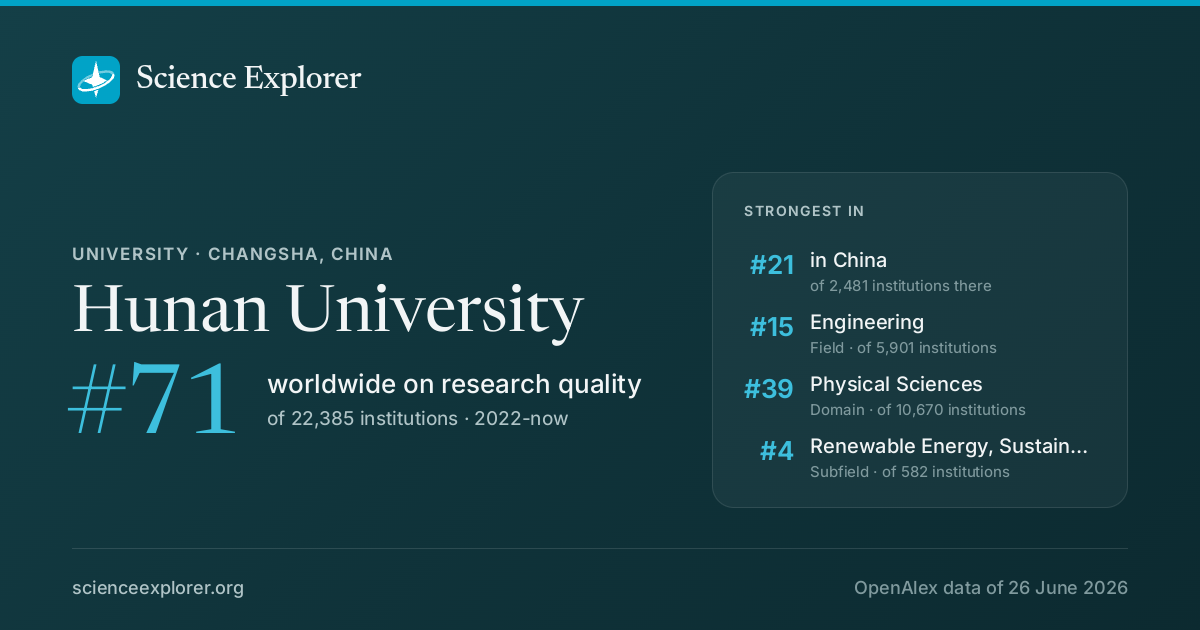
Badges for a website9Each links back here and updates with every snapshot
Its overall standing, then the domains, fields and subfields where Hunan University is in the world's top ten or its top 1%. Each has an image of its own.
Overall

Domains

Fields


Subfields


Research measures only: rankings here say nothing about teaching, admissions or student experience. Comparable institutions and collaboration partners have tabs of their own, above.
Discussion
Ask a question or share a note about Hunan University. Keep it to the research: no personal attacks, advertising or links. Any reader can report a post, which collapses it for everyone until it is opened.