Chongqing University
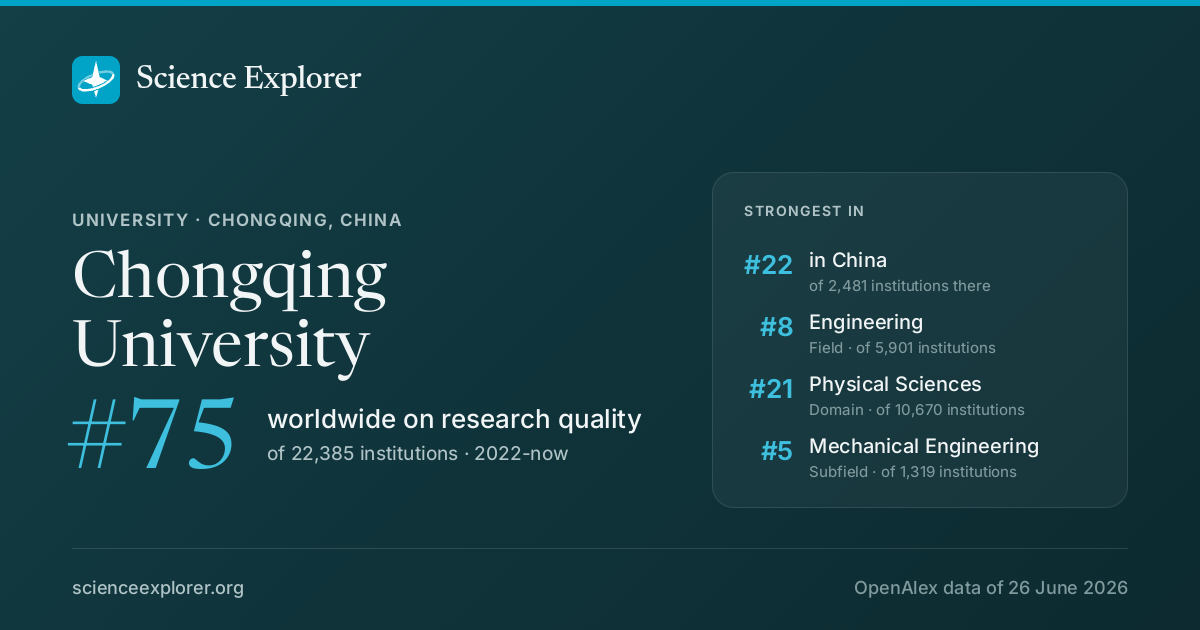
In research, Chongqing University stands highest in Engineering (#8 of 5,901 worldwide), Physical Sciences (#21 of 10,670 worldwide) and Mechanical Engineering (#5 of 1,319 worldwide), 2022-now. Relative to its size it is most specialised in Mechanics of Materials, Civil and Structural Engineering and Mechanical Engineering (Mechanics of Materials is 4.7× its share of world research).
- World rank, 2022-now
- #75 of 22,385 · #88 all time
- Rank in China
- #22 of 2,481
- Research works
- 76k ▲ 52% vs 2018-21
- Citations
- 1.2M 15.1 per fractional work
- Top-10% rate
- 15.7% all institutions 10.0%
- vs its own fields
- 1.36× 1.00× is exactly expected
- Open access
- 24% world 40%
- International
- 13% world 18%
What is Chongqing University known for in research?
The fields where it stands highest, 2022-now, ranked among every institution above the floor in each field.
| Field | World rank | Where that sits | Top-10% rate | Works | All time |
|---|---|---|---|---|---|
| EngineeringField | #8 of 5,901 | 16.5% | 10,918 | #15 | |
| Physical SciencesDomain | #21 of 10,670 | 15.6% | 18,513 | #26 | |
| Mechanical EngineeringSubfield | #5 of 1,319 | 17.7% | 1,862 | #5 | |
| Civil and Structural EngineeringSubfield | #5 of 908 | 19.3% | 1,217 | #2 | |
| Control and Systems EngineeringSubfield | #5 of 804 | 19.7% | 954 | #2 | |
| Mechanics of MaterialsSubfield | #3 of 482 | 19.1% | 762 | #3 | |
| Environmental ScienceField | #22 of 3,334 | 17.1% | 1,309 | #37 | |
| Materials ChemistrySubfield | #19 of 1,473 | 13.9% | 1,276 | #37 | |
| Electrical and Electronic EngineeringSubfield | #29 of 2,176 | 12.6% | 2,557 | #37 | |
| Computer ScienceField | #61 of 4,417 | 14.1% | 1,975 | #68 |
Each strip is that field's whole ranked pool, with the notch where Chongqing University sits in it, in the colour of the band that rank falls in. The track under the rate is the rate itself: it carries no average mark, because the average differs by field (from about 6% in Dentistry to 21% in Economics).
Which of those standings moved
The same fields on both windows: where it stood over the whole record, and where it stands in 2022-now. The distance is the story, and it is the one thing the two rank columns above cannot show.
- Engineering#15 #8
- Physical Sciences#26 #21
- Mechanical Engineering#5 #5
- Civil and Structural Engineering#2 #5
- Control and Systems Engineering#2 #5
- Mechanics of Materials#3 #3
- Environmental Science#37 #22
- Materials Chemistry#37 #19
- Electrical and Electronic Engineering#37 #29
- Computer Science#68 #61
A dot further right is a better standing. Fields it was not ranked in over the whole record are left out.
Which fields of science does Chongqing University work in?
In 2022-now, 82% of research at Chongqing University is in Physical Sciences, 7% in Social Sciences. Its largest fields are Engineering (48%), Materials Science (9%), Computer Science (9%). It does 2.1× the world's share of Physical Sciences.
Each ring splits the one inside it: the four domains of science, their fields, their subfields. Size is fractional works in 2022-now. Every slice is a page; the interactive view zooms down to single topics and colours each by how much more of it this institution does than the world.
Its 4 domains and 26 fields, with their numbers
- Physical Sciences21k82.1%
- Engineering12k48.2%
- Materials Science2,3139.1%
- Computer Science2,2498.9%
- Environmental Science1,4725.8%
- Physics and Astronomy6752.7%
- Energy6212.5%
- Chemistry5102.0%
- Earth and Planetary Sciences3001.2%
- Chemical Engineering2330.9%
- Mathematics1900.8%
- Social Sciences1,7446.9%
- Social Sciences5412.1%
- Business, Management and Accounting4031.6%
- Economics, Econometrics and Finance3381.3%
- Decision Sciences2270.9%
- Psychology1680.7%
- Arts and Humanities670.3%
- Life Sciences1,3945.5%
- Health Sciences1,3945.5%
- Medicine1,2404.9%
- Health Professions1100.4%
- Nursing230.1%
- Dentistry190.1%
- Veterinary20.0%
What does Chongqing University specialise in?
Where its research is concentrated relative to its size: Mechanics of Materials takes 4.7× the share of its output that it takes of world research.
- Mechanics of MaterialsSubfield · 853.7 works4.7×
- Civil and Structural EngineeringSubfield · 1,366.0 works4.6×
- Mechanical EngineeringSubfield · 2,091.8 works4.5×
- Safety, Risk, Reliability and QualitySubfield · 242.7 works4.0×
- Control and Systems EngineeringSubfield · 1,066.7 works3.9×
- Energy Engineering and Power TechnologySubfield · 101.2 works3.7×
- CatalysisSubfield · 128.8 works3.5×
Location quotient, a volume reading rather than an impact one. It surfaces small, lopsided specialities.
Field profile
Location quotient across every field it publishes in: outside the ring is more than an institution of this size would be expected to publish, inside it is less.
Rings at 0.5×, 1× and 2×. Widest outward: Engineering, 3.2×. Every wedge is a field page.
All 26 fields, with their numbers
- Engineering3.21×12k works
- Energy2.67×621 works
- Chemical Engineering2.63×233 works
- Materials Science2.62×2,313 works
- Chemistry1.29×510 works
- Physics and Astronomy1.20×675 works
- Environmental Science1.17×1,472 works
- Computer Science1.14×2,249 works
- Decision Sciences0.93×227 works
- Earth and Planetary Sciences0.76×300 works
- Mathematics0.64×190 works
- Economics, Econometrics and Finance0.62×338 works
- Biochemistry, Genetics and Molecular Biology0.60×814 works
- Business, Management and Accounting0.49×402 works
- Neuroscience0.45×186 works
- Immunology and Microbiology0.38×97 works
- Pharmacology, Toxicology and Pharmaceutics0.37×33 works
- Medicine0.26×1,240 works
- Agricultural and Biological Sciences0.22×266 works
- Psychology0.22×168 works
- Nursing0.18×23 works
- Social Sciences0.17×542 works
- Dentistry0.16×19 works
- Health Professions0.16×110 works
- Arts and Humanities0.09×67 works
- Veterinary0.06×2 works
- Engineering 3.2×
- Energy 2.7×
- Chemical Engineering 2.6×
- Materials Science 2.6×
- Chemistry 1.3×
- Physics and Astronomy 1.2×
- Environmental Science 1.2×
- Computer Science 1.1×
- Decision Sciences 0.9×
- Earth and Planetary Sciences 0.8×
- Mathematics 0.6×
- Economics, Econometrics and Finance 0.6×
- Biochemistry, Genetics and Molecular Biology 0.6×
- Business, Management and Accounting 0.5×
- Neuroscience 0.5×
- Immunology and Microbiology 0.4×
- Pharmacology, Toxicology and Pharmaceutics 0.4×
- Medicine 0.3×
- Agricultural and Biological Sciences 0.2×
- Psychology 0.2×
- Nursing 0.2×
- Social Sciences 0.2×
- Dentistry 0.2×
- Health Professions 0.2×
- Arts and Humanities 0.1×
- Veterinary 0.1×
Who are the top researchers at Chongqing University?
Ranked on the quality score, Hengyu Guo, Zhigang Zang and Quanle Zou lead among researchers whose main affiliation is Chongqing University.
- 1
Hengyu Guo
 China · #1,080 worldwide
29k citations · 288 works
- 2
Zhigang Zang
China · #5,978 worldwide
14k citations · 221 works
- 3
Quanle Zou
China · #6,218 worldwide
7.9k citations · 186 works
- 4
Minda Ma
China · #7,558 worldwide
5.6k citations · 89 works
- 5
Jiangzhao Chen
China · #8,924 worldwide
15k citations · 213 works
- 6
Yongduan Song
China · #10,614 worldwide
24k citations · 523 works
- 7
Bao‐Jie He
China · #10,839 worldwide
13k citations · 312 works
- 8
Liyin Shen
China · #12,255 worldwide
18k citations · 293 works
- 9
Wencong He
China · #13,150 worldwide
4.7k citations · 57 works
- 10
Chaohe Xu
China · #17,257 worldwide
14k citations · 181 works
Which keywords describe research at Chongqing University?
By fractional works in 2022-now, weighted toward what it does more of than the world: Mechanical Properties, Deep Learning, Energy Storage, Vibration Analysis, Microstructure, Neural Networks, Nanomaterials and Nanoparticles.
- Fracture
- Surface Roughness
- Microstructural Evolution
- Microstructure Evolution
- Wavelet Transform
- CO2 Sequestration
- Finite Element Analysis
- Rechargeable Batteries
- Renewable Energy Integration
- Carbon Nanotubes
- Thermal Management
- Nonlinear Dynamics
- Cathode Materials
- Vibration Analysis
- Energy Efficiency
- Graphene
- Energy Storage
- Nanoparticles
- Neural Networks
- Machine Learning
- Deep Learning
- Mechanical Properties
- Renewable Energy
- Nanomaterials
- Microstructure
- Environmental Impact
- Nanocomposites
- Biomedical Applications
- Lithium-ion Batteries
- Metal-Organic Frameworks
- Power Electronics
- Electric Vehicles
- Numerical Simulation
- Battery Technology
- Model Predictive Control
- Dynamic Behavior
- Implantable Devices
- Rock Mechanics
- Corrosion Resistance
- Grain Refinement
Size is fractional works in 2022-now in the topics tagged with each word; colour is the word's share of this institution's work against its share of the world's. The 40 words are chosen for being large and distinctive. Each links to the topic it comes from most.
All 40 words, with their numbers
- Deep Learning1,567▲ 1.80×84 topics
- Machine Learning1,072▲ 1.27×91 topics
- Mechanical Properties1,062▲ 4.3×39 topics
- Neural Networks873▲ 2.2×38 topics
- Renewable Energy777▲ 2.1×48 topics
- Nanoparticles755▲ 2.4×44 topics
- Nanomaterials747▲ 2.8×20 topics
- Energy Storage700▲ 4.3×12 topics
- Microstructure643▲ 4.9×19 topics
- Graphene604▲ 3.5×12 topics
- Environmental Impact582▲ 1.35×56 topics
- Energy Efficiency568▲ 2.4×41 topics
- Nanocomposites553▲ 2.8×22 topics
- Vibration Analysis528▲ 7.8×8 topics
- Biomedical Applications486▲ 1.63×35 topics
- Cathode Materials423▲ 4.3×3 topics
- Lithium-ion Batteries405▲ 3.9×4 topics
- Nonlinear Dynamics400▲ 7.1×7 topics
- Metal-Organic Frameworks360▲ 3.4×6 topics
- Thermal Management356▲ 4.3×7 topics
- Power Electronics353▲ 4.3×8 topics
- Carbon Nanotubes347▲ 4.1×9 topics
- Electric Vehicles345▲ 4.7×5 topics
- Renewable Energy Integration317▲ 3.8×5 topics
- Numerical Simulation316▲ 4.3×14 topics
- Rechargeable Batteries310▲ 4.6×2 topics
- Battery Technology303▲ 4.3×3 topics
- Finite Element Analysis294▲ 5.1×9 topics
- Model Predictive Control278▲ 4.3×6 topics
- CO2 Sequestration272▲ 5.5×4 topics
- Dynamic Behavior270▲ 9.2×3 topics
- Wavelet Transform268▲ 4.6×7 topics
- Implantable Devices259▲ 19×2 topics
- Microstructure Evolution257▲ 14×5 topics
- Rock Mechanics248▲ 10×4 topics
- Microstructural Evolution244▲ 6.7×4 topics
- Corrosion Resistance241▲ 14×4 topics
- Surface Roughness241▲ 7.1×4 topics
- Grain Refinement230▲ 7.9×4 topics
- Fracture226▲ 9.0×3 topics
Which research topics does Chongqing University publish most on?
By volume in 2022-now: Rock Mechanics and Modeling, Magnesium Alloys: Properties and Applications, Aluminum Alloys Composites Properties and Advanced Battery Technologies Research.
Area is fractional works; colour is the subfield each topic belongs to.
- 1 Rock Mechanics and Modeling Mechanics of Materials 191 works
- 2 Magnesium Alloys: Properties and Applications Biomaterials 190 works
- 3 Aluminum Alloys Composites Properties Mechanical Engineering 179 works
- 4 Advanced Battery Technologies Research Automotive Engineering 176 works
- 5 Gear and Bearing Dynamics Analysis Mechanical Engineering 175 works
- 6 Advancements in Battery Materials Electrical and Electronic Engineering 171 works
- 7 Electrocatalysts for Energy Conversion Renewable Energy, Sustainability and the Environment 153 works
- 8 Machine Fault Diagnosis Techniques Control and Systems Engineering 146 works
- 9 High voltage insulation and dielectric phenomena Materials Chemistry 142 works
- 10 Advanced Sensor and Energy Harvesting Materials Biomedical Engineering 140 works
How open and international is its research?
Against the world's own shares: the tick on each track. Both are shares of its output, so they sit on one scale and can be read against each other as well as against the world.
World: 40% of research is openly available.
World: 18% is written across borders.
How has Chongqing University's research output changed?
Output in 2022-2025 was 52% higher than in 2018-2021.
The same series as a ribbon: one cell per year, darker for more. The line above answers how much; this answers when.
Its share of all research
Growing output can still be a shrinking share: all of science grows. This is Chongqing University as a percentage of every work published that year, 0.10% in 2024.
Fractional works of Chongqing University over all fractional works that year. How the balance of science has shifted.
How much of it reaches the world top 10%
Year by year, against all institutions in the same year.
Of each year's output, the share that reached the world's 10% most cited for its field and year. Peak 16.6% in 2020.
Other research institutions in Chongqing
- Southwest University
- Chongqing Medical University
- Chongqing University of Posts and Telecommunications
- Army Medical University
- Chongqing University of Technology
- Chongqing Jiaotong University
- Chongqing Normal University
- Chongqing Technology and Business University
Which institutions have research most like Chongqing University's?
Among the world's leading institutions, Tianjin University has the research profile closest to Chongqing University's, with both strong in Engineering.
- 1
Tianjin UniversityChina · Both strong in Engineering, Energy, Chemical Engineering
0.97 Compare
- 2
Fuzhou UniversityChina · Both strong in Energy, Chemical Engineering, Materials Science
0.97 Compare
- 3
Dalian University of TechnologyChina · Both strong in Engineering, Chemical Engineering, Materials Science
0.96 Compare
- 4
Hunan UniversityChina · Both strong in Engineering, Energy, Chemical Engineering
0.96 Compare
- 5
Shenzhen UniversityChina · Both strong in Energy, Materials Science, Engineering
0.95 Compare
Similarity is the correlation of each side's location quotients across every field it publishes in, on a log scale: 1 is the same shape of research, 0 is unrelated. It ignores size. How it is measured.
Compare Chongqing University with
- vs
 Inserm
- vs
 King's College London
- vs University of Manchester
- vs
 Heidelberg University
- vs
 University of Zurich
- vs
 Pennsylvania State University
Share Chongqing University's ranking
Badges for a website8Each links back here and updates with every snapshot
Its overall standing, then the domains, fields and subfields where Chongqing University is in the world's top ten or its top 1%. Each has an image of its own.
Overall

Domains

Fields


Subfields


Research measures only: rankings here say nothing about teaching, admissions or student experience. Comparable institutions and collaboration partners have tabs of their own, above.
Discussion
Ask a question or share a note about Chongqing University. Posts are plain text and can be reported.