Princeton University

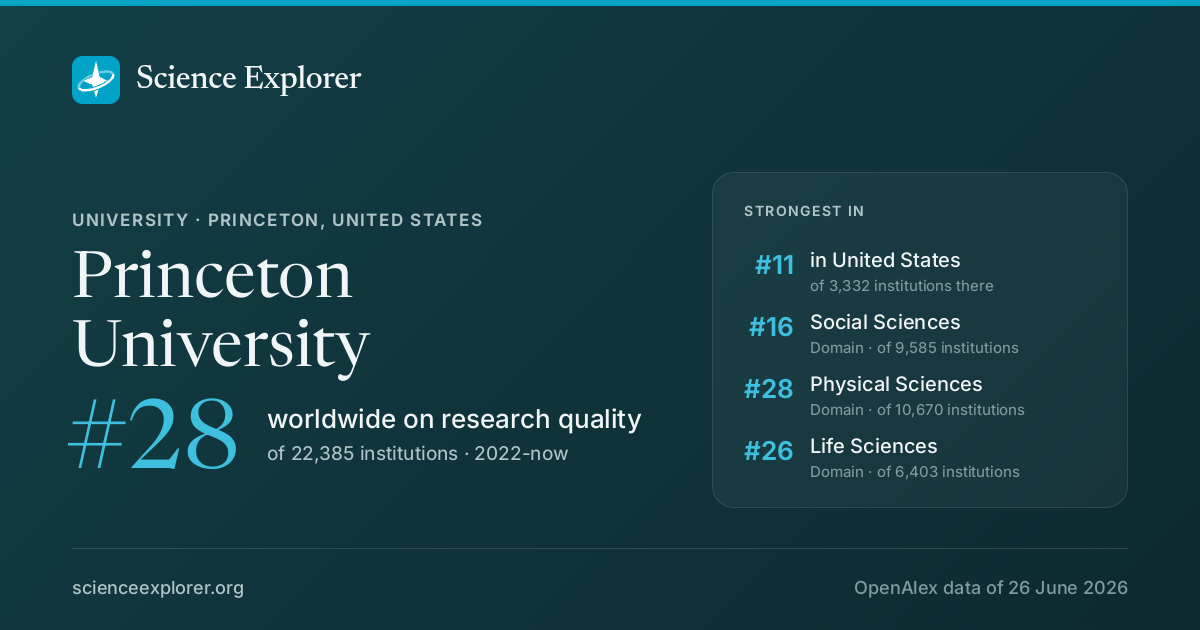
In research, Princeton University stands highest in Social Sciences (#16 of 9,585 worldwide), Physical Sciences (#28 of 10,670 worldwide) and Social Sciences (#20 of 5,988 worldwide), 2022-now. Relative to its size it is most specialised in General Decision Sciences, Nuclear and High Energy Physics and Astronomy and Astrophysics (General Decision Sciences is 10.0× its share of world research).
- World rank, 2022-now
- #28 of 22,385 · #21 all time
- Rank in United States
- #11 of 3,332
- Research works
- 102k ▼ 6% vs 2018-21
- Citations
- 5.7M 56.2 per fractional work
- Top-10% rate
- 16.2% all institutions 10.0%
- vs its own fields
- 1.76× 1.00× is exactly expected
- Open access
- 33% world 40%
- International
- 15% world 18%
What is Princeton University known for in research?
The fields where it stands highest, 2022-now, ranked among every institution above the floor in each field.
| Field | World rank | Where that sits | Top-10% rate | Works | All time |
|---|---|---|---|---|---|
| Social SciencesDomain | #16 of 9,585 | 14.4% | 2,725 | #12 | |
| Physical SciencesDomain | #28 of 10,670 | 17.8% | 5,114 | #15 | |
| Social SciencesField | #20 of 5,988 | 14.9% | 1,313 | #10 | |
| Life SciencesDomain | #26 of 6,403 | 17.9% | 965 | #25 | |
| Physics and AstronomyField | #8 of 1,417 | 20.7% | 1,245 | #8 | |
| MathematicsField | #6 of 1,051 | 20.6% | 329 | #2 | |
| Arts and HumanitiesField | #12 of 1,896 | 12.0% | 617 | #10 | |
| Sociology and Political ScienceSubfield | #16 of 2,526 | 15.2% | 520 | #11 | |
| Computer ScienceField | #34 of 4,417 | 17.2% | 852 | #13 | |
| Economics, Econometrics and FinanceField | #15 of 1,798 | 18.7% | 312 | #6 |
Each strip is that field's whole ranked pool, with the notch where Princeton University sits in it, in the colour of the band that rank falls in. The track under the rate is the rate itself: it carries no average mark, because the average differs by field (from about 6% in Dentistry to 21% in Economics).
Which of those standings moved
The same fields on both windows: where it stood over the whole record, and where it stands in 2022-now. The distance is the story, and it is the one thing the two rank columns above cannot show.
- Social Sciences#12 #16
- Physical Sciences#15 #28
- Social Sciences#10 #20
- Life Sciences#25 #26
- Physics and Astronomy#8 #8
- Mathematics#2 #6
- Arts and Humanities#10 #12
- Sociology and Political Science#11 #16
- Computer Science#13 #34
- Economics, Econometrics and Finance#6 #15
A dot further right is a better standing. Fields it was not ranked in over the whole record are left out.
Which fields of science does Princeton University work in?
In 2022-now, 55% of research at Princeton University is in Physical Sciences, 29% in Social Sciences. Its largest fields are Social Sciences (14%), Physics and Astronomy (13%), Engineering (13%). It does 1.4× the world's share of Physical Sciences.
Each ring splits the one inside it: the four domains of science, their fields, their subfields. Size is fractional works in 2022-now. Every slice is a page; the interactive view zooms down to single topics and colours each by how much more of it this institution does than the world.
Its 4 domains and 26 fields, with their numbers
- Physical Sciences5,82555.2%
- Physics and Astronomy1,41413.4%
- Engineering1,39613.2%
- Computer Science9899.4%
- Environmental Science5104.8%
- Materials Science3923.7%
- Mathematics3713.5%
- Earth and Planetary Sciences3643.5%
- Chemistry2432.3%
- Energy820.8%
- Chemical Engineering650.6%
- Social Sciences3,09529.3%
- Social Sciences1,48014.0%
- Arts and Humanities7046.7%
- Economics, Econometrics and Finance3343.2%
- Psychology3153.0%
- Decision Sciences1351.3%
- Business, Management and Accounting1271.2%
- Life Sciences1,13010.7%
- Health Sciences4954.7%
- Medicine3923.7%
- Health Professions840.8%
- Nursing110.1%
- Veterinary50.0%
- Dentistry40.0%
What does Princeton University specialise in?
Where its research is concentrated relative to its size: General Decision Sciences takes 10.0× the share of its output that it takes of world research.
- General Decision SciencesSubfield · 20.0 works10×
- Nuclear and High Energy PhysicsSubfield · 329.3 works9.9×
- Astronomy and AstrophysicsSubfield · 450.5 works8.2×
- Discrete Mathematics and CombinatoricsSubfield · 32.0 works7.7×
- InstrumentationSubfield · 35.0 works6.7×
- ClassicsSubfield · 41.4 works6.6×
- Physics and AstronomyField · 1,413.6 works6.0×
Location quotient, a volume reading rather than an impact one. It surfaces small, lopsided specialities.
Field profile
Location quotient across every field it publishes in: outside the ring is more than an institution of this size would be expected to publish, inside it is less.
Rings at 0.5×, 1× and 2×. Widest outward: Physics and Astronomy, 6.0×. Every wedge is a field page.
All 26 fields, with their numbers
- Physics and Astronomy6.03×1,414 works
- Mathematics2.99×371 works
- Arts and Humanities2.31×704 works
- Earth and Planetary Sciences2.20×364 works
- Chemical Engineering1.78×66 works
- Neuroscience1.59×272 works
- Economics, Econometrics and Finance1.48×334 works
- Chemistry1.47×243 works
- Decision Sciences1.33×135 works
- Computer Science1.21×989 works
- Biochemistry, Genetics and Molecular Biology1.14×642 works
- Social Sciences1.11×1,480 works
- Materials Science1.06×392 works
- Psychology0.98×315 works
- Environmental Science0.97×510 works
- Engineering0.88×1,396 works
- Energy0.85×82 works
- Pharmacology, Toxicology and Pharmaceutics0.47×18 works
- Immunology and Microbiology0.39×41 works
- Business, Management and Accounting0.37×127 works
- Veterinary0.32×4 works
- Agricultural and Biological Sciences0.31×157 works
- Health Professions0.30×84 works
- Nursing0.22×11 works
- Medicine0.19×392 works
- Dentistry0.07×4 works
- Physics and Astronomy 6.0×
- Mathematics 3.0×
- Arts and Humanities 2.3×
- Earth and Planetary Sciences 2.2×
- Chemical Engineering 1.8×
- Neuroscience 1.6×
- Economics, Econometrics and Finance 1.5×
- Chemistry 1.5×
- Decision Sciences 1.3×
- Computer Science 1.2×
- Biochemistry, Genetics and Molecular Biology 1.1×
- Social Sciences 1.1×
- Materials Science 1.1×
- Psychology 1.0×
- Environmental Science 1.0×
- Engineering 0.9×
- Energy 0.8×
- Pharmacology, Toxicology and Pharmaceutics 0.5×
- Immunology and Microbiology 0.4×
- Business, Management and Accounting 0.4×
- Veterinary 0.3×
- Agricultural and Biological Sciences 0.3×
- Health Professions 0.3×
- Nursing 0.2×
- Medicine 0.2×
- Dentistry 0.1×
Who are the top researchers at Princeton University?
Ranked on the quality score, Jon Brinkmann, Joshua D. Rabinowitz and David W. C. MacMillan lead among researchers whose main affiliation is Princeton University.
- 1
Jon Brinkmann
 United States · #147 worldwide
113k citations · 272 works
- 2
Joshua D. Rabinowitz
United States · #332 worldwide
76k citations · 786 works
- 3
David W. C. MacMillan
United States · #354 worldwide
75k citations · 471 works
- 4
Daniel J. Kahneman
United States · #1,456 worldwide
395k citations · 372 works
- 5
Douglas S. Massey
United States · #2,106 worldwide
67k citations · 544 works
- 6
Kevin M. Huffenberger
United States · #2,168 worldwide
68k citations · 339 works
- 7
G. John Ikenberry
United States · #2,414 worldwide
77k citations · 645 works
- 8
Abigail G. Doyle
United States · #2,481 worldwide
21k citations · 297 works
- 9
Kosuke Imai
United States · #2,598 worldwide
39k citations · 2,073 works
- 10
Iain D. Couzin
United States · #2,691 worldwide
32k citations · 298 works
Which keywords describe research at Princeton University?
By fractional works in 2022-now, weighted toward what it does more of than the world: Climate Change, Turbulence, Diagnostics, Tokamak, Transport, History, Solar Wind and Globalization.
- Accretion Disks
- Approximation Algorithms
- Supernovae
- Magnetosphere
- Electron Acceleration
- Public Opinion
- Ocean Circulation
- Molecular Dynamics
- Black Holes
- Solar Wind
- Transport
- Culture
- Gender
- Religion
- Literature
- Colonialism
- Neural Networks
- Identity
- Deep Learning
- Machine Learning
- Climate Change
- Globalization
- History
- Turbulence
- Nationalism
- Global Warming
- Human Rights
- Ethics
- Diagnostics
- Tokamak
- Philosophy
- Democracy
- Feminism
- Society
- Entanglement
- Dark Matter
- Ionosphere
- Star Formation
- Quantum Gravity
- Magnetic Fields
Size is fractional works in 2022-now in the topics tagged with each word; colour is the word's share of this institution's work against its share of the world's. The 40 words are chosen for being large and distinctive. Each links to the topic it comes from most.
All 40 words, with their numbers
- Climate Change432▲ 1.51×10² topics
- Machine Learning346◆ 0.99×80 topics
- Globalization300▲ 1.45×122 topics
- Deep Learning297▼ 0.82×77 topics
- History207▲ 2.8×56 topics
- Identity182▲ 2.4×65 topics
- Turbulence178▲ 19×5 topics
- Neural Networks176◆ 1.08×37 topics
- Nationalism174▲ 3.7×33 topics
- Colonialism169▲ 3.4×44 topics
- Global Warming160▲ 3.6×14 topics
- Literature154▲ 2.7×56 topics
- Human Rights152▲ 1.41×66 topics
- Religion152▲ 3.1×41 topics
- Ethics149▲ 2.8×45 topics
- Gender140▲ 2.5×48 topics
- Diagnostics139▲ 17×2 topics
- Culture137▲ 2.5×34 topics
- Tokamak136▲ 60×1 topic
- Transport136▲ 41×1 topic
- Philosophy130▲ 2.8×41 topics
- Solar Wind126▲ 13×2 topics
- Democracy123▲ 3.3×24 topics
- Black Holes118▲ 12×3 topics
- Feminism101▲ 3.3×21 topics
- Molecular Dynamics98▲ 5.3×6 topics
- Society90▲ 4.5×20 topics
- Ocean Circulation89▲ 6.2×3 topics
- Entanglement85▲ 5.3×4 topics
- Public Opinion84▲ 6.6×6 topics
- Dark Matter80▲ 6.6×4 topics
- Electron Acceleration76▲ 11×2 topics
- Ionosphere74▲ 13×1 topic
- Magnetosphere74▲ 13×1 topic
- Star Formation72▲ 12×2 topics
- Supernovae71▲ 8.3×2 topics
- Quantum Gravity70▲ 7.9×4 topics
- Approximation Algorithms65▲ 8.3×5 topics
- Magnetic Fields63▲ 8.9×3 topics
- Accretion Disks61▲ 12×2 topics
Which research topics does Princeton University publish most on?
By volume in 2022-now: Magnetic confinement fusion research, Ionosphere and magnetosphere dynamics, Climate variability and models and Solar and Space Plasma Dynamics.
Area is fractional works; colour is the subfield each topic belongs to.
- 1 Magnetic confinement fusion research Nuclear and High Energy Physics 136 works
- 2 Ionosphere and magnetosphere dynamics Astronomy and Astrophysics 74 works
- 3 Climate variability and models Global and Planetary Change 55 works
- 4 Solar and Space Plasma Dynamics Astronomy and Astrophysics 52 works
- 5 Black Holes and Theoretical Physics Nuclear and High Energy Physics 49 works
- 6 Cosmology and Gravitation Theories Astronomy and Astrophysics 45 works
- 7 Laser-Plasma Interactions and Diagnostics Nuclear and High Energy Physics 45 works
- 8 Fusion materials and technologies Materials Chemistry 44 works
- 9 Stellar, planetary, and galactic studies Astronomy and Astrophysics 44 works
- 10 Plasma Diagnostics and Applications Electrical and Electronic Engineering 41 works
How open and international is its research?
Against the world's own shares: the tick on each track. Both are shares of its output, so they sit on one scale and can be read against each other as well as against the world.
World: 40% of research is openly available.
World: 18% is written across borders.
How has Princeton University's research output changed?
Output in 2022-2025 was 6% lower than in 2018-2021.
The same series as a ribbon: one cell per year, darker for more. The line above answers how much; this answers when.
Its share of all research
Growing output can still be a shrinking share: all of science grows. This is Princeton University as a percentage of every work published that year, 0.042% in 2024.
Fractional works of Princeton University over all fractional works that year. How the balance of science has shifted.
How much of it reaches the world top 10%
Year by year, against all institutions in the same year.
Of each year's output, the share that reached the world's 10% most cited for its field and year. Peak 23.6% in 2004.
Other research institutions in Princeton
- Institute for Advanced Study
- Educational Testing Service
- Textile Research Institute
- Princeton Theological Seminary
- Mathematica Policy Research
- Robert Wood Johnson Foundation
- Princeton Public Schools
- Covance (United States)

Which institutions have research most like Princeton University's?
Among the world's leading institutions, University of California, Santa Barbara has the research profile closest to Princeton University's, with both strong in Physics and Astronomy.
- 1
University of California, Santa BarbaraUnited States · Both strong in Physics and Astronomy, Earth and Planetary Sciences, Mathematics
0.96 Compare
- 2
Université Paris Sciences et Lettres
 France · Both strong in Physics and Astronomy, Arts and Humanities, Earth and Planetary Sciences
0.92 Compare
- 3
Max Planck Society
 Germany · Both strong in Physics and Astronomy, Mathematics, Chemical Engineering
0.91 Compare
- 4
University of Notre DameUnited States · Both strong in Mathematics, Physics and Astronomy, Arts and Humanities
0.91 Compare
- 5
University of California, BerkeleyUnited States · Both strong in Physics and Astronomy, Earth and Planetary Sciences, Mathematics
0.89 Compare



Similarity is the correlation of each side's location quotients across every field it publishes in, on a log scale: 1 is the same shape of research, 0 is unrelated. It ignores size. How it is measured.
Compare Princeton University with
- vs
 University of Chinese Academy of Sciences
- vs University of California San Diego
- vs Yale University
- vs New York University
- vs University of Washington
- vs Wuhan University
Share Princeton University's ranking
Badges for a website10Each links back here and updates with every snapshot
Its overall standing, then the domains, fields and subfields where Princeton University is in the world's top ten or its top 1%. Each has an image of its own.
Overall

Domains


Fields


Subfields


Research measures only: rankings here say nothing about teaching, admissions or student experience. Comparable institutions and collaboration partners have tabs of their own, above.
Questions people ask
What is Princeton University known for in research?
In research, Princeton University stands highest in Social Sciences (#16 of 9,585 worldwide), Physical Sciences (#28 of 10,670 worldwide) and Social Sciences (#20 of 5,988 worldwide), 2022-now. Relative to its size it is most specialised in General Decision Sciences, Nuclear and High Energy Physics and Astronomy and Astrophysics (General Decision Sciences is 10.0× its share of world research).
Discussion
Ask a question or share a note about Princeton University. Keep it to the research: no personal attacks, advertising or links. Any reader can report a post, which collapses it for everyone until it is opened.