Institute for Advanced Study
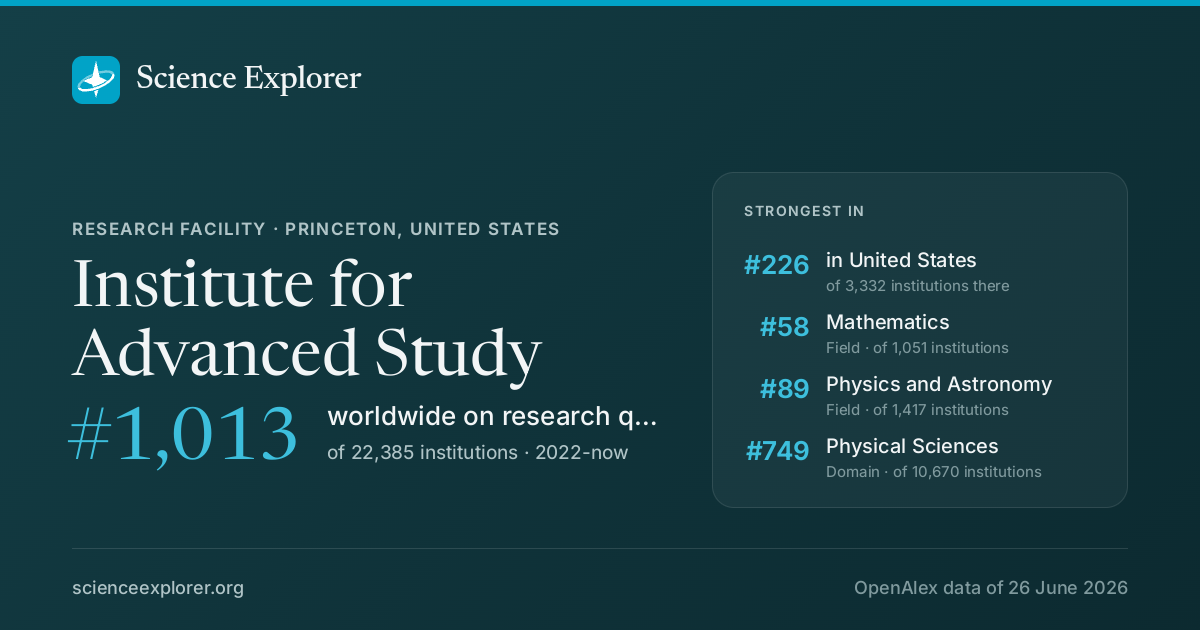
In research, Institute for Advanced Study stands highest in Mathematics (#58 of 1,051 worldwide), Physics and Astronomy (#89 of 1,417 worldwide) and Physical Sciences (#749 of 10,670 worldwide), 2022-now. Relative to its size it is most specialised in Geometry and Topology, Nuclear and High Energy Physics and Mathematical Physics (Geometry and Topology is 37.7× its share of world research).
- World rank, 2022-now
- #1,013 of 22,385 · #689 all time
- Rank in United States
- #226 of 3,332
- Research works
- 9k ▼ 3% vs 2018-21
- Citations
- 697k 77.7 per fractional work
- Top-10% rate
- 21.7% all institutions 10.0%
- vs its own fields
- 1.51× 1.00× is exactly expected
- Open access
- 41% world 40%
- International
- 21% world 18%
What is Institute for Advanced Study known for in research?
The fields where it stands highest, 2022-now, ranked among every institution above the floor in each field.
| Field | World rank | Where that sits | Top-10% rate | Works | All time |
|---|---|---|---|---|---|
| MathematicsField | #58 of 1,051 | 25.2% | 121 | #21 | |
| Physics and AstronomyField | #89 of 1,417 | 30.0% | 235 | #107 | |
| Physical SciencesDomain | #749 of 10,670 | 25.5% | 451 | #575 | |
| Social SciencesDomain | #1,396 of 9,585 | 14.4% | 158 | #818 | |
| Astronomy and AstrophysicsSubfield | #62 of 400 | 27.2% | 103 | #52 | |
| Social SciencesField | #1,215 of 5,988 | 13.8% | 86 | #806 | |
| Nuclear and High Energy PhysicsSubfield | #105 of 254 | 34.3% | 66 | #43 |
Each strip is that field's whole ranked pool, with the notch where Institute for Advanced Study sits in it, in the colour of the band that rank falls in. The track under the rate is the rate itself: it carries no average mark, because the average differs by field (from about 6% in Dentistry to 21% in Economics).
Which of those standings moved
The same fields on both windows: where it stood over the whole record, and where it stands in 2022-now. The distance is the story, and it is the one thing the two rank columns above cannot show.
- Mathematics#21 #58
- Physics and Astronomy#107 #89
- Physical Sciences#575 #749
- Social Sciences#818 #1,396
- Astronomy and Astrophysics#52 #62
- Social Sciences#806 #1,215
- Nuclear and High Energy Physics#43 #105
A dot further right is a better standing. Fields it was not ranked in over the whole record are left out.
Which fields of science does Institute for Advanced Study work in?
In 2022-now, 69% of research at Institute for Advanced Study is in Physical Sciences, 24% in Social Sciences. Its largest fields are Physics and Astronomy (35%), Mathematics (19%), Social Sciences (13%). It does 1.8× the world's share of Physical Sciences.
Each ring splits the one inside it: the four domains of science, their fields, their subfields. Size is fractional works in 2022-now. Every slice is a page; the interactive view zooms down to single topics and colours each by how much more of it this institution does than the world.
Its 4 domains and 25 fields, with their numbers
- Physical Sciences48869.4%
- Physics and Astronomy24935.4%
- Mathematics13419.0%
- Computer Science557.8%
- Engineering324.6%
- Environmental Science50.7%
- Materials Science50.6%
- Earth and Planetary Sciences40.6%
- Chemistry30.5%
- Chemical Engineering10.1%
- Energy00.1%
- Social Sciences16924.1%
- Social Sciences9313.2%
- Arts and Humanities456.4%
- Psychology162.3%
- Economics, Econometrics and Finance81.1%
- Business, Management and Accounting40.6%
- Decision Sciences40.5%
- Life Sciences273.8%
- Health Sciences192.8%
- Medicine172.4%
- Health Professions20.3%
- Nursing00.0%
- Veterinary00.0%
What does Institute for Advanced Study specialise in?
Where its research is concentrated relative to its size: Geometry and Topology takes 37.7× the share of its output that it takes of world research.
- Geometry and TopologySubfield · 43.2 works38×
- Nuclear and High Energy PhysicsSubfield · 71.1 works32×
- Mathematical PhysicsSubfield · 35.3 works32×
- Astronomy and AstrophysicsSubfield · 108.9 works30×
- MathematicsField · 133.7 works16×
- Physics and AstronomyField · 249.0 works16×
Location quotient, a volume reading rather than an impact one. It surfaces small, lopsided specialities.
Field profile
Location quotient across every field it publishes in: outside the ring is more than an institution of this size would be expected to publish, inside it is less.
Rings at 0.5×, 1× and 2×. Widest outward: Mathematics, 16.1×. Every wedge is a field page.
All 25 fields, with their numbers
- Mathematics16.15×134 works
- Physics and Astronomy15.92×249 works
- Arts and Humanities2.21×45 works
- Social Sciences1.04×93 works
- Computer Science1.01×55 works
- Psychology0.74×16 works
- Neuroscience0.57×6 works
- Decision Sciences0.54×4 works
- Economics, Econometrics and Finance0.52×8 works
- Biochemistry, Genetics and Molecular Biology0.39×14 works
- Earth and Planetary Sciences0.37×4 works
- Immunology and Microbiology0.33×2 works
- Chemical Engineering0.32×1 works
- Chemistry0.30×3 works
- Engineering0.30×32 works
- Materials Science0.19×5 works
- Business, Management and Accounting0.19×4 works
- Pharmacology, Toxicology and Pharmaceutics0.16×0 works
- Environmental Science0.14×5 works
- Health Professions0.13×2 works
- Medicine0.13×17 works
- Agricultural and Biological Sciences0.09×3 works
- Energy0.07×0 works
- Veterinary0.04×0 works
- Nursing0.02×0 works
- Mathematics 16.1×
- Physics and Astronomy 15.9×
- Arts and Humanities 2.2×
- Social Sciences 1.0×
- Computer Science 1.0×
- Psychology 0.7×
- Neuroscience 0.6×
- Decision Sciences 0.5×
- Economics, Econometrics and Finance 0.5×
- Biochemistry, Genetics and Molecular Biology 0.4×
- Earth and Planetary Sciences 0.4×
- Immunology and Microbiology 0.3×
- Chemical Engineering 0.3×
- Chemistry 0.3×
- Engineering 0.3×
- Materials Science 0.2×
- Business, Management and Accounting 0.2×
- Pharmacology, Toxicology and Pharmaceutics 0.2×
- Environmental Science 0.1×
- Health Professions 0.1×
- Medicine 0.1×
- Agricultural and Biological Sciences 0.1×
- Energy 0.1×
- Veterinary 0.0×
- Nursing 0.0×
Who are the top researchers at Institute for Advanced Study?
Ranked on the quality score, Edward H. Witten, Nathan Seiberg and Nima Arkani–Hamed lead among researchers whose main affiliation is Institute for Advanced Study.
- 1
Edward H. Witten
 United States · #45 worldwide
174k citations · 644 works
- 2
Nathan Seiberg
United States · #155 worldwide
53k citations · 257 works
- 3
Nima Arkani–Hamed
United States · #1,998 worldwide
32k citations · 225 works
- 4
JUAN M. MALDACENA
United States · #3,014 worldwide
62k citations · 195 works
- 5
Matías Zaldarriaga
United States · #5,900 worldwide
30k citations · 352 works
- 6
Arnold J. Levine
United States · #6,747 worldwide
133k citations · 633 works
- 7
Jean Bourgain
United States · #9,175 worldwide
30k citations · 584 works
- 8
Shu-Heng Shao
United States · #10,955 worldwide
5.8k citations · 125 works
- 9
Scott D. Tremaine
United States · #21,603 worldwide
40k citations · 350 works
- 10
Armand Borel
United States · #23,849 worldwide
19k citations · 271 works
Which keywords describe research at Institute for Advanced Study?
By fractional works in 2022-now, weighted toward what it does more of than the world: Black Holes, Quantum Gravity, String Theory, Quantum Entanglement, Field Theories, Holographic, Supernovae and Dark Matter.
- Protoplanetary Disks
- X-Ray Astronomy
- Dynamical Systems
- K-Theory
- Tropical Geometry
- Noncommutative Field Theory
- Galaxies
- Modular Forms
- Cosmic Rays
- Particle Physics
- Entanglement
- Cosmology
- Gravitational Waves
- Accretion Disks
- Cosmological Parameters
- Dark Energy
- Dark Matter
- Holographic
- Quantum Entanglement
- Quantum Gravity
- Black Holes
- String Theory
- Field Theories
- Supernovae
- General Relativity
- Cosmic Microwave Background
- Star Formation
- Magnetic Fields
- Symplectic Geometry
- Renormalization Group
- Galactic Center
- Quantum Groups
- Neutrinos
- Turbulence
- Lorentz Violation
- Stellar Populations
- Exoplanets
- Stellar Astrophysics
- Event Horizon Telescope
- Molecular Clouds
Size is fractional works in 2022-now in the topics tagged with each word; colour is the word's share of this institution's work against its share of the world's. The 40 words are chosen for being large and distinctive. Each links to the topic it comes from most.
All 40 words, with their numbers
- Black Holes59▲ 86×3 topics
- Quantum Gravity49▲ 82×4 topics
- String Theory36▲ 93×2 topics
- Quantum Entanglement36▲ 79×2 topics
- Field Theories36▲ 114×1 topic
- Holographic36▲ 114×1 topic
- Supernovae34▲ 60×2 topics
- Dark Matter27▲ 34×4 topics
- General Relativity27▲ 57×2 topics
- Dark Energy25▲ 56×2 topics
- Cosmic Microwave Background25▲ 65×1 topic
- Cosmological Parameters25▲ 65×1 topic
- Star Formation23▲ 58×2 topics
- Accretion Disks22▲ 64×2 topics
- Magnetic Fields22▲ 48×2 topics
- Gravitational Waves19▲ 47×2 topics
- Symplectic Geometry18▲ 71×2 topics
- Cosmology18▲ 38×3 topics
- Renormalization Group18▲ 45×2 topics
- Entanglement16▲ 15×4 topics
- Galactic Center16▲ 49×2 topics
- Particle Physics15▲ 28×2 topics
- Quantum Groups13▲ 52×2 topics
- Cosmic Rays13▲ 36×2 topics
- Neutrinos13▲ 36×2 topics
- Modular Forms12▲ 45×3 topics
- Turbulence12▲ 19×4 topics
- Galaxies12▲ 57×1 topic
- Lorentz Violation12▲ 99×1 topic
- Noncommutative Field Theory12▲ 99×1 topic
- Stellar Populations12▲ 57×1 topic
- Tropical Geometry12▲ 51×2 topics
- Exoplanets12▲ 41×1 topic
- K-Theory12▲ 64×2 topics
- Stellar Astrophysics12▲ 41×1 topic
- Dynamical Systems11▲ 24×3 topics
- Event Horizon Telescope11▲ 70×1 topic
- X-Ray Astronomy11▲ 70×1 topic
- Molecular Clouds11▲ 59×1 topic
- Protoplanetary Disks11▲ 59×1 topic
Which research topics does Institute for Advanced Study publish most on?
By volume in 2022-now: Black Holes and Theoretical Physics, Cosmology and Gravitation Theories, Noncommutative and Quantum Gravity Theories and Galaxies: Formation, Evolution, Phenomena.
Area is fractional works; colour is the subfield each topic belongs to.
- 1 Black Holes and Theoretical Physics Nuclear and High Energy Physics 36 works
- 2 Cosmology and Gravitation Theories Astronomy and Astrophysics 25 works
- 3 Noncommutative and Quantum Gravity Theories Statistical and Nonlinear Physics 12 works
- 4 Galaxies: Formation, Evolution, Phenomena Astronomy and Astrophysics 12 works
- 5 Stellar, planetary, and galactic studies Astronomy and Astrophysics 12 works
- 6 Astrophysical Phenomena and Observations Astronomy and Astrophysics 11 works
- 7 Astrophysics and Star Formation Studies Astronomy and Astrophysics 11 works
- 8 Algebraic structures and combinatorial models Geometry and Topology 10 works
- 9 Particle physics theoretical and experimental studies Nuclear and High Energy Physics 10 works
- 10 Pulsars and Gravitational Waves Research Astronomy and Astrophysics 10 works
How open and international is its research?
Against the world's own shares: the tick on each track. Both are shares of its output, so they sit on one scale and can be read against each other as well as against the world.
World: 40% of research is openly available.
World: 18% is written across borders.
How has Institute for Advanced Study's research output changed?
Output in 2022-2025 was 3% lower than in 2018-2021.
The same series as a ribbon: one cell per year, darker for more. The line above answers how much; this answers when.
Its share of all research
Growing output can still be a shrinking share: all of science grows. This is Institute for Advanced Study as a percentage of every work published that year, 0.0027% in 2024.
Fractional works of Institute for Advanced Study over all fractional works that year. How the balance of science has shifted.
How much of it reaches the world top 10%
Year by year, against all institutions in the same year.
Of each year's output, the share that reached the world's 10% most cited for its field and year. Peak 32.6% in 2016.
Other research institutions in Princeton
- Princeton University
- Educational Testing Service
- Textile Research Institute
- Princeton Theological Seminary
- Mathematica Policy Research
- Robert Wood Johnson Foundation
- Princeton Public Schools
- Covance (United States)


Share Institute for Advanced Study's ranking



Research measures only: rankings here say nothing about teaching, admissions or student experience. Comparable institutions and collaboration partners have tabs of their own, above.
Discussion
Ask a question or share a note about Institute for Advanced Study. Posts are plain text and can be reported.