Beijing Normal University
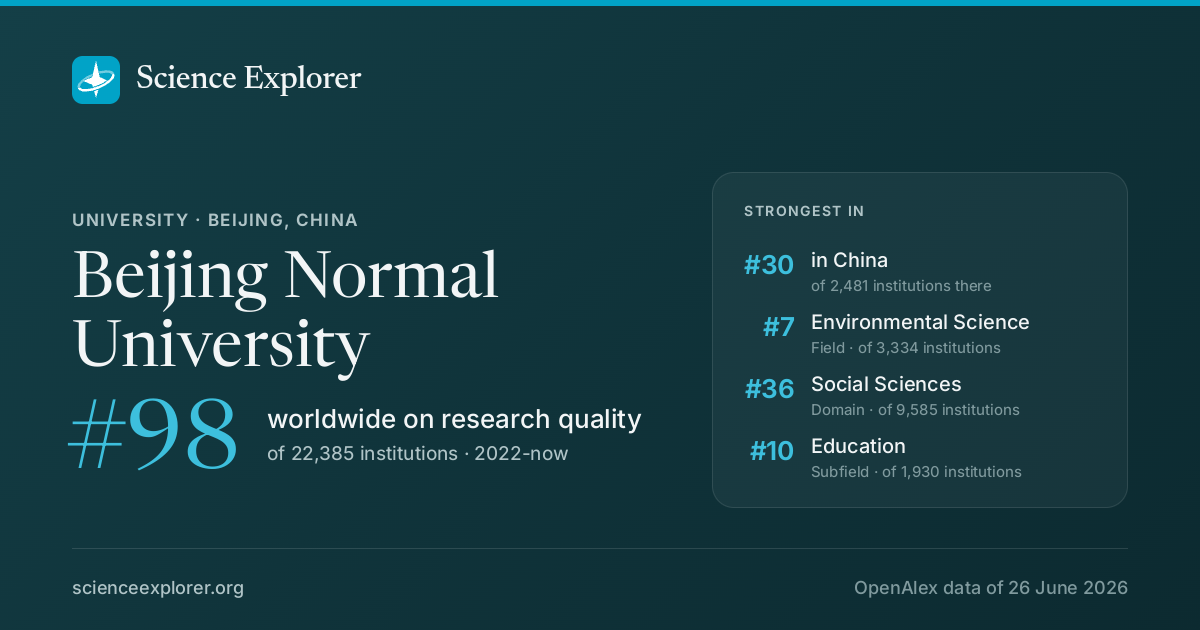
In research, Beijing Normal University stands highest in Environmental Science (#7 of 3,334 worldwide), Social Sciences (#36 of 9,585 worldwide) and Education (#10 of 1,930 worldwide), 2022-now. Relative to its size it is most specialised in Atmospheric Science, Global and Planetary Change and Environmental Engineering (Atmospheric Science is 6.4× its share of world research).
- World rank, 2022-now
- #98 of 22,385 · #168 all time
- Rank in China
- #30 of 2,481
- Research works
- 62k ▲ 56% vs 2018-21
- Citations
- 1M 16.3 per fractional work
- Top-10% rate
- 14.7% all institutions 10.0%
- vs its own fields
- 1.24× 1.00× is exactly expected
- Open access
- 30% world 40%
- International
- 18% world 18%
What is Beijing Normal University known for in research?
The fields where it stands highest, 2022-now, ranked among every institution above the floor in each field.
| Field | World rank | Where that sits | Top-10% rate | Works | All time |
|---|---|---|---|---|---|
| Environmental ScienceField | #7 of 3,334 | 18.1% | 2,696 | #8 | |
| Social SciencesDomain | #36 of 9,585 | 15.1% | 5,114 | #74 | |
| EducationSubfield | #10 of 1,930 | 21.2% | 637 | #33 | |
| Social SciencesField | #37 of 5,988 | 15.6% | 2,291 | #82 | |
| Physical SciencesDomain | #70 of 10,670 | 14.9% | 9,222 | #129 | |
| PsychologyField | #14 of 2,121 | 16.1% | 1,293 | #45 | |
| Applied MathematicsSubfield | #1 of 146 | 23.7% | 166 | #7 | |
| Global and Planetary ChangeSubfield | #6 of 544 | 18.9% | 761 | #13 | |
| Business, Management and AccountingField | #32 of 2,581 | 13.9% | 462 | #99 | |
| Water Science and TechnologySubfield | #5 of 315 | 18.5% | 320 | #3 |
Each strip is that field's whole ranked pool, with the notch where Beijing Normal University sits in it, in the colour of the band that rank falls in. The track under the rate is the rate itself: it carries no average mark, because the average differs by field (from about 6% in Dentistry to 21% in Economics).
Which of those standings moved
The same fields on both windows: where it stood over the whole record, and where it stands in 2022-now. The distance is the story, and it is the one thing the two rank columns above cannot show.
- Environmental Science#8 #7
- Social Sciences#74 #36
- Education#33 #10
- Social Sciences#82 #37
- Physical Sciences#129 #70
- Psychology#45 #14
- Applied Mathematics#7 #1
- Global and Planetary Change#13 #6
- Business, Management and Accounting#99 #32
- Water Science and Technology#3 #5
A dot further right is a better standing. Fields it was not ranked in over the whole record are left out.
Which fields of science does Beijing Normal University work in?
In 2022-now, 56% of research at Beijing Normal University is in Physical Sciences, 31% in Social Sciences. Its largest fields are Environmental Science (16%), Social Sciences (14%), Engineering (10%). It does 1.4× the world's share of Physical Sciences.
Each ring splits the one inside it: the four domains of science, their fields, their subfields. Size is fractional works in 2022-now. Every slice is a page; the interactive view zooms down to single topics and colours each by how much more of it this institution does than the world.
Its 4 domains and 26 fields, with their numbers
- Physical Sciences10k56.3%
- Environmental Science3,06416.5%
- Engineering1,91310.3%
- Computer Science1,89010.2%
- Physics and Astronomy9445.1%
- Earth and Planetary Sciences8074.3%
- Materials Science6703.6%
- Mathematics5683.1%
- Chemistry3611.9%
- Energy1981.1%
- Chemical Engineering430.2%
- Social Sciences5,68330.6%
- Social Sciences2,52513.6%
- Psychology1,4727.9%
- Economics, Econometrics and Finance5813.1%
- Business, Management and Accounting5072.7%
- Arts and Humanities3722.0%
- Decision Sciences2251.2%
- Life Sciences1,5578.4%
- Health Sciences8874.8%
- Medicine6683.6%
- Health Professions1811.0%
- Nursing300.2%
- Dentistry60.0%
- Veterinary20.0%
What does Beijing Normal University specialise in?
Where its research is concentrated relative to its size: Atmospheric Science takes 6.4× the share of its output that it takes of world research.
- Atmospheric ScienceSubfield · 526.6 works6.4×
- Global and Planetary ChangeSubfield · 863.0 works6.1×
- Environmental EngineeringSubfield · 417.3 works4.2×
- Water Science and TechnologySubfield · 371.0 works3.9×
- Applied MathematicsSubfield · 192.5 works3.6×
- Experimental and Cognitive PsychologySubfield · 311.8 works3.5×
- InstrumentationSubfield · 32.0 works3.5×
Location quotient, a volume reading rather than an impact one. It surfaces small, lopsided specialities.
Field profile
Location quotient across every field it publishes in: outside the ring is more than an institution of this size would be expected to publish, inside it is less.
Rings at 0.5×, 1× and 2×. Widest outward: Environmental Science, 3.3×. Every wedge is a field page.
All 26 fields, with their numbers
- Environmental Science3.32×3,064 works
- Earth and Planetary Sciences2.77×807 works
- Mathematics2.60×568 works
- Psychology2.60×1,472 works
- Physics and Astronomy2.28×944 works
- Neuroscience1.64×495 works
- Economics, Econometrics and Finance1.46×581 works
- Computer Science1.31×1,890 works
- Decision Sciences1.26×226 works
- Chemistry1.24×361 works
- Energy1.16×198 works
- Social Sciences1.07×2,525 works
- Materials Science1.03×670 works
- Business, Management and Accounting0.85×507 works
- Engineering0.69×1,913 works
- Arts and Humanities0.69×372 works
- Chemical Engineering0.67×43 works
- Agricultural and Biological Sciences0.62×552 works
- Biochemistry, Genetics and Molecular Biology0.45×450 works
- Health Professions0.37×181 works
- Nursing0.33×30 works
- Pharmacology, Toxicology and Pharmaceutics0.32×21 works
- Immunology and Microbiology0.21×40 works
- Medicine0.19×668 works
- Veterinary0.09×2 works
- Dentistry0.07×6 works
- Environmental Science 3.3×
- Earth and Planetary Sciences 2.8×
- Mathematics 2.6×
- Psychology 2.6×
- Physics and Astronomy 2.3×
- Neuroscience 1.6×
- Economics, Econometrics and Finance 1.5×
- Computer Science 1.3×
- Decision Sciences 1.3×
- Chemistry 1.2×
- Energy 1.2×
- Social Sciences 1.1×
- Materials Science 1.0×
- Business, Management and Accounting 0.8×
- Engineering 0.7×
- Arts and Humanities 0.7×
- Chemical Engineering 0.7×
- Agricultural and Biological Sciences 0.6×
- Biochemistry, Genetics and Molecular Biology 0.5×
- Health Professions 0.4×
- Nursing 0.3×
- Pharmacology, Toxicology and Pharmaceutics 0.3×
- Immunology and Microbiology 0.2×
- Medicine 0.2×
- Veterinary 0.1×
- Dentistry 0.1×
Who are the top researchers at Beijing Normal University?
Ranked on the quality score, Sha Zhou, Yanxu Liu and Yongshuo H. Fu lead among researchers whose main affiliation is Beijing Normal University.
- 1
Sha Zhou
 China · #2,883 worldwide
11k citations · 135 works
- 2
Yanxu Liu
China · #7,527 worldwide
18k citations · 300 works
- 3
Yongshuo H. Fu
China · #7,786 worldwide
16k citations · 239 works
- 4
Dongpeng Yan
China · #10,017 worldwide
26k citations · 429 works
- 5
Zengchao Hao
China · #10,260 worldwide
12k citations · 156 works
- 6
Chiyuan Miao
China · #10,733 worldwide
19k citations · 345 works
- 7
Xi‐Nian Zuo
China · #10,890 worldwide
44k citations · 352 works
- 8
Ahmed Tlili
China · #12,741 worldwide
7.5k citations · 191 works
- 9
Tommy Tanu Wijaya
China · #15,285 worldwide
4.3k citations · 237 works
- 10
Wenwu Zhao
China · #16,372 worldwide
13k citations · 394 works
Which keywords describe research at Beijing Normal University?
By fractional works in 2022-now, weighted toward what it does more of than the world: Climate Change, Remote Sensing, Land Use Change, Deep Learning, Urbanization, Global Warming, Machine Learning and Hydrological Modeling.
- Drought
- Phenology
- China
- Hydrological Cycle
- Ocean Circulation
- Climate
- Human-Nature Interactions
- Academic Achievement
- Global Change
- Emotion Regulation
- Biomass Estimation
- Environmental Policy
- Greenhouse Gas Emissions
- Biodiversity Conservation
- Global Warming
- Urbanization
- Mental Health
- Land Use Change
- Machine Learning
- Remote Sensing
- Climate Change
- Deep Learning
- Sustainability
- Globalization
- Environmental Impact
- Neural Networks
- Ecosystem Services
- Hydrological Modeling
- Water Resources
- Water Quality
- Well-being
- Social-Ecological Systems
- Sediment Transport
- Global Impact
- Spatial Dynamics
- Self-Regulation
- Hydrology
- Model Evaluation
- Extreme Events
- Vegetation Monitoring
Size is fractional works in 2022-now in the topics tagged with each word; colour is the word's share of this institution's work against its share of the world's. The 40 words are chosen for being large and distinctive. Each links to the topic it comes from most.
All 40 words, with their numbers
- Climate Change1,670▲ 3.3×10⁷ topics
- Remote Sensing1,055▲ 4.7×41 topics
- Deep Learning932▲ 1.45×85 topics
- Machine Learning818▲ 1.32×94 topics
- Sustainability617▲ 1.36×89 topics
- Land Use Change597▲ 11×8 topics
- Globalization478▲ 1.31×10² topics
- Mental Health464▲ 1.75×41 topics
- Environmental Impact427▲ 1.35×55 topics
- Urbanization422▲ 5.6×13 topics
- Neural Networks417▲ 1.45×41 topics
- Global Warming408▲ 5.1×15 topics
- Ecosystem Services354▲ 4.9×13 topics
- Biodiversity Conservation326▲ 4.7×15 topics
- Hydrological Modeling319▲ 7.2×5 topics
- Greenhouse Gas Emissions273▲ 5.3×9 topics
- Water Resources267▲ 5.9×10 topics
- Environmental Policy250▲ 6.7×8 topics
- Water Quality246▲ 3.3×16 topics
- Biomass Estimation242▲ 8.4×3 topics
- Well-being240▲ 3.3×14 topics
- Emotion Regulation240▲ 4.1×9 topics
- Social-Ecological Systems238▲ 9.2×3 topics
- Global Change233▲ 4.7×7 topics
- Sediment Transport226▲ 7.5×6 topics
- Academic Achievement222▲ 6.9×10 topics
- Global Impact219▲ 7.0×4 topics
- Human-Nature Interactions213▲ 13×1 topic
- Spatial Dynamics213▲ 13×1 topic
- Climate207▲ 12×2 topics
- Self-Regulation202▲ 6.0×6 topics
- Ocean Circulation196▲ 7.7×3 topics
- Hydrology189▲ 7.8×4 topics
- Hydrological Cycle183▲ 9.7×2 topics
- Model Evaluation181▲ 7.6×2 topics
- China171▲ 10×7 topics
- Extreme Events167▲ 9.7×2 topics
- Phenology166▲ 13×1 topic
- Vegetation Monitoring166▲ 13×1 topic
- Drought165▲ 9.0×3 topics
Which research topics does Beijing Normal University publish most on?
By volume in 2022-now: Land Use and Ecosystem Services, Remote Sensing in Agriculture, Hydrology and Watershed Management Studies and Climate variability and models.
Area is fractional works; colour is the subfield each topic belongs to.
- 1 Land Use and Ecosystem Services Global and Planetary Change 213 works
- 2 Remote Sensing in Agriculture Ecology 166 works
- 3 Hydrology and Watershed Management Studies Water Science and Technology 145 works
- 4 Climate variability and models Global and Planetary Change 142 works
- 5 Plant Water Relations and Carbon Dynamics Global and Planetary Change 106 works
- 6 Child and Adolescent Psychosocial and Emotional Development Clinical Psychology 98 works
- 7 Remote Sensing and Land Use Atmospheric Science 88 works
- 8 Flood Risk Assessment and Management Global and Planetary Change 87 works
- 9 Energy, Environment, Economic Growth Economics and Econometrics 85 works
- 10 Chinese history and philosophy Sociology and Political Science 82 works
How open and international is its research?
Against the world's own shares: the tick on each track. Both are shares of its output, so they sit on one scale and can be read against each other as well as against the world.
World: 40% of research is openly available.
World: 18% is written across borders.
How has Beijing Normal University's research output changed?
Output in 2022-2025 was 56% higher than in 2018-2021.
The same series as a ribbon: one cell per year, darker for more. The line above answers how much; this answers when.
Its share of all research
Growing output can still be a shrinking share: all of science grows. This is Beijing Normal University as a percentage of every work published that year, 0.076% in 2024.
Fractional works of Beijing Normal University over all fractional works that year. How the balance of science has shifted.
How much of it reaches the world top 10%
Year by year, against all institutions in the same year.
Of each year's output, the share that reached the world's 10% most cited for its field and year. Peak 15.6% in 2024.
Other research institutions in Beijing
- Chinese Academy of Sciences
- Tsinghua University
- Peking University
- Chinese Academy of Agricultural Sciences
- University of Chinese Academy of Sciences
- Beihang University
- Beijing Institute of Technology
- Capital Medical University

Which institutions have research most like Beijing Normal University's?
Among the world's leading institutions, University of California, Santa Barbara has the research profile closest to Beijing Normal University's, with both strong in Earth and Planetary Sciences.
- 1
University of California, Santa Barbara
 United States · Both strong in Earth and Planetary Sciences, Physics and Astronomy, Mathematics
0.90 Compare
- 2
University of California, BerkeleyUnited States · Both strong in Earth and Planetary Sciences, Physics and Astronomy, Mathematics
0.89 Compare
- 3
East China Normal UniversityChina · Both strong in Mathematics, Physics and Astronomy, Earth and Planetary Sciences
0.86 Compare
- 4
Nanjing Normal UniversityChina · Both strong in Environmental Science, Earth and Planetary Sciences, Mathematics
0.86 Compare
- 5
University of Waterloo
 Canada · Both strong in Mathematics, Physics and Astronomy, Earth and Planetary Sciences
0.85 Compare


Similarity is the correlation of each side's location quotients across every field it publishes in, on a log scale: 1 is the same shape of research, 0 is unrelated. It ignores size. How it is measured.
Compare Beijing Normal University with
- vs
 The University of Tokyo
- vs South China University of Technology
- vs California Institute of Technology
- vs
 Leibniz Association
- vs Universität Hamburg
- vs
 Aarhus University
Share Beijing Normal University's ranking
Badges for a website10Each links back here and updates with every snapshot
Its overall standing, then the domains, fields and subfields where Beijing Normal University is in the world's top ten or its top 1%. Each has an image of its own.
Overall

Domains


Fields


Subfields


Research measures only: rankings here say nothing about teaching, admissions or student experience. Comparable institutions and collaboration partners have tabs of their own, above.
Discussion
Ask a question or share a note about Beijing Normal University. Keep it to the research: no personal attacks, advertising or links. Any reader can report a post, which collapses it for everyone until it is opened.