Northwestern Polytechnical University
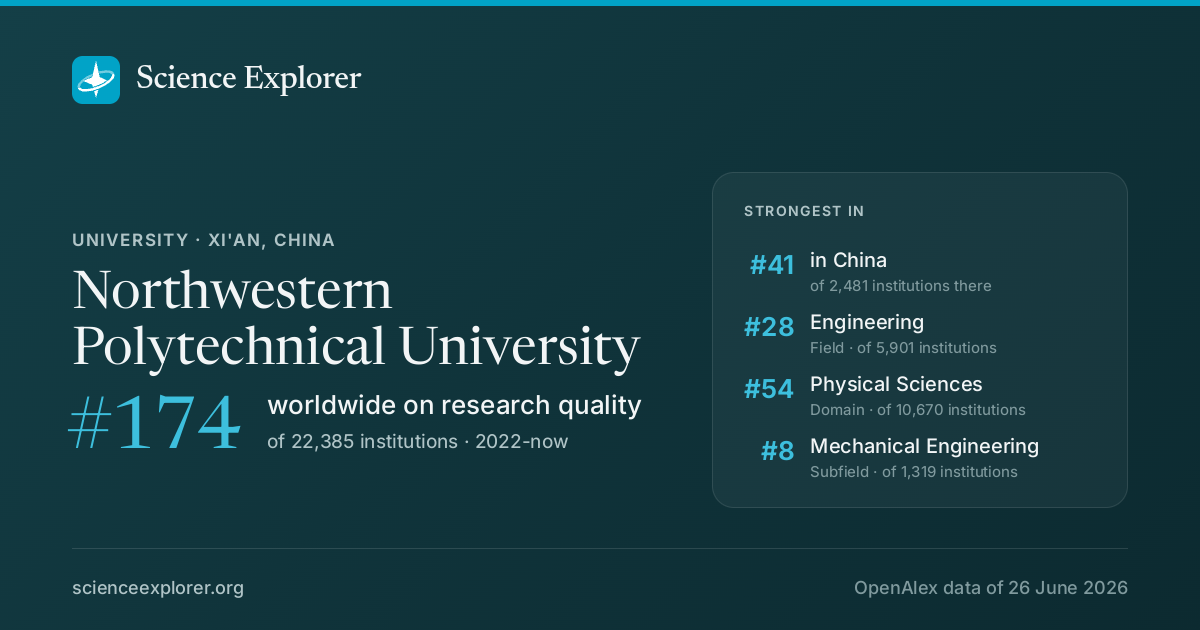
In research, Northwestern Polytechnical University stands highest in Engineering (#28 of 5,901 worldwide), Physical Sciences (#54 of 10,670 worldwide) and Mechanical Engineering (#8 of 1,319 worldwide), 2022-now. Relative to its size it is most specialised in Ceramics and Composites, Aerospace Engineering and Computational Mechanics (Ceramics and Composites is 12.8× its share of world research).
- World rank, 2022-now
- #174 of 22,385 · #276 all time
- Rank in China
- #41 of 2,481
- Research works
- 87k ▲ 41% vs 2018-21
- Citations
- 1.2M 13.7 per fractional work
- Top-10% rate
- 16.4% all institutions 10.0%
- vs its own fields
- 1.38× 1.00× is exactly expected
- Open access
- 20% world 40%
- International
- 12% world 18%
What is Northwestern Polytechnical University known for in research?
The fields where it stands highest, 2022-now, ranked among every institution above the floor in each field.
| Field | World rank | Where that sits | Top-10% rate | Works | All time |
|---|---|---|---|---|---|
| EngineeringField | #28 of 5,901 | 16.5% | 12,524 | #57 | |
| Physical SciencesDomain | #54 of 10,670 | 16.5% | 21,251 | #102 | |
| Mechanical EngineeringSubfield | #8 of 1,319 | 18.9% | 2,132 | #22 | |
| Aerospace EngineeringSubfield | #6 of 785 | 16.7% | 2,588 | #15 | |
| Mechanics of MaterialsSubfield | #7 of 482 | 21.0% | 874 | #25 | |
| Computer ScienceField | #77 of 4,417 | 15.4% | 3,786 | #177 | |
| Materials ScienceField | #42 of 2,276 | 19.4% | 2,644 | #102 | |
| Control and Systems EngineeringSubfield | #15 of 804 | 13.9% | 1,198 | #31 | |
| Materials ChemistrySubfield | #30 of 1,473 | 18.2% | 1,455 | #80 | |
| Electrical and Electronic EngineeringSubfield | #48 of 2,176 | 14.7% | 2,050 | #94 |
Each strip is that field's whole ranked pool, with the notch where Northwestern Polytechnical University sits in it, in the colour of the band that rank falls in. The track under the rate is the rate itself: it carries no average mark, because the average differs by field (from about 6% in Dentistry to 21% in Economics).
Which of those standings moved
The same fields on both windows: where it stood over the whole record, and where it stands in 2022-now. The distance is the story, and it is the one thing the two rank columns above cannot show.
- Engineering#57 #28
- Physical Sciences#102 #54
- Mechanical Engineering#22 #8
- Aerospace Engineering#15 #6
- Mechanics of Materials#25 #7
- Computer Science#177 #77
- Materials Science#102 #42
- Control and Systems Engineering#31 #15
- Materials Chemistry#80 #30
- Electrical and Electronic Engineering#94 #48
A dot further right is a better standing. Fields it was not ranked in over the whole record are left out.
Which fields of science does Northwestern Polytechnical University work in?
In 2022-now, 90% of research at Northwestern Polytechnical University is in Physical Sciences, 5% in Social Sciences. Its largest fields are Engineering (53%), Computer Science (16%), Materials Science (11%). It does 2.3× the world's share of Physical Sciences.
Each ring splits the one inside it: the four domains of science, their fields, their subfields. Size is fractional works in 2022-now. Every slice is a page; the interactive view zooms down to single topics and colours each by how much more of it this institution does than the world.
Its 4 domains and 26 fields, with their numbers
- Physical Sciences24k89.8%
- Engineering14k52.7%
- Computer Science4,25616.1%
- Materials Science2,95011.1%
- Physics and Astronomy6852.6%
- Environmental Science5021.9%
- Earth and Planetary Sciences3751.4%
- Chemistry3321.3%
- Energy3021.1%
- Mathematics2581.0%
- Chemical Engineering1640.6%
- Social Sciences1,2704.8%
- Decision Sciences3691.4%
- Social Sciences2751.0%
- Business, Management and Accounting2651.0%
- Psychology1520.6%
- Economics, Econometrics and Finance1440.5%
- Arts and Humanities660.2%
- Life Sciences8263.1%
- Health Sciences6042.3%
- Medicine5192.0%
- Health Professions590.2%
- Nursing130.1%
- Dentistry110.0%
- Veterinary10.0%
What does Northwestern Polytechnical University specialise in?
Where its research is concentrated relative to its size: Ceramics and Composites takes 12.8× the share of its output that it takes of world research.
- Ceramics and CompositesSubfield · 236.1 works13×
- Aerospace EngineeringSubfield · 2,923.0 works9.4×
- Computational MechanicsSubfield · 1,003.3 works6.5×
- Mechanics of MaterialsSubfield · 973.6 works5.2×
- Mechanical EngineeringSubfield · 2,393.9 works4.9×
- Statistics, Probability and UncertaintySubfield · 209.7 works4.7×
- Control and Systems EngineeringSubfield · 1,299.5 works4.5×
Location quotient, a volume reading rather than an impact one. It surfaces small, lopsided specialities.
Field profile
Location quotient across every field it publishes in: outside the ring is more than an institution of this size would be expected to publish, inside it is less.
Rings at 0.5×, 1× and 2×. Widest outward: Engineering, 3.5×. Every wedge is a field page.
All 26 fields, with their numbers
- Engineering3.51×14k works
- Materials Science3.19×2,950 works
- Computer Science2.07×4,256 works
- Chemical Engineering1.77×164 works
- Decision Sciences1.44×369 works
- Energy1.24×302 works
- Physics and Astronomy1.16×685 works
- Earth and Planetary Sciences0.90×375 works
- Mathematics0.83×258 works
- Chemistry0.80×332 works
- Neuroscience0.52×226 works
- Environmental Science0.38×502 works
- Biochemistry, Genetics and Molecular Biology0.32×450 works
- Business, Management and Accounting0.31×265 works
- Economics, Econometrics and Finance0.25×144 works
- Psychology0.19×152 works
- Pharmacology, Toxicology and Pharmaceutics0.14×13 works
- Immunology and Microbiology0.10×27 works
- Medicine0.10×519 works
- Nursing0.10×13 works
- Agricultural and Biological Sciences0.09×110 works
- Dentistry0.09×11 works
- Arts and Humanities0.09×66 works
- Health Professions0.08×59 works
- Social Sciences0.08×275 works
- Veterinary0.03×1 works
- Engineering 3.5×
- Materials Science 3.2×
- Computer Science 2.1×
- Chemical Engineering 1.8×
- Decision Sciences 1.4×
- Energy 1.2×
- Physics and Astronomy 1.2×
- Earth and Planetary Sciences 0.9×
- Mathematics 0.8×
- Chemistry 0.8×
- Neuroscience 0.5×
- Environmental Science 0.4×
- Biochemistry, Genetics and Molecular Biology 0.3×
- Business, Management and Accounting 0.3×
- Economics, Econometrics and Finance 0.2×
- Psychology 0.2×
- Pharmacology, Toxicology and Pharmaceutics 0.1×
- Immunology and Microbiology 0.1×
- Medicine 0.1×
- Nursing 0.1×
- Agricultural and Biological Sciences 0.1×
- Dentistry 0.1×
- Arts and Humanities 0.1×
- Health Professions 0.1×
- Social Sciences 0.1×
- Veterinary 0.0×
Who are the top researchers at Northwestern Polytechnical University?
Ranked on the quality score, Junwei Gu, Kunpeng Ruan and Hongjing Wu lead among researchers whose main affiliation is Northwestern Polytechnical University.
- 1
Junwei Gu
 China · #115 worldwide
46k citations · 360 works
- 2
Kunpeng Ruan
China · #705 worldwide
15k citations · 80 works
- 3
Hongjing Wu
China · #724 worldwide
25k citations · 354 works
- 4
Panbo Liu
China · #753 worldwide
14k citations · 126 works
- 5
Cao Guan
China · #1,000 worldwide
22k citations · 182 works
- 6
Mukun He
China · #1,115 worldwide
8.7k citations · 77 works
- 7
Gong Cheng
China · #4,841 worldwide
22k citations · 217 works
- 8
Yongqiang Guo
China · #5,815 worldwide
13k citations · 131 works
- 9
Chaobo Liang
China · #9,051 worldwide
10k citations · 71 works
- 10
Shengxi Zhou
China · #12,353 worldwide
13k citations · 260 works
Which keywords describe research at Northwestern Polytechnical University?
By fractional works in 2022-now, weighted toward what it does more of than the world: Mechanical Properties, Deep Learning, Microstructure, Neural Networks, Heat Transfer, Large-Eddy Simulation, Machine Learning and Graphene.
- Microstructure Evolution
- Phase Stability
- Processing Techniques
- Collision Avoidance
- Nonlinear Dynamics
- Neural Network
- Sensor Networks
- Numerical Simulation
- Adaptive Control
- Sintering
- Wireless Sensor Networks
- Vibration Analysis
- Additive Manufacturing
- Polymer Composites
- Large-Eddy Simulation
- Nanocomposites
- Biomedical Applications
- Heat Transfer
- Neural Networks
- Mechanical Properties
- Deep Learning
- Machine Learning
- Microstructure
- Graphene
- Convolutional Neural Networks
- Energy Storage
- Nonlinear Systems
- Multi-Agent Systems
- Microstructural Evolution
- Carbon Nanotubes
- Composite Materials
- Sparse Representation
- Oxidation Resistance
- Spark Plasma Sintering
- Optimal Control
- MXenes
- Feedback Control
- Grain Refinement
- Control
- Vortex Dynamics
Size is fractional works in 2022-now in the topics tagged with each word; colour is the word's share of this institution's work against its share of the world's. The 40 words are chosen for being large and distinctive. Each links to the topic it comes from most.
All 40 words, with their numbers
- Deep Learning2,542▲ 2.8×85 topics
- Mechanical Properties1,703▲ 6.6×39 topics
- Machine Learning1,307▲ 1.48×89 topics
- Neural Networks1,226▲ 3.0×38 topics
- Microstructure1,128▲ 8.2×19 topics
- Heat Transfer769▲ 5.9×19 topics
- Graphene721▲ 4.0×12 topics
- Biomedical Applications650▲ 2.1×35 topics
- Convolutional Neural Networks633▲ 3.3×14 topics
- Nanocomposites588▲ 2.8×22 topics
- Energy Storage570▲ 3.3×12 topics
- Large-Eddy Simulation555▲ 11×5 topics
- Nonlinear Systems484▲ 8.4×8 topics
- Polymer Composites471▲ 6.7×7 topics
- Multi-Agent Systems463▲ 9.2×6 topics
- Additive Manufacturing453▲ 5.5×8 topics
- Microstructural Evolution452▲ 12×4 topics
- Vibration Analysis451▲ 6.3×8 topics
- Carbon Nanotubes450▲ 5.1×9 topics
- Wireless Sensor Networks445▲ 3.8×22 topics
- Composite Materials431▲ 7.8×11 topics
- Sintering420▲ 13×5 topics
- Sparse Representation410▲ 8.2×6 topics
- Adaptive Control403▲ 11×7 topics
- Oxidation Resistance392▲ 14×3 topics
- Numerical Simulation386▲ 5.0×14 topics
- Spark Plasma Sintering385▲ 15×2 topics
- Sensor Networks368▲ 5.8×5 topics
- Optimal Control353▲ 17×6 topics
- Neural Network334▲ 7.0×9 topics
- MXenes329▲ 13×2 topics
- Nonlinear Dynamics328▲ 5.6×9 topics
- Feedback Control321▲ 7.3×8 topics
- Collision Avoidance311▲ 6.5×4 topics
- Grain Refinement298▲ 9.8×4 topics
- Processing Techniques294▲ 13×2 topics
- Control293▲ 8.5×5 topics
- Phase Stability287▲ 16×2 topics
- Vortex Dynamics280▲ 9.3×4 topics
- Microstructure Evolution274▲ 14×5 topics
Which research topics does Northwestern Polytechnical University publish most on?
By volume in 2022-now: Adaptive Control of Nonlinear Systems, Advanced ceramic materials synthesis, Computational Fluid Dynamics and Aerodynamics and Advanced Antenna and Metasurface Technologies.
Area is fractional works; colour is the subfield each topic belongs to.
- 1 Adaptive Control of Nonlinear Systems Control and Systems Engineering 226 works
- 2 Advanced ceramic materials synthesis Ceramics and Composites 223 works
- 3 Computational Fluid Dynamics and Aerodynamics Computational Mechanics 204 works
- 4 Advanced Antenna and Metasurface Technologies Aerospace Engineering 200 works
- 5 Underwater Vehicles and Communication Systems Ocean Engineering 197 works
- 6 Guidance and Control Systems Aerospace Engineering 187 works
- 7 Distributed Control Multi-Agent Systems Computer Networks and Communications 185 works
- 8 Robotic Path Planning Algorithms Computer Vision and Pattern Recognition 185 works
- 9 Electromagnetic wave absorption materials Electronic, Optical and Magnetic Materials 182 works
- 10 Fluid Dynamics and Turbulent Flows Computational Mechanics 182 works
How open and international is its research?
Against the world's own shares: the tick on each track. Both are shares of its output, so they sit on one scale and can be read against each other as well as against the world.
World: 40% of research is openly available.
World: 18% is written across borders.
How has Northwestern Polytechnical University's research output changed?
Output in 2022-2025 was 41% higher than in 2018-2021.
The same series as a ribbon: one cell per year, darker for more. The line above answers how much; this answers when.
Its share of all research
Growing output can still be a shrinking share: all of science grows. This is Northwestern Polytechnical University as a percentage of every work published that year, 0.11% in 2024.
Fractional works of Northwestern Polytechnical University over all fractional works that year. How the balance of science has shifted.
How much of it reaches the world top 10%
Year by year, against all institutions in the same year.
Of each year's output, the share that reached the world's 10% most cited for its field and year. Peak 17.6% in 2024.
Other research institutions in Xi'an
- Xi'an Jiaotong University
- Xidian University
- Shaanxi Normal University
- Xi'an University of Technology
- Chang'an University
- Air Force Medical University
- Northwest University
- Air Force Engineering University
Which institutions have research most like Northwestern Polytechnical University's?
Among the world's leading institutions, Beijing Institute of Technology has the research profile closest to Northwestern Polytechnical University's, with both strong in Engineering.
- 1
Beijing Institute of TechnologyChina · Both strong in Engineering, Materials Science, Computer Science
0.98 Compare
- 2
Harbin Institute of TechnologyChina · Both strong in Engineering, Materials Science, Chemical Engineering
0.96 Compare
- 3
Dalian University of TechnologyChina · Both strong in Engineering, Materials Science, Chemical Engineering
0.95 Compare
- 4
Nanjing University of Science and TechnologyChina · Both strong in Engineering, Materials Science, Computer Science
0.95 Compare
- 5
Guangdong University of TechnologyChina · Both strong in Materials Science, Engineering, Computer Science
0.94 Compare
Similarity is the correlation of each side's location quotients across every field it publishes in, on a log scale: 1 is the same shape of research, 0 is unrelated. It ignores size. How it is measured.
Compare Northwestern Polytechnical University with
- vs
 University of Bonn
- vs Soochow University
- vs Ministry of Education of the People's Republic of China
- vs
 Lund University
- vs
 United States Department of Veterans Affairs
- vs
 University of Liverpool
Share Northwestern Polytechnical University's ranking
Badges for a website7Each links back here and updates with every snapshot
Its overall standing, then the domains, fields and subfields where Northwestern Polytechnical University is in the world's top ten or its top 1%. Each has an image of its own.
Overall

Domains

Fields

Subfields


Research measures only: rankings here say nothing about teaching, admissions or student experience. Comparable institutions and collaboration partners have tabs of their own, above.
Discussion
Ask a question or share a note about Northwestern Polytechnical University. Posts are plain text and can be reported.