Chang'an University
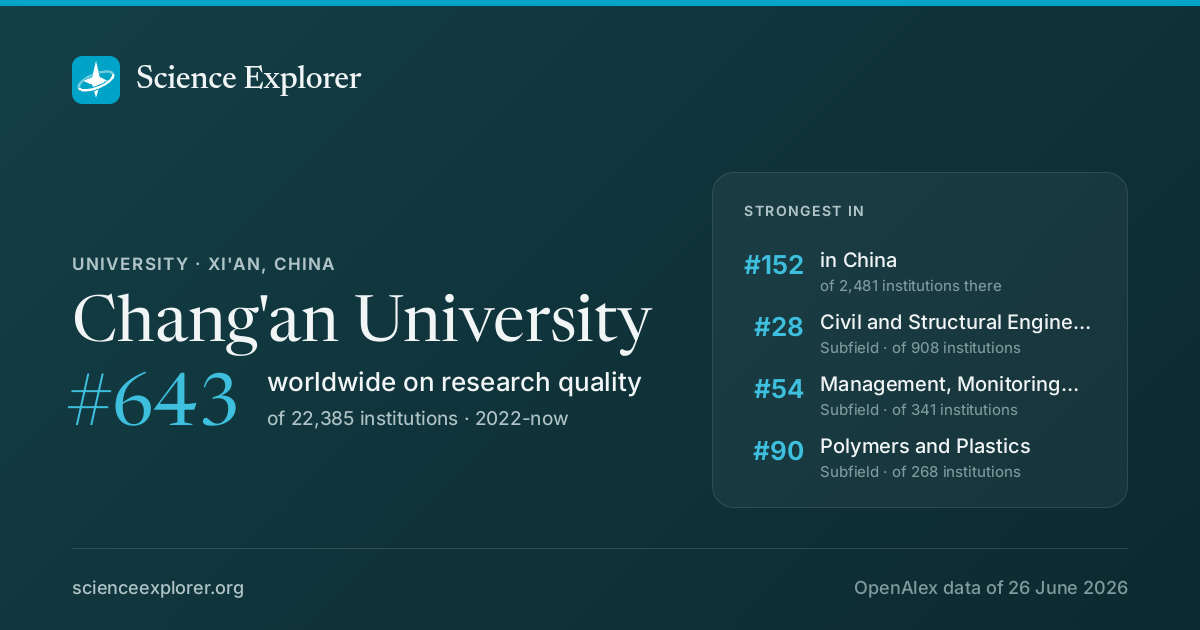
In research, Chang'an University stands highest in Civil and Structural Engineering (#28 of 908 worldwide), Engineering (#186 of 5,901 worldwide) and Physical Sciences (#355 of 10,670 worldwide), 2022-now. Relative to its size it is most specialised in Civil and Structural Engineering, Safety, Risk, Reliability and Quality and Automotive Engineering (Civil and Structural Engineering is 15.2× its share of world research).
- World rank, 2022-now
- #643 of 22,385 · #904 all time
- Rank in China
- #152 of 2,481
- Research works
- 24k ▲ 52% vs 2018-21
- Citations
- 272k 11.2 per fractional work
- Top-10% rate
- 14.2% all institutions 10.0%
- vs its own fields
- 1.20× 1.00× is exactly expected
- Open access
- 26% world 40%
- International
- 11% world 18%
What is Chang'an University known for in research?
The fields where it stands highest, 2022-now, ranked among every institution above the floor in each field.
| Field | World rank | Where that sits | Top-10% rate | Works | All time |
|---|---|---|---|---|---|
| Civil and Structural EngineeringSubfield | #28 of 908 | 16.5% | 1,401 | #56 | |
| EngineeringField | #186 of 5,901 | 14.3% | 4,148 | #326 | |
| Physical SciencesDomain | #355 of 10,670 | 14.3% | 6,802 | #542 | |
| Environmental ScienceField | #290 of 3,334 | 16.8% | 856 | #343 | |
| Computer ScienceField | #475 of 4,417 | 10.9% | 647 | #694 | |
| Social SciencesDomain | #1,252 of 9,585 | 16.2% | 680 | #1284 | |
| Mechanical EngineeringSubfield | #179 of 1,319 | 16.5% | 346 | #369 | |
| Management, Monitoring, Policy and LawSubfield | #54 of 341 | 17.5% | 153 | #148 | |
| Electrical and Electronic EngineeringSubfield | #471 of 2,176 | 10.6% | 378 | #761 | |
| Materials ChemistrySubfield | #331 of 1,473 | 14.5% | 256 | #574 |
Each strip is that field's whole ranked pool, with the notch where Chang'an University sits in it, in the colour of the band that rank falls in. The track under the rate is the rate itself: it carries no average mark, because the average differs by field (from about 6% in Dentistry to 21% in Economics).
Which of those standings moved
The same fields on both windows: where it stood over the whole record, and where it stands in 2022-now. The distance is the story, and it is the one thing the two rank columns above cannot show.
- Civil and Structural Engineering#56 #28
- Engineering#326 #186
- Physical Sciences#542 #355
- Environmental Science#343 #290
- Computer Science#694 #475
- Social Sciences#1,284 #1,252
- Mechanical Engineering#369 #179
- Management, Monitoring, Policy and Law#148 #54
- Electrical and Electronic Engineering#761 #471
- Materials Chemistry#574 #331
A dot further right is a better standing. Fields it was not ranked in over the whole record are left out.
Which fields of science does Chang'an University work in?
In 2022-now, 88% of research at Chang'an University is in Physical Sciences, 9% in Social Sciences. Its largest fields are Engineering (53%), Environmental Science (11%), Computer Science (9%). It does 2.3× the world's share of Physical Sciences.
Each ring splits the one inside it: the four domains of science, their fields, their subfields. Size is fractional works in 2022-now. Every slice is a page; the interactive view zooms down to single topics and colours each by how much more of it this institution does than the world.
Its 4 domains and 26 fields, with their numbers
- Physical Sciences7,74487.8%
- Engineering4,69753.2%
- Environmental Science98011.1%
- Computer Science7588.6%
- Materials Science5045.7%
- Earth and Planetary Sciences4234.8%
- Energy1471.7%
- Physics and Astronomy800.9%
- Chemistry770.9%
- Chemical Engineering410.5%
- Mathematics360.4%
- Social Sciences7638.6%
- Social Sciences3293.7%
- Business, Management and Accounting1571.8%
- Economics, Econometrics and Finance861.0%
- Psychology861.0%
- Decision Sciences851.0%
- Arts and Humanities200.2%
- Health Sciences1601.8%
- Medicine1041.2%
- Health Professions480.5%
- Nursing60.1%
- Dentistry20.0%
- Veterinary00.0%
- Life Sciences1571.8%
What does Chang'an University specialise in?
Where its research is concentrated relative to its size: Civil and Structural Engineering takes 15.2× the share of its output that it takes of world research.
- Civil and Structural EngineeringSubfield · 1,576.4 works15×
- Safety, Risk, Reliability and QualitySubfield · 205.7 works9.7×
- Automotive EngineeringSubfield · 357.8 works7.6×
- Building and ConstructionSubfield · 381.4 works7.0×
- TransportationSubfield · 198.3 works6.8×
- Geochemistry and PetrologySubfield · 59.1 works6.6×
Location quotient, a volume reading rather than an impact one. It surfaces small, lopsided specialities.
Field profile
Location quotient across every field it publishes in: outside the ring is more than an institution of this size would be expected to publish, inside it is less.
Rings at 0.5×, 1× and 2×. Widest outward: Engineering, 3.5×. Every wedge is a field page.
All 26 fields, with their numbers
- Engineering3.55×4,697 works
- Earth and Planetary Sciences3.06×423 works
- Environmental Science2.24×980 works
- Energy1.81×147 works
- Materials Science1.64×504 works
- Chemical Engineering1.33×41 works
- Computer Science1.11×758 works
- Decision Sciences1.00×85 works
- Chemistry0.56×77 works
- Business, Management and Accounting0.55×157 works
- Economics, Econometrics and Finance0.46×86 works
- Physics and Astronomy0.41×80 works
- Mathematics0.35×36 works
- Psychology0.32×86 works
- Social Sciences0.29×329 works
- Agricultural and Biological Sciences0.22×91 works
- Health Professions0.20×48 works
- Nursing0.14×6 works
- Neuroscience0.13×19 works
- Pharmacology, Toxicology and Pharmaceutics0.10×3 works
- Biochemistry, Genetics and Molecular Biology0.09×42 works
- Arts and Humanities0.08×20 works
- Medicine0.06×104 works
- Dentistry0.04×2 works
- Immunology and Microbiology0.02×2 works
- Veterinary0.02×0 works
- Engineering 3.5×
- Earth and Planetary Sciences 3.1×
- Environmental Science 2.2×
- Energy 1.8×
- Materials Science 1.6×
- Chemical Engineering 1.3×
- Computer Science 1.1×
- Decision Sciences 1.0×
- Chemistry 0.6×
- Business, Management and Accounting 0.6×
- Economics, Econometrics and Finance 0.5×
- Physics and Astronomy 0.4×
- Mathematics 0.3×
- Psychology 0.3×
- Social Sciences 0.3×
- Agricultural and Biological Sciences 0.2×
- Health Professions 0.2×
- Nursing 0.1×
- Neuroscience 0.1×
- Pharmacology, Toxicology and Pharmaceutics 0.1×
- Biochemistry, Genetics and Molecular Biology 0.1×
- Arts and Humanities 0.1×
- Medicine 0.1×
- Dentistry 0.0×
- Immunology and Microbiology 0.0×
- Veterinary 0.0×
Who are the top researchers at Chang'an University?
Ranked on the quality score, Syed Abdul Rehman Khan, Peiyue Li and Jianhua Wu lead among researchers whose main affiliation is Chang'an University.
- 1
Syed Abdul Rehman Khan
 China · #1,750 worldwide
18k citations · 258 works
- 2
Peiyue Li
China · #9,696 worldwide
19k citations · 327 works
- 3
Jianhua Wu
China · #9,802 worldwide
13k citations · 135 works
- 4
Zhenhong Li
China · #46,471 worldwide
17k citations · 535 works
- 5
Han Bao
China · #50,406 worldwide
1.7k citations · 81 works
- 6
Jinxing Lai
China · #55,548 worldwide
5.4k citations · 174 works
- 7
Junling Qiu
China · #56,862 worldwide
3.5k citations · 90 works
- 8
Zhang Yu
China · #64,471 worldwide
13k citations · 339 works
- 9
Wenxue Zhang
China · #67,504 worldwide
6.1k citations · 145 works
- 10
Jianbing Peng
China · #70,782 worldwide
5.2k citations · 168 works
Which keywords describe research at Chang'an University?
By fractional works in 2022-now, weighted toward what it does more of than the world: Deep Learning, Recycled Materials, Remote Sensing, Convolutional Neural Networks, Life Cycle Assessment, Nanomaterials, Image Processing and Rheology.
- Geopolymer
- Reinforcement Learning
- CO2 Sequestration
- Probabilistic Forecasting
- Travel Behavior
- Landslide
- GIS-based Modeling
- Liquefaction
- Artificial Neural Networks
- Finite Element Analysis
- Pavement
- Traffic Flow
- Bitumen Modification
- Intelligent Transportation Systems
- Image Processing
- Mechanical Properties
- Climate Change
- Recycled Materials
- Machine Learning
- Remote Sensing
- Deep Learning
- Nanomaterials
- Convolutional Neural Networks
- Environmental Impact
- Life Cycle Assessment
- Neural Networks
- Rheology
- Asphalt
- Defect Detection
- Crack Detection
- Risk Assessment
- Autonomous Vehicles
- Electric Vehicles
- Tunnel
- Hazard
- Collision Avoidance
- Urban Traffic
- Time Series Analysis
- Short-Term Forecasting
- Graph Convolutional Networks
Size is fractional works in 2022-now in the topics tagged with each word; colour is the word's share of this institution's work against its share of the world's. The 40 words are chosen for being large and distinctive. Each links to the topic it comes from most.
All 40 words, with their numbers
- Deep Learning987▲ 3.2×82 topics
- Remote Sensing483▲ 4.5×38 topics
- Nanomaterials422▲ 4.6×20 topics
- Machine Learning418▲ 1.42×86 topics
- Convolutional Neural Networks393▲ 6.1×14 topics
- Recycled Materials388▲ 39×2 topics
- Environmental Impact359▲ 2.4×48 topics
- Climate Change350▲ 1.46×78 topics
- Life Cycle Assessment344▲ 14×8 topics
- Mechanical Properties338▲ 3.9×38 topics
- Neural Networks334▲ 2.5×37 topics
- Image Processing303▲ 7.9×13 topics
- Rheology294▲ 17×8 topics
- Intelligent Transportation Systems282▲ 22×4 topics
- Asphalt263▲ 90×1 topic
- Bitumen Modification263▲ 90×1 topic
- Defect Detection260▲ 23×3 topics
- Traffic Flow248▲ 27×2 topics
- Crack Detection241▲ 39×1 topic
- Pavement241▲ 39×1 topic
- Risk Assessment219▲ 3.8×20 topics
- Finite Element Analysis212▲ 11×9 topics
- Autonomous Vehicles196▲ 11×4 topics
- Artificial Neural Networks178▲ 4.4×9 topics
- Electric Vehicles174▲ 6.8×4 topics
- Liquefaction165▲ 22×2 topics
- Tunnel165▲ 22×2 topics
- GIS-based Modeling150▲ 20×2 topics
- Hazard146▲ 24×1 topic
- Landslide146▲ 24×1 topic
- Collision Avoidance143▲ 8.9×4 topics
- Travel Behavior141▲ 18×2 topics
- Urban Traffic140▲ 14×3 topics
- Probabilistic Forecasting138▲ 8.1×3 topics
- Time Series Analysis138▲ 9.2×4 topics
- CO2 Sequestration137▲ 7.9×4 topics
- Short-Term Forecasting135▲ 11×2 topics
- Reinforcement Learning132▲ 13×4 topics
- Graph Convolutional Networks132▲ 13×2 topics
- Geopolymer131▲ 10×2 topics
Which research topics does Chang'an University publish most on?
By volume in 2022-now: Asphalt Pavement Performance Evaluation, Infrastructure Maintenance and Monitoring, Landslides and related hazards and Innovative concrete reinforcement materials.
Area is fractional works; colour is the subfield each topic belongs to.
- 1 Asphalt Pavement Performance Evaluation Civil and Structural Engineering 263 works
- 2 Infrastructure Maintenance and Monitoring Civil and Structural Engineering 241 works
- 3 Landslides and related hazards Management, Monitoring, Policy and Law 146 works
- 4 Innovative concrete reinforcement materials Civil and Structural Engineering 126 works
- 5 Traffic Prediction and Management Techniques Building and Construction 125 works
- 6 Traffic control and management Control and Systems Engineering 123 works
- 7 Transportation Planning and Optimization Transportation 113 works
- 8 Concrete and Cement Materials Research Civil and Structural Engineering 109 works
- 9 Geotechnical Engineering and Underground Structures Civil and Structural Engineering 101 works
- 10 Autonomous Vehicle Technology and Safety Automotive Engineering 101 works
How open and international is its research?
Against the world's own shares: the tick on each track. Both are shares of its output, so they sit on one scale and can be read against each other as well as against the world.
World: 40% of research is openly available.
World: 18% is written across borders.
How has Chang'an University's research output changed?
Output in 2022-2025 was 52% higher than in 2018-2021.
The same series as a ribbon: one cell per year, darker for more. The line above answers how much; this answers when.
Its share of all research
Growing output can still be a shrinking share: all of science grows. This is Chang'an University as a percentage of every work published that year, 0.037% in 2024.
Fractional works of Chang'an University over all fractional works that year. How the balance of science has shifted.
How much of it reaches the world top 10%
Year by year, against all institutions in the same year.
Of each year's output, the share that reached the world's 10% most cited for its field and year. Peak 15.1% in 2024.
Other research institutions in Xi'an
- Xi'an Jiaotong University
- Northwestern Polytechnical University
- Xidian University
- Shaanxi Normal University
- Xi'an University of Technology
- Air Force Medical University
- Northwest University
- Air Force Engineering University
Compare Chang'an University with
- vs
 University of Central Florida
- vs Pfizer (United States)
- vs
 Carl von Ossietzky Universität Oldenburg
- vs Chinese Institute for Brain Research
- vs Kansas State University
- vs
 Indian Institute of Technology Kanpur
Share Chang'an University's ranking



Research measures only: rankings here say nothing about teaching, admissions or student experience. Comparable institutions and collaboration partners have tabs of their own, above.
Discussion
Ask a question or share a note about Chang'an University. Posts are plain text and can be reported.