 Science in Czechia
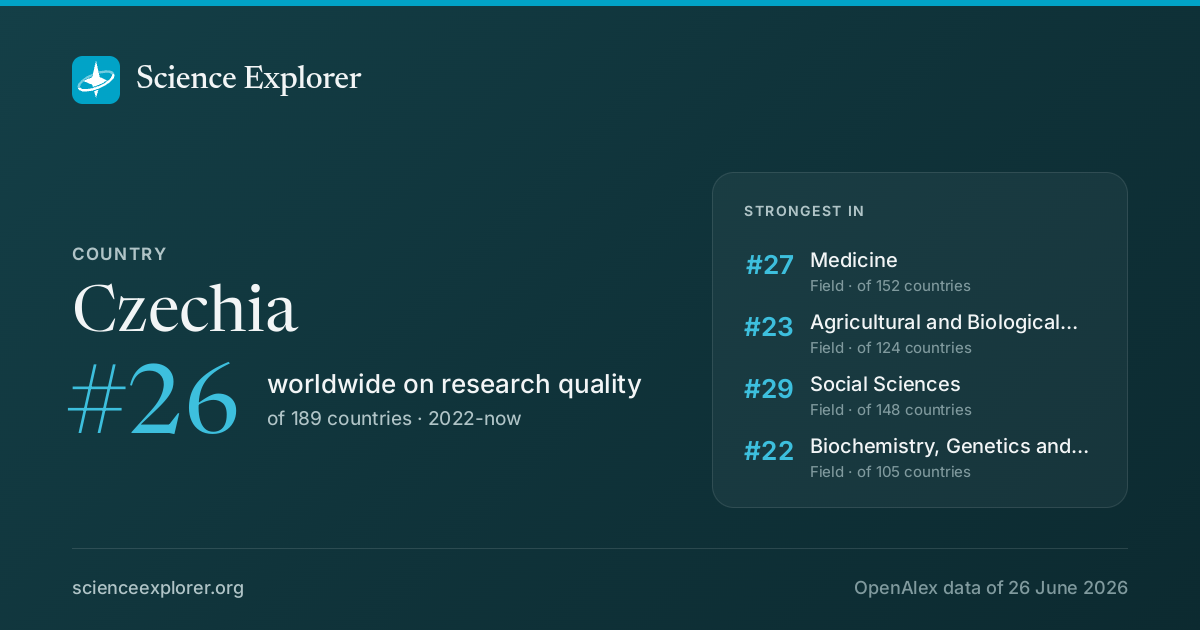
The Czechia ranks #26 of 189 countries on research quality in 2022-now (#30 all time), with 83k research works and 8.5% of them in the world's top 10%.
- World rank, 2022-now
- #26 of 189 · #30 all time
- Works, 2022-now
- 83k ▼ 3% vs 2018-21
- Citations
- 7.1M 14.2 per fractional work, all time
- Top-10% rate
- 8.5% all institutions 10.0%
- vs its own fields
- 0.85× 1.00× is exactly expected
- In the world top 100
- 0 5 in the top 1,000
- Open access
- 44% world 40%
- International
- 31% world 18%
CzechiaWhat is Czechia strongest at in science?
On research quality in 2022-now, the Czechia ranks highest in Medicine (#27 of 152), Agricultural and Biological Sciences (#23 of 124) and Social Sciences (#29 of 148). Relative to its size it is most specialised in Structural Biology, Paleontology and Ecology, Evolution, Behavior and Systematics.
| Field | World rank | Where that sits | Top-10% rate | Works | All time | Institutions |
|---|---|---|---|---|---|---|
| MedicineField | #27 of 152 | 8.9% | 12,011 | #29 | Institutions | |
| Agricultural and Biological SciencesField | #23 of 124 | 10.3% | 5,219 | #27 | Institutions | |
| Social SciencesField | #29 of 148 | 9.9% | 10,105 | #31 | Institutions | |
| Biochemistry, Genetics and Molecular BiologyField | #22 of 105 | 8.9% | 5,123 | #25 | Institutions | |
| Political Science and International RelationsSubfield | #21 of 95 | 12.1% | 1,885 | #23 | Institutions | |
| Environmental ScienceField | #27 of 122 | 8.8% | 5,120 | #26 | Institutions | |
| Plant ScienceSubfield | #21 of 90 | 10.5% | 1,862 | #22 | Institutions | |
| Economics, Econometrics and FinanceField | #25 of 107 | 11.0% | 1,919 | #28 | Institutions | |
| EngineeringField | #31 of 131 | 6.5% | 13,566 | #32 | Institutions | |
| Computer ScienceField | #31 of 128 | 8.1% | 5,408 | #29 | Institutions | |
| Ecology, Evolution, Behavior and SystematicsSubfield | #17 of 69 | 10.8% | 1,118 | #19 | Institutions | |
| Sociology and Political ScienceSubfield | #30 of 119 | 8.9% | 3,056 | #32 | Institutions |
Where its research is concentrated
Location quotient: how much more (or less) of each node it does than its size predicts. Drawn around 1×, where "twice the world share" and "half of it" are the same distance apart in opposite directions. A volume reading, which on a country axis is largely population and industrial structure.
- Structural BiologySubfield · 48.4 works · #17 of 126 active here3.2×
- PaleontologySubfield · 357.8 works · #20 of 212 active here3.1×
- Ecology, Evolution, Behavior and SystematicsSubfield · 1,336.6 works · #20 of 223 active here3.0×
- Insect ScienceSubfield · 660.0 works · #24 of 214 active here2.4×
- Nature and Landscape ConservationSubfield · 519.4 works · #22 of 222 active here2.3×
- Ecological ModelingSubfield · 165.0 works · #23 of 210 active here2.3×
- General Materials ScienceSubfield · 90.7 works · #20 of 155 active here2.2×
- Space and Planetary ScienceSubfield · 41.1 works · #26 of 158 active here2.1×
The whole field profile
All 26 fields at once. A specialist and a generalist produce the same ranked list and a completely different shape.
Rings at 0.5×, 1× and 2×. Widest outward: Physics and Astronomy, 1.7×. Every wedge is a field page.
All 26 fields, with their numbers
- Physics and Astronomy1.70×3,599 works
- Earth and Planetary Sciences1.50×2,246 works
- Chemistry1.39×2,079 works
- Materials Science1.38×4,581 works
- Agricultural and Biological Sciences1.33×6,011 works
- Veterinary1.33×172 works
- Mathematics1.32×1,480 works
- Environmental Science1.25×5,933 works
- Arts and Humanities1.19×3,272 works
- Biochemistry, Genetics and Molecular Biology1.18×5,988 works
- Chemical Engineering1.12×373 works
- Engineering1.06×15k works
- Pharmacology, Toxicology and Pharmaceutics1.05×354 works
- Economics, Econometrics and Finance1.04×2,120 works
- Immunology and Microbiology1.00×964 works
- Neuroscience1.00×1,555 works
- Decision Sciences0.99×918 works
- Social Sciences0.94×11k works
- Psychology0.84×2,446 works
- Computer Science0.83×6,194 works
- Energy0.80×698 works
- Medicine0.75×14k works
- Nursing0.73×340 works
- Business, Management and Accounting0.70×2,163 works
- Health Professions0.52×1,319 works
- Dentistry0.44×206 works
Which fields of science does Czechia work in?
In 2022-now, 44% of research in Czechia is in Physical Sciences, 23% in Social Sciences. Its largest fields are Engineering (16%), Medicine (15%), Social Sciences (12%).
Each ring splits the one inside it: the four domains of science, their fields, their subfields. Size is fractional works in 2022-now. Every slice is a page; the interactive view zooms down to single topics and colours each by how much more of it this country does than the world.
Its 4 domains and 26 fields, with their numbers
- Physical Sciences42k44.4%
- Engineering15k15.9%
- Computer Science6,1946.5%
- Environmental Science5,9336.2%
- Materials Science4,5814.8%
- Physics and Astronomy3,5993.8%
- Earth and Planetary Sciences2,2462.4%
- Chemistry2,0792.2%
- Mathematics1,4801.6%
- Energy6980.7%
- Chemical Engineering3730.4%
- Social Sciences22k23.4%
- Social Sciences11k12.0%
- Arts and Humanities3,2723.4%
- Psychology2,4462.6%
- Business, Management and Accounting2,1632.3%
- Economics, Econometrics and Finance2,1202.2%
- Decision Sciences9181.0%
- Health Sciences16k16.6%
- Medicine14k14.5%
- Health Professions1,3191.4%
- Nursing3400.4%
- Dentistry2060.2%
- Veterinary1720.2%
- Life Sciences15k15.6%
- Agricultural and Biological Sciences6,0116.3%
- Biochemistry, Genetics and Molecular Biology5,9886.3%
- Neuroscience1,5551.6%
- Immunology and Microbiology9641.0%
- Pharmacology, Toxicology and Pharmaceutics3540.4%
Which keywords describe research in Czechia?
By fractional works in 2022-now, weighted toward what it does more of than the world: Climate Change, Invasive Species, Biodiversity, Mechanical Properties, Epidemiology, Sustainability, Environmental Impact and School Climate.
- DNA Barcoding
- Pedagogical Research
- Student Attitudes
- School Climate
- Habitat Fragmentation
- Evolution
- Philosophy
- Nationalism
- Biogeography
- Literature
- Microstructure
- Nanocomposites
- Human Rights
- Invasive Species
- Oxidative Stress
- Inflammation
- Mechanical Properties
- Environmental Impact
- Sustainability
- Epidemiology
- Climate Change
- Machine Learning
- Deep Learning
- Globalization
- Biodiversity
- Biomedical Applications
- Nanoparticles
- Sustainable Development
- Nanomaterials
- Identity
- Conservation
- History
- Phylogenetic Analysis
- Digital Education
- Ethnicity
- Phylogeny
- Global Change
- Learning Environments
- Educational Methods
- Taxonomy
Size is fractional works in 2022-now in the topics tagged with each word; colour is the word's share of this country's work against its share of the world's. The 40 words are chosen for being large and distinctive. Each links to the topic it comes from most.
All 40 words, with their numbers
- Climate Change3,523▲ 1.36×131 topics
- Epidemiology2,794▼ 0.73×140 topics
- Machine Learning2,315▼ 0.73×97 topics
- Sustainability2,225◆ 0.95×138 topics
- Deep Learning1,970▼ 0.60×85 topics
- Environmental Impact1,880▲ 1.16×74 topics
- Globalization1,752◆ 0.93×183 topics
- Mechanical Properties1,582▲ 1.69×39 topics
- Biodiversity1,573▲ 2.2×38 topics
- Inflammation1,488▼ 0.73×83 topics
- Biomedical Applications1,442▲ 1.28×36 topics
- Oxidative Stress1,441◆ 0.92×63 topics
- Nanoparticles1,376◆ 1.14×44 topics
- Invasive Species1,340▲ 3.3×21 topics
- Sustainable Development1,261▼ 0.84×111 topics
- Human Rights1,091◆ 1.12×90 topics
- Nanomaterials1,042◆ 1.04×21 topics
- Nanocomposites992▲ 1.32×22 topics
- Identity959▲ 1.39×79 topics
- Microstructure916▲ 1.85×19 topics
- Conservation908▲ 2.2×24 topics
- Literature858▲ 1.64×63 topics
- History848▲ 1.28×65 topics
- Biogeography828▲ 3.1×20 topics
- Phylogenetic Analysis746▲ 2.5×16 topics
- Nationalism729▲ 1.70×34 topics
- Digital Education714▲ 5.0×7 topics
- Philosophy712▲ 1.68×46 topics
- Ethnicity669▲ 1.87×24 topics
- Evolution654▲ 2.6×19 topics
- Phylogeny634▲ 4.0×17 topics
- Habitat Fragmentation631▲ 3.1×5 topics
- Global Change627▲ 2.5×7 topics
- School Climate617▲ 14×3 topics
- Learning Environments602▲ 22×3 topics
- Student Attitudes595▲ 6.2×2 topics
- Educational Methods588▲ 109×1 topic
- Pedagogical Research588▲ 109×1 topic
- Taxonomy568▲ 4.1×15 topics
- DNA Barcoding546▲ 3.3×9 topics
Which research topics does Czechia publish the most in?
Its largest topics in 2022-now are Education, Psychology, and Social Research, Legal and Regulatory Analysis, Military Technology and Strategies.
Area is fractional works in 2022-now; colour is the subfield each topic belongs to. Every tile is a topic page.
- 1 Education, Psychology, and Social Research Education 588 works
- 2 Legal and Regulatory Analysis Transportation 376 works
- 3 Military Technology and Strategies Aerospace Engineering 367 works
- 4 Linguistic, Cultural, and Literary Studies Sociology and Political Science 362 works
- 5 Eastern European Communism and Reforms Sociology and Political Science 255 works
- 6 Plant and animal studies Ecology, Evolution, Behavior and Systematics 220 works
- 7 Additive Manufacturing and 3D Printing Technologies Automotive Engineering 214 works
- 8 Concrete and Cement Materials Research Civil and Structural Engineering 198 works
- 9 Ecology and Vegetation Dynamics Studies Nature and Landscape Conservation 189 works
- 10 Geological and Geochemical Analysis Geophysics 139 works
- 11 Insect and Pesticide Research Insect Science 137 works
- 12 Species Distribution and Climate Change Ecological Modeling 136 works
How many world-class institutions does Czechia hold?
Average quality and elite capacity disagree by construction, and both are worth knowing: the first is decided by a country's whole institution population, the second counts the institutions it holds at the top. One square per institution.
| Standing among countries | 2022-now | Where that sits | All time |
|---|---|---|---|
| Average qualityits whole institution population | #26 of 189 | #30 of 203 | |
| Elite capacitythe institutions it holds at the top | #28 of 204 | #29 of 216 |
Elite capacity counts a country's institutions by their worldwide rank, weighted so a place at #1 counts for more than one at #480. Countries under 100 fractional works are left out.
Bands are exclusive, so the squares add up to 5 (the institutions it holds in the world top 1,000), not to four times it.
Which universities in Czechia lead research?
Czech Academy of Sciences, Charles University and Masaryk University rank highest in Czechia on research quality in 2022-now.
One dot per institution in the list below. The upper left is the interesting corner.
- 1Czech Academy of SciencesGovernment institution · Prague · #295 worldwide8.3% top 10% · 14k works
- 2Charles UniversityUniversity · Prague · #482 worldwide9.8% top 10% · 9.7k works
- 3Masaryk UniversityUniversity · Brno · #518 worldwide9.8% top 10% · 6.1k works
- 4VSB - Technical University of OstravaUniversity · Ostrava · #910 worldwide9.9% top 10% · 2.6k works
- 5Palacký University OlomoucUniversity · Olomouc · #926 worldwide9.4% top 10% · 3.3k works
- 6Czech University of Life Sciences PragueUniversity · Prague · #1,286 worldwide13.8% top 10% · 2.1k works
- 7University of South Bohemia in České BudějoviceUniversity · České Budějovice · #1,388 worldwide12.4% top 10% · 1.2k works
- 8Brno University of TechnologyUniversity · Brno · #1,413 worldwide7.0% top 10% · 3.4k works
- 9Mendel University in BrnoUniversity · Brno · #1,881 worldwide8.5% top 10% · 1.5k works
- 10University of OstravaUniversity · Ostrava · #1,898 worldwide8.0% top 10% · 1.5k works
- 11University of West Bohemia in PilsenUniversity · Pilsen · #2,453 worldwide5.6% top 10% · 1.7k works
- 12Tomas Bata University in ZlínUniversity · Zlín · #2,498 worldwide10.8% top 10% · 1k works
- 13University of Hradec KrálovéUniversity · Hradec Králové · #2,679 worldwide14.7% top 10% · 1.3k works
- 14Pharmaceutical Biotechnology (Czechia)Company · Prague · #2,828 worldwide12.5% top 10% · 399 works
- 15Prague University of Economics and BusinessUniversity · Prague · #2,907 worldwide10.1% top 10% · 987 works






The track on each row is its top-10% rate; the tick is the average of all institutions, 10.0% (how it is set): teal above it, red below.
All ranked institutions in CzechiaWho are the top researchers in Czechia?
Petr Baldrián, C. Søgaard and L. Montaño Zetina rank highest among researchers based in Czechia.
- 1 Petr Baldrián #105 worldwide 38k citations · 8,877 works
- 2 C. Søgaard #2,458 worldwide 20k citations · 139 works
- 3 L. Montaño Zetina #2,558 worldwide 18k citations · 105 works
- 4 Francesco de Bello #4,452 worldwide 26k citations · 293 works
- 5 M. Vajzer #4,462 worldwide 14k citations · 88 works
- 6 Petr Pyšek #4,497 worldwide 92k citations · 783 works
- 7 Michal Sumbera #5,385 worldwide 73k citations · 979 works
- 8 Jan Pergl #5,427 worldwide 34k citations · 313 works
- 9 J. Cepila #6,840 worldwide 21k citations · 202 works
- 10 Z. Vykydal #7,869 worldwide 39k citations · 539 works
Which cities in Czechia are research hubs?
- 1
PragueCzechia
276k works
- 2
BrnoCzechia
82k works
- 3
OstravaCzechia
21k works
- 4
OlomoucCzechia
20k works
- 5
České BudějoviceCzechia
18k works
How much of it is in the largest
The same cities as shares of everything these twelve account for.
Shares of the rows listed above, not of the whole node.
How open and international is Czechia's research?
44% of its research is openly available (world: 40%), and 31% is written with international co-authors (world: 18%).
World: 40% of research is openly available.
World: 18% is written across borders.
In 2022-now, 68% of its research is openly available (world 63%) and 38% is written with co-authors abroad (world 22%). Against what its own mix of topics predicts, that is 1.12× the expected open access and 1.64× the expected international share, which puts it #71 of 173 countries on openness.
How has Czechia's research grown?
Output in 2022-2025 was 3% lower than in 2018-2021.
The same series as a ribbon: one cell per year, darker for more. The line above answers how much; this answers when.
Its share of all research
Growing output can still be a shrinking share: all of science grows. This is Czechia as a percentage of every work published that year, 0.36% in 2024.
Fractional works of Czechia over all fractional works that year. How the balance of science has shifted.
How much of it reaches the world top 10%
Over the whole record, 7.3% of its 499k works since 1950 reached the world top 10% for their field and year.
Of each year's output, the share that reached the world's 10% most cited for its field and year. Peak 8.9% in 2025.
Which countries have research most like the Czechia's?
Slovakia is the Czechia's closest research twin: of all countries, its research is spread across the fields most like the Czechia's, with both strong in Earth and Planetary Sciences.
- 1
 SlovakiaBoth strong in Earth and Planetary Sciences, Veterinary, Agricultural and Biological Sciences
0.71 Compare
- 2
 RussiaBoth strong in Physics and Astronomy, Earth and Planetary Sciences, Chemistry
0.70 Compare
- 3
 BelarusBoth strong in Physics and Astronomy, Chemistry, Materials Science
0.63 Compare
- 4
 FranceBoth strong in Physics and Astronomy, Earth and Planetary Sciences, Mathematics
0.60 Compare
- 5
 TajikistanBoth strong in Physics and Astronomy, Earth and Planetary Sciences, Mathematics
0.56 Compare
Similarity is the correlation of each side's location quotients across every field it publishes in, on a log scale: 1 is the same shape of research, 0 is unrelated. It ignores size. How it is measured.
Compare Czechia with
 New Zealand
 Portugal
 Taiwan
 Brazil
 Poland
 South Africa
Share Czechia's ranking
Badges for a website1Each links back here and updates with every snapshot

Research fields in Czechia
- Life Sciences
- Physical Sciences
- Social Sciences
- Health Sciences
- Medicine
- Agricultural and Biological Sciences
- Social Sciences
- Biochemistry, Genetics and Molecular Biology
- Political Science and International Relations
- Environmental Science
- Plant Science
- Economics, Econometrics and Finance
- Engineering
- Computer Science
- Ecology, Evolution, Behavior and Systematics
- Sociology and Political Science
- Economics and Econometrics
- Molecular Biology
- Psychology
- Education
- Arts and Humanities
- Business, Management and Accounting
- Physics and Astronomy
- Materials Science
- Health Professions
- Earth and Planetary Sciences
- Mathematics
- Surgery
- Electrical and Electronic Engineering
- Chemistry
- Materials Chemistry
- Cardiology and Cardiovascular Medicine
- Genetics
- Artificial Intelligence
- Pulmonary and Respiratory Medicine
- Epidemiology
- Ecology
- Language and Linguistics
- Information Systems
- Biomedical Engineering
- Immunology and Microbiology
- Neuroscience
- Atomic and Molecular Physics, and Optics
- Global and Planetary Change
- Mechanical Engineering
- Organic Chemistry
- Public Health, Environmental and Occupational Health
- Radiology, Nuclear Medicine and Imaging
- Insect Science
- General Health Professions
- Aerospace Engineering
- Decision Sciences
- Transportation
- Computer Vision and Pattern Recognition
- Social Psychology
- Food Science
- Computational Theory and Mathematics
- Accounting
- Renewable Energy, Sustainability and the Environment
- Computer Networks and Communications
Questions people ask
What is Czechia strongest at in science?
On research quality in 2022-now, the Czechia ranks highest in Medicine (#27 of 152), Agricultural and Biological Sciences (#23 of 124) and Social Sciences (#29 of 148). Relative to its size it is most specialised in Structural Biology, Paleontology and Ecology, Evolution, Behavior and Systematics.
See the full answerDiscussion
Ask a question or share a note about Czechia. Keep it to the research: no personal attacks, advertising or links. Any reader can report a post, which collapses it for everyone until it is opened.