 Science in Belarus
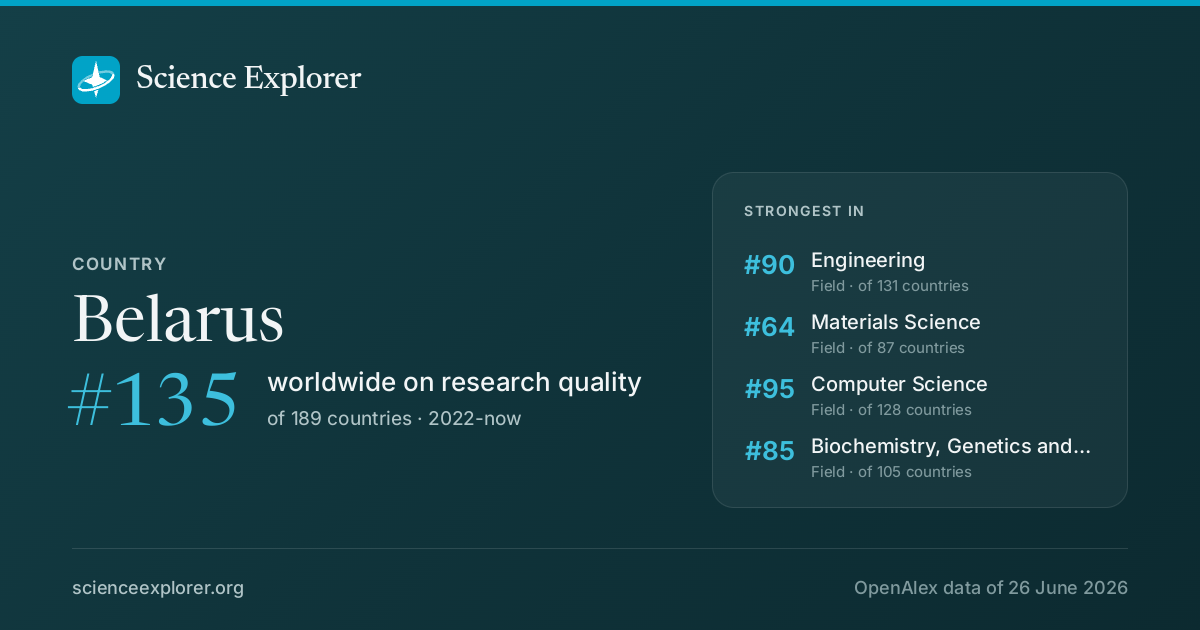
Belarus ranks #135 of 189 countries on research quality in 2022-now (#132 all time), with 15k research works and 3.4% of them in the world's top 10%.
- World rank, 2022-now
- #135 of 189 · #132 all time
- Works, 2022-now
- 15k ◆ 0% vs 2018-21
- Citations
- 457k 6.3 per fractional work, all time
- Top-10% rate
- 3.4% all institutions 10.0%
- vs its own fields
- 0.33× 1.00× is exactly expected
- In the world top 100
- 0 0 in the top 1,000
- Open access
- 46% world 40%
- International
- 26% world 18%
BelarusWhat is Belarus strongest at in science?
On research quality in 2022-now, Belarus ranks highest in Engineering (#90 of 131), Materials Science (#64 of 87) and Computer Science (#95 of 128). Relative to its size it is most specialised in Nuclear Energy and Engineering, General Materials Science and Discrete Mathematics and Combinatorics.
| Field | World rank | Where that sits | Top-10% rate | Works | All time | Institutions |
|---|---|---|---|---|---|---|
| EngineeringField | #90 of 131 | 2.7% | 2,826 | #89 | Institutions | |
| Materials ScienceField | #64 of 87 | 2.7% | 1,022 | #70 | Institutions | |
| Computer ScienceField | #95 of 128 | 3.3% | 900 | #97 | Institutions | |
| Biochemistry, Genetics and Molecular BiologyField | #85 of 105 | 3.3% | 680 | #78 | Institutions | |
| MedicineField | #125 of 152 | 3.2% | 2,407 | #101 | Institutions | |
| EpidemiologySubfield | #65 of 77 | 3.1% | 236 | #81 | ||
| ChemistryField | #61 of 71 | 1.9% | 347 | #72 | Institutions | |
| Mechanical EngineeringSubfield | #64 of 74 | 2.5% | 549 | #75 | Institutions | |
| Social SciencesField | #129 of 148 | 5.0% | 1,815 | #130 | Institutions | |
| Materials ChemistrySubfield | #62 of 71 | 2.8% | 567 | #67 | Institutions | |
| Molecular BiologySubfield | #74 of 84 | 3.4% | 359 | #75 | Institutions | |
| Sociology and Political ScienceSubfield | #105 of 119 | 5.1% | 471 | - | Institutions |
Where its research is concentrated
Location quotient: how much more (or less) of each node it does than its size predicts. Drawn around 1×, where "twice the world share" and "half of it" are the same distance apart in opposite directions. A volume reading, which on a country axis is largely population and industrial structure.
- Nuclear Energy and EngineeringSubfield · 22.1 works · #10 of 121 active here19×
- General Materials ScienceSubfield · 136.9 works · #13 of 155 active here19×
- Discrete Mathematics and CombinatoricsSubfield · 58.6 works · #32 of 151 active here8.7×
- Fuel TechnologySubfield · 11.4 works · #16 of 113 active here8.2×
- DevelopmentSubfield · 126.0 works · #33 of 190 active here7.4×
- AnatomySubfield · 25.6 works · #31 of 159 active here6.3×
- General Economics, Econometrics and FinanceSubfield · 175.3 works · #51 of 211 active here4.1×
- Numerical AnalysisSubfield · 57.2 works · #54 of 173 active here4.0×
The whole field profile
All 26 fields at once. A specialist and a generalist produce the same ranked list and a completely different shape.
Rings at 0.5×, 1× and 2×. Widest outward: Mathematics, 2.1×. Every wedge is a field page.
All 26 fields, with their numbers
- Mathematics2.08×414 works
- Materials Science1.91×1,127 works
- Physics and Astronomy1.54×580 works
- Chemistry1.45×385 works
- Agricultural and Biological Sciences1.28×1,026 works
- Engineering1.24×3,138 works
- Pharmacology, Toxicology and Pharmaceutics1.21×72 works
- Economics, Econometrics and Finance1.07×386 works
- Veterinary1.02×24 works
- Energy1.00×155 works
- Immunology and Microbiology0.98×168 works
- Social Sciences0.96×2,046 works
- Business, Management and Accounting0.89×486 works
- Biochemistry, Genetics and Molecular Biology0.88×795 works
- Chemical Engineering0.88×52 works
- Medicine0.87×2,832 works
- Environmental Science0.85×718 works
- Earth and Planetary Sciences0.81×215 works
- Computer Science0.79×1,037 works
- Arts and Humanities0.78×379 works
- Neuroscience0.76×210 works
- Dentistry0.76×63 works
- Nursing0.67×56 works
- Decision Sciences0.66×108 works
- Psychology0.50×260 works
- Health Professions0.43×191 works
Which fields of science does Belarus work in?
In 2022-now, 46% of research in Belarus is in Physical Sciences, 22% in Social Sciences. Its largest fields are Engineering (19%), Medicine (17%), Social Sciences (12%).
Each ring splits the one inside it: the four domains of science, their fields, their subfields. Size is fractional works in 2022-now. Every slice is a page; the interactive view zooms down to single topics and colours each by how much more of it this country does than the world.
Its 4 domains and 26 fields, with their numbers
- Physical Sciences7,82146.2%
- Engineering3,13818.5%
- Materials Science1,1276.7%
- Computer Science1,0376.1%
- Environmental Science7184.2%
- Physics and Astronomy5803.4%
- Mathematics4132.4%
- Chemistry3852.3%
- Earth and Planetary Sciences2151.3%
- Energy1550.9%
- Chemical Engineering520.3%
- Social Sciences3,66621.7%
- Social Sciences2,04612.1%
- Business, Management and Accounting4862.9%
- Economics, Econometrics and Finance3862.3%
- Arts and Humanities3792.2%
- Psychology2601.5%
- Decision Sciences1080.6%
- Health Sciences3,16518.7%
- Medicine2,83216.7%
- Health Professions1911.1%
- Dentistry630.4%
- Nursing560.3%
- Veterinary230.1%
- Life Sciences2,27113.4%
Which keywords describe research in Belarus?
By fractional works in 2022-now, weighted toward what it does more of than the world: Sustainable Development, Digital Transformation, Digital Economy, Climate Change, Artificial Intelligence, Regional Development, Food Security and Innovation.
- Geographical Analysis
- Polymer Composite Materials
- Adhesive Joints
- Structural Properties
- Foresight
- Industrial Policy
- Industry 4.0
- Language
- Ethnicity
- Metal Nanoparticles
- Economic Security
- Legal Regulation
- Economic Development
- Regional Development
- Mechanical Properties
- Food Security
- Energy Efficiency
- Digital Transformation
- Epidemiology
- Climate Change
- Sustainable Development
- Artificial Intelligence
- Innovation
- Globalization
- Oxidative Stress
- Sustainability
- Digital Economy
- Renewable Energy
- Nanoparticles
- Digitalization
- Agricultural Development
- Nutrition
- Synthesis
- Global Economy
- Aerospace Applications
- Geopolitics
- Transition
- Cultural History
- Carbon Fiber Reinforced Plastics
- Information Security
Size is fractional works in 2022-now in the topics tagged with each word; colour is the word's share of this country's work against its share of the world's. The 40 words are chosen for being large and distinctive. Each links to the topic it comes from most.
All 40 words, with their numbers
- Sustainable Development948▲ 3.6×91 topics
- Climate Change760▲ 1.65×112 topics
- Artificial Intelligence586▲ 2.4×61 topics
- Epidemiology525▼ 0.78×133 topics
- Innovation508▲ 2.9×67 topics
- Digital Transformation494▲ 5.4×25 topics
- Globalization482▲ 1.45×111 topics
- Energy Efficiency418▲ 2.7×41 topics
- Oxidative Stress414▲ 1.49×63 topics
- Food Security410▲ 4.5×24 topics
- Sustainability404◆ 0.98×10² topics
- Mechanical Properties374▲ 2.2×39 topics
- Digital Economy369▲ 11×19 topics
- Regional Development359▲ 6.2×19 topics
- Renewable Energy331▲ 1.35×55 topics
- Economic Development331▲ 2.4×43 topics
- Nanoparticles313▲ 1.47×44 topics
- Legal Regulation294▲ 7.7×8 topics
- Digitalization253▲ 7.3×14 topics
- Economic Security232▲ 6.5×7 topics
- Agricultural Development225▲ 8.7×7 topics
- Metal Nanoparticles220▲ 8.2×6 topics
- Nutrition215▲ 2.9×14 topics
- Ethnicity207▲ 3.3×18 topics
- Synthesis202▲ 3.2×35 topics
- Language193▲ 4.6×12 topics
- Global Economy189▲ 8.7×7 topics
- Industry 4.0167▲ 19×3 topics
- Aerospace Applications150▲ 9.2×3 topics
- Industrial Policy149▲ 8.2×4 topics
- Geopolitics144▲ 5.6×10 topics
- Foresight144▲ 6.5×2 topics
- Transition140▲ 9.4×6 topics
- Structural Properties138▲ 18×2 topics
- Cultural History136▲ 6.7×9 topics
- Adhesive Joints134▲ 12×2 topics
- Carbon Fiber Reinforced Plastics132▲ 24×1 topic
- Polymer Composite Materials132▲ 24×1 topic
- Information Security130▲ 7.8×4 topics
- Geographical Analysis126▲ 18×2 topics
Which research topics does Belarus publish the most in?
Its largest topics in 2022-now are Material Properties and Applications, Legal and Regulatory Analysis, Food Industry and Aquatic Biology.
Area is fractional works in 2022-now; colour is the subfield each topic belongs to. Every tile is a topic page.
- 1 Material Properties and Applications General Materials Science 132 works
- 2 Legal and Regulatory Analysis Transportation 123 works
- 3 Food Industry and Aquatic Biology Food Science 117 works
- 4 Economic and Technological Developments in Russia Development 116 works
- 5 Military Technology and Strategies Aerospace Engineering 108 works
- 6 Eastern European Communism and Reforms Sociology and Political Science 107 works
- 7 Linguistic, Cultural, and Literary Studies Sociology and Political Science 103 works
- 8 Engineering Technology and Methodologies Industrial and Manufacturing Engineering 100 works
- 9 Regional Socio-Economic Development Trends Demography 98 works
- 10 Agricultural Development and Policies Agronomy and Crop Science 90 works
- 11 Discourse Analysis and Cultural Communication Cultural Studies 90 works
- 12 Industrial Engineering and Technologies Mechanical Engineering 86 works
Which universities in Belarus lead research?
National Academy of Sciences of Belarus, Euphrosyne Polotskaya State University and Belarusian National Technical University rank highest in Belarus on research quality in 2022-now.
One dot per institution in the list below. The upper left is the interesting corner.
- 1National Academy of Sciences of BelarusGovernment institution · Minsk · #3,043 worldwide5.2% top 10% · 4.7k works
- 2Euphrosyne Polotskaya State UniversityUniversity · Navapolatsk · #8,515 worldwide2.4% top 10% · 452 works
- 3Belarusian National Technical UniversityUniversity · Minsk · #8,804 worldwide2.9% top 10% · 900 works
- 4Vitebsk State Medical UniversityUniversity · Vitebsk · #10,940 worldwide1.8% top 10% · 335 works
- 5Yanka Kupala State University of GrodnoUniversity · Hrodna · #11,358 worldwide3.8% top 10% · 323 works
- 6Belarusian State Technological UniversityUniversity · Minsk · #12,374 worldwide1.8% top 10% · 472 works
- 7Belarusian State UniversityUniversity · Minsk · #13,094 worldwide3.2% top 10% · 2.1k works
- 8Francisk Skorina Gomel State UniversityUniversity · Homyel · #13,179 worldwide2.4% top 10% · 345 works
- 9Belarusian State Economic UniversityUniversity · Minsk · #13,340 worldwide2.9% top 10% · 198 works
- 10Belarusian State Medical UniversityUniversity · Minsk · #13,920 worldwide1.3% top 10% · 436 works
- 11Belarusian Russian UniversityUniversity · Mogilev · #14,292 worldwide1.7% top 10% · 166 works
- 12RSPC MTResearch facility · Minsk · #15,227 worldwide3.1% top 10% · 126 works
- 13Republican Scientific and Practical Center of Neurology and NeurosurgeryResearch facility · Minsk · #15,260 worldwide2.6% top 10% · 315 works
- 14Belarusian State University of Culture and ArtsUniversity · Minsk · #15,344 worldwide7.5% top 10% · 155 works
- 15Belarusian State Agrarian Technical UniversityUniversity · Minsk · #15,662 worldwide3.0% top 10% · 97 works




The track on each row is its top-10% rate; the tick is the average of all institutions, 10.0% (how it is set): teal above it, red below.
All ranked institutions in BelarusWho are the top researchers in Belarus?
Alena Skrahina, Andrey Litvin and Dzmitry Mukha rank highest among researchers based in Belarus.
- 1 Alena Skrahina #47,327 worldwide 8.7k citations · 157 works
- 2 Andrey Litvin #129,746 worldwide 8.9k citations · 233 works
- 3 Dzmitry Mukha #487,907 worldwide 1k citations · 23 works
- 4 Varvara Solodovnikova #491,374 worldwide 2k citations · 46 works
- 5 Svetlana N. Samovich #706,105 worldwide 992 citations · 41 works
- 6 Mikhail V. Artemyev #772,082 worldwide 8.1k citations · 272 works
- 7 Eugene P. Demidchik #808,722 worldwide 2.4k citations · 37 works
- 8 Anatol V. Prudnikau #855,648 worldwide 2.5k citations · 84 works
- 9 Sergei V. Levchik #922,658 worldwide 9.5k citations · 185 works
- 10 Anna A. Zborovskaya #937,781 worldwide 9.4k citations · 56 works
Which cities in Belarus are research hubs?
How open and international is Belarus's research?
46% of its research is openly available (world: 40%), and 26% is written with international co-authors (world: 18%).
World: 40% of research is openly available.
World: 18% is written across borders.
In 2022-now, 73% of its research is openly available (world 63%) and 28% is written with co-authors abroad (world 22%). Against what its own mix of topics predicts, that is 1.18× the expected open access and 1.37× the expected international share, which puts it #55 of 173 countries on openness.
How has Belarus's research grown?
Output in 2022-2025 was 0% higher than in 2018-2021.
The same series as a ribbon: one cell per year, darker for more. The line above answers how much; this answers when.
Its share of all research
Growing output can still be a shrinking share: all of science grows. This is Belarus as a percentage of every work published that year, 0.061% in 2024.
Fractional works of Belarus over all fractional works that year. How the balance of science has shifted.
How much of it reaches the world top 10%
Over the whole record, 3.6% of its 73k works since 1951 reached the world top 10% for their field and year.
Of each year's output, the share that reached the world's 10% most cited for its field and year. Peak 4.8% in 2025.
Which countries have research most like Belarus'?
Russia is Belarus' closest research twin: of all countries, its research is spread across the fields most like Belarus', with both strong in Mathematics.
- 1
 RussiaBoth strong in Mathematics, Physics and Astronomy, Materials Science
0.72 Compare
- 2
 AlgeriaBoth strong in Mathematics, Materials Science, Chemistry
0.64 Compare
- 3
 CzechiaBoth strong in Physics and Astronomy, Chemistry, Materials Science
0.63 Compare
- 4
 North KoreaBoth strong in Mathematics, Materials Science, Physics and Astronomy
0.55 Compare
- 5
 ArmeniaBoth strong in Mathematics, Physics and Astronomy, Chemistry
0.45 Compare
Similarity is the correlation of each side's location quotients across every field it publishes in, on a log scale: 1 is the same shape of research, 0 is unrelated. It ignores size. How it is measured.
Compare Belarus with
 Albania
 Jamaica
 Cameroon
 New Caledonia
 Liberia
 Bosnia and Herzegovina
Share Belarus's ranking
Badges for a website1Each links back here and updates with every snapshot

Research fields in Belarus
- Engineering
- Life Sciences
- Materials Science
- Computer Science
- Physical Sciences
- Biochemistry, Genetics and Molecular Biology
- Medicine
- Chemistry
- Health Sciences
- Mechanical Engineering
- Social Sciences
- Materials Chemistry
- Molecular Biology
- Social Sciences
- Sociology and Political Science
- Mechanics of Materials
- Environmental Science
- Mathematics
- Electrical and Electronic Engineering
- Physics and Astronomy
- Political Science and International Relations
- Arts and Humanities
- Artificial Intelligence
- Agricultural and Biological Sciences
- Biomedical Engineering
- Economics, Econometrics and Finance
- Information Systems
- Plant Science
- Atomic and Molecular Physics, and Optics
- Food Science
- Business, Management and Accounting
Discussion
Ask a question or share a note about Belarus. Posts are plain text and can be reported.