 Science in Armenia
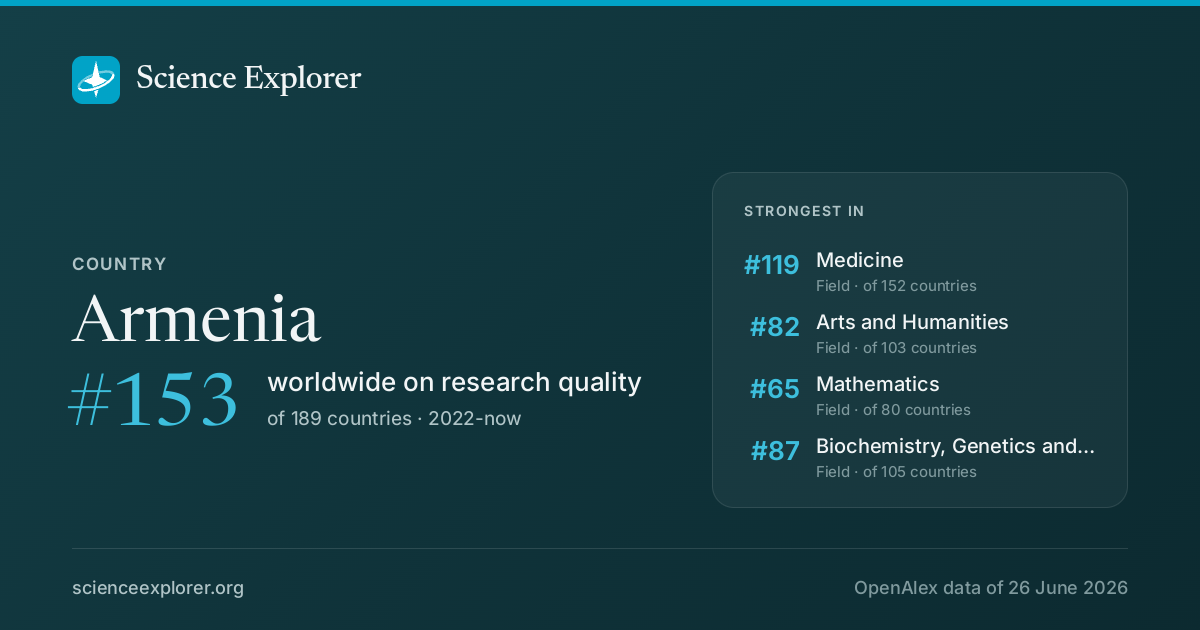
Armenia ranks #153 of 189 countries on research quality in 2022-now (#163 all time), with 9.9k research works and 4.0% of them in the world's top 10%.
- World rank, 2022-now
- #153 of 189 · #163 all time
- Works, 2022-now
- 9.9k ▲ 97% vs 2018-21
- Citations
- 268k 8.0 per fractional work, all time
- Top-10% rate
- 4.0% all institutions 10.0%
- vs its own fields
- 0.43× 1.00× is exactly expected
- In the world top 100
- 0 0 in the top 1,000
- Open access
- 47% world 40%
- International
- 26% world 18%
ArmeniaWhat is Armenia strongest at in science?
On research quality in 2022-now, Armenia ranks highest in Medicine (#119 of 152), Arts and Humanities (#82 of 103) and Mathematics (#65 of 80). Relative to its size it is most specialised in General Energy, Archeology and Classics.
| Field | World rank | Where that sits | Top-10% rate | Works | All time | Institutions |
|---|---|---|---|---|---|---|
| MedicineField | #119 of 152 | 4.6% | 1,036 | #134 | Institutions | |
| Arts and HumanitiesField | #82 of 103 | 5.0% | 544 | #104 | Institutions | |
| MathematicsField | #65 of 80 | 3.4% | 264 | #67 | Institutions | |
| Biochemistry, Genetics and Molecular BiologyField | #87 of 105 | 3.9% | 394 | #98 | Institutions | |
| Political Science and International RelationsSubfield | #79 of 95 | 5.9% | 690 | #95 | Institutions | |
| Physics and AstronomyField | #64 of 76 | 3.9% | 585 | #67 | Institutions | |
| Cultural StudiesSubfield | #41 of 47 | 4.2% | 223 | - | Institutions | |
| Molecular BiologySubfield | #75 of 84 | 3.9% | 229 | #86 | Institutions | |
| Atomic and Molecular Physics, and OpticsSubfield | #51 of 57 | 4.5% | 201 | #59 | Institutions | |
| Social SciencesField | #133 of 148 | 4.9% | 2,091 | #149 | Institutions | |
| EngineeringField | #121 of 131 | 3.0% | 967 | #120 | Institutions | |
| PsychologyField | #99 of 106 | 3.5% | 291 | #97 | Institutions |
Where its research is concentrated
Location quotient: how much more (or less) of each node it does than its size predicts. Drawn around 1×, where "twice the world share" and "half of it" are the same distance apart in opposite directions. A volume reading, which on a country axis is largely population and industrial structure.
- General EnergySubfield · 86.4 works · #18 of 167 active here28×
- ArcheologySubfield · 34.2 works · #23 of 158 active here20×
- ClassicsSubfield · 50.6 works · #39 of 153 active here7.5×
- Cultural StudiesSubfield · 248.1 works · #44 of 211 active here5.4×
- Space and Planetary ScienceSubfield · 11.3 works · #56 of 158 active here5.0×
- Political Science and International RelationsSubfield · 761.0 works · #62 of 219 active here4.5×
- DevelopmentSubfield · 50.9 works · #56 of 190 active here4.5×
- Language and LinguisticsSubfield · 210.4 works · #68 of 213 active here4.2×
The whole field profile
All 26 fields at once. A specialist and a generalist produce the same ranked list and a completely different shape.
Rings at 0.5×, 1× and 2×. Widest outward: Physics and Astronomy, 2.7×. Every wedge is a field page.
All 26 fields, with their numbers
- Physics and Astronomy2.67×668 works
- Economics, Econometrics and Finance2.43×586 works
- Mathematics2.28×302 works
- Arts and Humanities1.84×599 works
- Chemistry1.63×289 works
- Social Sciences1.63×2,331 works
- Dentistry1.53×84 works
- Energy1.41×146 works
- Agricultural and Biological Sciences1.23×658 works
- Pharmacology, Toxicology and Pharmaceutics1.15×46 works
- Business, Management and Accounting1.11×402 works
- Earth and Planetary Sciences1.07×189 works
- Psychology0.96×331 works
- Materials Science0.84×330 works
- Chemical Engineering0.79×31 works
- Biochemistry, Genetics and Molecular Biology0.75×453 works
- Environmental Science0.74×416 works
- Decision Sciences0.71×78 works
- Computer Science0.70×615 works
- Neuroscience0.65×119 works
- Engineering0.65×1,093 works
- Health Professions0.62×185 works
- Nursing0.57×32 works
- Veterinary0.57×9 works
- Medicine0.56×1,222 works
- Immunology and Microbiology0.54×61 works
Which fields of science does Armenia work in?
In 2022-now, 38% of research in Armenia is in Social Sciences, 36% in Physical Sciences. Its largest fields are Social Sciences (21%), Medicine (11%), Engineering (10%). It does 1.5× the world's share of Social Sciences.
Each ring splits the one inside it: the four domains of science, their fields, their subfields. Size is fractional works in 2022-now. Every slice is a page; the interactive view zooms down to single topics and colours each by how much more of it this country does than the world.
Its 4 domains and 26 fields, with their numbers
- Social Sciences4,32838.4%
- Social Sciences2,33120.7%
- Arts and Humanities5995.3%
- Economics, Econometrics and Finance5865.2%
- Business, Management and Accounting4023.6%
- Psychology3312.9%
- Decision Sciences780.7%
- Physical Sciences4,08036.2%
- Engineering1,0939.7%
- Physics and Astronomy6685.9%
- Computer Science6155.5%
- Environmental Science4163.7%
- Materials Science3302.9%
- Mathematics3022.7%
- Chemistry2892.6%
- Earth and Planetary Sciences1891.7%
- Energy1461.3%
- Chemical Engineering310.3%
- Health Sciences1,53213.6%
- Medicine1,22310.8%
- Health Professions1851.6%
- Dentistry840.7%
- Nursing320.3%
- Veterinary90.1%
- Life Sciences1,33711.9%
Which keywords describe research in Armenia?
By fractional works in 2022-now, weighted toward what it does more of than the world: Globalization, Neoliberalism, Cultural Exchange, Human Rights, Innovation, Sustainable Development, Education and Climate Change.
- Nation-Building
- Eurasian Exchange
- Cultural Interaction
- Human Capital
- Financial Crisis
- European Legal Systems
- Constitutionalism
- Judicial Review
- Legal Regulation
- Labor Market
- Political Economy
- Economic Growth
- Democracy
- European Immigration
- Renewable Energy
- Cultural Exchange
- Artificial Intelligence
- Human Rights
- Education
- Climate Change
- Globalization
- Sustainable Development
- Sustainability
- Innovation
- Neoliberalism
- Economic Development
- Immigration
- Human Agency
- International Relations
- Geopolitics
- Digital Transformation
- Synthesis
- Agriculture
- Global Governance
- ECHR
- Central Asia
- Sovereignty
- Linguistics
- Ethnic Conflict
- Silk Roads
Size is fractional works in 2022-now in the topics tagged with each word; colour is the word's share of this country's work against its share of the world's. The 40 words are chosen for being large and distinctive. Each links to the topic it comes from most.
All 40 words, with their numbers
- Globalization724▲ 3.3×114 topics
- Climate Change514▲ 1.68×110 topics
- Sustainable Development436▲ 2.5×93 topics
- Education435▲ 2.2×90 topics
- Sustainability389▲ 1.41×10⁷ topics
- Human Rights387▲ 3.4×69 topics
- Innovation380▲ 3.3×65 topics
- Artificial Intelligence291▲ 1.81×53 topics
- Neoliberalism288▲ 7.1×19 topics
- Cultural Exchange272▲ 19×7 topics
- Economic Development271▲ 3.0×42 topics
- Renewable Energy242▲ 1.49×51 topics
- Immigration218▲ 18×7 topics
- European Immigration207▲ 181×1 topic
- Human Agency207▲ 181×1 topic
- Democracy186▲ 4.7×21 topics
- International Relations186▲ 6.8×26 topics
- Economic Growth185▲ 2.0×34 topics
- Geopolitics167▲ 9.8×10 topics
- Political Economy163▲ 5.6×15 topics
- Digital Transformation160▲ 2.6×26 topics
- Labor Market160▲ 5.0×13 topics
- Synthesis157▲ 3.7×35 topics
- Legal Regulation151▲ 6.0×8 topics
- Agriculture150▲ 3.5×14 topics
- Judicial Review150▲ 16×5 topics
- Global Governance146▲ 5.4×21 topics
- Constitutionalism140▲ 14×3 topics
- ECHR139▲ 36×1 topic
- European Legal Systems139▲ 36×1 topic
- Central Asia135▲ 17×4 topics
- Financial Crisis123▲ 9.7×14 topics
- Sovereignty119▲ 12×10 topics
- Human Capital118▲ 6.8×9 topics
- Linguistics115▲ 6.5×7 topics
- Cultural Interaction100▲ 35×2 topics
- Ethnic Conflict98▲ 19×4 topics
- Eurasian Exchange95▲ 41×1 topic
- Silk Roads95▲ 41×1 topic
- Nation-Building92▲ 15×4 topics
Which research topics does Armenia publish the most in?
Its largest topics in 2022-now are History and Cultural Heritage, European and International Law Studies, Eurasian Exchange Networks.
Area is fractional works in 2022-now; colour is the subfield each topic belongs to. Every tile is a topic page.
- 1 History and Cultural Heritage Cultural Studies 207 works
- 2 European and International Law Studies Political Science and International Relations 139 works
- 3 Eurasian Exchange Networks Anthropology 95 works
- 4 Global Energy Security and Policy General Energy 86 works
- 5 Post-Soviet Geopolitical Dynamics Political Science and International Relations 82 works
- 6 Global Socioeconomic and Political Dynamics Economics and Econometrics 80 works
- 7 Security, Politics, and Digital Transformation Political Science and International Relations 66 works
- 8 Linguistics and Cultural Studies Language and Linguistics 63 works
- 9 Economic Sanctions and International Relations Economics and Econometrics 55 works
- 10 Russia and Soviet political economy Political Science and International Relations 52 works
- 11 Turkey's Politics and Society Political Science and International Relations 50 works
- 12 Byzantine Studies and History Classics 49 works
Which universities in Armenia lead research?
Armenian State University of Economics, National University of Architecture and Construction of Armenia and Yerevan State University rank highest in Armenia on research quality in 2022-now.
One dot per institution in the list below. The upper left is the interesting corner.
- 1Armenian State University of EconomicsUniversity · Yerevan · #5,949 worldwide3.0% top 10% · 787 works
- 2National University of Architecture and Construction of ArmeniaUniversity · Yerevan · #8,540 worldwide3.7% top 10% · 322 works
- 3Yerevan State UniversityUniversity · Yerevan · #8,873 worldwide4.1% top 10% · 2.3k works
- 4Shirak State UniversityUniversity · Gyumri · #9,827 worldwide0.9% top 10% · 261 works
- 5American University of ArmeniaUniversity · Yerevan · #10,263 worldwide10.0% top 10% · 190 works
- 6National Statistical Service of the Republic of ArmeniaInstitution · Yerevan · #11,006 worldwide3.5% top 10% · 173 works
- 7Armenian State Pedagogical University after Khachatur AbovianUniversity · Yerevan · #11,322 worldwide3.4% top 10% · 327 works
- 8National Academy of Sciences of ArmeniaGovernment institution · Yerevan · #11,631 worldwide3.7% top 10% · 917 works
- 9Armenian National Agrarian UniversityUniversity · Yerevan · #11,685 worldwide2.9% top 10% · 337 works
- 10National Institute of HealthGovernment institution · Yerevan · #11,694 worldwide7.8% top 10% · 186 works
- 11National Polytechnic University of ArmeniaUniversity · Yerevan · #11,898 worldwide3.0% top 10% · 535 works
- 12Institute of BotanyResearch facility · Yerevan · #12,068 worldwide4.1% top 10% · 253 works
- 13Institute of Molecular BiologyResearch facility · Yerevan · #13,106 worldwide18.9% top 10% · 73 works
- 14Russian-Armenian UniversityUniversity · Yerevan · #13,669 worldwide2.6% top 10% · 534 works
- 15Yerevan State Medical UniversityUniversity · Yerevan · #13,802 worldwide4.6% top 10% · 612 works





The track on each row is its top-10% rate; the tick is the average of all institutions, 10.0% (how it is set): teal above it, red below.
All ranked institutions in ArmeniaWho are the top researchers in Armenia?
T. Dahms, W. Haj Ahmad and H. Van Haevermaet rank highest among researchers based in Armenia.
- 1 T. Dahms #1,639 worldwide 82k citations · 841 works
- 2 W. Haj Ahmad #1,668 worldwide 47k citations · 510 works
- 3 H. Van Haevermaet #1,688 worldwide 78k citations · 848 works
- 4 P. Ronchese #1,703 worldwide 30k citations · 258 works
- 5 O. Bondu #1,778 worldwide 40k citations · 463 works
- 6 S. Paktinat Mehdiabadi #1,886 worldwide 87k citations · 881 works
- 7 M. Chamizo Llatas #1,911 worldwide 84k citations · 738 works
- 8 P. Adzic #1,912 worldwide 35k citations · 296 works
- 9 J. Rodrigues Antunes #1,976 worldwide 66k citations · 653 works
- 10 J. Mans #1,982 worldwide 39k citations · 386 works
Which cities in Armenia are research hubs?
How open and international is Armenia's research?
47% of its research is openly available (world: 40%), and 26% is written with international co-authors (world: 18%).
World: 40% of research is openly available.
World: 18% is written across borders.
In 2022-now, 65% of its research is openly available (world 63%) and 22% is written with co-authors abroad (world 22%). Against what its own mix of topics predicts, that is 1.00× the expected open access and 1.08× the expected international share, which puts it #159 of 173 countries on openness.
How has Armenia's research grown?
Output in 2022-2025 was 97% higher than in 2018-2021.
The same series as a ribbon: one cell per year, darker for more. The line above answers how much; this answers when.
Its share of all research
Growing output can still be a shrinking share: all of science grows. This is Armenia as a percentage of every work published that year, 0.045% in 2024.
Fractional works of Armenia over all fractional works that year. How the balance of science has shifted.
How much of it reaches the world top 10%
Over the whole record, 4.3% of its 33k works since 1950 reached the world top 10% for their field and year.
Of each year's output, the share that reached the world's 10% most cited for its field and year. Peak 6.0% in 1992.
Which countries have research most like Armenia's?
Azerbaijan is Armenia's closest research twin: of all countries, its research is spread across the fields most like Armenia's, with both strong in Economics, Econometrics and Finance.
- 1
 AzerbaijanBoth strong in Economics, Econometrics and Finance, Mathematics, Arts and Humanities
0.81 Compare
- 2
 UzbekistanBoth strong in Economics, Econometrics and Finance, Arts and Humanities, Mathematics
0.73 Compare
- 3
 TajikistanBoth strong in Mathematics, Economics, Econometrics and Finance, Arts and Humanities
0.68 Compare
- 4
 GeorgiaBoth strong in Economics, Econometrics and Finance, Mathematics, Arts and Humanities
0.64 Compare
- 5
 RussiaBoth strong in Physics and Astronomy, Chemistry, Mathematics
0.62 Compare
Similarity is the correlation of each side's location quotients across every field it publishes in, on a log scale: 1 is the same shape of research, 0 is unrelated. It ignores size. How it is measured.
Compare Armenia with
 French Polynesia
 Faroe Islands
 Senegal
 Gabon
 Martinique
 Togo
Share Armenia's ranking
Badges for a website1Each links back here and updates with every snapshot

Research fields in Armenia
- Medicine
- Life Sciences
- Arts and Humanities
- Health Sciences
- Mathematics
- Social Sciences
- Biochemistry, Genetics and Molecular Biology
- Political Science and International Relations
- Physics and Astronomy
- Cultural Studies
- Molecular Biology
- Atomic and Molecular Physics, and Optics
- Social Sciences
- Engineering
- Physical Sciences
- Psychology
- Agricultural and Biological Sciences
- Economics, Econometrics and Finance
- Sociology and Political Science
- Plant Science
- Computer Science
- Economics and Econometrics
- Business, Management and Accounting
- Electrical and Electronic Engineering
- Chemistry
- Organic Chemistry
- Materials Science
Discussion
Ask a question or share a note about Armenia. Posts are plain text and can be reported.