 Science in Georgia
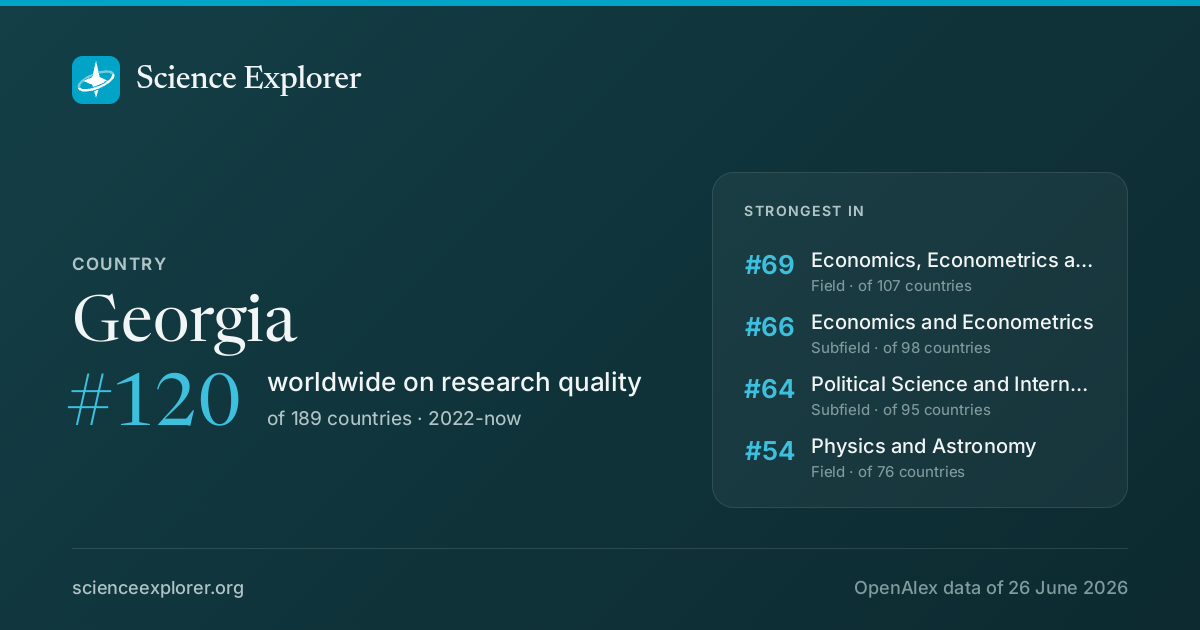
Georgia ranks #120 of 189 countries on research quality in 2022-now (#129 all time), with 11k research works and 3.6% of them in the world's top 10%.
- World rank, 2022-now
- #120 of 189 · #129 all time
- Works, 2022-now
- 11k ▲ 81% vs 2018-21
- Citations
- 144k 5.0 per fractional work, all time
- Top-10% rate
- 3.6% all institutions 10.0%
- vs its own fields
- 0.40× 1.00× is exactly expected
- In the world top 100
- 0 0 in the top 1,000
- Open access
- 55% world 40%
- International
- 26% world 18%
GeorgiaWhat is Georgia strongest at in science?
On research quality in 2022-now, Georgia ranks highest in Economics, Econometrics and Finance (#69 of 107), Economics and Econometrics (#66 of 98) and Political Science and International Relations (#64 of 95). Relative to its size it is most specialised in General Energy, Classics and Archeology.
| Field | World rank | Where that sits | Top-10% rate | Works | All time | Institutions |
|---|---|---|---|---|---|---|
| Economics, Econometrics and FinanceField | #69 of 107 | 6.6% | 846 | #72 | Institutions | |
| Economics and EconometricsSubfield | #66 of 98 | 7.0% | 685 | #70 | Institutions | |
| Political Science and International RelationsSubfield | #64 of 95 | 3.9% | 812 | #76 | Institutions | |
| MedicineField | #108 of 152 | 3.6% | 1,534 | #106 | Institutions | |
| Physics and AstronomyField | #54 of 76 | 4.4% | 208 | #65 | Institutions | |
| Social SciencesField | #106 of 148 | 3.6% | 2,367 | #111 | Institutions | |
| Agricultural and Biological SciencesField | #92 of 124 | 1.9% | 1,046 | #108 | Institutions | |
| Plant ScienceSubfield | #68 of 90 | 1.0% | 514 | #86 | Institutions | |
| Earth and Planetary SciencesField | #59 of 78 | 3.7% | 207 | #73 | Institutions | |
| Language and LinguisticsSubfield | #56 of 65 | 2.0% | 336 | #66 | Institutions | |
| Sociology and Political ScienceSubfield | #104 of 119 | 3.1% | 414 | #117 | Institutions | |
| PsychologyField | #93 of 106 | 2.8% | 283 | #94 | Institutions |
Where its research is concentrated
Location quotient: how much more (or less) of each node it does than its size predicts. Drawn around 1×, where "twice the world share" and "half of it" are the same distance apart in opposite directions. A volume reading, which on a country axis is largely population and industrial structure.
- General EnergySubfield · 33.6 works · #44 of 167 active here10×
- ClassicsSubfield · 62.3 works · #35 of 153 active here8.4×
- ArcheologySubfield · 15.7 works · #44 of 158 active here8.3×
- DevelopmentSubfield · 101.0 works · #38 of 190 active here8.1×
- General Social SciencesSubfield · 98.0 works · #39 of 191 active here7.2×
- Language and LinguisticsSubfield · 364.9 works · #54 of 213 active here6.7×
- AnatomySubfield · 15.7 works · #46 of 159 active here5.3×
- Political Science and International RelationsSubfield · 919.3 works · #55 of 219 active here5.0×
The whole field profile
All 26 fields at once. A specialist and a generalist produce the same ranked list and a completely different shape.
Rings at 0.5×, 1× and 2×. Widest outward: Economics, Econometrics and Finance, 3.7×. Every wedge is a field page.
All 26 fields, with their numbers
- Economics, Econometrics and Finance3.72×987 works
- Arts and Humanities2.78×994 works
- Agricultural and Biological Sciences2.01×1,186 works
- Mathematics1.85×269 works
- Social Sciences1.72×2,704 works
- Pharmacology, Toxicology and Pharmaceutics1.64×72 works
- Earth and Planetary Sciences1.31×255 works
- Business, Management and Accounting1.02×406 works
- Physics and Astronomy0.88×243 works
- Psychology0.88×331 works
- Dentistry0.85×51 works
- Medicine0.77×1,840 works
- Environmental Science0.75×460 works
- Immunology and Microbiology0.73×91 works
- Biochemistry, Genetics and Molecular Biology0.71×466 works
- Health Professions0.70×229 works
- Nursing0.69×42 works
- Decision Sciences0.68×81 works
- Energy0.67×76 works
- Neuroscience0.64×129 works
- Chemistry0.51×99 works
- Computer Science0.49×477 works
- Veterinary0.46×8 works
- Materials Science0.44×190 works
- Engineering0.37×694 works
- Chemical Engineering0.26×11 works
Which fields of science does Georgia work in?
In 2022-now, 44% of research in Georgia is in Social Sciences, 22% in Physical Sciences. Its largest fields are Social Sciences (22%), Medicine (15%), Agricultural and Biological Sciences (10%). It does 1.8× the world's share of Social Sciences.
Each ring splits the one inside it: the four domains of science, their fields, their subfields. Size is fractional works in 2022-now. Every slice is a page; the interactive view zooms down to single topics and colours each by how much more of it this country does than the world.
Its 4 domains and 26 fields, with their numbers
- Social Sciences5,50444.4%
- Social Sciences2,70421.8%
- Arts and Humanities9958.0%
- Economics, Econometrics and Finance9878.0%
- Business, Management and Accounting4063.3%
- Psychology3312.7%
- Decision Sciences810.7%
- Physical Sciences2,77422.4%
- Engineering6945.6%
- Computer Science4773.8%
- Environmental Science4603.7%
- Mathematics2692.2%
- Earth and Planetary Sciences2552.1%
- Physics and Astronomy2432.0%
- Materials Science1901.5%
- Chemistry990.8%
- Energy760.6%
- Chemical Engineering110.1%
- Health Sciences2,17017.5%
- Medicine1,84014.9%
- Health Professions2291.8%
- Dentistry510.4%
- Nursing420.3%
- Veterinary80.1%
- Life Sciences1,94315.7%
Which keywords describe research in Georgia?
By fractional works in 2022-now, weighted toward what it does more of than the world: Globalization, Innovation, Economic Development, Labor Market, Medicinal Plants, Agriculture, Human Capital and Financial Crisis.
- Geopolitics
- Taxonomy
- Sovereignty
- Historical Phonology
- Political Economy
- Ethnobotanical Survey
- International Relations
- Drug Discovery
- Regional Development
- Herbal Medicine
- Language
- Antioxidant
- Human Rights
- Post-Communist Countries
- Education
- Human Capital
- Medicinal Plants
- Sustainable Development
- Sustainability
- Innovation
- Globalization
- Economic Development
- Climate Change
- Labor Market
- Agriculture
- Financial Crisis
- Artificial Intelligence
- Trade Relations
- Migration
- Digital Transformation
- Linguistics
- Biogeography
- Phylogeny
- Economy
- Phytochemical Constituents
- Traditional Ecological Knowledge
- Etymology
- Russia
- Nation-Building
- Central Asia
Size is fractional works in 2022-now in the topics tagged with each word; colour is the word's share of this country's work against its share of the world's. The 40 words are chosen for being large and distinctive. Each links to the topic it comes from most.
All 40 words, with their numbers
- Globalization1,176▲ 4.8×126 topics
- Innovation819▲ 6.4×66 topics
- Economic Development692▲ 7.0×45 topics
- Sustainability667▲ 2.2×10⁴ topics
- Climate Change618▲ 1.83×10⁹ topics
- Sustainable Development519▲ 2.7×90 topics
- Labor Market493▲ 14×17 topics
- Medicinal Plants472▲ 9.8×18 topics
- Agriculture471▲ 10.0×13 topics
- Human Capital441▲ 23×10 topics
- Financial Crisis412▲ 30×13 topics
- Education410▲ 1.92×94 topics
- Artificial Intelligence396▲ 2.2×51 topics
- Post-Communist Countries380▲ 199×1 topic
- Trade Relations380▲ 199×1 topic
- Human Rights355▲ 2.8×76 topics
- Migration318▲ 7.5×30 topics
- Antioxidant291▲ 3.4×50 topics
- Digital Transformation272▲ 4.1×27 topics
- Language269▲ 8.8×14 topics
- Linguistics247▲ 13×7 topics
- Herbal Medicine232▲ 6.7×13 topics
- Biogeography230▲ 6.7×20 topics
- Regional Development228▲ 5.4×19 topics
- Phylogeny225▲ 11×17 topics
- Drug Discovery205▲ 7.4×12 topics
- Economy197▲ 21×4 topics
- International Relations189▲ 6.3×28 topics
- Phytochemical Constituents188▲ 49×2 topics
- Ethnobotanical Survey187▲ 47×1 topic
- Traditional Ecological Knowledge187▲ 35×1 topic
- Political Economy180▲ 5.7×17 topics
- Etymology174▲ 30×2 topics
- Historical Phonology174▲ 30×2 topics
- Russia172▲ 33×3 topics
- Sovereignty170▲ 15×9 topics
- Nation-Building168▲ 25×4 topics
- Taxonomy162▲ 9.0×15 topics
- Central Asia159▲ 18×4 topics
- Geopolitics156▲ 8.3×11 topics
Which research topics does Georgia publish the most in?
Its largest topics in 2022-now are Global Socioeconomic and Political Dynamics, Ethnobotanical and Medicinal Plants Studies, Post-Soviet Geopolitical Dynamics.
Area is fractional works in 2022-now; colour is the subfield each topic belongs to. Every tile is a topic page.
- 1 Global Socioeconomic and Political Dynamics Economics and Econometrics 380 works
- 2 Ethnobotanical and Medicinal Plants Studies Plant Science 187 works
- 3 Post-Soviet Geopolitical Dynamics Political Science and International Relations 142 works
- 4 Linguistics and language evolution Language and Linguistics 102 works
- 5 Russia and Soviet political economy Political Science and International Relations 101 works
- 6 Marine and environmental studies Oceanography 101 works
- 7 Security, Politics, and Digital Transformation Political Science and International Relations 97 works
- 8 Economic and Technological Developments in Russia Development 93 works
- 9 Cultural, Linguistic, Economic Studies General Social Sciences 92 works
- 10 Economic Analysis and Policy Economics and Econometrics 76 works
- 11 European and International Law Studies Political Science and International Relations 76 works
- 12 Linguistics and Cultural Studies Language and Linguistics 72 works
Which universities in Georgia lead research?
Ilia State University, Tbilisi State University and Batumi Shota Rustaveli State University rank highest in Georgia on research quality in 2022-now.
One dot per institution in the list below. The upper left is the interesting corner.
- 1Ilia State UniversityUniversity · Tbilisi · #3,350 worldwide3.6% top 10% · 1.6k works
- 2Tbilisi State UniversityUniversity · Tbilisi · #3,479 worldwide3.4% top 10% · 2.1k works
- 3Batumi Shota Rustaveli State UniversityUniversity · Batumi · #6,484 worldwide4.5% top 10% · 649 works
- 4International Black Sea UniversityUniversity · Tbilisi · #8,184 worldwide6.3% top 10% · 261 works
- 5University of GeorgiaUniversity · Tbilisi · #8,248 worldwide14.7% top 10% · 218 works
- 6Georgian Technical UniversityUniversity · Tbilisi · #8,842 worldwide2.1% top 10% · 1.1k works
- 7Caucasus UniversityUniversity · Tbilisi · #9,318 worldwide5.1% top 10% · 279 works
- 8Akaki Tsereteli State UniversityUniversity · Kutaisi · #10,214 worldwide1.2% top 10% · 698 works
- 9Caucasus International UniversityUniversity · Tbilisi · #12,498 worldwide2.7% top 10% · 222 works
- 10Sokhumi State UniversityUniversity · Sukhumi · #13,327 worldwide0.7% top 10% · 343 works
- 11Gori State UniversityUniversity · Gori · #13,465 worldwide3.9% top 10% · 204 works
- 12Grigol Robakidze UniversityUniversity · Tbilisi · #14,150 worldwide4.2% top 10% · 182 works
- 13Iakob Gogebashvili Telavi State UniversityUniversity · Telavi · #14,757 worldwide0.6% top 10% · 191 works
- 14David Agmashenebeli University of GeorgiaUniversity · Tbilisi · #15,033 worldwide1.2% top 10% · 141 works
- 15Sulkhan-Saba Orbeliani UniversityUniversity · Tbilisi · #16,532 worldwide1.3% top 10% · 182 works

The track on each row is its top-10% rate; the tick is the average of all institutions, 10.0% (how it is set): teal above it, red below.
All ranked institutions in GeorgiaWho are the top researchers in Georgia?
F. Chlebana, David Lordkipanidze and J. Sturdy rank highest among researchers based in Georgia.
- 1 F. Chlebana #33,051 worldwide 6k citations · 76 works
- 2 David Lordkipanidze #43,553 worldwide 8.8k citations · 168 works
- 3 J. Sturdy #43,642 worldwide 6.3k citations · 89 works
- 4 A. Petrilli #45,877 worldwide 3.4k citations · 55 works
- 5 K. Sung #50,952 worldwide 7.7k citations · 100 works
- 6 C. Contreras-Campana #54,435 worldwide 7.2k citations · 111 works
- 7 Azer Dilanchiev #56,680 worldwide 2.6k citations · 54 works
- 8 T. Frueboes #64,210 worldwide 3.7k citations · 65 works
- 9 C. Flores #75,750 worldwide 3.8k citations · 52 works
- 10 U. Langenegger #76,408 worldwide 4.1k citations · 75 works
Which cities in Georgia are research hubs?
How open and international is Georgia's research?
55% of its research is openly available (world: 40%), and 26% is written with international co-authors (world: 18%).
World: 40% of research is openly available.
World: 18% is written across borders.
In 2022-now, 74% of its research is openly available (world 63%) and 26% is written with co-authors abroad (world 22%). Against what its own mix of topics predicts, that is 1.08× the expected open access and 1.33× the expected international share, which puts it #110 of 173 countries on openness.
How has Georgia's research grown?
Output in 2022-2025 was 81% higher than in 2018-2021.
The same series as a ribbon: one cell per year, darker for more. The line above answers how much; this answers when.
Its share of all research
Growing output can still be a shrinking share: all of science grows. This is Georgia as a percentage of every work published that year, 0.051% in 2024.
Fractional works of Georgia over all fractional works that year. How the balance of science has shifted.
How much of it reaches the world top 10%
Over the whole record, 4.4% of its 29k works since 1952 reached the world top 10% for their field and year.
Of each year's output, the share that reached the world's 10% most cited for its field and year. Peak 6.6% in 1990.
Which countries have research most like Georgia's?
Kyrgyzstan is Georgia's closest research twin: of all countries, its research is spread across the fields most like Georgia's, with both strong in Economics, Econometrics and Finance.
- 1
 KyrgyzstanBoth strong in Economics, Econometrics and Finance, Arts and Humanities, Mathematics
0.71 Compare
- 2
 Republic of the CongoBoth strong in Economics, Econometrics and Finance, Arts and Humanities, Agricultural and Biological Sciences
0.69 Compare
- 3
 UzbekistanBoth strong in Economics, Econometrics and Finance, Arts and Humanities, Mathematics
0.68 Compare
- 4
 CroatiaBoth strong in Economics, Econometrics and Finance, Arts and Humanities, Social Sciences
0.66 Compare
- 5
 Cape VerdeBoth strong in Economics, Econometrics and Finance, Mathematics, Social Sciences
0.65 Compare
Similarity is the correlation of each side's location quotients across every field it publishes in, on a log scale: 1 is the same shape of research, 0 is unrelated. It ignores size. How it is measured.
Compare Georgia with
 North Macedonia
 Mali
 Madagascar
 Guatemala
 Maldives
Share Georgia's ranking
Badges for a website1Each links back here and updates with every snapshot

Research fields in Georgia
- Economics, Econometrics and Finance
- Physical Sciences
- Economics and Econometrics
- Political Science and International Relations
- Medicine
- Physics and Astronomy
- Social Sciences
- Social Sciences
- Health Sciences
- Agricultural and Biological Sciences
- Plant Science
- Earth and Planetary Sciences
- Language and Linguistics
- Sociology and Political Science
- Psychology
- Arts and Humanities
- Life Sciences
- Engineering
- Biochemistry, Genetics and Molecular Biology
- Business, Management and Accounting
- Environmental Science
- Molecular Biology
- Computer Science
- Mathematics
Discussion
Ask a question or share a note about Georgia. Posts are plain text and can be reported.