Georgian Technical University
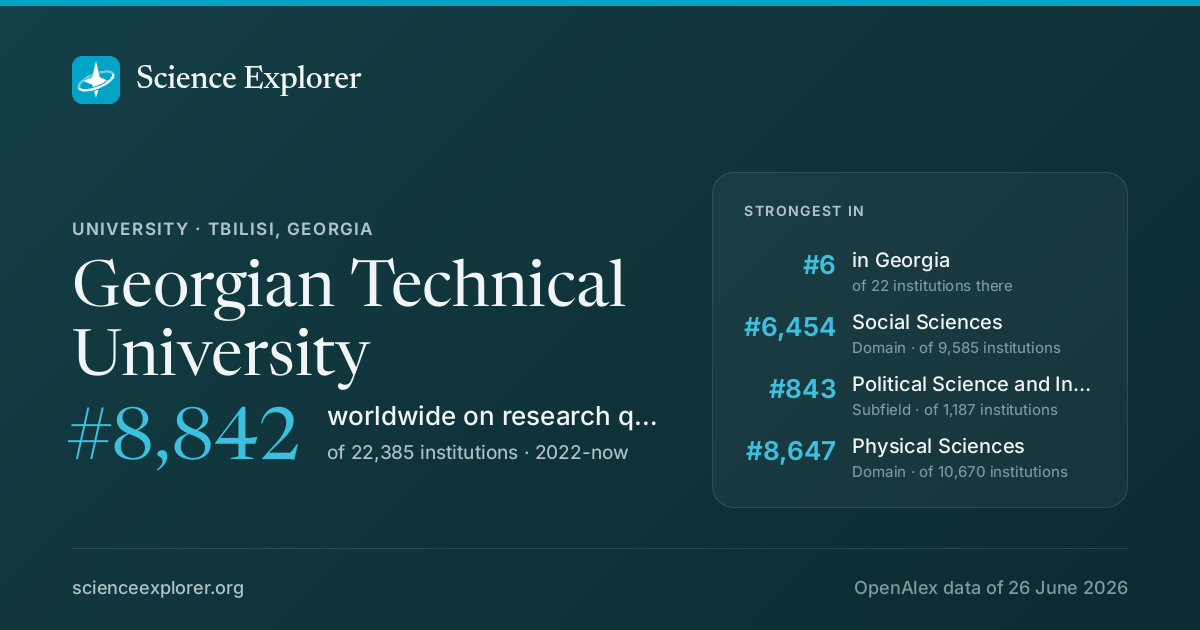
In research, Georgian Technical University stands highest in Social Sciences (#6,454 of 9,585 worldwide), Political Science and International Relations (#843 of 1,187 worldwide) and Physical Sciences (#8,647 of 10,670 worldwide), 2022-now.
- World rank, 2022-now
- #8,842 of 22,385 · #26,483 all time
- Rank in Georgia
- #6 of 22
- Research works
- 2.9k ▲ 106% vs 2018-21
- Citations
- 6.5k 2.3 per fractional work
- Top-10% rate
- 2.6% all institutions 10.0%
- vs its own fields
- 0.45× 1.00× is exactly expected
- Open access
- 61% world 40%
- International
- 17% world 18%
What is Georgian Technical University known for in research?
The fields where it stands highest, 2022-now, ranked among every institution above the floor in each field.
| Field | World rank | Where that sits | Top-10% rate | Works | All time |
|---|---|---|---|---|---|
| Social SciencesDomain | #6,454 of 9,585 | 3.1% | 450 | #12675 | |
| Political Science and International RelationsSubfield | #843 of 1,187 | 4.0% | 88 | #1993 | |
| Physical SciencesDomain | #8,647 of 10,670 | 0.9% | 545 | #16629 | |
| Social SciencesField | #5,016 of 5,988 | 3.4% | 219 | #8428 | |
| Life SciencesDomain | #5,830 of 6,403 | 3.6% | 78 | #10557 | |
| Economics, Econometrics and FinanceField | #1,652 of 1,798 | 3.7% | 114 | #2903 | |
| Economics and EconometricsSubfield | #1,219 of 1,307 | 4.4% | 89 | #2274 | |
| Computer ScienceField | #4,235 of 4,417 | 0.3% | 65 | #6175 | |
| Health SciencesDomain | #9,604 of 9,902 | 4.0% | 68 | #16324 | |
| Materials ScienceField | #2,213 of 2,276 | 0.0% | 63 | #3751 |
Each strip is that field's whole ranked pool, with the notch where Georgian Technical University sits in it, in the colour of the band that rank falls in. The track under the rate is the rate itself: it carries no average mark, because the average differs by field (from about 6% in Dentistry to 21% in Economics).
Which of those standings moved
The same fields on both windows: where it stood over the whole record, and where it stands in 2022-now. The distance is the story, and it is the one thing the two rank columns above cannot show.
- Social Sciences#12,675 #6,454
- Political Science and International Relations#1,993 #843
- Physical Sciences#16,629 #8,647
- Social Sciences#8,428 #5,016
- Life Sciences#10,557 #5,830
- Economics, Econometrics and Finance#2,903 #1,652
- Economics and Econometrics#2,274 #1,219
- Computer Science#6,175 #4,235
- Health Sciences#16,324 #9,604
- Materials Science#3,751 #2,213
A dot further right is a better standing. Fields it was not ranked in over the whole record are left out.
Which fields of science does Georgian Technical University work in?
In 2022-now, 48% of research at Georgian Technical University is in Physical Sciences, 39% in Social Sciences. Its largest fields are Engineering (21%), Social Sciences (19%), Economics, Econometrics and Finance (10%). It does 1.6× the world's share of Social Sciences.
Each ring splits the one inside it: the four domains of science, their fields, their subfields. Size is fractional works in 2022-now. Every slice is a page; the interactive view zooms down to single topics and colours each by how much more of it this institution does than the world.
Its 4 domains and 25 fields, with their numbers
- Physical Sciences65047.7%
- Engineering28721.1%
- Environmental Science816.0%
- Computer Science775.6%
- Materials Science695.1%
- Earth and Planetary Sciences362.6%
- Physics and Astronomy312.3%
- Mathematics292.2%
- Energy261.9%
- Chemistry60.5%
- Chemical Engineering60.4%
- Social Sciences53139.0%
- Social Sciences25618.8%
- Economics, Econometrics and Finance13810.1%
- Business, Management and Accounting584.2%
- Arts and Humanities413.0%
- Psychology241.8%
- Decision Sciences141.0%
- Life Sciences1017.4%
- Health Sciences805.9%
- Medicine523.8%
- Health Professions272.0%
- Nursing20.1%
- Dentistry10.1%
Field profile
Location quotient across every field it publishes in: outside the ring is more than an institution of this size would be expected to publish, inside it is less.
Rings at 0.5×, 1× and 2×. Widest outward: Economics, Econometrics and Finance, 4.7×. Every wedge is a field page.
All 25 fields, with their numbers
- Economics, Econometrics and Finance4.74×138 works
- Energy2.09×26 works
- Mathematics1.83×29 works
- Earth and Planetary Sciences1.68×36 works
- Social Sciences1.49×256 works
- Materials Science1.46×69 works
- Engineering1.41×287 works
- Business, Management and Accounting1.31×58 works
- Chemical Engineering1.28×6 works
- Environmental Science1.20×81 works
- Decision Sciences1.07×14 works
- Agricultural and Biological Sciences1.05×68 works
- Physics and Astronomy1.04×31 works
- Arts and Humanities1.04×41 works
- Health Professions0.74×27 works
- Pharmacology, Toxicology and Pharmaceutics0.72×3 works
- Computer Science0.72×77 works
- Psychology0.58×24 works
- Neuroscience0.35×8 works
- Chemistry0.30×6 works
- Biochemistry, Genetics and Molecular Biology0.29×21 works
- Nursing0.23×2 works
- Medicine0.20×52 works
- Dentistry0.12×1 works
- Immunology and Microbiology0.04×1 works
- Economics, Econometrics and Finance 4.7×
- Energy 2.1×
- Mathematics 1.8×
- Earth and Planetary Sciences 1.7×
- Social Sciences 1.5×
- Materials Science 1.5×
- Engineering 1.4×
- Business, Management and Accounting 1.3×
- Chemical Engineering 1.3×
- Environmental Science 1.2×
- Decision Sciences 1.1×
- Agricultural and Biological Sciences 1.1×
- Physics and Astronomy 1.0×
- Arts and Humanities 1.0×
- Health Professions 0.7×
- Pharmacology, Toxicology and Pharmaceutics 0.7×
- Computer Science 0.7×
- Psychology 0.6×
- Neuroscience 0.3×
- Chemistry 0.3×
- Biochemistry, Genetics and Molecular Biology 0.3×
- Nursing 0.2×
- Medicine 0.2×
- Dentistry 0.1×
- Immunology and Microbiology 0.0×
Who are the top researchers at Georgian Technical University?
Ranked on the quality score, Lily Petriashvili, Ramaz Otinashvili and Irakli Kervalishvili lead among researchers whose main affiliation is Georgian Technical University.
- 1
Lily Petriashvili
 Georgia · #3,717,513 worldwide
91 citations · 29 works
- 2
Ramaz Otinashvili
Georgia · #4,192,014 worldwide
42 citations · 17 works
- 3
Irakli Kervalishvili
Georgia · #4,678,417 worldwide
4 citations · 15 works
- 4
Salome Oniani
Georgia · #4,737,113 worldwide
289 citations · 18 works
- 5
Medea Chelidze
Georgia · #5,136,699 worldwide
15 citations · 19 works
- 6
Nodar Davitashvili
Georgia · #5,186,351 worldwide
33 citations · 17 works
- 7
George Lotishvili
Georgia · #5,240,928 worldwide
0 citations · 26 works
- 8
Otar Chkadua
Georgia · #5,366,544 worldwide
419 citations · 37 works
- 9
Edisher Kvesitadze
Georgia · #5,404,471 worldwide
221 citations · 16 works
- 10
George Kordzakhia
Georgia · #5,511,452 worldwide
84 citations · 17 works
Which keywords describe research at Georgian Technical University?
By fractional works in 2022-now, weighted toward what it does more of than the world: Globalization, Innovation, Economic Development, Sustainability, Sustainable Development, Labor Market, Climate Change and Agriculture.
- Mediterranean
- Nation-Building
- Metal Nanoparticles
- Global Economy
- Oil Industry
- Environment
- Transition
- Digital Economy
- International Relations
- Economy
- Geopolitics
- Regional Development
- Digital Transformation
- Artificial Intelligence
- Post-Communist Countries
- Renewable Energy
- Agriculture
- Sustainable Development
- Climate Change
- Sustainability
- Globalization
- Innovation
- Economic Development
- Labor Market
- Human Capital
- Financial Crisis
- Trade Relations
- Energy Efficiency
- Environmental Impact
- Russia
- Political Economy
- Environmental Management
- Migration
- Global Governance
- Capitalism
- Barter
- Industrial Policy
- Financial Security
- Sovereignty
- Renewable Energy Sources
Size is fractional works in 2022-now in the topics tagged with each word; colour is the word's share of this institution's work against its share of the world's. The 40 words are chosen for being large and distinctive. Each links to the topic it comes from most.
All 40 words, with their numbers
- Globalization160▲ 6.0×54 topics
- Sustainability132▲ 4.0×64 topics
- Innovation118▲ 8.4×44 topics
- Climate Change109▲ 2.9×68 topics
- Economic Development109▲ 10.0×25 topics
- Sustainable Development107▲ 5.0×63 topics
- Labor Market69▲ 18×9 topics
- Agriculture66▲ 13×6 topics
- Human Capital62▲ 30×7 topics
- Renewable Energy60▲ 3.1×36 topics
- Financial Crisis60▲ 39×5 topics
- Post-Communist Countries56▲ 264×1 topic
- Trade Relations56▲ 264×1 topic
- Artificial Intelligence54▲ 2.8×30 topics
- Energy Efficiency53▲ 4.2×26 topics
- Digital Transformation44▲ 6.0×19 topics
- Environmental Impact42▲ 1.79×34 topics
- Regional Development35▲ 7.5×14 topics
- Russia33▲ 57×3 topics
- Geopolitics32▲ 16×8 topics
- Political Economy30▲ 8.8×9 topics
- Economy29▲ 29×2 topics
- Environmental Management28▲ 5.1×12 topics
- International Relations26▲ 8.0×15 topics
- Migration24▲ 5.2×12 topics
- Digital Economy23▲ 8.4×15 topics
- Global Governance23▲ 7.0×13 topics
- Transition22▲ 18×4 topics
- Capitalism22▲ 25×2 topics
- Environment21▲ 63×2 topics
- Barter21▲ 117×1 topic
- Oil Industry21▲ 117×1 topic
- Industrial Policy21▲ 14×6 topics
- Global Economy19▲ 11×5 topics
- Financial Security19▲ 13×3 topics
- Metal Nanoparticles18▲ 8.5×5 topics
- Sovereignty18▲ 15×7 topics
- Nation-Building16▲ 23×4 topics
- Renewable Energy Sources16▲ 26×3 topics
- Mediterranean16▲ 13×3 topics
Which research topics does Georgian Technical University publish most on?
By volume in 2022-now: Global Socioeconomic and Political Dynamics, Russia and Soviet political economy, Economic and Technological Developments in Russia and Post-Soviet Geopolitical Dynamics.
Area is fractional works; colour is the subfield each topic belongs to.
- 1 Global Socioeconomic and Political Dynamics Economics and Econometrics 56 works
- 2 Russia and Soviet political economy Political Science and International Relations 21 works
- 3 Economic and Technological Developments in Russia Development 15 works
- 4 Post-Soviet Geopolitical Dynamics Political Science and International Relations 14 works
- 5 Marine and environmental studies Oceanography 13 works
- 6 Structural mechanics and materials Materials Chemistry 12 works
- 7 Material Properties and Applications General Materials Science 12 works
- 8 Security, Politics, and Digital Transformation Political Science and International Relations 11 works
- 9 Economic Analysis and Policy Economics and Econometrics 11 works
- 10 Global Energy Security and Policy General Energy 10 works
How open and international is its research?
Against the world's own shares: the tick on each track. Both are shares of its output, so they sit on one scale and can be read against each other as well as against the world.
World: 40% of research is openly available.
World: 18% is written across borders.
How has Georgian Technical University's research output changed?
Output in 2022-2025 was 106% higher than in 2018-2021.
The same series as a ribbon: one cell per year, darker for more. The line above answers how much; this answers when.
Its share of all research
Growing output can still be a shrinking share: all of science grows. This is Georgian Technical University as a percentage of every work published that year, 0.0057% in 2024.
Fractional works of Georgian Technical University over all fractional works that year. How the balance of science has shifted.
How much of it reaches the world top 10%
Year by year, against all institutions in the same year.
Of each year's output, the share that reached the world's 10% most cited for its field and year. Peak 5.4% in 2017.
Other research institutions in Tbilisi
- Tbilisi State University
- Ilia State University
- Tbilisi State Medical University
- Georgian National Academy of Sciences
- International Black Sea University
- Caucasus University
- Evgeni Kharadze Georgian National Astrophysical Observatory
- Grigol Robakidze University


Share Georgian Technical University's ranking
Badges for a website1Each links back here and updates with every snapshot

Research measures only: rankings here say nothing about teaching, admissions or student experience. Comparable institutions and collaboration partners have tabs of their own, above.
Discussion
Ask a question or share a note about Georgian Technical University. Posts are plain text and can be reported.