 Science in Algeria
Algeria ranks #148 of 189 countries on research quality in 2022-now (#124 all time), with 43k research works and 5.8% of them in the world's top 10%.
- World rank, 2022-now
- #148 of 189 · #124 all time
- Works, 2022-now
- 43k ◆ 1% vs 2018-21
- Citations
- 1.1M 7.1 per fractional work, all time
- Top-10% rate
- 5.8% all institutions 10.0%
- vs its own fields
- 0.61× 1.00× is exactly expected
- In the world top 100
- 0 0 in the top 1,000
- Open access
- 39% world 40%
- International
- 24% world 18%
AlgeriaWhat is Algeria strongest at in science?
On research quality in 2022-now, Algeria ranks highest in Engineering (#92 of 131), Computer Science (#97 of 128) and Energy (#60 of 71). Relative to its size it is most specialised in Numerical Analysis, Applied Mathematics and Modeling and Simulation.
| Field | World rank | Where that sits | Top-10% rate | Works | All time | Institutions |
|---|---|---|---|---|---|---|
| EngineeringField | #92 of 131 | 5.7% | 11,265 | #69 | Institutions | |
| Computer ScienceField | #97 of 128 | 6.1% | 4,801 | #67 | Institutions | |
| EnergyField | #60 of 71 | 6.8% | 1,207 | #55 | Institutions | |
| Electrical and Electronic EngineeringSubfield | #76 of 86 | 5.9% | 3,114 | #69 | Institutions | |
| Mechanics of MaterialsSubfield | #55 of 62 | 7.5% | 611 | #61 | ||
| Renewable Energy, Sustainability and the EnvironmentSubfield | #59 of 66 | 6.8% | 997 | #61 | Institutions | |
| Physics and AstronomyField | #68 of 76 | 6.2% | 1,163 | #75 | Institutions | |
| Environmental ScienceField | #110 of 122 | 5.4% | 2,543 | #102 | Institutions | |
| Mechanical EngineeringSubfield | #68 of 74 | 6.1% | 1,327 | #70 | Institutions | |
| Organic ChemistrySubfield | #58 of 63 | 9.6% | 526 | #63 | ||
| MathematicsField | #74 of 80 | 6.7% | 1,732 | - | Institutions | |
| Control and Systems EngineeringSubfield | #63 of 68 | 6.4% | 1,398 | #63 | Institutions |
Where its research is concentrated
Location quotient: how much more (or less) of each node it does than its size predicts. Drawn around 1×, where "twice the world share" and "half of it" are the same distance apart in opposite directions. A volume reading, which on a country axis is largely population and industrial structure.
- Numerical AnalysisSubfield · 220.3 works · #21 of 173 active here5.4×
- Applied MathematicsSubfield · 718.3 works · #19 of 195 active here5.2×
- Modeling and SimulationSubfield · 300.3 works · #27 of 206 active here4.5×
- Energy Engineering and Power TechnologySubfield · 201.4 works · #24 of 187 active here3.9×
- Linguistics and LanguageSubfield · 214.2 works · #28 of 194 active here3.9×
- MathematicsField · 1,956.9 works · #18 of 205 active here3.5×
- BiochemistrySubfield · 190.3 works · #33 of 198 active here3.2×
- Mathematical PhysicsSubfield · 233.6 works3.1×
The whole field profile
All 26 fields at once. A specialist and a generalist produce the same ranked list and a completely different shape.
Rings at 0.5×, 1× and 2×. Widest outward: Mathematics, 3.5×. Every wedge is a field page.
All 26 fields, with their numbers
- Mathematics3.45×1,957 works
- Energy3.02×1,335 works
- Materials Science1.81×3,051 works
- Engineering1.72×12k works
- Chemistry1.42×1,072 works
- Computer Science1.40×5,247 works
- Agricultural and Biological Sciences1.39×3,187 works
- Physics and Astronomy1.24×1,332 works
- Environmental Science1.22×2,917 works
- Arts and Humanities1.15×1,606 works
- Earth and Planetary Sciences1.09×822 works
- Chemical Engineering1.03×174 works
- Pharmacology, Toxicology and Pharmaceutics0.95×161 works
- Veterinary0.90×59 works
- Nursing0.78×185 works
- Decision Sciences0.78×362 works
- Economics, Econometrics and Finance0.68×698 works
- Social Sciences0.60×3,659 works
- Business, Management and Accounting0.55×851 works
- Biochemistry, Genetics and Molecular Biology0.47×1,206 works
- Medicine0.46×4,224 works
- Health Professions0.43×540 works
- Psychology0.39×573 works
- Immunology and Microbiology0.38×186 works
- Neuroscience0.37×290 works
- Dentistry0.26×60 works
Which fields of science does Algeria work in?
In 2022-now, 63% of research in Algeria is in Physical Sciences, 16% in Social Sciences. Its largest fields are Engineering (26%), Computer Science (11%), Medicine (9%). It does 1.6× the world's share of Physical Sciences.
Each ring splits the one inside it: the four domains of science, their fields, their subfields. Size is fractional works in 2022-now. Every slice is a page; the interactive view zooms down to single topics and colours each by how much more of it this country does than the world.
Its 4 domains and 26 fields, with their numbers
- Physical Sciences30k62.9%
- Engineering12k25.8%
- Computer Science5,24710.9%
- Materials Science3,0516.3%
- Environmental Science2,9176.1%
- Mathematics1,9574.1%
- Energy1,3352.8%
- Physics and Astronomy1,3322.8%
- Chemistry1,0722.2%
- Earth and Planetary Sciences8221.7%
- Chemical Engineering1740.4%
- Social Sciences7,74816.1%
- Social Sciences3,6597.6%
- Arts and Humanities1,6063.3%
- Business, Management and Accounting8511.8%
- Economics, Econometrics and Finance6981.4%
- Psychology5731.2%
- Decision Sciences3620.8%
- Health Sciences5,06810.5%
- Medicine4,2248.8%
- Health Professions5401.1%
- Nursing1850.4%
- Dentistry600.1%
- Veterinary590.1%
- Life Sciences5,03010.4%
Which keywords describe research in Algeria?
By fractional works in 2022-now, weighted toward what it does more of than the world: Renewable Energy, Machine Learning, Deep Learning, Solar Energy, Power Electronics, Parameter Estimation, Mechanical Properties and Heat Transfer.
- Phase Change Materials
- Boundary Value Problems
- Spintronics
- Maximum Power Point Tracking
- Modeling and Simulation
- Nonlinear Equations
- Grid Integration
- Flavonoids
- Efficiency
- Nonlinear Systems
- Medicinal Plants
- Antioxidant Activity
- Artificial Neural Networks
- Energy Efficiency
- Power Electronics
- Remote Sensing
- Mechanical Properties
- Sustainability
- Climate Change
- Machine Learning
- Deep Learning
- Renewable Energy
- Environmental Impact
- Neural Networks
- Nanomaterials
- Solar Energy
- Heat Transfer
- Antioxidant
- Nanostructures
- Renewable Energy Integration
- Parameter Estimation
- Nanocrystals
- Semiconductors
- Model Predictive Control
- Grid-Connected Inverters
- Phenolic Compounds
- Controllability
- Photovoltaic Arrays
- Decentralized Control
- Experimental Investigation
Size is fractional works in 2022-now in the topics tagged with each word; colour is the word's share of this country's work against its share of the world's. The 40 words are chosen for being large and distinctive. Each links to the topic it comes from most.
All 40 words, with their numbers
- Deep Learning2,412▲ 1.45×84 topics
- Machine Learning2,407▲ 1.50×95 topics
- Renewable Energy1,864▲ 2.7×59 topics
- Climate Change1,361◆ 1.04×117 topics
- Environmental Impact1,193▲ 1.45×72 topics
- Sustainability1,073◆ 0.91×119 topics
- Neural Networks1,047▲ 1.41×41 topics
- Mechanical Properties1,038▲ 2.2×39 topics
- Nanomaterials948▲ 1.88×21 topics
- Remote Sensing904▲ 1.54×37 topics
- Solar Energy845▲ 5.6×5 topics
- Power Electronics836▲ 5.4×8 topics
- Heat Transfer756▲ 3.2×20 topics
- Energy Efficiency742▲ 1.67×46 topics
- Antioxidant715▲ 2.2×51 topics
- Artificial Neural Networks705▲ 3.2×10 topics
- Nanostructures664▲ 3.4×17 topics
- Antioxidant Activity653▲ 2.2×32 topics
- Renewable Energy Integration643▲ 4.1×6 topics
- Medicinal Plants613▲ 3.3×20 topics
- Parameter Estimation578▲ 9.5×6 topics
- Nonlinear Systems537▲ 5.1×8 topics
- Nanocrystals496▲ 4.0×5 topics
- Efficiency461▲ 3.2×8 topics
- Semiconductors458▲ 3.3×6 topics
- Flavonoids453▲ 3.7×12 topics
- Model Predictive Control450▲ 3.7×6 topics
- Grid Integration442▲ 8.8×4 topics
- Grid-Connected Inverters442▲ 13×2 topics
- Nonlinear Equations423▲ 6.8×6 topics
- Phenolic Compounds411▲ 4.7×9 topics
- Modeling and Simulation397▲ 13×2 topics
- Controllability389▲ 18×2 topics
- Maximum Power Point Tracking388▲ 16×1 topic
- Photovoltaic Arrays388▲ 16×1 topic
- Spintronics376▲ 6.1×4 topics
- Decentralized Control345▲ 6.1×2 topics
- Boundary Value Problems344▲ 14×3 topics
- Experimental Investigation322▲ 6.5×5 topics
- Phase Change Materials319▲ 7.0×3 topics
Which research topics does Algeria publish the most in?
Its largest topics in 2022-now are Photovoltaic System Optimization Techniques, Microgrid Control and Optimization, Solar Thermal and Photovoltaic Systems.
Area is fractional works in 2022-now; colour is the subfield each topic belongs to. Every tile is a topic page.
- 1 Photovoltaic System Optimization Techniques Renewable Energy, Sustainability and the Environment 388 works
- 2 Microgrid Control and Optimization Control and Systems Engineering 288 works
- 3 Solar Thermal and Photovoltaic Systems Renewable Energy, Sustainability and the Environment 246 works
- 4 Nonlinear Differential Equations Analysis Applied Mathematics 237 works
- 5 Fractional Differential Equations Solutions Modeling and Simulation 236 works
- 6 Essential Oils and Antimicrobial Activity Food Science 230 works
- 7 Adsorption and biosorption for pollutant removal Water Science and Technology 224 works
- 8 Multiculturalism, Politics, Migration, Gender Political Science and International Relations 215 works
- 9 Solar Radiation and Photovoltaics Artificial Intelligence 209 works
- 10 French Urban and Social Studies Sociology and Political Science 191 works
- 11 ZnO doping and properties Materials Chemistry 179 works
- 12 Multilevel Inverters and Converters Electrical and Electronic Engineering 177 works
Which universities in Algeria lead research?
Ministère de la Culture, University of Biskra and Centre Hospitalo-Universitaire Bab El Oued rank highest in Algeria on research quality in 2022-now.
One dot per institution in the list below. The upper left is the interesting corner.
- 1Ministère de la CultureGovernment institution · Algiers · #2,950 worldwide8.1% top 10% · 1k works
- 2University of BiskraUniversity · Biskra · #3,504 worldwide6.5% top 10% · 1.3k works
- 3Centre Hospitalo-Universitaire Bab El OuedHospital / health system · Algiers · #5,544 worldwide8.9% top 10% · 592 works
- 4University of BéjaïaUniversity · Béjaïa · #5,555 worldwide4.8% top 10% · 1.2k works
- 5University of LaghouatUniversity · Laghouat · #5,606 worldwide4.8% top 10% · 845 works
- 6University of Batna 1University · Batna City · #5,700 worldwide4.2% top 10% · 1.4k works
- 7Université Constantine 2University · Constantine · #5,875 worldwide5.9% top 10% · 629 works
- 8University of BlidaUniversity · Blida · #5,988 worldwide4.8% top 10% · 1.2k works
- 9Université Larbi TébessiUniversity · Tébessa · #6,059 worldwide7.1% top 10% · 639 works
- 10Ahmed Draia UniversityUniversity · Adrar · #6,091 worldwide4.6% top 10% · 415 works
- 11University of GuelmaUniversity · Guelma · #6,558 worldwide8.1% top 10% · 721 works
- 12Polytechnic School of AlgiersUniversity · Algiers · #6,573 worldwide7.4% top 10% · 1k works
- 13Ziane Achour University of DjelfaUniversity · Djelfa · #6,657 worldwide5.5% top 10% · 687 works
- 14University of JijelUniversity · Jijel · #6,663 worldwide6.6% top 10% · 641 works
- 15University Ferhat Abbas of SetifUniversity · Sétif · #6,832 worldwide6.4% top 10% · 1.5k works
The track on each row is its top-10% rate; the tick is the average of all institutions, 10.0% (how it is set): teal above it, red below.
All ranked institutions in AlgeriaWho are the top researchers in Algeria?
Kamel Si Mohammed, Meriem Abdoun and A. Mellit rank highest among researchers based in Algeria.
- 1 Kamel Si Mohammed #16,456 worldwide 2.9k citations · 120 works
- 2 Meriem Abdoun #19,682 worldwide 16k citations · 80 works
- 3 A. Mellit #43,083 worldwide 15k citations · 267 works
- 4 Abdelmalek Bouzenada #44,864 worldwide 1.2k citations · 139 works
- 5 Khaled Derkaoui #70,622 worldwide 1k citations · 56 works
- 6 Omar Sami Oubbati #95,657 worldwide 3.5k citations · 38 works
- 7 Mohamed Amine Ferrag #125,345 worldwide 12k citations · 226 works
- 8 Fateh Mebarek‐Oudina #142,809 worldwide 8.4k citations · 168 works
- 9 Amina–Aicha Khennaoui #166,425 worldwide 2.8k citations · 76 works
- 10 Aissa Abderrahmane #197,363 worldwide 4.5k citations · 146 works
Which cities in Algeria are research hubs?
How open and international is Algeria's research?
39% of its research is openly available (world: 40%), and 24% is written with international co-authors (world: 18%).
World: 40% of research is openly available.
World: 18% is written across borders.
In 2022-now, 52% of its research is openly available (world 63%) and 26% is written with co-authors abroad (world 22%). Against what its own mix of topics predicts, that is 0.96× the expected open access and 1.14× the expected international share, which puts it #160 of 173 countries on openness.
How has Algeria's research grown?
Output in 2022-2025 was 1% lower than in 2018-2021.
The same series as a ribbon: one cell per year, darker for more. The line above answers how much; this answers when.
Its share of all research
Growing output can still be a shrinking share: all of science grows. This is Algeria as a percentage of every work published that year, 0.20% in 2024.
Fractional works of Algeria over all fractional works that year. How the balance of science has shifted.
How much of it reaches the world top 10%
Over the whole record, 5.2% of its 158k works since 1950 reached the world top 10% for their field and year.
Of each year's output, the share that reached the world's 10% most cited for its field and year. Peak 7.1% in 1998.
Which countries have research most like Algeria's?
Belarus is Algeria's closest research twin: of all countries, its research is spread across the fields most like Algeria's, with both strong in Mathematics.
- 1
 BelarusBoth strong in Mathematics, Materials Science, Chemistry
0.64 Compare
- 2
 KazakhstanBoth strong in Mathematics, Agricultural and Biological Sciences, Energy
0.64 Compare
- 3
 MoroccoBoth strong in Mathematics, Energy, Computer Science
0.62 Compare
- 4
 AzerbaijanBoth strong in Mathematics, Energy, Chemistry
0.61 Compare
- 5
 RussiaBoth strong in Mathematics, Materials Science, Chemistry
0.58 Compare
Similarity is the correlation of each side's location quotients across every field it publishes in, on a log scale: 1 is the same shape of research, 0 is unrelated. It ignores size. How it is measured.
Compare Algeria with
 Niger
 Turkmenistan
 Somalia
 Martinique
 French Guiana
 Senegal
Share Algeria's ranking
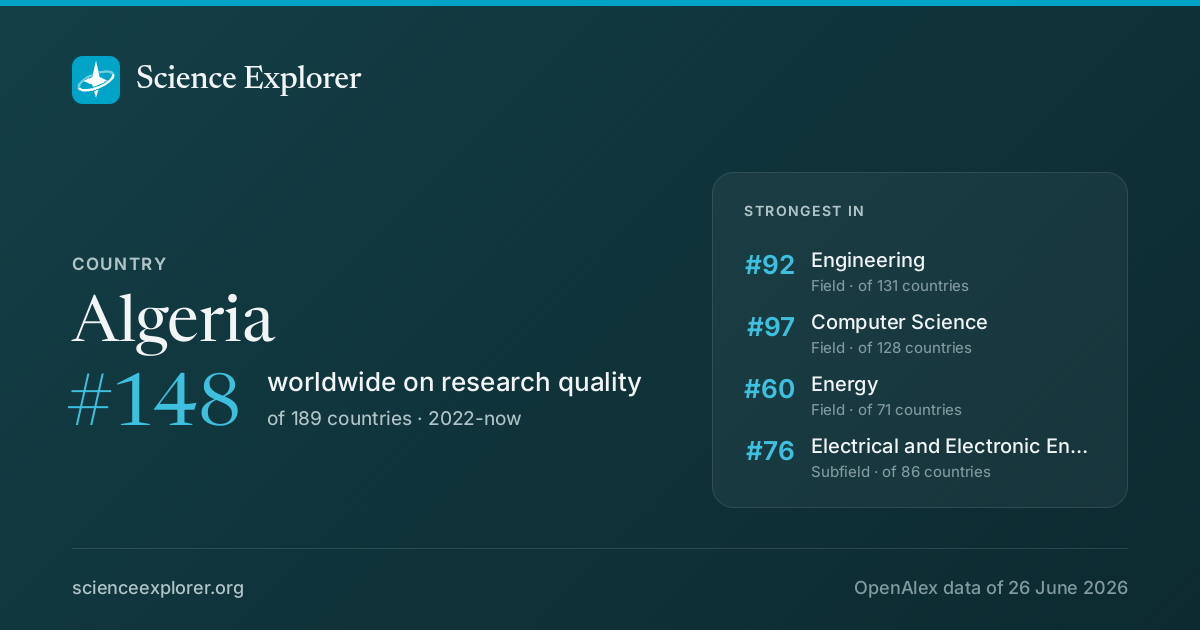
Badges for a website1Each links back here and updates with every snapshot

Research fields in Algeria
- Physical Sciences
- Engineering
- Computer Science
- Energy
- Electrical and Electronic Engineering
- Renewable Energy, Sustainability and the Environment
- Physics and Astronomy
- Environmental Science
- Mechanical Engineering
- Mathematics
- Control and Systems Engineering
- Artificial Intelligence
- Computer Vision and Pattern Recognition
- Archeology
- Materials Science
- Materials Chemistry
- Life Sciences
- Aerospace Engineering
- Social Sciences
- Agricultural and Biological Sciences
- Medicine
- Health Sciences
- Biochemistry, Genetics and Molecular Biology
- Civil and Structural Engineering
- Social Sciences
- Arts and Humanities
- Earth and Planetary Sciences
- Political Science and International Relations
- Sociology and Political Science
Discussion
Ask a question or share a note about Algeria. Posts are plain text and can be reported.