Charles University

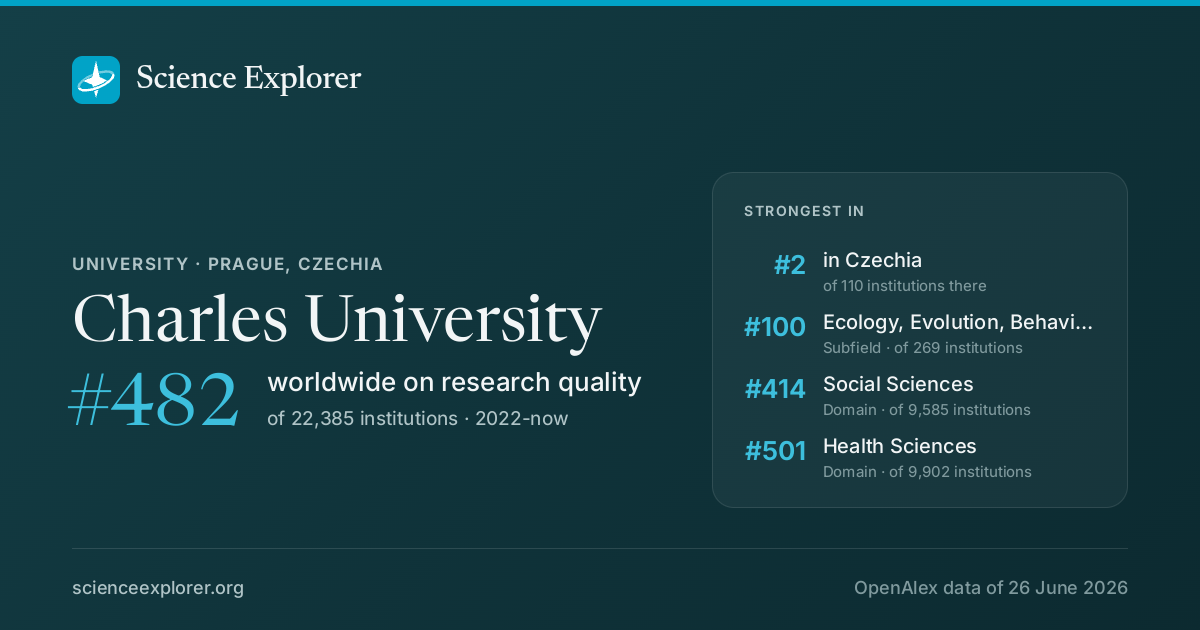
In research, Charles University stands highest in Social Sciences (#414 of 9,585 worldwide), Health Sciences (#501 of 9,902 worldwide) and Medicine (#445 of 8,541 worldwide), 2022-now. Relative to its size it is most specialised in Discrete Mathematics and Combinatorics, Algebra and Number Theory and Geometry and Topology (Discrete Mathematics and Combinatorics is 6.5× its share of world research).
- World rank, 2022-now
- #482 of 22,385 · #602 all time
- Rank in Czechia
- #2 of 110
- Research works
- 61k ▲ 2% vs 2018-21
- Citations
- 1M 16.6 per fractional work
- Top-10% rate
- 9.7% all institutions 10.0%
- vs its own fields
- 0.89× 1.00× is exactly expected
- Open access
- 40% world 40%
- International
- 28% world 18%
What is Charles University known for in research?
The fields where it stands highest, 2022-now, ranked among every institution above the floor in each field.
| Field | World rank | Where that sits | Top-10% rate | Works | All time |
|---|---|---|---|---|---|
| Social SciencesDomain | #414 of 9,585 | 11.3% | 2,408 | #519 | |
| Health SciencesDomain | #501 of 9,902 | 11.4% | 2,534 | #752 | |
| MedicineField | #445 of 8,541 | 11.4% | 2,311 | #658 | |
| Physical SciencesDomain | #655 of 10,670 | 7.4% | 3,202 | #601 | |
| Social SciencesField | #489 of 5,988 | 11.5% | 1,292 | #486 | |
| Life SciencesDomain | #569 of 6,403 | 9.4% | 1,573 | #741 | |
| Agricultural and Biological SciencesField | #393 of 3,157 | 11.0% | 333 | #405 | |
| Arts and HumanitiesField | #293 of 1,896 | 12.1% | 447 | #449 | |
| EngineeringField | #931 of 5,901 | 7.6% | 545 | #808 | |
| Biochemistry, Genetics and Molecular BiologyField | #479 of 2,964 | 9.8% | 788 | #665 |
Each strip is that field's whole ranked pool, with the notch where Charles University sits in it, in the colour of the band that rank falls in. The track under the rate is the rate itself: it carries no average mark, because the average differs by field (from about 6% in Dentistry to 21% in Economics).
Which of those standings moved
The same fields on both windows: where it stood over the whole record, and where it stands in 2022-now. The distance is the story, and it is the one thing the two rank columns above cannot show.
- Social Sciences#519 #414
- Health Sciences#752 #501
- Medicine#658 #445
- Physical Sciences#601 #655
- Social Sciences#486 #489
- Life Sciences#741 #569
- Agricultural and Biological Sciences#405 #393
- Arts and Humanities#449 #293
- Engineering#808 #931
- Biochemistry, Genetics and Molecular Biology#665 #479
A dot further right is a better standing. Fields it was not ranked in over the whole record are left out.
Which fields of science does Charles University work in?
In 2022-now, 33% of research at Charles University is in Physical Sciences, 26% in Health Sciences. Its largest fields are Medicine (24%), Social Sciences (13%), Biochemistry, Genetics and Molecular Biology (8%). It does 1.3× the world's share of Life Sciences.
Each ring splits the one inside it: the four domains of science, their fields, their subfields. Size is fractional works in 2022-now. Every slice is a page; the interactive view zooms down to single topics and colours each by how much more of it this institution does than the world.
Its 4 domains and 26 fields, with their numbers
- Physical Sciences3,65233.0%
- Computer Science6806.1%
- Engineering6045.5%
- Physics and Astronomy5374.8%
- Environmental Science4824.4%
- Mathematics3443.1%
- Materials Science3383.1%
- Chemistry3192.9%
- Earth and Planetary Sciences2652.4%
- Energy530.5%
- Chemical Engineering300.3%
- Health Sciences2,87225.9%
- Medicine2,62223.7%
- Health Professions1631.5%
- Nursing430.4%
- Dentistry310.3%
- Veterinary130.1%
- Social Sciences2,72124.6%
- Social Sciences1,47313.3%
- Arts and Humanities5004.5%
- Psychology3523.2%
- Economics, Econometrics and Finance2021.8%
- Business, Management and Accounting1171.1%
- Decision Sciences780.7%
- Life Sciences1,82916.5%
What does Charles University specialise in?
Where its research is concentrated relative to its size: Discrete Mathematics and Combinatorics takes 6.5× the share of its output that it takes of world research.
- Discrete Mathematics and CombinatoricsSubfield · 28.7 works6.5×
- Algebra and Number TheorySubfield · 37.1 works5.2×
- Geometry and TopologySubfield · 78.7 works4.4×
- PaleontologySubfield · 49.2 works3.7×
- Computational Theory and MathematicsSubfield · 172.5 works3.6×
- Astronomy and AstrophysicsSubfield · 193.6 works3.4×
- Mathematical PhysicsSubfield · 58.2 works3.3×
Location quotient, a volume reading rather than an impact one. It surfaces small, lopsided specialities.
Field profile
Location quotient across every field it publishes in: outside the ring is more than an institution of this size would be expected to publish, inside it is less.
Rings at 0.5×, 1× and 2×. Widest outward: Mathematics, 2.6×. Every wedge is a field page.
All 26 fields, with their numbers
- Mathematics2.64×344 works
- Physics and Astronomy2.18×537 works
- Chemistry1.83×319 works
- Neuroscience1.68×302 works
- Arts and Humanities1.56×500 works
- Biochemistry, Genetics and Molecular Biology1.54×911 works
- Immunology and Microbiology1.53×171 works
- Earth and Planetary Sciences1.53×265 works
- Medicine1.23×2,622 works
- Pharmacology, Toxicology and Pharmaceutics1.21×47 works
- Social Sciences1.05×1,472 works
- Psychology1.04×352 works
- Environmental Science0.88×482 works
- Materials Science0.88×338 works
- Veterinary0.86×13 works
- Economics, Econometrics and Finance0.85×202 works
- Computer Science0.79×680 works
- Nursing0.79×43 works
- Chemical Engineering0.78×30 works
- Agricultural and Biological Sciences0.76×398 works
- Decision Sciences0.73×78 works
- Dentistry0.58×31 works
- Health Professions0.56×163 works
- Energy0.52×53 works
- Engineering0.36×604 works
- Business, Management and Accounting0.33×117 works
- Mathematics 2.6×
- Physics and Astronomy 2.2×
- Chemistry 1.8×
- Neuroscience 1.7×
- Arts and Humanities 1.6×
- Biochemistry, Genetics and Molecular Biology 1.5×
- Immunology and Microbiology 1.5×
- Earth and Planetary Sciences 1.5×
- Medicine 1.2×
- Pharmacology, Toxicology and Pharmaceutics 1.2×
- Social Sciences 1.1×
- Psychology 1.0×
- Environmental Science 0.9×
- Materials Science 0.9×
- Veterinary 0.9×
- Economics, Econometrics and Finance 0.8×
- Computer Science 0.8×
- Nursing 0.8×
- Chemical Engineering 0.8×
- Agricultural and Biological Sciences 0.8×
- Decision Sciences 0.7×
- Dentistry 0.6×
- Health Professions 0.6×
- Energy 0.5×
- Engineering 0.4×
- Business, Management and Accounting 0.3×
Who are the top researchers at Charles University?
Ranked on the quality score, Jitka Palich Fucikova, M. Finger and M. Zeman lead among researchers whose main affiliation is Charles University.
- 1
Jitka Palich Fucikova
 Czechia · #12,064 worldwide
11k citations · 150 works
- 2
M. Finger
Czechia · #16,923 worldwide
44k citations · 604 works
- 3
M. Zeman
Czechia · #22,568 worldwide
43k citations · 517 works
- 4
M. H. Finger
Czechia · #30,600 worldwide
105k citations · 1,575 works
- 5
Matyáš Fendrych
Czechia · #34,288 worldwide
3.9k citations · 93 works
- 6
Petr Kohout
Czechia · #38,001 worldwide
14k citations · 140 works
- 7
Ladislav Krištoufek
Czechia · #38,657 worldwide
8.8k citations · 190 works
- 8
J. Marco
Czechia · #50,994 worldwide
5.3k citations · 77 works
- 9
Tomáš Havránek
Czechia · #52,381 worldwide
6.1k citations · 253 works
- 10
Jan Bělohlávek
Czechia · #55,163 worldwide
25k citations · 423 works
Which keywords describe research at Charles University?
By fractional works in 2022-now, weighted toward what it does more of than the world: Epidemiology, Climate Change, Inflammation, Identity, Invasive Species, Oxidative Stress, Globalization and Biodiversity.
- Post-Communist
- Algorithmic Applications
- Educational Methods
- Learning Environments
- Authoritarianism
- Approximation Algorithms
- Digital Education
- Evolution
- Phylogenetic Analysis
- Genetic Mutations
- Catalysis
- Neurological Disorders
- Chemotherapy
- Ethics
- Cardiovascular Disease
- Treatment
- Identity
- Cancer
- Globalization
- Climate Change
- Epidemiology
- Inflammation
- Oxidative Stress
- Human Rights
- Biodiversity
- Social Media
- Invasive Species
- Diagnosis
- Nationalism
- Religion
- Prognostic Factors
- Biogeography
- Global Change
- Habitat Fragmentation
- Cultural History
- School Climate
- Transition
- Student Attitudes
- Pedagogical Research
- Dissent
Size is fractional works in 2022-now in the topics tagged with each word; colour is the word's share of this institution's work against its share of the world's. The 40 words are chosen for being large and distinctive. Each links to the topic it comes from most.
All 40 words, with their numbers
- Epidemiology493◆ 1.12×129 topics
- Climate Change350▲ 1.16×98 topics
- Inflammation275▲ 1.17×83 topics
- Globalization238◆ 1.09×113 topics
- Oxidative Stress221▲ 1.21×62 topics
- Cancer181▲ 1.21×59 topics
- Human Rights174▲ 1.54×64 topics
- Identity174▲ 2.2×61 topics
- Biodiversity156▲ 1.85×36 topics
- Treatment156▲ 1.16×51 topics
- Social Media149◆ 0.97×28 topics
- Cardiovascular Disease143◆ 1.13×39 topics
- Invasive Species135▲ 2.9×21 topics
- Ethics126▲ 2.2×49 topics
- Diagnosis124▲ 1.20×40 topics
- Chemotherapy123▲ 1.57×24 topics
- Nationalism119▲ 2.4×28 topics
- Neurological Disorders117▲ 1.86×20 topics
- Religion112▲ 2.2×36 topics
- Catalysis110▲ 1.49×29 topics
- Prognostic Factors101▲ 2.1×14 topics
- Genetic Mutations95▲ 1.97×23 topics
- Biogeography86▲ 2.8×20 topics
- Phylogenetic Analysis85▲ 2.5×16 topics
- Global Change82▲ 2.8×6 topics
- Evolution77▲ 2.6×19 topics
- Habitat Fragmentation75▲ 3.1×5 topics
- Digital Education67▲ 4.1×6 topics
- Cultural History66▲ 4.9×11 topics
- Approximation Algorithms66▲ 8.0×5 topics
- School Climate65▲ 12×3 topics
- Authoritarianism64▲ 6.5×5 topics
- Transition64▲ 6.5×6 topics
- Learning Environments62▲ 19×3 topics
- Student Attitudes62▲ 5.5×2 topics
- Educational Methods61▲ 98×1 topic
- Pedagogical Research61▲ 98×1 topic
- Algorithmic Applications50▲ 13×2 topics
- Dissent49▲ 23×1 topic
- Post-Communist49▲ 23×1 topic
Which research topics does Charles University publish most on?
By volume in 2022-now: Education, Psychology, and Social Research, Eastern European Communism and Reforms, Natural Language Processing Techniques and Advanced Graph Theory Research.
Area is fractional works; colour is the subfield each topic belongs to.
- 1 Education, Psychology, and Social Research Education 61 works
- 2 Eastern European Communism and Reforms Sociology and Political Science 49 works
- 3 Natural Language Processing Techniques Artificial Intelligence 40 works
- 4 Advanced Graph Theory Research Computational Theory and Mathematics 36 works
- 5 Plant and animal studies Ecology, Evolution, Behavior and Systematics 32 works
- 6 Black Holes and Theoretical Physics Nuclear and High Energy Physics 31 works
- 7 Cosmology and Gravitation Theories Astronomy and Astrophysics 28 works
- 8 Sports Performance and Training Orthopedics and Sports Medicine 26 works
- 9 Topic Modeling Artificial Intelligence 26 works
- 10 Ecology and Vegetation Dynamics Studies Nature and Landscape Conservation 24 works
How open and international is its research?
Against the world's own shares: the tick on each track. Both are shares of its output, so they sit on one scale and can be read against each other as well as against the world.
World: 40% of research is openly available.
World: 18% is written across borders.
How has Charles University's research output changed?
Output in 2022-2025 was 2% higher than in 2018-2021.
The same series as a ribbon: one cell per year, darker for more. The line above answers how much; this answers when.
Its share of all research
Growing output can still be a shrinking share: all of science grows. This is Charles University as a percentage of every work published that year, 0.042% in 2024.
Fractional works of Charles University over all fractional works that year. How the balance of science has shifted.
How much of it reaches the world top 10%
Year by year, against all institutions in the same year.
Of each year's output, the share that reached the world's 10% most cited for its field and year. Peak 10.0% in 2025.
Other research institutions in Prague
- Czech Academy of Sciences
- Czech Technical University in Prague
- University of Chemistry and Technology, Prague
- Czech University of Life Sciences Prague
- Prague University of Economics and Business
- Institute of Endocrinology
- Gender Studies
- Institute of Clinical and Experimental Medicine



Compare Charles University with
- vs
 University of Potsdam
- vs
 University of Milano-Bicocca
- vs
 Nanjing University of Aeronautics and Astronautics
- vs
 Academia Sinica
- vs
 Duke Medical Center
- vs Huazhong Agricultural University
Share Charles University's ranking



Research measures only: rankings here say nothing about teaching, admissions or student experience. Comparable institutions and collaboration partners have tabs of their own, above.
Discussion
Ask a question or share a note about Charles University. Keep it to the research: no personal attacks, advertising or links. Any reader can report a post, which collapses it for everyone until it is opened.