 Science in Finland
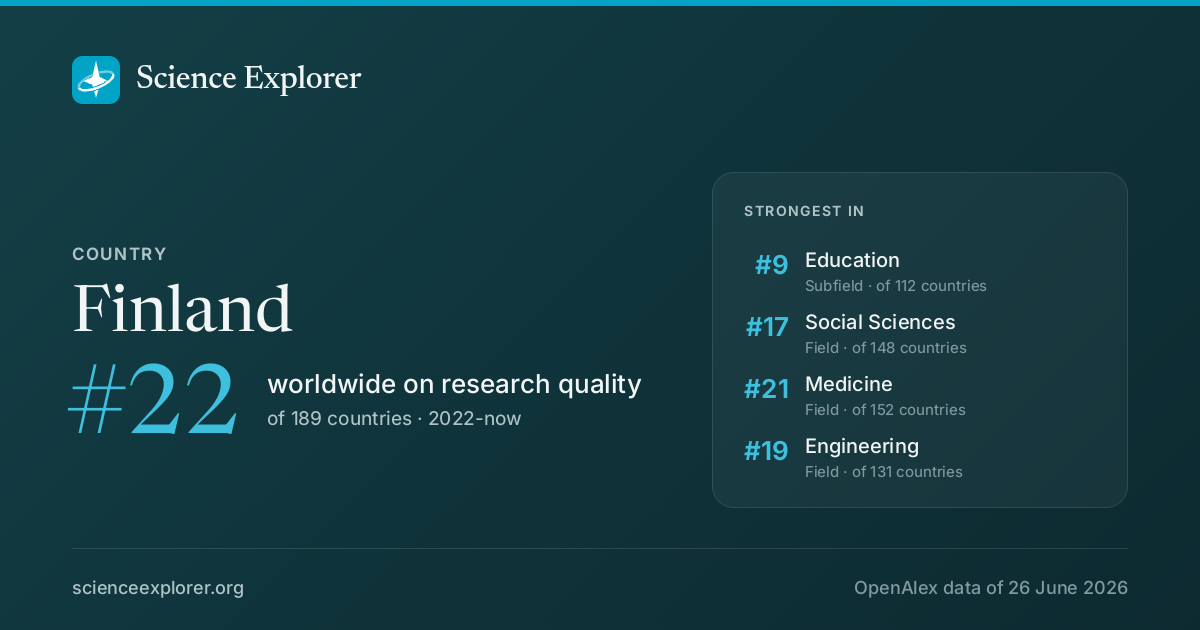
Finland ranks #22 of 189 countries on research quality in 2022-now (#22 all time), with 70k research works and 12.9% of them in the world's top 10%.
- World rank, 2022-now
- #22 of 189 · #22 all time
- Works, 2022-now
- 70k ◆ 2% vs 2018-21
- Citations
- 12.4M 27.6 per fractional work, all time
- Top-10% rate
- 12.9% all institutions 10.0%
- vs its own fields
- 1.21× 1.00× is exactly expected
- In the world top 100
- 0 8 in the top 1,000
- Open access
- 43% world 40%
- International
- 26% world 18%
FinlandWhat is Finland strongest at in science?
On research quality in 2022-now, Finland ranks highest in Education (#9 of 112), Social Sciences (#17 of 148) and Medicine (#21 of 152). Relative to its size it is most specialised in Public Administration, Research and Theory and Music.
| Field | World rank | Where that sits | Top-10% rate | Works | All time | Institutions |
|---|---|---|---|---|---|---|
| EducationSubfield | #9 of 112 | 11.2% | 4,183 | #10 | Institutions | |
| Social SciencesField | #17 of 148 | 13.4% | 12,639 | #21 | Institutions | |
| MedicineField | #21 of 152 | 13.5% | 10,826 | #21 | Institutions | |
| EngineeringField | #19 of 131 | 11.6% | 9,059 | #22 | Institutions | |
| Business, Management and AccountingField | #16 of 110 | 17.1% | 2,804 | #17 | Institutions | |
| PsychologyField | #16 of 106 | 13.8% | 3,480 | #17 | Institutions | |
| Computer ScienceField | #20 of 128 | 13.0% | 5,459 | #20 | Institutions | |
| Sociology and Political ScienceSubfield | #19 of 119 | 15.2% | 3,261 | #21 | Institutions | |
| Arts and HumanitiesField | #18 of 103 | 15.0% | 2,954 | #21 | Institutions | |
| Agricultural and Biological SciencesField | #22 of 124 | 14.0% | 2,058 | #21 | Institutions | |
| Environmental ScienceField | #22 of 122 | 12.4% | 4,269 | #23 | Institutions | |
| Strategy and ManagementSubfield | #14 of 77 | 17.5% | 816 | #17 | Institutions |
Where its research is concentrated
Location quotient: how much more (or less) of each node it does than its size predicts. Drawn around 1×, where "twice the world share" and "half of it" are the same distance apart in opposite directions. A volume reading, which on a country axis is largely population and industrial structure.
- Public AdministrationSubfield · 177.1 works · #19 of 186 active here4.1×
- Research and TheorySubfield · 72.2 works · #23 of 183 active here3.5×
- MusicSubfield · 187.6 works · #25 of 174 active here2.9×
- Human-Computer InteractionSubfield · 467.9 works · #23 of 193 active here2.8×
- CommunicationSubfield · 458.2 works · #34 of 204 active here2.1×
- Issues, ethics and legal aspectsSubfield · 34.2 works · #27 of 172 active here2.1×
- Atmospheric ScienceSubfield · 719.5 works · #22 of 217 active here2.0×
- EquineSubfield · 20.9 works · #31 of 135 active here2.0×
The whole field profile
All 26 fields at once. A specialist and a generalist produce the same ranked list and a completely different shape.
Rings at 0.5×, 1× and 2×. Widest outward: Psychology, 1.6×. Every wedge is a field page.
All 26 fields, with their numbers
- Psychology1.64×4,014 works
- Arts and Humanities1.42×3,287 works
- Social Sciences1.40×14k works
- Veterinary1.27×138 works
- Environmental Science1.26×5,019 works
- Health Professions1.23×2,603 works
- Decision Sciences1.21×940 works
- Business, Management and Accounting1.20×3,110 works
- Earth and Planetary Sciences1.12×1,412 works
- Dentistry1.12×434 works
- Neuroscience1.11×1,443 works
- Physics and Astronomy1.06×1,892 works
- Computer Science1.01×6,263 works
- Nursing0.89×348 works
- Mathematics0.88×832 works
- Biochemistry, Genetics and Molecular Biology0.86×3,688 works
- Engineering0.85×10k works
- Chemical Engineering0.84×235 works
- Medicine0.81×12k works
- Economics, Econometrics and Finance0.79×1,360 works
- Energy0.74×544 works
- Materials Science0.70×1,958 works
- Immunology and Microbiology0.68×548 works
- Agricultural and Biological Sciences0.63×2,392 works
- Chemistry0.59×747 works
- Pharmacology, Toxicology and Pharmaceutics0.51×143 works
Which fields of science does Finland work in?
In 2022-now, 36% of research in Finland is in Physical Sciences, 34% in Social Sciences. Its largest fields are Social Sciences (18%), Medicine (15%), Engineering (13%). It does 1.4× the world's share of Social Sciences.
Each ring splits the one inside it: the four domains of science, their fields, their subfields. Size is fractional works in 2022-now. Every slice is a page; the interactive view zooms down to single topics and colours each by how much more of it this country does than the world.
Its 4 domains and 26 fields, with their numbers
- Physical Sciences29k36.3%
- Engineering10k12.7%
- Computer Science6,2637.8%
- Environmental Science5,0196.3%
- Materials Science1,9582.4%
- Physics and Astronomy1,8922.4%
- Earth and Planetary Sciences1,4121.8%
- Mathematics8321.0%
- Chemistry7470.9%
- Energy5440.7%
- Chemical Engineering2350.3%
- Social Sciences27k33.5%
- Social Sciences14k17.7%
- Psychology4,0145.0%
- Arts and Humanities3,2874.1%
- Business, Management and Accounting3,1113.9%
- Economics, Econometrics and Finance1,3601.7%
- Decision Sciences9401.2%
- Health Sciences16k19.9%
- Medicine12k15.5%
- Health Professions2,6033.2%
- Dentistry4340.5%
- Nursing3480.4%
- Veterinary1380.2%
- Life Sciences8,21410.3%
- Biochemistry, Genetics and Molecular Biology3,6894.6%
- Agricultural and Biological Sciences2,3923.0%
- Neuroscience1,4431.8%
- Immunology and Microbiology5480.7%
- Pharmacology, Toxicology and Pharmaceutics1430.2%
Which keywords describe research in Finland?
By fractional works in 2022-now, weighted toward what it does more of than the world: Ethics, Communication, Pedagogy, Social Sciences, Phenomenology, Family Dynamics, Work Environment and Qualitative Research.
- Participatory Design
- Physical Activity
- Social Interaction
- Social Capital
- Identity
- Depression
- Remote Sensing
- Artificial Intelligence
- Quality of Life
- Renewable Energy
- Environmental Impact
- Inflammation
- Globalization
- Machine Learning
- Family Dynamics
- Phenomenology
- Epidemiology
- Pedagogy
- Climate Change
- Healthcare
- Education
- Ethics
- Qualitative Research
- Communication
- Social Sciences
- Sustainability
- Work Environment
- Deep Learning
- Mental Health
- Public Health
- Cardiovascular Disease
- Social Media
- Big Data
- Energy Efficiency
- Innovation
- Biodiversity
- Health Effects
- Well-being
- Biodiversity Conservation
- Neoliberalism
Size is fractional works in 2022-now in the topics tagged with each word; colour is the word's share of this country's work against its share of the world's. The 40 words are chosen for being large and distinctive. Each links to the topic it comes from most.
All 40 words, with their numbers
- Education3,577▲ 2.6×146 topics
- Healthcare3,177▲ 3.5×41 topics
- Ethics3,174▲ 7.8×57 topics
- Climate Change3,133▲ 1.44×128 topics
- Qualitative Research2,935▲ 4.3×42 topics
- Pedagogy2,767▲ 6.9×30 topics
- Communication2,716▲ 11×23 topics
- Epidemiology2,620▼ 0.82×140 topics
- Social Sciences2,571▲ 22×19 topics
- Phenomenology2,562▲ 30×5 topics
- Sustainability2,451▲ 1.25×130 topics
- Family Dynamics2,440▲ 24×8 topics
- Work Environment2,421▲ 171×2 topics
- Machine Learning2,389◆ 0.90×94 topics
- Deep Learning2,063▼ 0.75×84 topics
- Globalization1,975▲ 1.25×175 topics
- Mental Health1,474▲ 1.29×47 topics
- Inflammation1,451▼ 0.85×83 topics
- Public Health1,335◆ 1.14×74 topics
- Environmental Impact1,291◆ 0.94×70 topics
- Cardiovascular Disease1,212▲ 1.33×39 topics
- Renewable Energy1,211◆ 1.04×59 topics
- Social Media1,105◆ 1.00×41 topics
- Quality of Life1,084◆ 0.94×61 topics
- Big Data1,031▲ 1.35×36 topics
- Artificial Intelligence1,017◆ 0.89×63 topics
- Energy Efficiency881▲ 1.19×45 topics
- Remote Sensing880◆ 0.90×42 topics
- Innovation865◆ 1.05×84 topics
- Depression810◆ 1.15×25 topics
- Biodiversity752▲ 1.23×38 topics
- Identity708▲ 1.22×75 topics
- Health Effects691▲ 1.42×24 topics
- Social Capital686▲ 1.65×21 topics
- Well-being637▲ 2.0×14 topics
- Social Interaction628▲ 2.0×11 topics
- Biodiversity Conservation609▲ 2.0×22 topics
- Physical Activity603▲ 1.55×13 topics
- Neoliberalism593▲ 2.1×29 topics
- Participatory Design281▲ 6.6×2 topics
Which research topics does Finland publish the most in?
Its largest topics in 2022-now are Research in Social Sciences, Ethics and Social Impacts of AI, Sustainable Supply Chain Management.
Area is fractional works in 2022-now; colour is the subfield each topic belongs to. Every tile is a topic page.
- 1 Research in Social Sciences Education 2.4k works
- 2 Ethics and Social Impacts of AI Safety Research 192 works
- 3 Sustainable Supply Chain Management Strategy and Management 181 works
- 4 Workplace Health and Well-being General Health Professions 164 works
- 5 Employment and Welfare Studies General Health Professions 162 works
- 6 Digital Transformation in Industry Industrial and Manufacturing Engineering 160 works
- 7 Management and Organizational Studies Organizational Behavior and Human Resource Management 157 works
- 8 Atmospheric chemistry and aerosols Atmospheric Science 156 works
- 9 Historical Legal Studies and Society Political Science and International Relations 153 works
- 10 Sustainability and Climate Change Governance Global and Planetary Change 149 works
- 11 Early Childhood Education and Development Education 149 works
- 12 Social Media and Politics Communication 147 works
How many world-class institutions does Finland hold?
Average quality and elite capacity disagree by construction, and both are worth knowing: the first is decided by a country's whole institution population, the second counts the institutions it holds at the top. One square per institution.
| Standing among countries | 2022-now | Where that sits | All time |
|---|---|---|---|
| Average qualityits whole institution population | #22 of 189 | #22 of 203 | |
| Elite capacitythe institutions it holds at the top | #22 of 204 | #21 of 216 |
Elite capacity counts a country's institutions by their worldwide rank, weighted so a place at #1 counts for more than one at #480. Countries under 100 fractional works are left out.
Bands are exclusive, so the squares add up to 8 (the institutions it holds in the world top 1,000), not to four times it.
Which universities in Finland lead research?
University of Helsinki, Aalto University and University of Oulu rank highest in Finland on research quality in 2022-now.
One dot per institution in the list below. The upper left is the interesting corner.
- 1University of HelsinkiUniversity · Helsinki · #131 worldwide13.2% top 10% · 15k works
- 2Aalto UniversityUniversity · Espoo · #309 worldwide13.6% top 10% · 6.2k works
- 3University of OuluUniversity · Oulu · #377 worldwide14.8% top 10% · 5.7k works
- 4University of TurkuUniversity · Turku · #434 worldwide12.1% top 10% · 6.9k works
- 5Tampere UniversityUniversity · Tampere · #453 worldwide12.8% top 10% · 6.4k works
- 6University of JyväskyläUniversity · Jyväskylä · #540 worldwide13.9% top 10% · 3.7k works
- 7Lappeenranta-Lahti University of TechnologyUniversity · Lappeenranta · #654 worldwide16.2% top 10% · 2.1k works
- 8University of Eastern FinlandUniversity · Joensuu · #666 worldwide13.4% top 10% · 4.5k works
- 9Finnish Institute for Health and WelfareFunder · Helsinki · #1,155 worldwide13.9% top 10% · 828 works
- 10University of VaasaUniversity · Vaasa · #1,160 worldwide18.9% top 10% · 1.1k works
- 11Åbo Akademi UniversityUniversity · Turku · #1,309 worldwide12.0% top 10% · 1.9k works
- 12VTT Technical Research Centre of FinlandNonprofit · Espoo · #1,427 worldwide11.2% top 10% · 1.4k works
- 13Nokia (Finland)Company · Espoo · #1,831 worldwide10.7% top 10% · 1.2k works
- 14Turku University of Applied SciencesUniversity · Turku · #2,411 worldwide10.9% top 10% · 401 works
- 15Tampere University of Applied SciencesUniversity · Tampere · #2,914 worldwide10.3% top 10% · 419 works




The track on each row is its top-10% rate; the tick is the average of all institutions, 10.0% (how it is set): teal above it, red below.
All ranked institutions in FinlandWho are the top researchers in Finland?
M. Linden-Vørnle, Tuomo J Meretoja and A.-S. Suur-Uski rank highest among researchers based in Finland.
- 1 M. Linden-Vørnle #1,674 worldwide 57k citations · 184 works
- 2 Tuomo J Meretoja #1,759 worldwide 178k citations · 247 works
- 3 A.-S. Suur-Uski #2,517 worldwide 77k citations · 200 works
- 4 Atte Meretoja #3,853 worldwide 208k citations · 270 works
- 5 Samuli Ripatti #3,897 worldwide 92k citations · 730 works
- 6 Christian Breyer #4,067 worldwide 29k citations · 398 works
- 7 Kari K. Alitalo #4,302 worldwide 127k citations · 1,079 works
- 8 Andrea Ganna #4,634 worldwide 41k citations · 312 works
- 9 Paavo Ritala #4,690 worldwide 15k citations · 273 works
- 10 G. Roudier #4,973 worldwide 53k citations · 115 works
Which cities in Finland are research hubs?
- 1
HelsinkiFinland
173k works
- 2
TurkuFinland
61k works
- 3
EspooFinland
54k works
- 4
OuluFinland
39k works
- 5
TampereFinland
29k works
- 6
JyvaskylaFinland
24k works
- 7
JoensuuFinland
24k works
How much of it is in the largest
The same cities as shares of everything these twelve account for.
Shares of the rows listed above, not of the whole node.
How open and international is Finland's research?
43% of its research is openly available (world: 40%), and 26% is written with international co-authors (world: 18%).
World: 40% of research is openly available.
World: 18% is written across borders.
In 2022-now, 78% of its research is openly available (world 63%) and 36% is written with co-authors abroad (world 22%). Against what its own mix of topics predicts, that is 1.27× the expected open access and 1.58× the expected international share, which puts it #9 of 173 countries on openness.
How has Finland's research grown?
Output in 2022-2025 was 2% higher than in 2018-2021.
The same series as a ribbon: one cell per year, darker for more. The line above answers how much; this answers when.
Its share of all research
Growing output can still be a shrinking share: all of science grows. This is Finland as a percentage of every work published that year, 0.31% in 2024.
Fractional works of Finland over all fractional works that year. How the balance of science has shifted.
How much of it reaches the world top 10%
Over the whole record, 12.1% of its 449k works since 1950 reached the world top 10% for their field and year.
Of each year's output, the share that reached the world's 10% most cited for its field and year. Peak 13.6% in 2022.
Which countries have research most like Finland's?
Norway is Finland's closest research twin: of all countries, its research is spread across the fields most like Finland's, with both strong in Psychology.
- 1
 NorwayBoth strong in Psychology, Arts and Humanities, Environmental Science
0.79 Compare
- 2
 ChileBoth strong in Psychology, Arts and Humanities, Social Sciences
0.71 Compare
- 3
 United KingdomBoth strong in Psychology, Arts and Humanities, Veterinary
0.70 Compare
- 4
 SwedenBoth strong in Psychology, Veterinary, Health Professions
0.69 Compare
- 5
 PortugalBoth strong in Arts and Humanities, Psychology, Veterinary
0.67 Compare
Similarity is the correlation of each side's location quotients across every field it publishes in, on a log scale: 1 is the same shape of research, 0 is unrelated. It ignores size. How it is measured.
Compare Finland with
 Poland
 Israel
 Taiwan
 Belgium
 New Zealand
Share Finland's ranking



Research fields in Finland
- Education
- Social Sciences
- Social Sciences
- Health Sciences
- Medicine
- Physical Sciences
- Life Sciences
- Engineering
- Business, Management and Accounting
- Psychology
- Computer Science
- Sociology and Political Science
- Arts and Humanities
- Agricultural and Biological Sciences
- Environmental Science
- Strategy and Management
- Information Systems
- Political Science and International Relations
- Biochemistry, Genetics and Molecular Biology
- Health Professions
- General Health Professions
- Language and Linguistics
- Materials Science
- Electrical and Electronic Engineering
- Economics, Econometrics and Finance
- Artificial Intelligence
- Computer Networks and Communications
- Developmental and Educational Psychology
- Clinical Psychology
- Economics and Econometrics
- Epidemiology
- Public Health, Environmental and Occupational Health
- Molecular Biology
- Decision Sciences
- Surgery
- Mechanical Engineering
- Social Psychology
- Pediatrics, Perinatology and Child Health
- Literature and Literary Theory
- Ecology
- Nursing
- Plant Science
- Energy
- Mathematics
- Aerospace Engineering
- Building and Construction
- Immunology and Microbiology
- Biomedical Engineering
- Earth and Planetary Sciences
- Computer Vision and Pattern Recognition
- Physics and Astronomy
- Ecology, Evolution, Behavior and Systematics
- Neuroscience
- Genetics
- Cardiology and Cardiovascular Medicine
- Global and Planetary Change
- Physiology
- Automotive Engineering
- Pulmonary and Respiratory Medicine
- Oncology
Questions people ask
What is Finland strongest at in science?
On research quality in 2022-now, Finland ranks highest in Education (#9 of 112), Social Sciences (#17 of 148) and Medicine (#21 of 152). Relative to its size it is most specialised in Public Administration, Research and Theory and Music.
See the full answerDiscussion
Ask a question or share a note about Finland. Keep it to the research: no personal attacks, advertising or links. Any reader can report a post, which collapses it for everyone until it is opened.