Université Mohammed VI Polytechnique

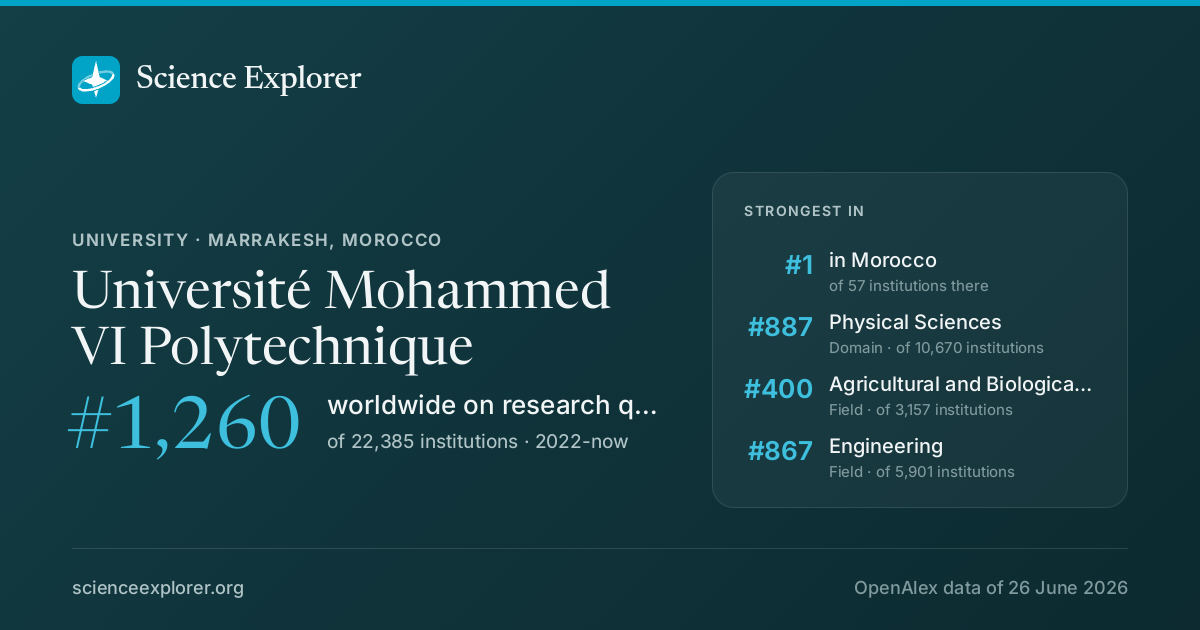
In research, Université Mohammed VI Polytechnique stands highest in Physical Sciences (#887 of 10,670 worldwide), Agricultural and Biological Sciences (#400 of 3,157 worldwide) and Engineering (#867 of 5,901 worldwide), 2022-now. Relative to its size it is most specialised in Soil Science, Water Science and Technology and Biomaterials (Soil Science is 5.7× its share of world research).
- World rank, 2022-now
- #1,260 of 22,385 · #1,668 all time
- Rank in Morocco
- #1 of 57
- Research works
- 2.9k ▲ 238% vs 2018-21
- Citations
- 36k 12.5 per fractional work
- Top-10% rate
- 16.4% all institutions 10.0%
- vs its own fields
- 1.47× 1.00× is exactly expected
- Open access
- 49% world 40%
- International
- 51% world 18%
What is Université Mohammed VI Polytechnique known for in research?
The fields where it stands highest, 2022-now, ranked among every institution above the floor in each field.
| Field | World rank | Where that sits | Top-10% rate | Works | All time |
|---|---|---|---|---|---|
| Physical SciencesDomain | #887 of 10,670 | 15.4% | 1,186 | #1136 | |
| Agricultural and Biological SciencesField | #400 of 3,157 | 25.9% | 244 | #651 | |
| EngineeringField | #867 of 5,901 | 14.2% | 425 | #1400 | |
| Life SciencesDomain | #1,005 of 6,403 | 23.8% | 328 | #1485 | |
| Materials ScienceField | #432 of 2,276 | 14.1% | 163 | #805 | |
| Environmental ScienceField | #641 of 3,334 | 18.4% | 219 | #934 | |
| Plant ScienceSubfield | #287 of 1,317 | 24.6% | 124 | #527 | |
| Computer ScienceField | #1,344 of 4,417 | 13.9% | 181 | #1611 | |
| Social SciencesDomain | #3,669 of 9,585 | 14.3% | 199 | #4198 | |
| Mechanical EngineeringSubfield | #601 of 1,319 | 19.2% | 60 | - |
Each strip is that field's whole ranked pool, with the notch where Université Mohammed VI Polytechnique sits in it, in the colour of the band that rank falls in. The track under the rate is the rate itself: it carries no average mark, because the average differs by field (from about 6% in Dentistry to 21% in Economics).
Which of those standings moved
The same fields on both windows: where it stood over the whole record, and where it stands in 2022-now. The distance is the story, and it is the one thing the two rank columns above cannot show.
- Physical Sciences#1,136 #887
- Agricultural and Biological Sciences#651 #400
- Engineering#1,400 #867
- Life Sciences#1,485 #1,005
- Materials Science#805 #432
- Environmental Science#934 #641
- Plant Science#527 #287
- Computer Science#1,611 #1,344
- Social Sciences#4,198 #3,669
A dot further right is a better standing. Fields it was not ranked in over the whole record are left out.
Which fields of science does Université Mohammed VI Polytechnique work in?
In 2022-now, 65% of research at Université Mohammed VI Polytechnique is in Physical Sciences, 18% in Life Sciences. Its largest fields are Engineering (23%), Agricultural and Biological Sciences (14%), Environmental Science (13%). It does 1.7× the world's share of Physical Sciences.
Each ring splits the one inside it: the four domains of science, their fields, their subfields. Size is fractional works in 2022-now. Every slice is a page; the interactive view zooms down to single topics and colours each by how much more of it this institution does than the world.
Its 4 domains and 26 fields, with their numbers
- Physical Sciences1,41765.5%
- Engineering50723.4%
- Environmental Science27112.5%
- Computer Science2079.6%
- Materials Science1949.0%
- Earth and Planetary Sciences663.1%
- Chemistry572.6%
- Energy462.1%
- Physics and Astronomy301.4%
- Mathematics211.0%
- Chemical Engineering170.8%
- Life Sciences39318.1%
- Social Sciences23610.9%
- Social Sciences1074.9%
- Business, Management and Accounting401.9%
- Economics, Econometrics and Finance381.7%
- Decision Sciences200.9%
- Psychology180.8%
- Arts and Humanities130.6%
- Health Sciences1195.5%
- Medicine934.3%
- Health Professions140.7%
- Nursing100.5%
- Dentistry20.1%
- Veterinary00.0%
What does Université Mohammed VI Polytechnique specialise in?
Where its research is concentrated relative to its size: Soil Science takes 5.7× the share of its output that it takes of world research.
- Soil ScienceSubfield · 36.8 works5.7×
- Water Science and TechnologySubfield · 60.9 works5.5×
- BiomaterialsSubfield · 43.0 works4.7×
- Industrial and Manufacturing EngineeringSubfield · 31.8 works4.5×
Location quotient, a volume reading rather than an impact one. It surfaces small, lopsided specialities.
Field profile
Location quotient across every field it publishes in: outside the ring is more than an institution of this size would be expected to publish, inside it is less.
Rings at 0.5×, 1× and 2×. Widest outward: Agricultural and Biological Sciences, 2.9×. Every wedge is a field page.
All 26 fields, with their numbers
- Agricultural and Biological Sciences2.86×294 works
- Materials Science2.57×194 works
- Environmental Science2.52×271 works
- Energy2.33×46 works
- Chemical Engineering2.29×17 works
- Earth and Planetary Sciences1.95×66 works
- Chemistry1.69×57 works
- Engineering1.56×507 works
- Computer Science1.23×207 works
- Decision Sciences0.95×20 works
- Nursing0.92×10 works
- Mathematics0.84×21 works
- Pharmacology, Toxicology and Pharmaceutics0.82×6 works
- Economics, Econometrics and Finance0.82×38 works
- Biochemistry, Genetics and Molecular Biology0.65×75 works
- Physics and Astronomy0.62×30 works
- Business, Management and Accounting0.57×40 works
- Social Sciences0.39×107 works
- Neuroscience0.34×12 works
- Psychology0.28×18 works
- Health Professions0.25×14 works
- Immunology and Microbiology0.24×5 works
- Medicine0.22×93 works
- Arts and Humanities0.21×13 works
- Dentistry0.15×2 works
- Veterinary0.08×0 works
- Agricultural and Biological Sciences 2.9×
- Materials Science 2.6×
- Environmental Science 2.5×
- Energy 2.3×
- Chemical Engineering 2.3×
- Earth and Planetary Sciences 1.9×
- Chemistry 1.7×
- Engineering 1.6×
- Computer Science 1.2×
- Decision Sciences 0.9×
- Nursing 0.9×
- Mathematics 0.8×
- Pharmacology, Toxicology and Pharmaceutics 0.8×
- Economics, Econometrics and Finance 0.8×
- Biochemistry, Genetics and Molecular Biology 0.7×
- Physics and Astronomy 0.6×
- Business, Management and Accounting 0.6×
- Social Sciences 0.4×
- Neuroscience 0.3×
- Psychology 0.3×
- Health Professions 0.2×
- Immunology and Microbiology 0.2×
- Medicine 0.2×
- Arts and Humanities 0.2×
- Dentistry 0.1×
- Veterinary 0.1×
Who are the top researchers at Université Mohammed VI Polytechnique?
Ranked on the quality score, Houssine Sehaqui, Mounir El Achaby and Yassine Taha lead among researchers whose main affiliation is Université Mohammed VI Polytechnique.
- 1
Houssine Sehaqui
 Morocco · #85,875 worldwide
6.6k citations · 98 works
- 2
Mounir El Achaby
Morocco · #105,540 worldwide
6.1k citations · 110 works
- 3
Yassine Taha
Morocco · #123,835 worldwide
3.8k citations · 158 works
- 4
Yassine Ait Brahim
Morocco · #135,852 worldwide
2.3k citations · 125 works
- 5
Jones Alami
Morocco · #157,157 worldwide
7.2k citations · 182 works
- 6
Ayalew H. Assen
Morocco · #160,833 worldwide
3.8k citations · 63 works
- 7
Karim Lyamlouli
Morocco · #238,804 worldwide
2.9k citations · 59 works
- 8
Abdallah Oukarroum
Morocco · #248,787 worldwide
8.7k citations · 145 works
- 9
Hanane Ait Ousaleh
Morocco · #273,196 worldwide
1.1k citations · 54 works
- 10
Mohamed Hamid Salim
Morocco · #276,209 worldwide
1k citations · 40 works
Which keywords describe research at Université Mohammed VI Polytechnique?
By fractional works in 2022-now, weighted toward what it does more of than the world: Machine Learning, Climate Change, Environmental Impact, Remote Sensing, Deep Learning, Lithium-ion Batteries, Nanomaterials and Adsorption.
- Host Recognition
- Water Treatment
- Sustainable Technology
- Rhizosphere Interactions
- Nanostructured Anodes
- Rare Earth Elements
- Battery Technology
- Ecosystem Functioning
- Rechargeable Batteries
- Heavy Metals
- Environmental Impacts
- Mechanical Properties
- Adsorption
- Cathode Materials
- Lithium-ion Batteries
- Nanocomposites
- Biomedical Applications
- Remote Sensing
- Sustainability
- Climate Change
- Machine Learning
- Deep Learning
- Environmental Impact
- Nanomaterials
- Renewable Energy
- Energy Storage
- Neural Networks
- Global Warming
- Energy Efficiency
- Biochar
- Ionic Liquids
- Metal Recovery
- Circular Economy
- Hydrological Modeling
- Wastewater Treatment
- Battery Materials
- Phosphorus
- Biodegradable Polymers
- Nitrogen Fixation
- Wastewater
Size is fractional works in 2022-now in the topics tagged with each word; colour is the word's share of this institution's work against its share of the world's. The 40 words are chosen for being large and distinctive. Each links to the topic it comes from most.
All 40 words, with their numbers
- Machine Learning138▲ 1.91×70 topics
- Climate Change125▲ 2.1×75 topics
- Deep Learning112▲ 1.50×69 topics
- Sustainability89▲ 1.68×58 topics
- Environmental Impact88▲ 2.4×46 topics
- Remote Sensing76▲ 2.9×27 topics
- Nanomaterials70▲ 3.1×20 topics
- Biomedical Applications63▲ 2.5×31 topics
- Renewable Energy58▲ 1.84×37 topics
- Nanocomposites56▲ 3.3×21 topics
- Energy Storage54▲ 3.8×12 topics
- Lithium-ion Batteries52▲ 5.8×4 topics
- Neural Networks45▲ 1.34×32 topics
- Cathode Materials43▲ 5.2×3 topics
- Global Warming41▲ 4.5×12 topics
- Adsorption40▲ 8.8×7 topics
- Energy Efficiency40▲ 2.0×31 topics
- Mechanical Properties38▲ 1.82×30 topics
- Biochar38▲ 10×4 topics
- Environmental Impacts29▲ 5.0×8 topics
- Ionic Liquids28▲ 4.7×10 topics
- Heavy Metals28▲ 5.4×8 topics
- Metal Recovery28▲ 6.7×3 topics
- Rechargeable Batteries28▲ 4.9×2 topics
- Circular Economy27▲ 4.6×8 topics
- Ecosystem Functioning27▲ 6.1×6 topics
- Hydrological Modeling27▲ 5.2×5 topics
- Battery Technology26▲ 4.4×3 topics
- Wastewater Treatment26▲ 4.9×11 topics
- Rare Earth Elements24▲ 7.6×4 topics
- Battery Materials23▲ 6.4×1 topic
- Nanostructured Anodes23▲ 6.4×1 topic
- Phosphorus22▲ 11×3 topics
- Rhizosphere Interactions21▲ 11×2 topics
- Biodegradable Polymers20▲ 5.4×4 topics
- Sustainable Technology19▲ 8.0×2 topics
- Nitrogen Fixation19▲ 13×3 topics
- Water Treatment18▲ 6.8×6 topics
- Wastewater17▲ 10×3 topics
- Host Recognition17▲ 13×2 topics
Which research topics does Université Mohammed VI Polytechnique publish most on?
By volume in 2022-now: Advancements in Battery Materials, Adsorption and biosorption for pollutant removal, Extraction and Separation Processes and Advanced Cellulose Research Studies.
Area is fractional works; colour is the subfield each topic belongs to.
- 1 Advancements in Battery Materials Electrical and Electronic Engineering 23 works
- 2 Adsorption and biosorption for pollutant removal Water Science and Technology 16 works
- 3 Extraction and Separation Processes Mechanical Engineering 16 works
- 4 Advanced Cellulose Research Studies Biomaterials 16 works
- 5 Advanced Battery Materials and Technologies Electrical and Electronic Engineering 15 works
- 6 Plant-Microbe Interactions and Immunity Plant Science 14 works
- 7 Phosphorus and nutrient management Industrial and Manufacturing Engineering 14 works
- 8 Climate variability and models Global and Planetary Change 13 works
- 9 Soil Carbon and Nitrogen Dynamics Soil Science 13 works
- 10 Advanced Battery Technologies Research Automotive Engineering 13 works
How open and international is its research?
Against the world's own shares: the tick on each track. Both are shares of its output, so they sit on one scale and can be read against each other as well as against the world.
World: 40% of research is openly available.
World: 18% is written across borders.
How has Université Mohammed VI Polytechnique's research output changed?
Output in 2022-2025 was 238% higher than in 2018-2021.
The same series as a ribbon: one cell per year, darker for more. The line above answers how much; this answers when.
Its share of all research
Growing output can still be a shrinking share: all of science grows. This is Université Mohammed VI Polytechnique as a percentage of every work published that year, 0.0084% in 2024.
Fractional works of Université Mohammed VI Polytechnique over all fractional works that year. How the balance of science has shifted.
How much of it reaches the world top 10%
Year by year, against all institutions in the same year.
Of each year's output, the share that reached the world's 10% most cited for its field and year. Peak 18.5% in 2022.
Other research institutions in Marrakesh
- Cadi Ayyad University
- Centre Hospitalier Universitaire Mohammed VI
- Hôpital Militaire Avicenne
- Sup de Co Marrakech
- École Normale Supérieure - Marrakech
- École Royale de l'Air de Marrakech
- Ressources Ingénierie (Morocco)
- École des Hautes Études Économiques et Commerciales

Share Université Mohammed VI Polytechnique's ranking



Research measures only: rankings here say nothing about teaching, admissions or student experience. Comparable institutions and collaboration partners have tabs of their own, above.
Discussion
Ask a question or share a note about Université Mohammed VI Polytechnique. Posts are plain text and can be reported.