 Science in Nigeria
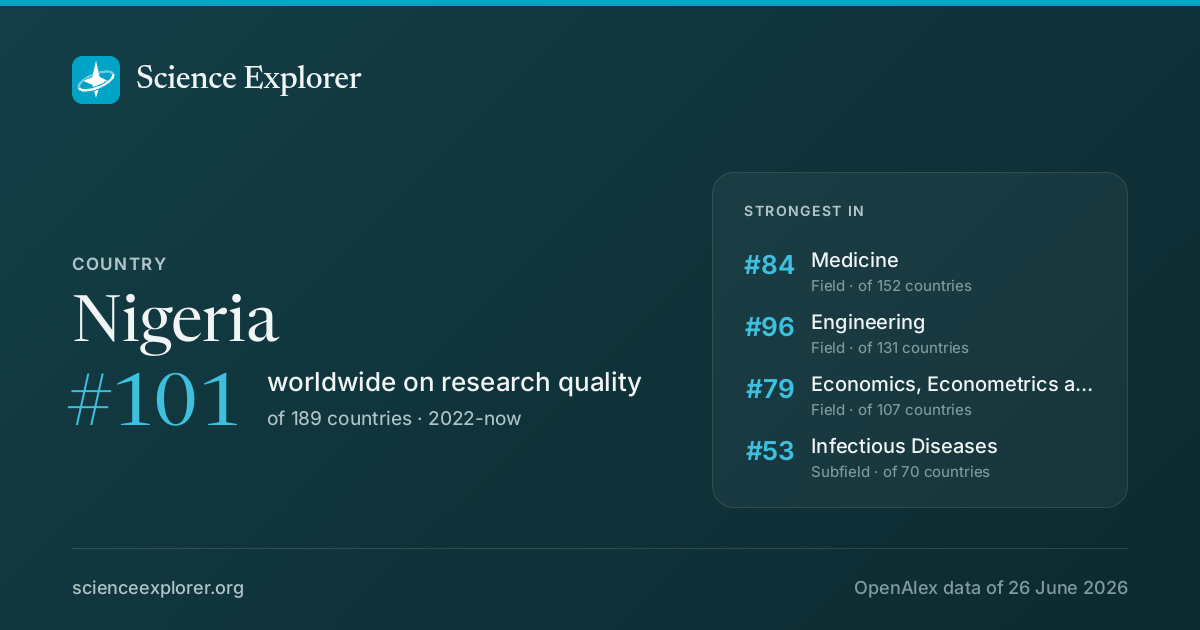
Nigeria ranks #101 of 189 countries on research quality in 2022-now (#104 all time), with 134k research works and 4.9% of them in the world's top 10%.
- World rank, 2022-now
- #101 of 189 · #104 all time
- Works, 2022-now
- 134k ▲ 22% vs 2018-21
- Citations
- 3.1M 7.4 per fractional work, all time
- Top-10% rate
- 4.9% all institutions 10.0%
- vs its own fields
- 0.52× 1.00× is exactly expected
- In the world top 100
- 0 0 in the top 1,000
- Open access
- 70% world 40%
- International
- 16% world 18%
NigeriaWhat is Nigeria strongest at in science?
On research quality in 2022-now, Nigeria ranks highest in Medicine (#84 of 152), Engineering (#96 of 131) and Economics, Econometrics and Finance (#79 of 107). Relative to its size it is most specialised in Library and Information Sciences, Drug Discovery and Chemical Health and Safety.
| Field | World rank | Where that sits | Top-10% rate | Works | All time | Institutions |
|---|---|---|---|---|---|---|
| MedicineField | #84 of 152 | 4.1% | 20,768 | #100 | Institutions | |
| EngineeringField | #96 of 131 | 4.9% | 13,563 | #90 | Institutions | |
| Economics, Econometrics and FinanceField | #79 of 107 | 5.0% | 6,486 | #74 | Institutions | |
| Infectious DiseasesSubfield | #53 of 70 | 4.2% | 1,643 | #63 | Institutions | |
| Social SciencesField | #113 of 148 | 5.7% | 19,760 | #97 | Institutions | |
| Economics and EconometricsSubfield | #76 of 98 | 5.2% | 4,840 | #74 | Institutions | |
| Arts and HumanitiesField | #80 of 103 | 8.7% | 2,751 | #83 | Institutions | |
| EpidemiologySubfield | #60 of 77 | 3.4% | 2,048 | #77 | Institutions | |
| Sociology and Political ScienceSubfield | #95 of 119 | 5.1% | 5,252 | #96 | Institutions | |
| Health ProfessionsField | #85 of 106 | 6.1% | 4,349 | #80 | Institutions | |
| Agricultural and Biological SciencesField | #103 of 124 | 4.0% | 14,371 | #106 | Institutions | |
| Immunology and MicrobiologyField | #59 of 71 | 5.0% | 1,261 | - | Institutions |
Where its research is concentrated
Location quotient: how much more (or less) of each node it does than its size predicts. Drawn around 1×, where "twice the world share" and "half of it" are the same distance apart in opposite directions. A volume reading, which on a country axis is largely population and industrial structure.
- Library and Information SciencesSubfield · 486.0 works · #2 of 146 active here16×
- Drug DiscoverySubfield · 88.8 works · #5 of 152 active here6.5×
- Chemical Health and SafetySubfield · 46.5 works · #8 of 139 active here4.5×
- HorticultureSubfield · 96.1 works · #12 of 178 active here4.5×
- ForestrySubfield · 732.7 works · #7 of 204 active here4.4×
- Animal Science and ZoologySubfield · 1,440.7 works · #8 of 205 active here4.1×
- PharmacologySubfield · 1,207.1 works · #6 of 204 active here4.0×
- PollutionSubfield · 2,360.9 works · #5 of 215 active here3.7×
The whole field profile
All 26 fields at once. A specialist and a generalist produce the same ranked list and a completely different shape.
Rings at 0.5×, 1× and 2×. Widest outward: Nursing, 2.8×. Every wedge is a field page.
All 26 fields, with their numbers
- Nursing2.82×2,223 works
- Pharmacology, Toxicology and Pharmaceutics2.64×1,493 works
- Economics, Econometrics and Finance2.21×7,608 works
- Agricultural and Biological Sciences2.18×17k works
- Business, Management and Accounting1.86×9,636 works
- Decision Sciences1.65×2,558 works
- Environmental Science1.51×12k works
- Energy1.41×2,082 works
- Veterinary1.36×297 works
- Social Sciences1.23×25k works
- Health Professions1.21×5,144 works
- Mathematics1.16×2,199 works
- Immunology and Microbiology0.95×1,535 works
- Psychology0.89×4,337 works
- Medicine0.79×24k works
- Computer Science0.78×9,772 works
- Arts and Humanities0.76×3,526 works
- Chemistry0.71×1,788 works
- Earth and Planetary Sciences0.70×1,763 works
- Engineering0.65×16k works
- Dentistry0.63×488 works
- Biochemistry, Genetics and Molecular Biology0.62×5,335 works
- Materials Science0.57×3,219 works
- Chemical Engineering0.44×247 works
- Neuroscience0.34×895 works
- Physics and Astronomy0.22×787 works
Which fields of science does Nigeria work in?
In 2022-now, 33% of research in Nigeria is in Social Sciences, 31% in Physical Sciences. Its largest fields are Social Sciences (16%), Medicine (15%), Agricultural and Biological Sciences (10%). It does 1.3× the world's share of Social Sciences.
Each ring splits the one inside it: the four domains of science, their fields, their subfields. Size is fractional works in 2022-now. Every slice is a page; the interactive view zooms down to single topics and colours each by how much more of it this country does than the world.
Its 4 domains and 26 fields, with their numbers
- Social Sciences53k32.8%
- Social Sciences25k15.6%
- Business, Management and Accounting9,6366.0%
- Economics, Econometrics and Finance7,6084.7%
- Psychology4,3372.7%
- Arts and Humanities3,5262.2%
- Decision Sciences2,5581.6%
- Physical Sciences50k30.8%
- Engineering16k9.7%
- Environmental Science12k7.5%
- Computer Science9,7726.1%
- Materials Science3,2192.0%
- Mathematics2,1991.4%
- Energy2,0821.3%
- Chemistry1,7881.1%
- Earth and Planetary Sciences1,7631.1%
- Physics and Astronomy7870.5%
- Chemical Engineering2470.2%
- Health Sciences33k20.3%
- Medicine24k15.2%
- Health Professions5,1443.2%
- Nursing2,2231.4%
- Dentistry4880.3%
- Veterinary2970.2%
- Life Sciences26k16.1%
- Agricultural and Biological Sciences17k10.4%
- Biochemistry, Genetics and Molecular Biology5,3353.3%
- Immunology and Microbiology1,5351.0%
- Pharmacology, Toxicology and Pharmaceutics1,4930.9%
- Neuroscience8950.6%
Which keywords describe research in Nigeria?
By fractional works in 2022-now, weighted toward what it does more of than the world: Environmental Impact, Education, Gender Equality, Economic Growth, Development, Nigeria, Sustainable Development and Sustainability.
- gender inclusion
- Inclusive Development
- Knowledge Economy
- Inequality
- ICT
- Bioactive Compounds
- Quality Assurance
- Toxicity
- Antioxidants
- Social Capital
- Information Technology
- Antioxidant Activity
- Risk Management
- Gender Equality
- Antioxidant
- Economic Growth
- Climate Change
- Sustainable Development
- Education
- Sustainability
- Epidemiology
- Environmental Impact
- Machine Learning
- Globalization
- Renewable Energy
- Oxidative Stress
- Development
- Corporate Governance
- Curriculum Development
- Nigeria
- Medicinal Plants
- Genetic Diversity
- Teacher Education
- Governance
- Fiscal Policy
- Youth Unemployment
- Institutional Quality
- Smallholder Farmers
- Mobile Phones
- financial access
Size is fractional works in 2022-now in the topics tagged with each word; colour is the word's share of this country's work against its share of the world's. The 40 words are chosen for being large and distinctive. Each links to the topic it comes from most.
All 40 words, with their numbers
- Epidemiology6,992◆ 1.09×140 topics
- Sustainability6,209▲ 1.58×131 topics
- Environmental Impact6,008▲ 2.2×72 topics
- Education5,751▲ 2.1×146 topics
- Machine Learning5,438◆ 1.02×97 topics
- Sustainable Development5,257▲ 2.1×10⁸ topics
- Globalization4,985▲ 1.58×173 topics
- Climate Change4,966◆ 1.14×127 topics
- Renewable Energy4,353▲ 1.87×61 topics
- Economic Growth4,324▲ 3.3×38 topics
- Oxidative Stress3,687▲ 1.39×63 topics
- Antioxidant3,412▲ 3.1×51 topics
- Development3,202▲ 5.6×23 topics
- Gender Equality3,084▲ 6.8×18 topics
- Corporate Governance2,913▲ 2.5×32 topics
- Risk Management2,754▲ 3.6×20 topics
- Curriculum Development2,746▲ 2.5×20 topics
- Antioxidant Activity2,743▲ 2.7×32 topics
- Nigeria2,734▲ 79×3 topics
- Information Technology2,674▲ 3.5×32 topics
- Medicinal Plants2,492▲ 4.0×21 topics
- Social Capital2,408▲ 2.9×20 topics
- Genetic Diversity2,394▲ 3.4×22 topics
- Antioxidants2,137▲ 3.0×17 topics
- Teacher Education2,125▲ 10×8 topics
- Toxicity2,107▲ 3.0×20 topics
- Governance2,098▲ 4.0×19 topics
- Quality Assurance2,067▲ 7.6×9 topics
- Fiscal Policy2,016▲ 6.2×11 topics
- Bioactive Compounds1,971▲ 4.9×15 topics
- Youth Unemployment1,884▲ 99×1 topic
- ICT1,763▲ 8.2×5 topics
- Institutional Quality1,723▲ 10×3 topics
- Inequality1,694▲ 4.6×18 topics
- Smallholder Farmers1,669▲ 4.9×6 topics
- Knowledge Economy1,451▲ 8.3×11 topics
- Mobile Phones1,415▲ 19×3 topics
- Inclusive Development1,410▲ 20×2 topics
- financial access1,397▲ 22×1 topic
- gender inclusion1,397▲ 22×1 topic
Which research topics does Nigeria publish the most in?
Its largest topics in 2022-now are African Education and Politics, Economic Growth and Development, Fiscal Policy and Economic Growth.
Area is fractional works in 2022-now; colour is the subfield each topic belongs to. Every tile is a topic page.
- 1 African Education and Politics Education 1.9k works
- 2 Economic Growth and Development Information Systems 1.4k works
- 3 Fiscal Policy and Economic Growth Economics and Econometrics 1.1k works
- 4 Global Maternal and Child Health Pediatrics, Perinatology and Child Health 1k works
- 5 Islamic Finance and Banking Studies Accounting 931 works
- 6 Energy and Environment Impacts Pollution 872 works
- 7 Child Nutrition and Water Access Nutrition and Dietetics 835 works
- 8 Urban and Rural Development Challenges Urban Studies 831 works
- 9 Water Quality and Pollution Assessment Water Science and Technology 763 works
- 10 Natural Antidiabetic Agents Studies Endocrinology, Diabetes and Metabolism 707 works
- 11 Heavy metals in environment Pollution 678 works
- 12 African Botany and Ecology Studies Forestry 631 works
Which universities in Nigeria lead research?
Covenant University, Lead City University and Adekunle Ajasin University rank highest in Nigeria on research quality in 2022-now.
One dot per institution in the list below. The upper left is the interesting corner.
- 1Covenant UniversityUniversity · Ota · #2,277 worldwide7.9% top 10% · 1.6k works
- 2Lead City UniversityUniversity · Ibadan · #3,168 worldwide4.8% top 10% · 1k works
- 3Adekunle Ajasin UniversityUniversity · Ondo · #3,436 worldwide5.6% top 10% · 1k works
- 4Redeemer's UniversityUniversity · Lagos · #3,480 worldwide8.4% top 10% · 599 works
- 5University of LagosUniversity · Lagos · #3,930 worldwide5.2% top 10% · 3.6k works
- 6University of IbadanUniversity · Ibadan · #4,014 worldwide6.0% top 10% · 5.8k works
- 7Landmark UniversityUniversity · Omu-Aran · #4,081 worldwide8.7% top 10% · 748 works
- 8University of AbujaUniversity · Abuja · #4,131 worldwide4.6% top 10% · 1.5k works
- 9Ebonyi State UniversityUniversity · Abakaliki · #4,214 worldwide6.3% top 10% · 1k works
- 10University of NigeriaUniversity · Nsukka · #4,263 worldwide7.5% top 10% · 5.2k works
- 11Federal University Oye EkitiUniversity · Ikole-Ekiti · #4,358 worldwide6.6% top 10% · 1.3k works
- 12Lagos State UniversityUniversity · Ikeja · #4,362 worldwide4.8% top 10% · 1.7k works
- 13Osun State UniversityUniversity · Osogbo · #4,500 worldwide6.2% top 10% · 1.5k works
- 14University of IlorinUniversity · Ilorin · #4,516 worldwide6.0% top 10% · 3.3k works
- 15Pan-Atlantic UniversityUniversity · Lagos · #4,549 worldwide7.3% top 10% · 619 works
The track on each row is its top-10% rate; the tick is the average of all institutions, 10.0% (how it is set): teal above it, red below.
All ranked institutions in NigeriaWho are the top researchers in Nigeria?
Michael Ekholuenetale, Olayinka Stephen Ilesanmi and Mu’awiyyah Babale Sufiyan rank highest among researchers based in Nigeria.
- 1 Michael Ekholuenetale #7,006 worldwide 69k citations · 215 works
- 2 Olayinka Stephen Ilesanmi #10,324 worldwide 161k citations · 355 works
- 3 Mu’awiyyah Babale Sufiyan #10,737 worldwide 123k citations · 106 works
- 4 Oye Gureje #14,357 worldwide 94k citations · 694 works
- 5 Aminu Shittu #16,229 worldwide 34k citations · 108 works
- 6 Bolajoko Olubukunola Olusanya #17,041 worldwide 159k citations · 339 works
- 7 Mayowa Ojo Owolabi #19,099 worldwide 224k citations · 560 works
- 8 Ganiyu Adeniyi Amusa #21,819 worldwide 19k citations · 51 works
- 9 Johnbosco C. Egbueri #22,329 worldwide 8k citations · 171 works
- 10 Muktar A Gadanya #23,996 worldwide 30k citations · 99 works
Which cities in Nigeria are research hubs?
- 1
IbadanNigeria
42k works
- 2
LagosNigeria
26k works
- 3
Port HarcourtNigeria
23k works
- 4
NsukkaNigeria
19k works
How much of it is in the largest
The same cities as shares of everything these twelve account for.
Shares of the rows listed above, not of the whole node.
How open and international is Nigeria's research?
70% of its research is openly available (world: 40%), and 16% is written with international co-authors (world: 18%).
World: 40% of research is openly available.
World: 18% is written across borders.
In 2022-now, 83% of its research is openly available (world 63%) and 20% is written with co-authors abroad (world 22%). Against what its own mix of topics predicts, that is 1.24× the expected open access and 0.91× the expected international share, which puts it #52 of 173 countries on openness.
How has Nigeria's research grown?
Output in 2022-2025 was 22% higher than in 2018-2021.
The same series as a ribbon: one cell per year, darker for more. The line above answers how much; this answers when.
Its share of all research
Growing output can still be a shrinking share: all of science grows. This is Nigeria as a percentage of every work published that year, 0.57% in 2024.
Fractional works of Nigeria over all fractional works that year. How the balance of science has shifted.
How much of it reaches the world top 10%
Over the whole record, 4.8% of its 423k works since 1950 reached the world top 10% for their field and year.
Of each year's output, the share that reached the world's 10% most cited for its field and year. Peak 6.1% in 1993.
Which countries have research most like Nigeria's?
Ghana is Nigeria's closest research twin: of all countries, its research is spread across the fields most like Nigeria's, with both strong in Nursing.
- 1
 GhanaBoth strong in Nursing, Economics, Econometrics and Finance, Business, Management and Accounting
0.88 Compare
- 2
 Sierra LeoneBoth strong in Nursing, Economics, Econometrics and Finance, Agricultural and Biological Sciences
0.85 Compare
- 3
 TanzaniaBoth strong in Nursing, Agricultural and Biological Sciences, Economics, Econometrics and Finance
0.85 Compare
- 4
 KenyaBoth strong in Nursing, Economics, Econometrics and Finance, Agricultural and Biological Sciences
0.84 Compare
- 5
 MalawiBoth strong in Nursing, Agricultural and Biological Sciences, Economics, Econometrics and Finance
0.82 Compare
Similarity is the correlation of each side's location quotients across every field it publishes in, on a log scale: 1 is the same shape of research, 0 is unrelated. It ignores size. How it is measured.
Compare Nigeria with
 Malta
 Fiji
 Réunion
 Cuba
 Paraguay
 Kuwait
Share Nigeria's ranking



Research fields in Nigeria
- Health Sciences
- Medicine
- Social Sciences
- Physical Sciences
- Life Sciences
- Engineering
- Economics, Econometrics and Finance
- Infectious Diseases
- Social Sciences
- Economics and Econometrics
- Arts and Humanities
- Epidemiology
- Sociology and Political Science
- Health Professions
- Agricultural and Biological Sciences
- Immunology and Microbiology
- Business, Management and Accounting
- Earth and Planetary Sciences
- Materials Science
- Environmental Science
- Plant Science
- Public Health, Environmental and Occupational Health
- Education
- Computer Science
- Pediatrics, Perinatology and Child Health
- General Health Professions
- Political Science and International Relations
- Biochemistry, Genetics and Molecular Biology
- Chemistry
- Psychology
- Water Science and Technology
- Materials Chemistry
- Civil and Structural Engineering
- Ocean Engineering
- Biomedical Engineering
- Information Systems
- Pollution
- Building and Construction
- Neuroscience
- Food Science
- Decision Sciences
- Nursing
- Molecular Biology
- Mechanical Engineering
- Mathematics
- Surgery
- Electrical and Electronic Engineering
- Social Psychology
- Strategy and Management
- Nutrition and Dietetics
- Renewable Energy, Sustainability and the Environment
- Clinical Psychology
- Accounting
- Global and Planetary Change
- Artificial Intelligence
- Pharmacology, Toxicology and Pharmaceutics
- Animal Science and Zoology
- Management Science and Operations Research
- Energy
Questions people ask
Which cities in Nigeria are research hubs?
By research output, Ibadan, Lagos, Port Harcourt and Nsukka.
See the full answerHow strong is science and technology in Nigeria?
Nigeria ranks #101 of 189 countries on research quality in 2022-now (#104 all time), with 134k research works and 4.9% of them in the world's top 10%.
Who are the top scientists in Nigeria?
Michael Ekholuenetale, Olayinka Stephen Ilesanmi and Mu’awiyyah Babale Sufiyan rank highest among researchers based in Nigeria.
Who are the top researchers in Nigeria?What is Nigeria strongest at in science?
On research quality in 2022-now, Nigeria ranks highest in Medicine (#84 of 152), Engineering (#96 of 131) and Economics, Econometrics and Finance (#79 of 107). Relative to its size it is most specialised in Library and Information Sciences, Drug Discovery and Chemical Health and Safety.
See the full answerHow fast is research in Nigeria growing?
Output in 2022-2025 was 22% higher than in 2018-2021.
How has Nigeria's research grown?Discussion
Ask a question or share a note about Nigeria. Keep it to the research: no personal attacks, advertising or links. Any reader can report a post, which collapses it for everyone until it is opened.