Science Explorer Back to mapMap
Discussion
University · Omu-Aran · Nigeria

Landmark University

In research, Landmark University stands highest in Physical Sciences (#3,016 of 10,670 worldwide), Life Sciences (#2,417 of 6,403 worldwide) and Agricultural and Biological Sciences (#1,432 of 3,157 worldwide), 2022-now.

World rank, 2022-now
#4,081
of 22,385 · #6,641 all time
Rank in Nigeria
#7
of 183
Research works
1.9k
▼ 7% vs 2018-21
Citations
28k
14.4 per fractional work
Top-10% rate
8.8%
all institutions 10.0%
vs its own fields
0.94×
1.00× is exactly expected
Open access
65%
world 40%
International
21%
world 18%

What is Landmark University known for in research?

The fields where it stands highest, 2022-now, ranked among every institution above the floor in each field.

FieldWorld rankWhere that sitsTop-10% rateWorksAll time
Physical SciencesDomain #3,016 of 10,670 7.6%383 #6224
Life SciencesDomain #2,417 of 6,403 10.3%166 #5302
Agricultural and Biological SciencesField #1,432 of 3,157 9.8%128 #2345
EngineeringField #3,083 of 5,901 8.7%138 #4185
Computer ScienceField #3,099 of 4,417 7.7%75 #4618
Health SciencesDomain #7,851 of 9,902 11.2%85 #13896
Social SciencesDomain #8,361 of 9,585 8.0%113 #8559

Each strip is that field's whole ranked pool, with the notch where Landmark University sits in it, in the colour of the band that rank falls in. The track under the rate is the rate itself: it carries no average mark, because the average differs by field (from about 6% in Dentistry to 21% in Economics).

Which of those standings moved

The same fields on both windows: where it stood over the whole record, and where it stands in 2022-now. The distance is the story, and it is the one thing the two rank columns above cannot show.

  1. Physical Sciences#6,224 #3,016
  2. Life Sciences#5,302 #2,417
  3. Agricultural and Biological Sciences#2,345 #1,432
  4. Engineering#4,185 #3,083
  5. Computer Science#4,618 #3,099
  6. Health Sciences#13,896 #7,851
  7. Social Sciences#8,559 #8,361
all time2022-now, better2022-now, worse

A dot further right is a better standing. Fields it was not ranked in over the whole record are left out.

Which fields of science does Landmark University work in?

In 2022-now, 50% of research at Landmark University is in Physical Sciences, 22% in Life Sciences. Its largest fields are Engineering (18%), Agricultural and Biological Sciences (17%), Computer Science (10%). It does 1.6× the world's share of Life Sciences.

Physical Sciences: 399 fractional works · 50.5% of its workEngineering: 143 fractional works · 18.1% of its workMechanical Engineering: 32 fractional works · 4.1% of its workBiomedical Engineering: 24 fractional works · 3.1% of its workCivil and Structural Engineering: 19 fractional works · 2.4% of its workElectrical and Electronic Engineering: 16 fractional works · 2.0% of its workBuilding and Construction: 13 fractional works · 1.6% of its workControl and Systems Engineering: 7 fractional works · 0.8% of its workMechanics of Materials: 6 fractional works · 0.8% of its workIndustrial and Manufacturing Engineering: 6 fractional works · 0.8% of its workAerospace Engineering: 4 fractional works · 0.6% of its workAutomotive Engineering: 4 fractional works · 0.5% of its workComputational Mechanics: 4 fractional works · 0.5% of its workOcean Engineering: 3 fractional works · 0.3% of its workMedia Technology: 2 fractional works · 0.3% of its workSafety, Risk, Reliability and Quality: 2 fractional works · 0.3% of its workComputer Science: 78 fractional works · 9.9% of its workInformation Systems: 27 fractional works · 3.5% of its workArtificial Intelligence: 21 fractional works · 2.6% of its workComputer Vision and Pattern Recognition: 9 fractional works · 1.1% of its workComputer Networks and Communications: 9 fractional works · 1.1% of its workSignal Processing: 6 fractional works · 0.8% of its workComputational Theory and Mathematics: 3 fractional works · 0.4% of its workComputer Science Applications: 2 fractional works · 0.3% of its workSmaller subfields together: 1 fractional works · 0.1% of its workEnvironmental Science: 63 fractional works · 7.9% of its workWater Science and Technology: 15 fractional works · 1.9% of its workPollution: 13 fractional works · 1.7% of its workIndustrial and Manufacturing Engineering: 11 fractional works · 1.4% of its workHealth, Toxicology and Mutagenesis: 6 fractional works · 0.8% of its workEnvironmental Engineering: 5 fractional works · 0.6% of its workEcology: 4 fractional works · 0.5% of its workManagement, Monitoring, Policy and Law: 4 fractional works · 0.5% of its workGlobal and Planetary Change: 4 fractional works · 0.5% of its workSmaller subfields together: 1 fractional works · 0.1% of its workMaterials Science: 37 fractional works · 4.7% of its workMaterials Chemistry: 19 fractional works · 2.4% of its workPolymers and Plastics: 7 fractional works · 0.9% of its workBiomaterials: 6 fractional works · 0.8% of its workCeramics and Composites: 2 fractional works · 0.2% of its workSmaller subfields together: 3 fractional works · 0.4% of its workMathematics: 32 fractional works · 4.0% of its workApplied Mathematics: 9 fractional works · 1.1% of its workNumerical Analysis: 8 fractional works · 1.1% of its workGeometry and Topology: 6 fractional works · 0.8% of its workStatistics and Probability: 5 fractional works · 0.6% of its workModeling and Simulation: 4 fractional works · 0.5% of its workSmaller subfields together: 0 fractional works · 0.0% of its workEnergy: 14 fractional works · 1.8% of its workRenewable Energy, Sustainability and the Environment: 11 fractional works · 1.4% of its workEnergy Engineering and Power Technology: 2 fractional works · 0.3% of its workChemistry: 14 fractional works · 1.8% of its workOrganic Chemistry: 5 fractional works · 0.7% of its workAnalytical Chemistry: 5 fractional works · 0.6% of its workInorganic Chemistry: 2 fractional works · 0.3% of its workSmaller subfields together: 2 fractional works · 0.2% of its workEarth and Planetary Sciences: 10 fractional works · 1.2% of its workGeophysics: 4 fractional works · 0.5% of its workGeochemistry and Petrology: 2 fractional works · 0.3% of its workSmaller subfields together: 3 fractional works · 0.4% of its workPhysics and Astronomy: 7 fractional works · 0.9% of its workAstronomy and Astrophysics: 3 fractional works · 0.4% of its workStatistical and Nonlinear Physics: 2 fractional works · 0.2% of its workAtomic and Molecular Physics, and Optics: 2 fractional works · 0.2% of its workSmaller subfields together: 0 fractional works · 0.0% of its workChemical Engineering: 2 fractional works · 0.2% of its workLife Sciences: 174 fractional works · 22.0% of its workAgricultural and Biological Sciences: 133 fractional works · 16.8% of its workPlant Science: 51 fractional works · 6.4% of its workFood Science: 25 fractional works · 3.2% of its workAnimal Science and Zoology: 14 fractional works · 1.7% of its workSoil Science: 12 fractional works · 1.5% of its workGeneral Agricultural and Biological Sciences: 11 fractional works · 1.4% of its workEcology, Evolution, Behavior and Systematics: 7 fractional works · 0.8% of its workForestry: 4 fractional works · 0.5% of its workAgronomy and Crop Science: 4 fractional works · 0.5% of its workAquatic Science: 3 fractional works · 0.4% of its workInsect Science: 3 fractional works · 0.3% of its workBiochemistry, Genetics and Molecular Biology: 27 fractional works · 3.5% of its workMolecular Biology: 14 fractional works · 1.8% of its workGenetics: 5 fractional works · 0.6% of its workBiotechnology: 2 fractional works · 0.2% of its workMolecular Medicine: 2 fractional works · 0.2% of its workSmaller subfields together: 5 fractional works · 0.6% of its workPharmacology, Toxicology and Pharmaceutics: 7 fractional works · 0.8% of its workPharmacology: 6 fractional works · 0.7% of its workSmaller subfields together: 1 fractional works · 0.1% of its workNeuroscience: 4 fractional works · 0.5% of its workNeurology: 2 fractional works · 0.2% of its workSmaller subfields together: 2 fractional works · 0.2% of its workImmunology and Microbiology: 3 fractional works · 0.4% of its workSocial Sciences: 128 fractional works · 16.1% of its workSocial Sciences: 48 fractional works · 6.1% of its workSociology and Political Science: 18 fractional works · 2.3% of its workEducation: 7 fractional works · 0.9% of its workCommunication: 6 fractional works · 0.7% of its workPolitical Science and International Relations: 4 fractional works · 0.5% of its workSafety Research: 3 fractional works · 0.3% of its workGender Studies: 3 fractional works · 0.3% of its workHealth: 2 fractional works · 0.2% of its workSmaller subfields together: 5 fractional works · 0.7% of its workBusiness, Management and Accounting: 32 fractional works · 4.0% of its workAccounting: 7 fractional works · 0.9% of its workManagement Information Systems: 6 fractional works · 0.7% of its workOrganizational Behavior and Human Resource Management: 5 fractional works · 0.7% of its workStrategy and Management: 4 fractional works · 0.5% of its workMarketing: 4 fractional works · 0.5% of its workManagement of Technology and Innovation: 3 fractional works · 0.4% of its workBusiness and International Management: 2 fractional works · 0.2% of its workEconomics, Econometrics and Finance: 29 fractional works · 3.6% of its workEconomics and Econometrics: 25 fractional works · 3.1% of its workGeneral Economics, Econometrics and Finance: 3 fractional works · 0.3% of its workFinance: 2 fractional works · 0.2% of its workDecision Sciences: 11 fractional works · 1.4% of its workManagement Science and Operations Research: 5 fractional works · 0.6% of its workInformation Systems and Management: 3 fractional works · 0.4% of its workStatistics, Probability and Uncertainty: 3 fractional works · 0.4% of its workPsychology: 5 fractional works · 0.6% of its workClinical Psychology: 2 fractional works · 0.2% of its workSocial Psychology: 2 fractional works · 0.2% of its workSmaller subfields together: 2 fractional works · 0.2% of its workArts and Humanities: 3 fractional works · 0.4% of its workHealth Sciences: 90 fractional works · 11.4% of its workMedicine: 61 fractional works · 7.8% of its workRadiology, Nuclear Medicine and Imaging: 8 fractional works · 1.0% of its workComplementary and alternative medicine: 6 fractional works · 0.8% of its workPublic Health, Environmental and Occupational Health: 6 fractional works · 0.7% of its workEndocrinology, Diabetes and Metabolism: 5 fractional works · 0.7% of its workEpidemiology: 4 fractional works · 0.6% of its workBiochemistry: 4 fractional works · 0.5% of its workPhysiology: 4 fractional works · 0.5% of its workPharmacology: 3 fractional works · 0.4% of its workInfectious Diseases: 3 fractional works · 0.4% of its workReproductive Medicine: 2 fractional works · 0.3% of its workHealth Informatics: 2 fractional works · 0.3% of its workSurgery: 2 fractional works · 0.2% of its workSmaller subfields together: 11 fractional works · 1.4% of its workHealth Professions: 15 fractional works · 1.9% of its workGeneral Health Professions: 7 fractional works · 0.8% of its workHealth Information Management: 5 fractional works · 0.6% of its workSmaller subfields together: 3 fractional works · 0.4% of its workNursing: 14 fractional works · 1.7% of its workNutrition and Dietetics: 14 fractional works · 1.7% of its workDentistry: 0 fractional works · 0.1% of its workALL ITS WORKLandmarkUniversity791fractional works, 2022-now
Life Sciences22%Physical Sciences50%Health Sciences11%Social Sciences16%

Each ring splits the one inside it: the four domains of science, their fields, their subfields. Size is fractional works in 2022-now. Every slice is a page; the interactive view zooms down to single topics and colours each by how much more of it this institution does than the world.

Its 4 domains and 25 fields, with their numbers
    1. Engineering14318.1%
    2. Computer Science789.9%
    3. Environmental Science637.9%
    4. Materials Science374.7%
    5. Mathematics324.0%
    6. Energy141.8%
    7. Chemistry141.8%
    8. Earth and Planetary Sciences101.2%
    9. Physics and Astronomy70.9%
    10. Chemical Engineering20.2%
    1. Agricultural and Biological Sciences13316.8%
    2. Biochemistry, Genetics and Molecular Biology273.5%
    3. Pharmacology, Toxicology and Pharmaceutics70.8%
    4. Neuroscience40.5%
    5. Immunology and Microbiology30.4%
    1. Social Sciences486.1%
    2. Business, Management and Accounting324.0%
    3. Economics, Econometrics and Finance293.6%
    4. Decision Sciences111.4%
    5. Psychology50.6%
    6. Arts and Humanities30.4%
    1. Medicine617.8%
    2. Health Professions151.9%
    3. Nursing141.7%
    4. Dentistry00.1%
All of science, and how each field's share has moved since 1950: the Science domain explorer

Field profile

Location quotient across every field it publishes in: outside the ring is more than an institution of this size would be expected to publish, inside it is less.

Agricultural and Biological Sciences: 3.54× its world share, 133 worksAgricultural and Bio…Biochemistry, Genetics and Molecular Biology: 0.65× its world share, 27 worksBiochemistry, Geneti…Immunology and Microbiology: 0.38× its world share, 3 worksImmunology and Micro…Neuroscience: 0.29× its world share, 4 worksNeurosciencePharmacology, Toxicology and Pharmaceutics: 2.38× its world share, 7 worksPharmacology, Toxico…Chemical Engineering: 0.60× its world share, 2 worksChemical EngineeringChemistry: 1.12× its world share, 14 worksChemistryComputer Science: 1.27× its world share, 78 worksComputer ScienceEarth and Planetary Sciences: 0.78× its world share, 10 worksEarth and Planetary …Energy: 1.91× its world share, 14 worksEnergyEngineering: 1.21× its world share, 143 worksEngineeringEnvironmental Science: 1.60× its world share, 63 worksEnvironmental ScienceMaterials Science: 1.35× its world share, 37 worksMaterials ScienceMathematics: 3.43× its world share, 32 worksMathematicsPhysics and Astronomy: 0.39× its world share, 7 worksPhysics and AstronomyDentistry: 0.13× its world share, 0 worksDentistryHealth Professions: 0.71× its world share, 15 worksHealth ProfessionsMedicine: 0.40× its world share, 61 worksMedicineNursing: 3.55× its world share, 14 worksNursingArts and Humanities: 0.12× its world share, 3 worksArts and HumanitiesBusiness, Management and Accounting: 1.24× its world share, 32 worksBusiness, Management…Decision Sciences: 1.48× its world share, 11 worksDecision SciencesEconomics, Econometrics and Finance: 1.70× its world share, 29 worksEconomics, Econometr…Psychology: 0.21× its world share, 5 worksPsychologySocial Sciences: 0.48× its world share, 48 worksSocial Sciences1×world share
more than its size predictsabout as predictedless

Rings at 0.5×, 1× and 2×. Widest outward: Nursing, 3.5×. Every wedge is a field page.

All 25 fields, with their numbers
  1. Nursing3.55×14 works
  2. Agricultural and Biological Sciences3.54×133 works
  3. Mathematics3.43×32 works
  4. Pharmacology, Toxicology and Pharmaceutics2.38×7 works
  5. Energy1.91×14 works
  6. Economics, Econometrics and Finance1.70×29 works
  7. Environmental Science1.60×63 works
  8. Decision Sciences1.48×11 works
  9. Materials Science1.35×37 works
  10. Computer Science1.27×78 works
  11. Business, Management and Accounting1.24×32 works
  12. Engineering1.21×143 works
  13. Chemistry1.12×14 works
  14. Earth and Planetary Sciences0.78×10 works
  15. Health Professions0.71×15 works
  16. Biochemistry, Genetics and Molecular Biology0.65×27 works
  17. Chemical Engineering0.60×2 works
  18. Social Sciences0.48×48 works
  19. Medicine0.40×61 works
  20. Physics and Astronomy0.39×7 works
  21. Immunology and Microbiology0.38×3 works
  22. Neuroscience0.29×4 works
  23. Psychology0.21×5 works
  24. Dentistry0.13×0 works
  25. Arts and Humanities0.12×3 works

Who are the top researchers at Landmark University?

Ranked on the quality score, Samuel Olatunde Dahunsi, Abiola John Asaleye and Ekemini Moses Okon lead among researchers whose main affiliation is Landmark University.

  1. 1 Samuel Olatunde Dahunsi Nigeria · #760,826 worldwide 3.4k citations · 128 works
  2. 2 Abiola John Asaleye Nigeria · #858,885 worldwide 1.7k citations · 115 works
  3. 3 Ekemini Moses Okon Nigeria · #960,749 worldwide 515 citations · 28 works
  4. 4 Adewumi Oluwasogo DADA Nigeria · #1,055,503 worldwide 2.8k citations · 81 works
  5. 5 Clinton Emeka Okonkwo Nigeria · #1,139,731 worldwide 1.5k citations · 91 works
  6. 6 Anthony Abiodun Eniola Nigeria · #1,196,353 worldwide 1.5k citations · 51 works
  7. 7 Akande Noah Oluwatobi Nigeria · #1,393,883 worldwide 705 citations · 59 works
  8. 8 Adedoyin Isola Lawal Nigeria · #1,396,055 worldwide 2.3k citations · 140 works
  9. 9 Sunday Chinedu Eze Nigeria · #1,480,942 worldwide 1.2k citations · 69 works
  10. 10 Adenike O. Bello Nigeria · #1,482,106 worldwide 728 citations · 26 works
All ranked researchers at Landmark University

What are the most cited papers from Landmark University?

The most cited paper from Landmark University is "Langmuir, Freundlich, Temkin and Dubinin–Radushkevich Isotherms Studies of Equilibrium Sorption of Zn 2+ Unto Phosphoric Acid Modified Rice Husk" (Dada A.O, 2012), with 1,937 citations. Next come "Kinetics, isotherms and thermodynamic modeling of liquid phase adsorption of Rhodamine B dye onto Raphia hookerie fruit epicarp" (641) and "Natural antioxidants from some fruits, seeds, foods, natural products, and associated health benefits: An update" (372).

Most cited papers
#PaperReleasedCitations
1 Langmuir, Freundlich, Temkin and Dubinin–Radushkevich Isotherms Studies of Equilibrium Sorption of Zn 2+ Unto Phosphoric Acid Modified Rice Husk Dada A.O · IOSR Journal of Applied Chemistry Open access 2012 1,937
2 Kinetics, isotherms and thermodynamic modeling of liquid phase adsorption of Rhodamine B dye onto Raphia hookerie fruit epicarp Adejumoke Abosede Inyinbor, Folahan A. Adekola, Gabriel Ademola Olatunji · Water Resources and Industry Open access 15 Jun 2016 641
3 Natural antioxidants from some fruits, seeds, foods, natural products, and associated health benefits: An update Md. Mizanur Rahaman, Rajib Hossain, Jesús Herrera‐Bravo et al. · Food Science & Nutrition Open access 13 Jan 2023 372
4 Microbial Inoculants for Improving Crop Quality and Human Health in Africa Elizabeth Temitope Alori, Olubukola Oluranti Babalola · Frontiers in Microbiology Open access 19 Sep 2018 356
5 Sputtering thin films: Materials, applications, challenges and future directions Renuka Garg, Spandana Gonuguntla, Saddam Sk et al. · Advances in Colloid and Interface Science 22 May 2024 350
All 61 most cited papers, with filters and sorting

Which keywords describe research at Landmark University?

By fractional works in 2022-now, weighted toward what it does more of than the world: Machine Learning, Environmental Impact, Sustainability, Mechanical Properties, Deep Learning, Biochar, Renewable Energy and Food Security.

▲ more of its work than of the world's◆ about the world's share▼ less than the world's

Size is fractional works in 2022-now in the topics tagged with each word; colour is the word's share of this institution's work against its share of the world's. The 40 words are chosen for being large and distinctive. Each links to the topic it comes from most.

All 40 words, with their numbers
  1. Machine Learning51▲ 1.93×60 topics
  2. Deep Learning44▲ 1.63×50 topics
  3. Sustainability42▲ 2.2×41 topics
  4. Environmental Impact38▲ 2.9×39 topics
  5. Mechanical Properties30▲ 3.9×27 topics
  6. Renewable Energy27▲ 2.4×29 topics
  7. Oxidative Stress21▲ 1.61×40 topics
  8. Antioxidant20▲ 3.7×41 topics
  9. Food Security19▲ 4.5×14 topics
  10. Healthcare19▲ 2.1×13 topics
  11. Antioxidant Activity18▲ 3.7×21 topics
  12. Internet of Things18▲ 2.7×18 topics
  13. Nanomaterials18▲ 2.1×15 topics
  14. Economic Growth16▲ 2.5×15 topics
  15. Security16▲ 3.0×15 topics
  16. Biochar16▲ 12×4 topics
  17. Antioxidants16▲ 4.4×15 topics
  18. Medicinal Plants14▲ 4.5×13 topics
  19. Smallholder Farmers13▲ 8.0×5 topics
  20. Health Benefits13▲ 5.0×12 topics
  21. Microstructure13▲ 3.2×11 topics
  22. Sustainable Agriculture13▲ 5.3×8 topics
  23. Social Networks13▲ 5.8×5 topics
  24. Dietary Fiber12▲ 15×3 topics
  25. Heavy Metals12▲ 6.4×6 topics
  26. Institutional Quality12▲ 14×3 topics
  27. Bioactive Compounds12▲ 5.9×12 topics
  28. Phytochemicals12▲ 14×7 topics
  29. Wastewater Treatment11▲ 5.8×8 topics
  30. Fiscal Policy11▲ 6.6×4 topics
  31. Flavonoids10▲ 5.2×9 topics
  32. ICT10▲ 9.7×3 topics
  33. Adsorption10▲ 6.0×3 topics
  34. Vulnerability10▲ 5.5×4 topics
  35. Knowledge Economy10▲ 11×3 topics
  36. Hypergeometric Functions9▲ 50×2 topics
  37. Inclusive Development9▲ 26×2 topics
  38. financial access9▲ 28×1 topic
  39. Contaminant Removal8▲ 14×1 topic
  40. Surface Area8▲ 14×1 topic

Which research topics does Landmark University publish most on?

By volume in 2022-now: Economic Growth and Development, Adsorption and biosorption for pollutant removal, Fiscal Policy and Economic Growth and Energy and Environment Impacts.

  1. 1 Economic Growth and Development Information Systems 9 works
  2. 2 Adsorption and biosorption for pollutant removal Water Science and Technology 8 works
  3. 3 Fiscal Policy and Economic Growth Economics and Econometrics 7 works
  4. 4 Energy and Environment Impacts Pollution 7 works
  5. 5 Corrosion Behavior and Inhibition Materials Chemistry 7 works
  6. 6 Analytic and geometric function theory Geometry and Topology 6 works
  7. 7 Agricultural Innovations and Practices General Agricultural and Biological Sciences 6 works
  8. 8 Cassava research and cyanide Plant Science 6 works
  9. 9 Rabbits: Nutrition, Reproduction, Health Animal Science and Zoology 5 works
  10. 10 Aluminum Alloys Composites Properties Mechanical Engineering 5 works

How open and international is its research?

Against the world's own shares: the tick on each track. Both are shares of its output, so they sit on one scale and can be read against each other as well as against the world.

openly available65.3%not open34.7%

World: 40% of research is openly available.

with international co-authors21.3%domestic only78.7%

World: 18% is written across borders.

How has Landmark University's research output changed?

Output in 2022-2025 was 7% lower than in 2018-2021.

still counting200020102020
grewheldshrank

The same series as a ribbon: one cell per year, darker for more. The line above answers how much; this answers when.

Its share of all research

Growing output can still be a shrinking share: all of science grows. This is Landmark University as a percentage of every work published that year, 0.0044% in 2024.

still counting0.0020%0.0040%0.0060%Landmark University0.0021% in 202519801990200020102020

Fractional works of Landmark University over all fractional works that year. How the balance of science has shifted.

How much of it reaches the world top 10%

Year by year, against all institutions in the same year.

still counting5%10%15%all institutions10.0% in 2025Landmark University7.0% in 20252020

Of each year's output, the share that reached the world's 10% most cited for its field and year. Peak 14.4% in 2020.

Share Landmark University's ranking
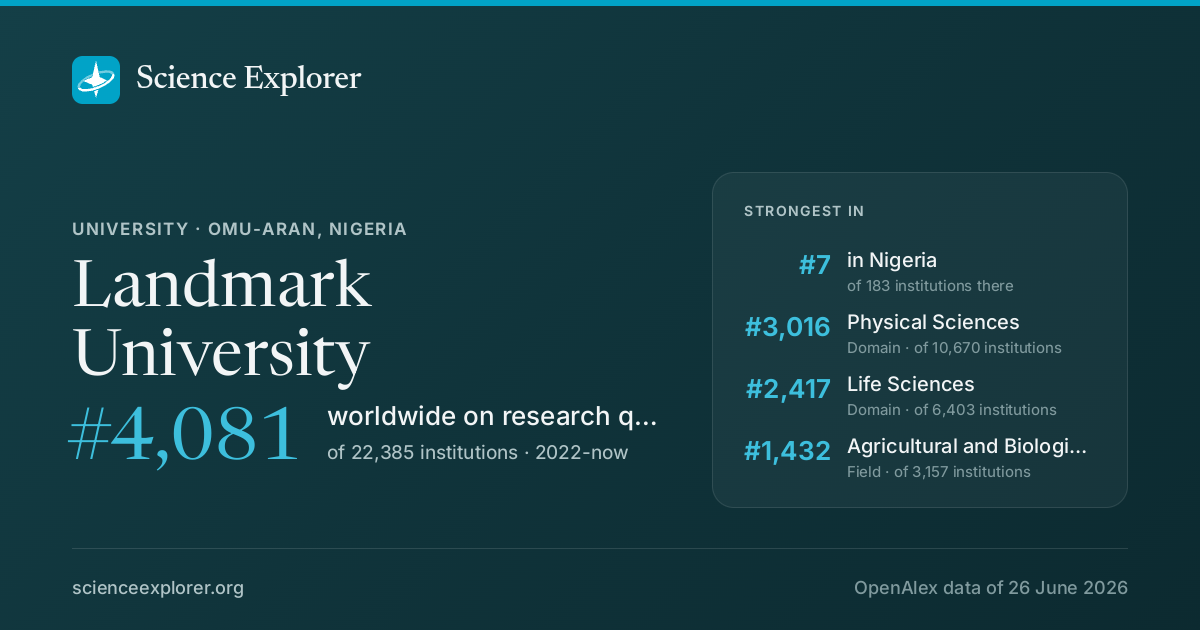
Landmark University on Science Explorer

A card with Landmark University's standing and the fields it leads in, for a post or a slide. A link to this page previews as the same card.

Download the card

1200 × 630 PNG, sized for social posts, drawn from the latest snapshot.

Badges for a website1Each links back here and updates with every snapshot

Research measures only: rankings here say nothing about teaching, admissions or student experience. Comparable institutions and collaboration partners have tabs of their own, above.

Discussion

Ask a question or share a note about Landmark University. Posts are plain text and can be reported.