Kyoto University
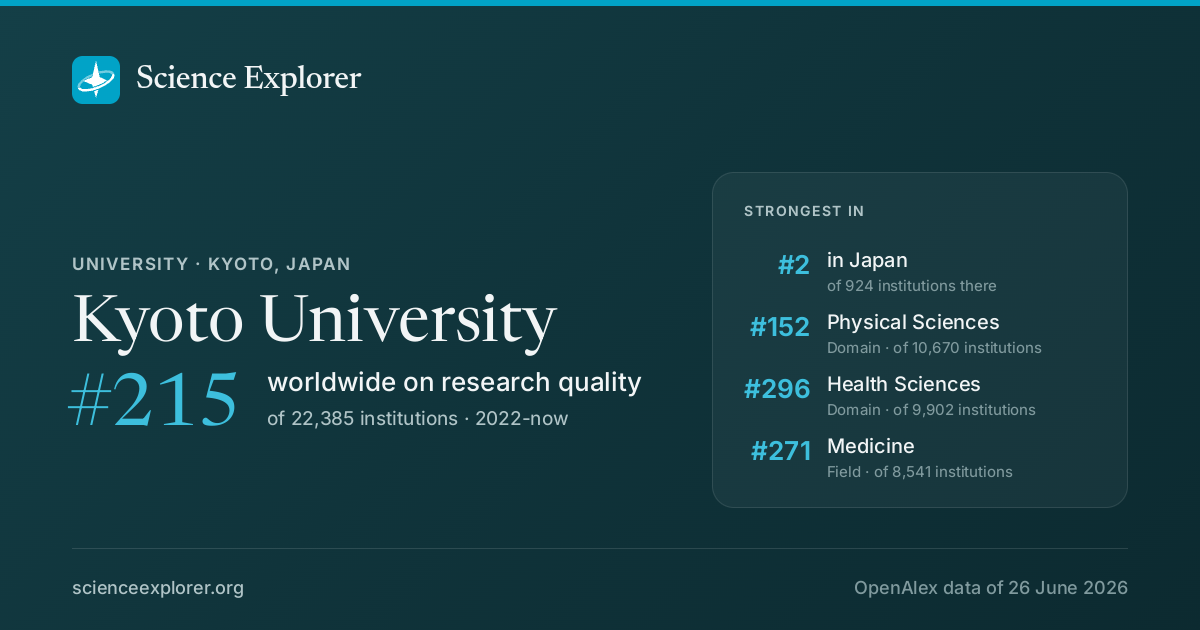
In research, Kyoto University stands highest in Physical Sciences (#152 of 10,670 worldwide), Health Sciences (#296 of 9,902 worldwide) and Medicine (#271 of 8,541 worldwide), 2022-now. Relative to its size it is most specialised in Condensed Matter Physics, Geometry and Topology and Mathematical Physics (Condensed Matter Physics is 5.3× its share of world research).
- World rank, 2022-now
- #215 of 22,385 · #240 all time
- Rank in Japan
- #2 of 924
- Research works
- 192k ▼ 14% vs 2018-21
- Citations
- 4.9M 25.5 per fractional work
- Top-10% rate
- 7.6% all institutions 10.0%
- vs its own fields
- 0.85× 1.00× is exactly expected
- Open access
- 42% world 40%
- International
- 14% world 18%
What is Kyoto University known for in research?
The fields where it stands highest, 2022-now, ranked among every institution above the floor in each field.
| Field | World rank | Where that sits | Top-10% rate | Works | All time |
|---|---|---|---|---|---|
| Physical SciencesDomain | #152 of 10,670 | 7.2% | 8,268 | #178 | |
| Health SciencesDomain | #296 of 9,902 | 8.0% | 3,329 | #330 | |
| MedicineField | #271 of 8,541 | 7.9% | 3,094 | #300 | |
| Life SciencesDomain | #215 of 6,403 | 7.0% | 2,619 | #221 | |
| Social SciencesDomain | #345 of 9,585 | 8.5% | 1,746 | #525 | |
| Physics and AstronomyField | #52 of 1,417 | 9.2% | 1,250 | #80 | |
| EngineeringField | #240 of 5,901 | 7.0% | 2,521 | #249 | |
| Social SciencesField | #346 of 5,988 | 9.4% | 750 | #555 | |
| Materials ScienceField | #132 of 2,276 | 6.7% | 1,038 | #118 | |
| MathematicsField | #71 of 1,051 | 8.5% | 450 | #79 |
Each strip is that field's whole ranked pool, with the notch where Kyoto University sits in it, in the colour of the band that rank falls in. The track under the rate is the rate itself: it carries no average mark, because the average differs by field (from about 6% in Dentistry to 21% in Economics).
Which of those standings moved
The same fields on both windows: where it stood over the whole record, and where it stands in 2022-now. The distance is the story, and it is the one thing the two rank columns above cannot show.
- Physical Sciences#178 #152
- Health Sciences#330 #296
- Medicine#300 #271
- Life Sciences#221 #215
- Social Sciences#525 #345
- Physics and Astronomy#80 #52
- Engineering#249 #240
- Social Sciences#555 #346
- Materials Science#118 #132
- Mathematics#79 #71
A dot further right is a better standing. Fields it was not ranked in over the whole record are left out.
Which fields of science does Kyoto University work in?
In 2022-now, 51% of research at Kyoto University is in Physical Sciences, 21% in Health Sciences. Its largest fields are Medicine (20%), Engineering (15%), Biochemistry, Genetics and Molecular Biology (9%). It does 1.3× the world's share of Physical Sciences.
Each ring splits the one inside it: the four domains of science, their fields, their subfields. Size is fractional works in 2022-now. Every slice is a page; the interactive view zooms down to single topics and colours each by how much more of it this institution does than the world.
Its 4 domains and 26 fields, with their numbers
- Physical Sciences9,28951.5%
- Engineering2,77615.4%
- Physics and Astronomy1,4267.9%
- Materials Science1,1526.4%
- Computer Science1,0105.6%
- Environmental Science9145.1%
- Chemistry6853.8%
- Earth and Planetary Sciences5162.9%
- Mathematics5072.8%
- Energy1851.0%
- Chemical Engineering1190.7%
- Health Sciences3,82121.2%
- Medicine3,54919.7%
- Health Professions1771.0%
- Nursing600.3%
- Dentistry210.1%
- Veterinary130.1%
- Life Sciences2,98116.5%
- Social Sciences1,96110.9%
- Social Sciences8414.7%
- Psychology4372.4%
- Economics, Econometrics and Finance2191.2%
- Arts and Humanities2111.2%
- Business, Management and Accounting1530.8%
- Decision Sciences1000.6%
What does Kyoto University specialise in?
Where its research is concentrated relative to its size: Condensed Matter Physics takes 5.3× the share of its output that it takes of world research.
- Condensed Matter PhysicsSubfield · 153.3 works5.3×
- Geometry and TopologySubfield · 143.6 works4.9×
- Mathematical PhysicsSubfield · 134.1 works4.7×
- Nuclear and High Energy PhysicsSubfield · 248.3 works4.4×
- RadiationSubfield · 96.6 works3.9×
- Physics and AstronomyField · 1,425.7 works3.5×
- GeophysicsSubfield · 221.5 works3.5×
Location quotient, a volume reading rather than an impact one. It surfaces small, lopsided specialities.
Field profile
Location quotient across every field it publishes in: outside the ring is more than an institution of this size would be expected to publish, inside it is less.
Rings at 0.5×, 1× and 2×. Widest outward: Physics and Astronomy, 3.5×. Every wedge is a field page.
All 26 fields, with their numbers
- Physics and Astronomy3.55×1,426 works
- Chemistry2.42×685 works
- Mathematics2.39×507 works
- Chemical Engineering1.89×119 works
- Materials Science1.83×1,152 works
- Earth and Planetary Sciences1.82×516 works
- Neuroscience1.64×480 works
- Biochemistry, Genetics and Molecular Biology1.63×1,573 works
- Immunology and Microbiology1.18×215 works
- Energy1.11×185 works
- Engineering1.02×2,776 works
- Environmental Science1.02×914 works
- Medicine1.02×3,549 works
- Pharmacology, Toxicology and Pharmaceutics0.90×57 works
- Psychology0.79×437 works
- Agricultural and Biological Sciences0.76×655 works
- Computer Science0.72×1,010 works
- Nursing0.68×60 works
- Decision Sciences0.57×100 works
- Economics, Econometrics and Finance0.57×219 works
- Veterinary0.54×13 works
- Arts and Humanities0.40×211 works
- Health Professions0.37×177 works
- Social Sciences0.37×841 works
- Business, Management and Accounting0.26×153 works
- Dentistry0.24×21 works
- Physics and Astronomy 3.5×
- Chemistry 2.4×
- Mathematics 2.4×
- Chemical Engineering 1.9×
- Materials Science 1.8×
- Earth and Planetary Sciences 1.8×
- Neuroscience 1.6×
- Biochemistry, Genetics and Molecular Biology 1.6×
- Immunology and Microbiology 1.2×
- Energy 1.1×
- Engineering 1.0×
- Environmental Science 1.0×
- Medicine 1.0×
- Pharmacology, Toxicology and Pharmaceutics 0.9×
- Psychology 0.8×
- Agricultural and Biological Sciences 0.8×
- Computer Science 0.7×
- Nursing 0.7×
- Decision Sciences 0.6×
- Economics, Econometrics and Finance 0.6×
- Veterinary 0.5×
- Arts and Humanities 0.4×
- Health Professions 0.4×
- Social Sciences 0.4×
- Business, Management and Accounting 0.3×
- Dentistry 0.2×
Who are the top researchers at Kyoto University?
Ranked on the quality score, Shimon Sakaguchi, Atsushi Togo and Masatoshi Takeichi lead among researchers whose main affiliation is Kyoto University.
- 1
Shimon Sakaguchi
 Japan · #5,730 worldwide
100k citations · 826 works
- 2
Atsushi Togo
Japan · #8,065 worldwide
28k citations · 15,749 works
- 3
Masatoshi Takeichi
Japan · #10,618 worldwide
56k citations · 356 works
- 4
Mitinori Saitou
Japan · #13,527 worldwide
28k citations · 207 works
- 5
Makoto Mark Taketo
Japan · #14,793 worldwide
54k citations · 691 works
- 6
Shinya Yamanaka
Japan · #15,990 worldwide
113k citations · 422 works
- 7
Mikio Furuse
Japan · #18,829 worldwide
40k citations · 211 works
- 8
Shigetada Nakanishi
Japan · #20,073 worldwide
58k citations · 429 works
- 9
T. Sekiguchi
Japan · #20,706 worldwide
11k citations · 111 works
- 10
Yuichiro Sekiguchi
Japan · #22,413 worldwide
12k citations · 211 works
Which keywords describe research at Kyoto University?
By fractional works in 2022-now, weighted toward what it does more of than the world: Climate Change, Catalysis, Nanoparticles, Epidemiology, Biomedical Applications, Inflammation, Self-Assembly and Superconductivity.
- Holographic
- Gravitational Waves
- Symplectic Geometry
- String Theory
- Drug Design
- Electronic Structure Calculations
- Quantum Gravity
- Electronic Structure
- Molecular Dynamics
- Tomography
- Nanostructures
- Gene Expression
- Biodiversity
- Chemotherapy
- Mechanical Properties
- Cancer
- Oxidative Stress
- Nanoparticles
- Inflammation
- Epidemiology
- Climate Change
- Machine Learning
- Deep Learning
- Biomedical Applications
- Catalysis
- Immunotherapy
- Self-Assembly
- Nanocomposites
- Tissue Engineering
- Superconductivity
- Crystal Growth
- Chemical Sensors
- Black Holes
- Transition Metal Complexes
- Supernovae
- Biological Applications
- Quantum Entanglement
- Differentiation
- Pluripotent Stem Cells
- Field Theories
Size is fractional works in 2022-now in the topics tagged with each word; colour is the word's share of this institution's work against its share of the world's. The 40 words are chosen for being large and distinctive. Each links to the topic it comes from most.
All 40 words, with their numbers
- Climate Change548◆ 1.12×10² topics
- Epidemiology522▼ 0.73×130 topics
- Machine Learning422▼ 0.70×88 topics
- Inflammation389◆ 1.01×83 topics
- Deep Learning373▼ 0.60×80 topics
- Nanoparticles330▲ 1.45×43 topics
- Biomedical Applications310▲ 1.45×35 topics
- Oxidative Stress304◆ 1.02×63 topics
- Catalysis294▲ 2.5×28 topics
- Cancer263◆ 1.08×55 topics
- Immunotherapy204▲ 1.56×19 topics
- Mechanical Properties195◆ 1.10×38 topics
- Self-Assembly185▲ 3.2×12 topics
- Chemotherapy185▲ 1.44×25 topics
- Nanocomposites183▲ 1.28×21 topics
- Biodiversity178▲ 1.29×35 topics
- Tissue Engineering171▲ 1.56×13 topics
- Gene Expression157▲ 1.39×20 topics
- Superconductivity148▲ 4.8×9 topics
- Nanostructures142▲ 1.93×17 topics
- Crystal Growth116▲ 2.4×12 topics
- Tomography112▲ 3.5×5 topics
- Chemical Sensors111▲ 2.7×3 topics
- Molecular Dynamics110▲ 3.5×6 topics
- Black Holes104▲ 6.0×3 topics
- Electronic Structure98▲ 3.0×8 topics
- Transition Metal Complexes93▲ 5.6×4 topics
- Quantum Gravity89▲ 5.8×4 topics
- Supernovae80▲ 5.4×2 topics
- Electronic Structure Calculations78▲ 6.6×2 topics
- Biological Applications73▲ 6.0×6 topics
- Drug Design72▲ 6.2×5 topics
- Quantum Entanglement71▲ 6.1×2 topics
- String Theory69▲ 6.9×2 topics
- Differentiation69▲ 6.1×2 topics
- Symplectic Geometry68▲ 10×2 topics
- Pluripotent Stem Cells68▲ 7.3×2 topics
- Gravitational Waves67▲ 6.5×2 topics
- Field Theories64▲ 8.0×1 topic
- Holographic64▲ 8.0×1 topic
Which research topics does Kyoto University publish most on?
By volume in 2022-now: earthquake and tectonic studies, Black Holes and Theoretical Physics, Luminescence and Fluorescent Materials and Advancements in Battery Materials.
Area is fractional works; colour is the subfield each topic belongs to.
- 1 earthquake and tectonic studies Geophysics 66 works
- 2 Black Holes and Theoretical Physics Nuclear and High Energy Physics 64 works
- 3 Luminescence and Fluorescent Materials Materials Chemistry 58 works
- 4 Advancements in Battery Materials Electrical and Electronic Engineering 56 works
- 5 Pluripotent Stem Cells Research Molecular Biology 52 works
- 6 Cosmology and Gravitation Theories Astronomy and Astrophysics 51 works
- 7 Perovskite Materials and Applications Electrical and Electronic Engineering 48 works
- 8 Advanced Battery Materials and Technologies Electrical and Electronic Engineering 46 works
- 9 Physics of Superconductivity and Magnetism Condensed Matter Physics 45 works
- 10 CRISPR and Genetic Engineering Molecular Biology 45 works
How open and international is its research?
Against the world's own shares: the tick on each track. Both are shares of its output, so they sit on one scale and can be read against each other as well as against the world.
World: 40% of research is openly available.
World: 18% is written across borders.
How has Kyoto University's research output changed?
Output in 2022-2025 was 14% lower than in 2018-2021.
The same series as a ribbon: one cell per year, darker for more. The line above answers how much; this answers when.
Its share of all research
Growing output can still be a shrinking share: all of science grows. This is Kyoto University as a percentage of every work published that year, 0.068% in 2024.
Fractional works of Kyoto University over all fractional works that year. How the balance of science has shifted.
How much of it reaches the world top 10%
Year by year, against all institutions in the same year.
Of each year's output, the share that reached the world's 10% most cited for its field and year. Peak 9.8% in 2007.
Other research institutions in Kyoto
- Ritsumeikan University
- Kyoto Prefectural University of Medicine
- Kyoto Institute of Technology
- Doshisha University
- Kyoto Pharmaceutical University
- Ryukoku University
- Ōtani University
- Kyoto University of Education

Which institutions have research most like Kyoto University's?
Among the world's leading institutions, Nagoya University has the research profile closest to Kyoto University's, with both strong in Physics and Astronomy.
- 1
Nagoya UniversityJapan · Both strong in Physics and Astronomy, Chemistry, Materials Science
0.96 Compare
- 2
Weizmann Institute of Science
 Israel · Both strong in Physics and Astronomy, Chemistry, Mathematics
0.92 Compare
- 3
The University of TokyoJapan · Both strong in Physics and Astronomy, Earth and Planetary Sciences, Neuroscience
0.91 Compare
- 4
RIKENJapan · Both strong in Physics and Astronomy, Chemistry, Materials Science
0.89 Compare
- 5
Indian Institute of Science Bangalore
 India · Both strong in Physics and Astronomy, Chemistry, Mathematics
0.88 Compare
Similarity is the correlation of each side's location quotients across every field it publishes in, on a log scale: 1 is the same shape of research, 0 is unrelated. It ignores size. How it is measured.
Compare Kyoto University with
- vs
 University of Southampton
- vs University of Warwick
- vs
 Southwest University
- vs
 Ruhr University Bochum
- vs
 University of Massachusetts Amherst
- vs
 Sungkyunkwan University
Share Kyoto University's ranking



Research measures only: rankings here say nothing about teaching, admissions or student experience. Comparable institutions and collaboration partners have tabs of their own, above.
Questions people ask
What is Kyoto University known for in research?
In research, Kyoto University stands highest in Physical Sciences (#152 of 10,670 worldwide), Health Sciences (#296 of 9,902 worldwide) and Medicine (#271 of 8,541 worldwide), 2022-now. Relative to its size it is most specialised in Condensed Matter Physics, Geometry and Topology and Mathematical Physics (Condensed Matter Physics is 5.3× its share of world research).
Discussion
Ask a question or share a note about Kyoto University. Keep it to the research: no personal attacks, advertising or links. Any reader can report a post, which collapses it for everyone until it is opened.