Advanced Technologies Application Center
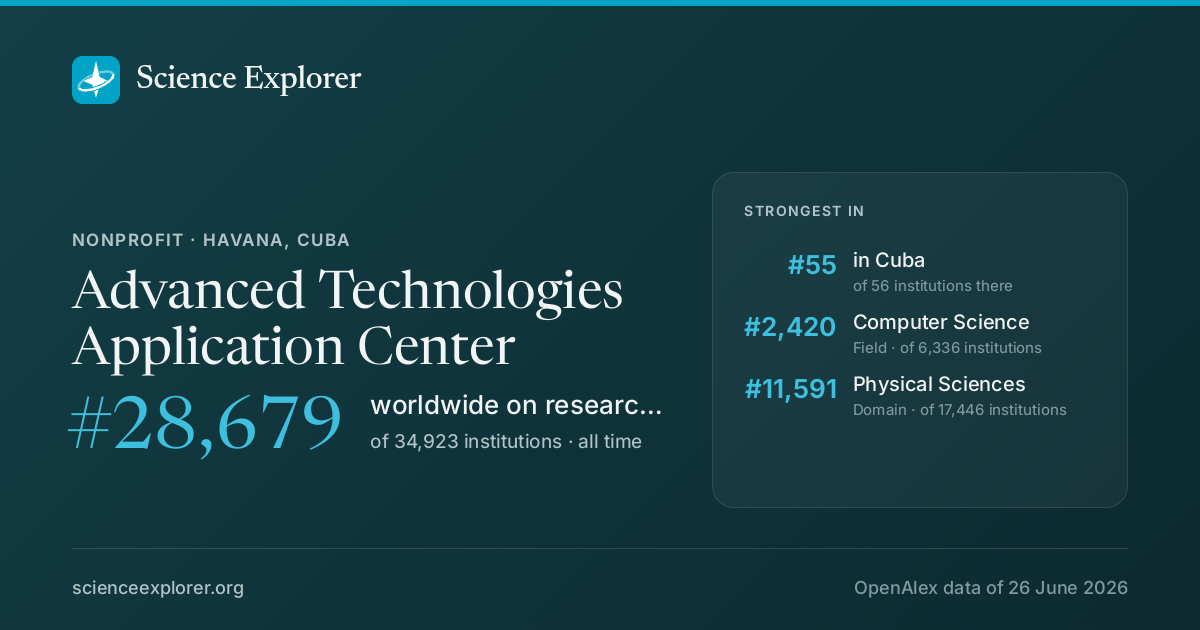
In research, Advanced Technologies Application Center stands highest in Computer Science (#2,420 of 6,336 worldwide) and Physical Sciences (#11,591 of 17,446 worldwide), over all time.
- World rank, all time
- #28,679 of 34,923
- Rank in Cuba
- #55 of 56
- Research works
- 258 ▼ 76% vs 2018-21
- Citations
- 2.7k 10.6 per fractional work
- Top-10% rate
- 4.2% all institutions 10.0%
- vs its own fields
- 0.98× 1.00× is exactly expected
- Open access
- 30% world 40%
- International
- 40% world 18%
What is Advanced Technologies Application Center known for in research?
The fields where it stands highest, over all time, ranked among every institution above the floor in each field.
| Field | World rank | Where that sits | Top-10% rate | Works |
|---|---|---|---|---|
| Computer ScienceField | #2,420 of 6,336 | 3.6% | 201 | |
| Physical SciencesDomain | #11,591 of 17,446 | 3.9% | 231 |
Each strip is that field's whole ranked pool, with the notch where Advanced Technologies Application Center sits in it, in the colour of the band that rank falls in. The track under the rate is the rate itself: it carries no average mark, because the average differs by field (from about 6% in Dentistry to 21% in Economics).
Which fields of science does Advanced Technologies Application Center work in?
In all years, 90% of research at Advanced Technologies Application Center is in Physical Sciences, 6% in Social Sciences. Its largest fields are Computer Science (78%), Engineering (5%), Social Sciences (4%). It does 2.2× the world's share of Physical Sciences.
Each ring splits the one inside it: the four domains of science, their fields, their subfields. Size is fractional works in all years. Every slice is a page; the interactive view zooms down to single topics and colours each by how much more of it this institution does than the world.
Its 4 domains and 22 fields, with their numbers
- Physical Sciences23189.5%
- Computer Science20178.0%
- Engineering145.4%
- Chemistry62.3%
- Physics and Astronomy41.4%
- Environmental Science20.6%
- Materials Science10.6%
- Mathematics10.5%
- Earth and Planetary Sciences10.4%
- Energy10.3%
- Social Sciences155.8%
- Life Sciences93.3%
- Health Sciences41.4%
- Medicine31.1%
- Dentistry10.2%
- Health Professions00.1%
Field profile
Location quotient across every field it publishes in: outside the ring is more than an institution of this size would be expected to publish, inside it is less.
Rings at 0.5×, 1× and 2×. Widest outward: Computer Science, 8.0×. Every wedge is a field page.
All 15 fields, with their numbers
- Computer Science7.95×11 works
- Decision Sciences2.62×0 works
- Arts and Humanities1.64×1 works
- Materials Science1.51×1 works
- Business, Management and Accounting0.88×0 works
- Chemistry0.65×0 works
- Environmental Science0.53×0 works
- Social Sciences0.52×1 works
- Physics and Astronomy0.45×0 works
- Engineering0.44×1 works
- Health Professions0.36×0 works
- Earth and Planetary Sciences0.24×0 works
- Immunology and Microbiology0.21×0 works
- Medicine0.17×1 works
- Biochemistry, Genetics and Molecular Biology0.04×0 works
- Computer Science 8.0×
- Decision Sciences 2.6×
- Arts and Humanities 1.6×
- Materials Science 1.5×
- Business, Management and Accounting 0.9×
- Chemistry 0.7×
- Environmental Science 0.5×
- Social Sciences 0.5×
- Physics and Astronomy 0.5×
- Engineering 0.4×
- Health Professions 0.4×
- Earth and Planetary Sciences 0.2×
- Immunology and Microbiology 0.2×
- Medicine 0.2×
- Biochemistry, Genetics and Molecular Biology 0.0×
Who are the top researchers at Advanced Technologies Application Center?
Ranked on the quality score, Vitali Herrera-Semenets, Sandro Vega-Pons and José Ruíz-Shulcloper lead among researchers whose main affiliation is Advanced Technologies Application Center.
- 1
Vitali Herrera-Semenets
 Cuba · #1,843,568 worldwide
116 citations · 25 works
- 2
Sandro Vega-Pons
Cuba · #2,048,823 worldwide
937 citations · 19 works
- 3
José Ruíz-Shulcloper
Cuba · #3,050,594 worldwide
1.4k citations · 67 works
- 4
Airel Pérez‐Suárez
Cuba · #3,062,160 worldwide
214 citations · 22 works
- 5
Yoanna Martínez-Díaz
Cuba · #3,194,340 worldwide
257 citations · 27 works
- 6
Heydi Méndez-Vázquez
Cuba · #3,530,504 worldwide
822 citations · 74 works
- 7
José Eladio Medina-Pagola
Cuba · #3,544,506 worldwide
363 citations · 29 works
- 8
Niusvel Acosta-Mendoza
Cuba · #3,821,097 worldwide
213 citations · 24 works
- 9
Gabriel Hernández Sierra
Cuba · #4,179,397 worldwide
21 citations · 15 works
- 10
Eduardo Garea-Llano
Cuba · #4,371,456 worldwide
93 citations · 16 works
Which keywords describe research at Advanced Technologies Application Center?
By fractional works in all years, weighted toward what it does more of than the world: Deep Learning, Convolutional Neural Networks, Face Recognition, Machine Learning, Feature Selection, Local Binary Patterns, Neural Networks and Feature Extraction.
- Shape Matching
- High-Dimensional Data
- Speech Enhancement
- Trajectory Data Mining
- Local Descriptors
- Speaker Verification
- Frequent Patterns
- Deep Neural Networks
- 3D Face Reconstruction
- Clustering Algorithms
- Pose Estimation
- Biometric Recognition
- Spectral Clustering
- Dimensionality Reduction
- Authentication
- Ensemble Methods
- Feature Extraction
- Local Binary Patterns
- Face Recognition
- Convolutional Neural Networks
- Deep Learning
- Machine Learning
- Feature Selection
- Neural Networks
- Sparse Representation
- Security
- Support Vector Machines
- Non-negative Matrix Factorization
- Privacy
- Fingerprint
- Data Mining
- Age Estimation
- Facial Landmark Detection
- Association Rules
- Acoustic Modeling
- Feature Matching
- GPS Trajectories
- Audio-Visual Speech Recognition
- Anomaly Detection
- Content-Based Image Retrieval
Size is fractional works in all years in the topics tagged with each word; colour is the word's share of this institution's work against its share of the world's. The 40 words are chosen for being large and distinctive. Each links to the topic it comes from most.
All 40 words, with their numbers
- Deep Learning72▲ 13×42 topics
- Convolutional Neural Networks39▲ 36×10 topics
- Machine Learning34▲ 6.1×28 topics
- Face Recognition32▲ 161×2 topics
- Feature Selection30▲ 63×5 topics
- Local Binary Patterns26▲ 123×2 topics
- Neural Networks23▲ 8.7×21 topics
- Feature Extraction23▲ 32×5 topics
- Sparse Representation20▲ 43×5 topics
- Ensemble Methods20▲ 137×2 topics
- Security20▲ 18×7 topics
- Authentication20▲ 83×4 topics
- Support Vector Machines19▲ 26×5 topics
- Dimensionality Reduction18▲ 119×2 topics
- Non-negative Matrix Factorization18▲ 185×1 topic
- Spectral Clustering18▲ 185×1 topic
- Privacy17▲ 37×2 topics
- Biometric Recognition16▲ 328×1 topic
- Fingerprint16▲ 328×1 topic
- Pose Estimation16▲ 85×2 topics
- Data Mining15▲ 13×4 topics
- Clustering Algorithms14▲ 52×2 topics
- Age Estimation14▲ 111×2 topics
- 3D Face Reconstruction14▲ 216×1 topic
- Facial Landmark Detection14▲ 216×1 topic
- Deep Neural Networks13▲ 77×2 topics
- Association Rules11▲ 125×1 topic
- Frequent Patterns11▲ 125×1 topic
- Acoustic Modeling10▲ 122×1 topic
- Speaker Verification10▲ 122×1 topic
- Feature Matching10▲ 64×1 topic
- Local Descriptors10▲ 64×1 topic
- GPS Trajectories9▲ 74×1 topic
- Trajectory Data Mining9▲ 74×1 topic
- Audio-Visual Speech Recognition9▲ 59×1 topic
- Speech Enhancement9▲ 59×1 topic
- Anomaly Detection8▲ 20×4 topics
- High-Dimensional Data8▲ 34×3 topics
- Content-Based Image Retrieval8▲ 69×1 topic
- Shape Matching8▲ 69×1 topic
Which research topics does Advanced Technologies Application Center publish most on?
By volume in 2022-now: Face recognition and analysis, Biometric Identification and Security, Handwritten Text Recognition Techniques and Image Processing and 3D Reconstruction.
Area is fractional works; colour is the subfield each topic belongs to.
- 1 Face recognition and analysis Computer Vision and Pattern Recognition 1 works
- 2 Biometric Identification and Security Signal Processing 1 works
- 3 Handwritten Text Recognition Techniques Computer Vision and Pattern Recognition 1 works
- 4 Image Processing and 3D Reconstruction Computer Vision and Pattern Recognition 1 works
- 5 Natural Language Processing Techniques Artificial Intelligence 1 works
- 6 Video Surveillance and Tracking Methods Computer Vision and Pattern Recognition 0 works
- 7 Face and Expression Recognition Computer Vision and Pattern Recognition 0 works
- 8 Spam and Phishing Detection Information Systems 0 works
- 9 Network Security and Intrusion Detection Computer Networks and Communications 0 works
- 10 Advanced Image and Video Retrieval Techniques Computer Vision and Pattern Recognition 0 works
How open and international is its research?
Against the world's own shares: the tick on each track. Both are shares of its output, so they sit on one scale and can be read against each other as well as against the world.
World: 40% of research is openly available.
World: 18% is written across borders.
How has Advanced Technologies Application Center's research output changed?
Output in 2022-2025 was 76% lower than in 2018-2021.
The same series as a ribbon: one cell per year, darker for more. The line above answers how much; this answers when.
Its share of all research
Growing output can still be a shrinking share: all of science grows. This is Advanced Technologies Application Center as a percentage of every work published that year, 0.000031% in 2024.
Fractional works of Advanced Technologies Application Center over all fractional works that year. How the balance of science has shifted.
Other research institutions in Havana
- University of Havana
- Universidad de Ciencias Médicas de la Habana
- Polytechnic José Antonio Echeverría
- Ministerio de Salud Pública
- Centro Nacional de Investigaciones Científicas
- Hermanos Ameijeiras Hospital
- Instituto de Medicina Tropical “Pedro Kourí”
- Centro de Ingeniería Genética y Biotecnología

Share Advanced Technologies Application Center's ranking
Badges for a website1Each links back here and updates with every snapshot

Research measures only: rankings here say nothing about teaching, admissions or student experience. Comparable institutions and collaboration partners have tabs of their own, above.
Discussion
Ask a question or share a note about Advanced Technologies Application Center. Keep it to the research: no personal attacks, advertising or links. Any reader can report a post, which collapses it for everyone until it is opened.