Alstom (Switzerland)
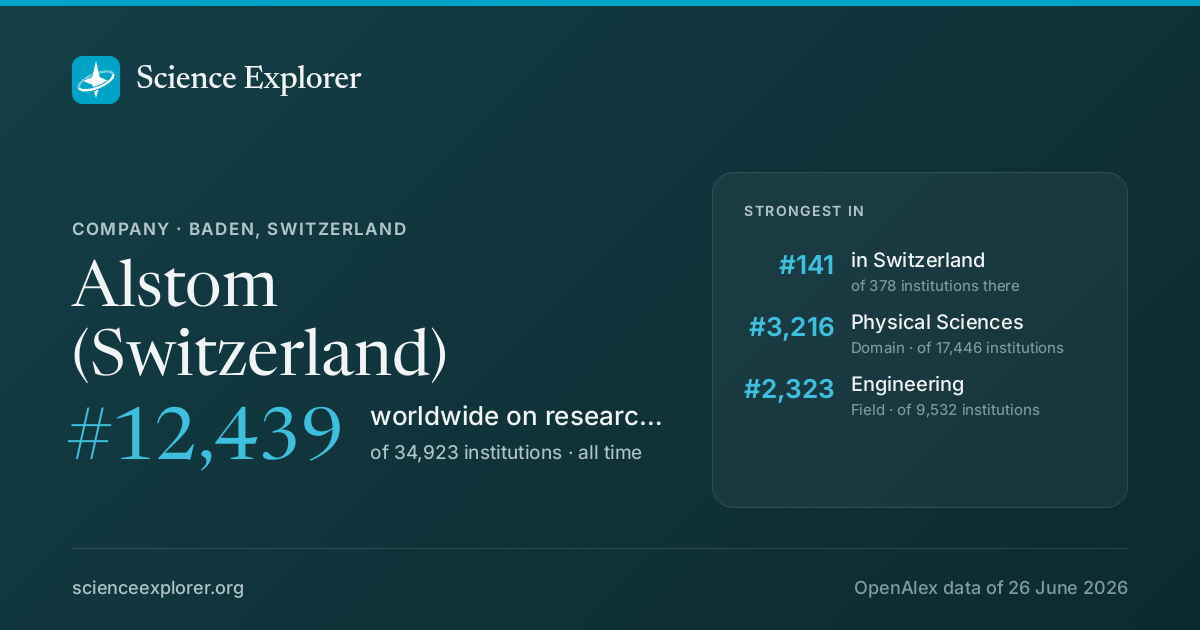
In research, Alstom (Switzerland) stands highest in Physical Sciences (#3,216 of 17,446 worldwide) and Engineering (#2,323 of 9,532 worldwide), over all time.
- World rank, all time
- #12,439 of 34,923
- Rank in Switzerland
- #141 of 378
- Research works
- 526 ▲ 84% vs 2018-21
- Citations
- 9.7k 18.4 per fractional work
- Top-10% rate
- 4.8% all institutions 10.0%
- vs its own fields
- 1.30× 1.00× is exactly expected
- Open access
- 11% world 40%
- International
- 37% world 18%
What is Alstom (Switzerland) known for in research?
The fields where it stands highest, over all time, ranked among every institution above the floor in each field.
| Field | World rank | Where that sits | Top-10% rate | Works |
|---|---|---|---|---|
| Physical SciencesDomain | #3,216 of 17,446 | 9.1% | 505 | |
| EngineeringField | #2,323 of 9,532 | 9.1% | 398 |
Each strip is that field's whole ranked pool, with the notch where Alstom (Switzerland) sits in it, in the colour of the band that rank falls in. The track under the rate is the rate itself: it carries no average mark, because the average differs by field (from about 6% in Dentistry to 21% in Economics).
Which fields of science does Alstom (Switzerland) work in?
In all years, 96% of research at Alstom (Switzerland) is in Physical Sciences, 3% in Social Sciences. Its largest fields are Engineering (76%), Chemical Engineering (8%), Materials Science (5%). It does 2.3× the world's share of Physical Sciences.
Each ring splits the one inside it: the four domains of science, their fields, their subfields. Size is fractional works in all years. Every slice is a page; the interactive view zooms down to single topics and colours each by how much more of it this institution does than the world.
Its 4 domains and 21 fields, with their numbers
- Physical Sciences50596.0%
- Engineering39875.7%
- Chemical Engineering417.8%
- Materials Science265.0%
- Environmental Science152.8%
- Energy91.7%
- Chemistry40.7%
- Computer Science40.7%
- Physics and Astronomy30.6%
- Earth and Planetary Sciences20.5%
- Mathematics20.4%
- Social Sciences142.7%
- Health Sciences40.8%
- Medicine40.7%
- Nursing00.0%
- Veterinary00.0%
- Life Sciences30.5%
Field profile
Location quotient across every field it publishes in: outside the ring is more than an institution of this size would be expected to publish, inside it is less.
Rings at 0.5×, 1× and 2×. Widest outward: Chemical Engineering, 18.2×. Every wedge is a field page.
All 7 fields, with their numbers
- Chemical Engineering18.20×0 works
- Engineering5.05×4 works
- Business, Management and Accounting1.97×0 works
- Materials Science1.82×0 works
- Economics, Econometrics and Finance1.20×0 works
- Computer Science0.27×0 works
- Social Sciences0.04×0 works
Who are the top researchers at Alstom (Switzerland)?
Ranked on the quality score, Michael Gritsch, Bruno B. H. Schuermans and Valter Bellucci lead among researchers whose main affiliation is Alstom (Switzerland).
- 1
Michael Gritsch
 Switzerland · #342,544 worldwide
2.4k citations · 46 works
- 2
Bruno B. H. Schuermans
Switzerland · #1,242,791 worldwide
3.4k citations · 139 works
- 3
Valter Bellucci
Switzerland · #1,522,065 worldwide
772 citations · 39 works
- 4
Peter Flohr
Switzerland · #1,824,086 worldwide
1.1k citations · 41 works
- 5
A. Schwery
Switzerland · #2,116,742 worldwide
1k citations · 48 works
- 6
Felix Güthe
Switzerland · #2,174,741 worldwide
1.5k citations · 62 works
- 7
Peter Stoll
Switzerland · #2,275,851 worldwide
698 citations · 18 works
- 8
Hans‐Peter Boßmann
Switzerland · #2,367,755 worldwide
495 citations · 22 works
- 9
Martin Schnieder
Switzerland · #2,882,403 worldwide
385 citations · 35 works
- 10
Bettina Paikert
Switzerland · #2,974,890 worldwide
554 citations · 18 works
Which keywords describe research at Alstom (Switzerland)?
By fractional works in all years, weighted toward what it does more of than the world: Heat Transfer, Large-Eddy Simulation, Chemical Kinetics, Combustion Instabilities, Premixed Combustion, Turbulent Flames, Boundary Layer and Film Cooling.
- Turbulent Flow
- Numerical Simulation
- Microstructural Evolution
- Boundary Layer Transition
- Inverse Analysis
- Vibration Analysis
- Laser Surface Texturing
- Vortex Dynamics
- Tribological Performance
- Friction Factor
- Experimental Investigation
- Turbulent Flows
- Renewable Energy
- Energy Efficiency
- Internal Combustion Engines
- Emissions
- Film Cooling
- Turbulent Flames
- Combustion Instabilities
- Large-Eddy Simulation
- Heat Transfer
- Chemical Kinetics
- Premixed Combustion
- Boundary Layer
- Turbine
- Combustion
- Soot Formation
- Microstructure
- Thermal Conductivity
- Monte Carlo Simulation
- Numerical Modeling
- Solar Air Heater
- Thermodynamic Analysis
- Friction Reduction
- Gas Turbine Engines
- Phase Stability
- Radiative Heat Transfer
- Particle Image Velocimetry
- High-Temperature Alloys
- Superalloys
Size is fractional works in all years in the topics tagged with each word; colour is the word's share of this institution's work against its share of the world's. The 40 words are chosen for being large and distinctive. Each links to the topic it comes from most.
All 40 words, with their numbers
- Heat Transfer144▲ 54×13 topics
- Large-Eddy Simulation124▲ 98×5 topics
- Chemical Kinetics95▲ 162×2 topics
- Combustion Instabilities62▲ 159×2 topics
- Premixed Combustion58▲ 231×1 topic
- Turbulent Flames58▲ 231×1 topic
- Boundary Layer48▲ 66×2 topics
- Film Cooling42▲ 449×1 topic
- Turbine42▲ 449×1 topic
- Emissions41▲ 40×4 topics
- Combustion38▲ 108×2 topics
- Internal Combustion Engines37▲ 148×1 topic
- Soot Formation37▲ 148×1 topic
- Energy Efficiency26▲ 6.2×13 topics
- Microstructure24▲ 9.1×12 topics
- Renewable Energy22▲ 4.1×21 topics
- Thermal Conductivity21▲ 29×6 topics
- Turbulent Flows20▲ 28×2 topics
- Monte Carlo Simulation18▲ 11×4 topics
- Experimental Investigation18▲ 40×2 topics
- Numerical Modeling18▲ 35×2 topics
- Friction Factor17▲ 94×1 topic
- Solar Air Heater17▲ 94×1 topic
- Tribological Performance17▲ 51×2 topics
- Thermodynamic Analysis17▲ 57×3 topics
- Vortex Dynamics16▲ 19×3 topics
- Friction Reduction16▲ 84×1 topic
- Laser Surface Texturing16▲ 84×1 topic
- Gas Turbine Engines15▲ 57×2 topics
- Vibration Analysis14▲ 9.0×8 topics
- Phase Stability14▲ 58×2 topics
- Inverse Analysis14▲ 138×1 topic
- Radiative Heat Transfer14▲ 138×1 topic
- Boundary Layer Transition14▲ 27×1 topic
- Particle Image Velocimetry14▲ 27×1 topic
- Microstructural Evolution14▲ 16×4 topics
- High-Temperature Alloys14▲ 103×1 topic
- Numerical Simulation14▲ 7.7×10 topics
- Superalloys14▲ 103×1 topic
- Turbulent Flow13▲ 19×4 topics
Which research topics does Alstom (Switzerland) publish most on?
By volume in 2022-now: Turbomachinery Performance and Optimization, Heat transfer and supercritical fluids, Nuclear reactor physics and engineering and Rocket and propulsion systems research.
Area is fractional works; colour is the subfield each topic belongs to.
- 1 Turbomachinery Performance and Optimization Aerospace Engineering 1 works
- 2 Heat transfer and supercritical fluids Computational Mechanics 0 works
- 3 Nuclear reactor physics and engineering Aerospace Engineering 0 works
- 4 Rocket and propulsion systems research Aerospace Engineering 0 works
- 5 Combustion and flame dynamics Computational Mechanics 0 works
- 6 Nuclear Engineering Thermal-Hydraulics Aerospace Engineering 0 works
- 7 Mechanical and Thermal Properties Analysis Mechanical Engineering 0 works
- 8 Advanced Combustion Engine Technologies Fluid Flow and Transfer Processes 0 works
- 9 Nuclear Materials and Properties Materials Chemistry 0 works
- 10 Tribology and Lubrication Engineering Mechanical Engineering 0 works
How open and international is its research?
Against the world's own shares: the tick on each track. Both are shares of its output, so they sit on one scale and can be read against each other as well as against the world.
World: 40% of research is openly available.
World: 18% is written across borders.
How has Alstom (Switzerland)'s research output changed?
Output in 2022-2025 was 84% higher than in 2018-2021.
The same series as a ribbon: one cell per year, darker for more. The line above answers how much; this answers when.
Its share of all research
Growing output can still be a shrinking share: all of science grows. This is Alstom (Switzerland) as a percentage of every work published that year, 0.000043% in 2023.
Fractional works of Alstom (Switzerland) over all fractional works that year. How the balance of science has shifted.
How much of it reaches the world top 10%
Year by year, against all institutions in the same year.
Of each year's output, the share that reached the world's 10% most cited for its field and year. Peak 15.7% in 2004.
Other research institutions in Baden
- Kantonsspital Baden
- Elekta (Switzerland)
- Bellikon Rehabilitation Clinic
- Axpo (Switzerland)
- Orchid (Switzerland)
- Bacher Energie (Switzerland)
- ÅF (Switzerland)
- Association for Regional and International Underground Storage

Share Alstom (Switzerland)'s ranking
Badges for a website1Each links back here and updates with every snapshot

Research measures only: rankings here say nothing about teaching, admissions or student experience. Comparable institutions and collaboration partners have tabs of their own, above.
Discussion
Ask a question or share a note about Alstom (Switzerland). Posts are plain text and can be reported.