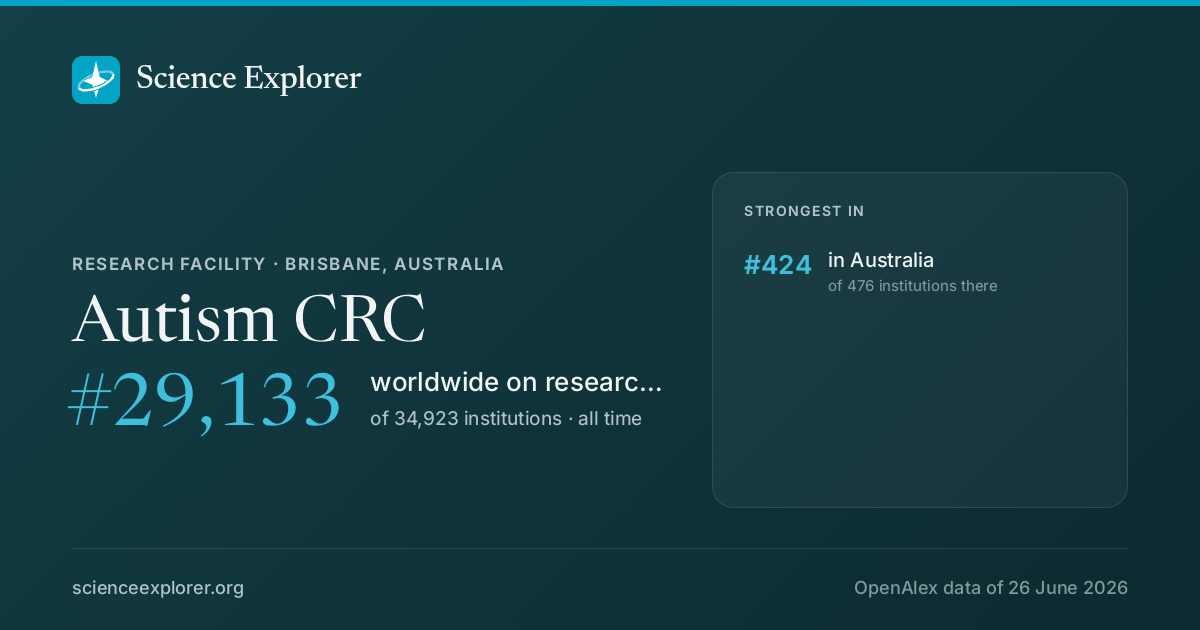
- World rank, all time
- #29,133 of 34,923
- Rank in Australia
- #424 of 476
- Research works
- 181 ▼ 27% vs 2018-21
- Citations
- 7k 38.5 per fractional work
- Top-10% rate
- 28.8% all institutions 10.0%
- vs its own fields
- 1.12× 1.00× is exactly expected
- Open access
- 57% world 40%
- International
- 30% world 18%
Which fields of science does Autism CRC work in?
In 2022-now, 53% of research at Autism CRC is in Social Sciences, 30% in Life Sciences. Its largest fields are Psychology (40%), Neuroscience (28%), Social Sciences (12%). It does 1.9× the world's share of Social Sciences.
Each ring splits the one inside it: the four domains of science, their fields, their subfields. Size is fractional works in 2022-now. Every slice is a page; the interactive view zooms down to single topics and colours each by how much more of it this institution does than the world.
Its 4 domains and 12 fields, with their numbers
- Social Sciences3053.3%
- Psychology2340.3%
- Social Sciences712.2%
- Business, Management and Accounting00.8%
- Arts and Humanities00.1%
- Life Sciences1729.7%
- Health Sciences916.4%
- Medicine610.9%
- Health Professions35.2%
- Dentistry00.3%
- Nursing00.0%
- Physical Sciences00.6%
- Computer Science00.3%
- Engineering00.3%
What does Autism CRC specialise in?
Where its research is concentrated relative to its size: Psychology takes 13.2× the share of its output that it takes of world research.
- PsychologyField · 22.7 works13×
Location quotient, a volume reading rather than an impact one. It surfaces small, lopsided specialities.
Field profile
Location quotient across every field it publishes in: outside the ring is more than an institution of this size would be expected to publish, inside it is less.
Rings at 0.5×, 1× and 2×. Widest outward: Neuroscience, 17.6×. Every wedge is a field page.
All 12 fields, with their numbers
- Neuroscience17.55×16 works
- Psychology13.22×23 works
- Health Professions1.96×3 works
- Social Sciences0.96×7 works
- Dentistry0.61×0 works
- Medicine0.57×6 works
- Business, Management and Accounting0.24×0 works
- Biochemistry, Genetics and Molecular Biology0.23×1 works
- Nursing0.07×0 works
- Computer Science0.04×0 works
- Engineering0.02×0 works
- Arts and Humanities0.02×0 works
Who are the top researchers at Autism CRC?
Ranked on the quality score, Melanie Heyworth, Ru Ying Cai and Vicki Gibbs lead among researchers whose main affiliation is Autism CRC.
- 1
Melanie Heyworth
 Australia · #193,280 worldwide
1.2k citations · 59 works
- 2
Ru Ying Cai
Australia · #398,948 worldwide
2.4k citations · 102 works
- 3
Vicki Gibbs
Australia · #466,316 worldwide
963 citations · 64 works
- 4
Chris Edwards
Australia · #794,078 worldwide
402 citations · 45 works
- 5
Abigail M. A. Love
Australia · #1,026,405 worldwide
654 citations · 63 works
- 6
Jill K. Ashburner
Australia · #1,229,141 worldwide
2k citations · 68 works
- 7
Trevor Clark
Australia · #1,519,806 worldwide
852 citations · 23 works
- 8
Fiona Aldridge
Australia · #1,718,211 worldwide
613 citations · 42 works
- 9
Debra Costley
Australia · #1,900,970 worldwide
1.3k citations · 40 works
- 10
Susan Bruck
Australia · #1,996,984 worldwide
522 citations · 25 works
Which keywords describe research at Autism CRC?
By fractional works in 2022-now, weighted toward what it does more of than the world: Autism Spectrum Disorders, Epidemiology, Genetics, Executive Functioning, Emotion Recognition, Neuroanatomy, Neurodevelopmental Disorders and Brain Connectivity.
- Intersectionality
- Neuroscience
- Digital Technology
- Feeding Problems
- Child Development
- Prevalence
- Parenting
- Behavioral Problems
- Special Education
- Psychopathology
- Evidence-Based Practice
- Adolescents
- Depression
- Mental Health
- Caregiver Well-Being
- Resilience
- Brain Connectivity
- Neuroanatomy
- Executive Functioning
- Epidemiology
- Autism Spectrum Disorders
- Genetics
- Emotion Recognition
- Neurodevelopmental Disorders
- Social Skills Interventions
- Coping Strategies
- Parenting Stress
- Quality of Life
- Emotion Regulation
- Developmental Trajectories
- Children
- Anxiety Disorders
- Behavioral Interventions
- Functional Analysis
- Positive Behavior Support
- Meta-Analysis
- Well-being
- Sensory Sensitivity
- Parental Mediation
- Comorbidity
Size is fractional works in 2022-now in the topics tagged with each word; colour is the word's share of this institution's work against its share of the world's. The 40 words are chosen for being large and distinctive. Each links to the topic it comes from most.
All 40 words, with their numbers
- Autism Spectrum Disorders17▲ 303×2 topics
- Epidemiology17▲ 7.6×10 topics
- Genetics17▲ 42×2 topics
- Executive Functioning16▲ 221×2 topics
- Emotion Recognition16▲ 141×3 topics
- Neuroanatomy16▲ 272×3 topics
- Neurodevelopmental Disorders16▲ 209×3 topics
- Brain Connectivity16▲ 294×1 topic
- Social Skills Interventions16▲ 432×1 topic
- Resilience12▲ 45×5 topics
- Coping Strategies12▲ 86×4 topics
- Caregiver Well-Being12▲ 407×1 topic
- Parenting Stress12▲ 310×1 topic
- Mental Health5▲ 5.8×10 topics
- Quality of Life4▲ 4.4×9 topics
- Depression4▲ 7.0×6 topics
- Emotion Regulation4▲ 20×4 topics
- Adolescents3▲ 17×4 topics
- Developmental Trajectories3▲ 45×2 topics
- Evidence-Based Practice3▲ 40×3 topics
- Children3▲ 22×2 topics
- Psychopathology3▲ 27×2 topics
- Anxiety Disorders3▲ 42×2 topics
- Special Education3▲ 76×2 topics
- Behavioral Interventions2▲ 53×2 topics
- Behavioral Problems2▲ 54×1 topic
- Functional Analysis2▲ 122×1 topic
- Parenting2▲ 35×1 topic
- Positive Behavior Support2▲ 245×1 topic
- Prevalence2▲ 8.5×3 topics
- Meta-Analysis2▲ 5.7×4 topics
- Child Development2▲ 7.8×5 topics
- Well-being2▲ 7.9×6 topics
- Feeding Problems2▲ 79×1 topic
- Sensory Sensitivity2▲ 79×1 topic
- Digital Technology1▲ 25×1 topic
- Parental Mediation1▲ 50×1 topic
- Neuroscience1▲ 7.7×3 topics
- Comorbidity1▲ 19×2 topics
- Intersectionality1▲ 10×2 topics
Which research topics does Autism CRC publish most on?
By volume in 2022-now: Autism Spectrum Disorder Research, Family and Disability Support Research, Behavioral and Psychological Studies and Child and Adolescent Psychosocial and Emotional Development.
Area is fractional works; colour is the subfield each topic belongs to.
- 1 Autism Spectrum Disorder Research Cognitive Neuroscience 16 works
- 2 Family and Disability Support Research Clinical Psychology 12 works
- 3 Behavioral and Psychological Studies Developmental and Educational Psychology 2 works
- 4 Child and Adolescent Psychosocial and Emotional Development Clinical Psychology 2 works
- 5 Child Nutrition and Feeding Issues Psychiatry and Mental health 2 works
- 6 Child Development and Digital Technology Education 1 works
- 7 Disability Education and Employment Safety Research 1 works
- 8 Attention Deficit Hyperactivity Disorder Psychiatry and Mental health 1 works
- 9 Disability Rights and Representation Safety Research 1 works
- 10 Assistive Technology in Communication and Mobility Occupational Therapy 1 works
How open and international is its research?
Against the world's own shares: the tick on each track. Both are shares of its output, so they sit on one scale and can be read against each other as well as against the world.
World: 40% of research is openly available.
World: 18% is written across borders.
How has Autism CRC's research output changed?
Output in 2022-2025 was 27% lower than in 2018-2021.
The same series as a ribbon: one cell per year, darker for more. The line above answers how much; this answers when.
Its share of all research
Growing output can still be a shrinking share: all of science grows. This is Autism CRC as a percentage of every work published that year, 0.00023% in 2024.
Fractional works of Autism CRC over all fractional works that year. How the balance of science has shifted.
Other research institutions in Brisbane
- The University of Queensland
- Griffith University
- Queensland University of Technology
- Australian Catholic University
- Queensland Health
- QIMR Berghofer Medical Research Institute
- Boeing (Australia)
- Queensland Government
Share Autism CRC's ranking
Badges for a website1Each links back here and updates with every snapshot

Research measures only: rankings here say nothing about teaching, admissions or student experience. Comparable institutions and collaboration partners have tabs of their own, above.
Discussion
Ask a question or share a note about Autism CRC. Keep it to the research: no personal attacks, advertising or links. Any reader can report a post, which collapses it for everyone until it is opened.