Behavior Therapy Associates
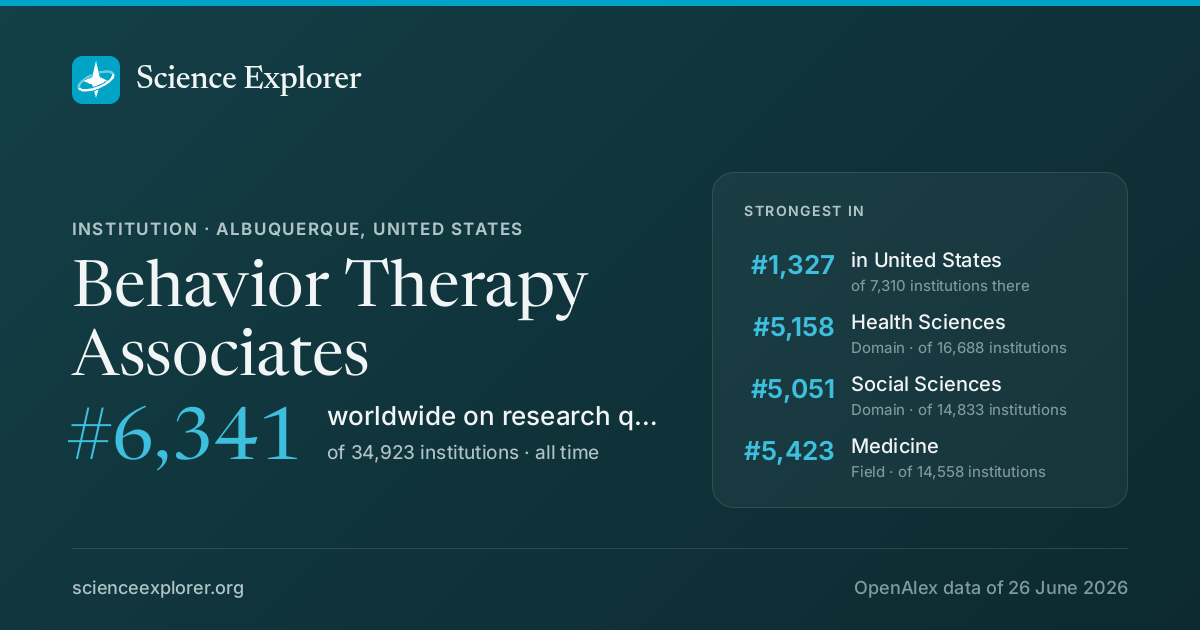
In research, Behavior Therapy Associates stands highest in Health Sciences (#5,158 of 16,688 worldwide), Social Sciences (#5,051 of 14,833 worldwide) and Medicine (#5,423 of 14,558 worldwide), over all time.
- World rank, all time
- #6,341 of 34,923
- Rank in United States
- #1,327 of 7,310
- Research works
- 1.1k ▲ 50% vs 2018-21
- Citations
- 12k 11.1 per fractional work
- Top-10% rate
- 6.8% all institutions 10.0%
- vs its own fields
- 0.96× 1.00× is exactly expected
- Open access
- 6% world 40%
- International
- 4% world 18%
What is Behavior Therapy Associates known for in research?
The fields where it stands highest, over all time, ranked among every institution above the floor in each field.
| Field | World rank | Where that sits | Top-10% rate | Works |
|---|---|---|---|---|
| Health SciencesDomain | #5,158 of 16,688 | 9.5% | 301 | |
| Social SciencesDomain | #5,051 of 14,833 | 10.9% | 579 | |
| MedicineField | #5,423 of 14,558 | 9.3% | 246 | |
| PsychologyField | #1,269 of 3,404 | 11.7% | 304 | |
| Life SciencesDomain | #5,657 of 11,023 | 8.1% | 129 | |
| Social SciencesField | #4,883 of 9,330 | 10.3% | 179 | |
| Clinical PsychologySubfield | #811 of 1,390 | 16.1% | 131 |
Each strip is that field's whole ranked pool, with the notch where Behavior Therapy Associates sits in it, in the colour of the band that rank falls in. The track under the rate is the rate itself: it carries no average mark, because the average differs by field (from about 6% in Dentistry to 21% in Economics).
Which fields of science does Behavior Therapy Associates work in?
In 2022-now, 49% of research at Behavior Therapy Associates is in Social Sciences, 32% in Health Sciences. Its largest fields are Psychology (37%), Medicine (22%), Neuroscience (11%). It does 1.8× the world's share of Social Sciences.
Each ring splits the one inside it: the four domains of science, their fields, their subfields. Size is fractional works in 2022-now. Every slice is a page; the interactive view zooms down to single topics and colours each by how much more of it this institution does than the world.
Its 4 domains and 18 fields, with their numbers
- Social Sciences2148.8%
- Health Sciences1431.8%
- Medicine921.5%
- Health Professions48.5%
- Veterinary11.4%
- Nursing00.4%
- Life Sciences614.4%
- Physical Sciences25.0%
- Environmental Science12.7%
- Earth and Planetary Sciences00.8%
- Computer Science00.8%
- Engineering00.6%
- Chemistry00.2%
Field profile
Location quotient across every field it publishes in: outside the ring is more than an institution of this size would be expected to publish, inside it is less.
Rings at 0.5×, 1× and 2×. Widest outward: Psychology, 12.2×. Every wedge is a field page.
All 18 fields, with their numbers
- Psychology12.19×16 works
- Veterinary10.32×1 works
- Neuroscience6.70×5 works
- Health Professions3.22×4 works
- Medicine1.12×9 works
- Decision Sciences1.06×0 works
- Immunology and Microbiology0.95×0 works
- Business, Management and Accounting0.83×1 works
- Nursing0.78×0 works
- Social Sciences0.58×3 works
- Environmental Science0.54×1 works
- Earth and Planetary Sciences0.52×0 works
- Biochemistry, Genetics and Molecular Biology0.32×1 works
- Economics, Econometrics and Finance0.29×0 works
- Agricultural and Biological Sciences0.17×0 works
- Chemistry0.12×0 works
- Computer Science0.10×0 works
- Engineering0.04×0 works
- Psychology 12.2×
- Veterinary 10.3×
- Neuroscience 6.7×
- Health Professions 3.2×
- Medicine 1.1×
- Decision Sciences 1.1×
- Immunology and Microbiology 0.9×
- Business, Management and Accounting 0.8×
- Nursing 0.8×
- Social Sciences 0.6×
- Environmental Science 0.5×
- Earth and Planetary Sciences 0.5×
- Biochemistry, Genetics and Molecular Biology 0.3×
- Economics, Econometrics and Finance 0.3×
- Agricultural and Biological Sciences 0.2×
- Chemistry 0.1×
- Computer Science 0.1×
- Engineering 0.0×
Who are the top researchers at Behavior Therapy Associates?
Ranked on the quality score, Reid K. Hester, Sam Goldstein and Richard A. Marafiote lead among researchers whose main affiliation is Behavior Therapy Associates.
- 1
Reid K. Hester
 United States · #998,666 worldwide
2.7k citations · 42 works
- 2
Sam Goldstein
United States · #1,896,926 worldwide
4.4k citations · 297 works
- 3
Richard A. Marafiote
United States · #2,050,555 worldwide
357 citations · 20 works
- 4
Sam Goldstein
United States · #2,093,369 worldwide
43 citations · 126 works
- 5
Suzanne Hetts
United States · #2,293,926 worldwide
882 citations · 19 works
- 6
Melissa L. DeVries
United States · #3,047,244 worldwide
204 citations · 33 works
- 7
Gary G. Forrest
United States · #3,704,062 worldwide
141 citations · 18 works
- 8
Sam Goldstein
United States · #3,759,651 worldwide
6k citations · 693 works
- 9
Jean M Baker
United States · #5,155,540 worldwide
70 citations · 41 works
Which keywords describe research at Behavior Therapy Associates?
By fractional works in 2022-now, weighted toward what it does more of than the world: Genetics, Autism Spectrum Disorders, Epidemiology, Emotion Recognition, Mental Health, Psychopathology, Early Intervention and Executive Functioning.
- Sensory Sensitivity
- Family Quality of Life
- Comorbidity
- Attention-Deficit/Hyperactivity Disorder
- Neurobiology
- Children
- Treatment
- DSM-5
- Anxiety Disorders
- Personality Traits
- Prevalence
- Depression
- Functional Analysis
- Adolescents
- Social Skills Interventions
- Evidence-Based Practice
- Executive Functioning
- Psychopathology
- Mental Health
- Genetics
- Epidemiology
- Autism Spectrum Disorders
- Emotion Recognition
- Early Intervention
- Brain Connectivity
- Neurodevelopmental Disorders
- Special Education
- Behavioral Interventions
- Emotion Regulation
- Neurobiological Correlates
- Resilience
- Meta-Analysis
- Borderline Personality Disorder
- Coping Strategies
- Parenting Stress
- Developmental Trajectories
- ADHD
- Caregiver Well-Being
- Executive Function
- Feeding Problems
Size is fractional works in 2022-now in the topics tagged with each word; colour is the word's share of this institution's work against its share of the world's. The 40 words are chosen for being large and distinctive. Each links to the topic it comes from most.
All 40 words, with their numbers
- Epidemiology7▲ 3.8×17 topics
- Genetics6▲ 19×5 topics
- Autism Spectrum Disorders5▲ 118×2 topics
- Mental Health4▲ 7.1×16 topics
- Emotion Recognition4▲ 50×3 topics
- Psychopathology4▲ 53×3 topics
- Early Intervention4▲ 102×2 topics
- Executive Functioning4▲ 72×2 topics
- Brain Connectivity4▲ 95×2 topics
- Evidence-Based Practice4▲ 65×4 topics
- Neurodevelopmental Disorders4▲ 67×1 topic
- Social Skills Interventions4▲ 138×1 topic
- Special Education3▲ 122×3 topics
- Adolescents3▲ 19×4 topics
- Behavioral Interventions3▲ 83×1 topic
- Functional Analysis3▲ 195×1 topic
- Emotion Regulation3▲ 21×6 topics
- Depression3▲ 7.3×8 topics
- Neurobiological Correlates3▲ 60×3 topics
- Prevalence3▲ 14×6 topics
- Resilience3▲ 12×7 topics
- Personality Traits2▲ 43×2 topics
- Meta-Analysis2▲ 9.0×4 topics
- Anxiety Disorders2▲ 43×2 topics
- Borderline Personality Disorder2▲ 241×1 topic
- DSM-52▲ 241×1 topic
- Coping Strategies2▲ 18×3 topics
- Treatment2▲ 3.7×6 topics
- Parenting Stress2▲ 62×2 topics
- Children2▲ 19×1 topic
- Developmental Trajectories2▲ 35×1 topic
- Neurobiology2▲ 14×3 topics
- ADHD1▲ 85×1 topic
- Attention-Deficit/Hyperactivity Disorder1▲ 85×1 topic
- Caregiver Well-Being1▲ 59×1 topic
- Comorbidity1▲ 29×2 topics
- Executive Function1▲ 62×2 topics
- Family Quality of Life1▲ 59×1 topic
- Feeding Problems1▲ 82×1 topic
- Sensory Sensitivity1▲ 82×1 topic
Which research topics does Behavior Therapy Associates publish most on?
By volume in 2022-now: Autism Spectrum Disorder Research, Behavioral and Psychological Studies, Personality Disorders and Psychopathology and Child and Adolescent Psychosocial and Emotional Development.
Area is fractional works; colour is the subfield each topic belongs to.
- 1 Autism Spectrum Disorder Research Cognitive Neuroscience 4 works
- 2 Behavioral and Psychological Studies Developmental and Educational Psychology 3 works
- 3 Personality Disorders and Psychopathology Clinical Psychology 2 works
- 4 Child and Adolescent Psychosocial and Emotional Development Clinical Psychology 2 works
- 5 Attention Deficit Hyperactivity Disorder Psychiatry and Mental health 1 works
- 6 Family and Disability Support Research Clinical Psychology 1 works
- 7 Child Nutrition and Feeding Issues Psychiatry and Mental health 1 works
- 8 Psychotherapy Techniques and Applications Clinical Psychology 1 works
- 9 Digital Marketing and Social Media Sociology and Political Science 0 works
- 10 Adolescent and Pediatric Healthcare Speech and Hearing 0 works
How open and international is its research?
Against the world's own shares: the tick on each track. Both are shares of its output, so they sit on one scale and can be read against each other as well as against the world.
World: 40% of research is openly available.
World: 18% is written across borders.
How has Behavior Therapy Associates's research output changed?
Output in 2022-2025 was 50% higher than in 2018-2021.
The same series as a ribbon: one cell per year, darker for more. The line above answers how much; this answers when.
Its share of all research
Growing output can still be a shrinking share: all of science grows. This is Behavior Therapy Associates as a percentage of every work published that year, 0.00028% in 2024.
Fractional works of Behavior Therapy Associates over all fractional works that year. How the balance of science has shifted.
Other research institutions in Albuquerque
- University of New Mexico
- Sandia National Laboratories
- Presbyterian Hospital
- Radiology Associates of Albuquerque
- Management Sciences (United States)
- Youth Development
- Lovelace Respiratory Research Institute
- Applied Research Associates (United States)
Share Behavior Therapy Associates's ranking
Badges for a website1Each links back here and updates with every snapshot

Research measures only: rankings here say nothing about teaching, admissions or student experience. Comparable institutions and collaboration partners have tabs of their own, above.
Discussion
Ask a question or share a note about Behavior Therapy Associates. Posts are plain text and can be reported.