Science Explorer Back to mapMap
Discussion
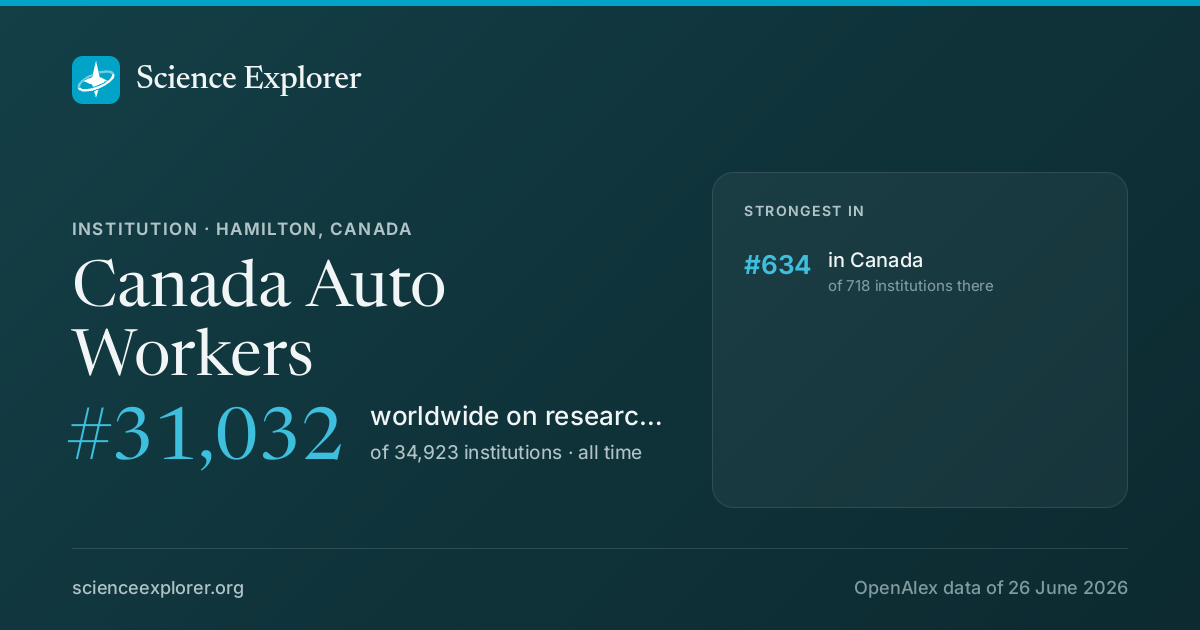
Institution · Hamilton · Canada

Canada Auto Workers

World rank, all time
#31,032
of 34,923
Rank in Canada
#634
of 718
Research works
130
▲ 14% vs 2018-21
Citations
2.1k
16.2 per fractional work
Top-10% rate
9.8%
all institutions 10.0%
vs its own fields
0.94×
1.00× is exactly expected
Open access
29%
world 40%
International
24%
world 18%

Which fields of science does Canada Auto Workers work in?

In 2022-now, 36% of research at Canada Auto Workers is in Health Sciences, 34% in Social Sciences. Its largest fields are Social Sciences (26%), Medicine (26%), Environmental Science (12%). It does 1.3× the world's share of Health Sciences.

Health Sciences: 8 fractional works · 36.0% of its workMedicine: 6 fractional works · 26.1% of its workPublic Health, Environmental and Occupational Health: 1 fractional works · 6.9% of its workPulmonary and Respiratory Medicine: 1 fractional works · 4.2% of its workPediatrics, Perinatology and Child Health: 1 fractional works · 3.3% of its workSurgery: 0 fractional works · 2.3% of its workPharmacology: 0 fractional works · 1.9% of its workNephrology: 0 fractional works · 1.6% of its workPhysiology: 0 fractional works · 1.6% of its workRadiology, Nuclear Medicine and Imaging: 0 fractional works · 1.6% of its workEpidemiology: 0 fractional works · 0.9% of its workEndocrinology, Diabetes and Metabolism: 0 fractional works · 0.4% of its workOtorhinolaryngology: 0 fractional works · 0.4% of its workEmergency Medicine: 0 fractional works · 0.3% of its workPathology and Forensic Medicine: 0 fractional works · 0.3% of its workRehabilitation: 0 fractional works · 0.3% of its workSmaller subfields together: 0 fractional works · 0.3% of its workHealth Professions: 2 fractional works · 9.2% of its workGeneral Health Professions: 1 fractional works · 4.6% of its workEmergency Medical Services: 0 fractional works · 1.7% of its workRadiological and Ultrasound Technology: 0 fractional works · 1.4% of its workOccupational Therapy: 0 fractional works · 0.8% of its workSpeech and Hearing: 0 fractional works · 0.4% of its workHealth Information Management: 0 fractional works · 0.3% of its workNursing: 0 fractional works · 0.7% of its workNutrition and Dietetics: 0 fractional works · 0.5% of its workSmaller subfields together: 0 fractional works · 0.1% of its workSocial Sciences: 7 fractional works · 34.5% of its workSocial Sciences: 6 fractional works · 26.4% of its workEducation: 2 fractional works · 10.4% of its workSociology and Political Science: 2 fractional works · 8.2% of its workPolitical Science and International Relations: 1 fractional works · 2.9% of its workGender Studies: 0 fractional works · 1.7% of its workSafety Research: 0 fractional works · 1.6% of its workHealth: 0 fractional works · 0.5% of its workPublic Administration: 0 fractional works · 0.5% of its workTransportation: 0 fractional works · 0.5% of its workEconomics, Econometrics and Finance: 1 fractional works · 2.7% of its workEconomics and Econometrics: 1 fractional works · 2.7% of its workPsychology: 0 fractional works · 2.3% of its workClinical Psychology: 0 fractional works · 1.5% of its workSocial Psychology: 0 fractional works · 0.5% of its workApplied Psychology: 0 fractional works · 0.3% of its workDecision Sciences: 0 fractional works · 1.9% of its workStatistics, Probability and Uncertainty: 0 fractional works · 1.0% of its workManagement Science and Operations Research: 0 fractional works · 0.8% of its workBusiness, Management and Accounting: 0 fractional works · 0.7% of its workOrganizational Behavior and Human Resource Management: 0 fractional works · 0.4% of its workStrategy and Management: 0 fractional works · 0.3% of its workArts and Humanities: 0 fractional works · 0.5% of its workLiterature and Literary Theory: 0 fractional works · 0.5% of its workPhysical Sciences: 6 fractional works · 26.1% of its workEnvironmental Science: 2 fractional works · 11.6% of its workManagement, Monitoring, Policy and Law: 1 fractional works · 3.5% of its workHealth, Toxicology and Mutagenesis: 0 fractional works · 2.3% of its workGlobal and Planetary Change: 0 fractional works · 2.0% of its workWater Science and Technology: 0 fractional works · 1.6% of its workEnvironmental Chemistry: 0 fractional works · 0.8% of its workEnvironmental Engineering: 0 fractional works · 0.8% of its workEcology: 0 fractional works · 0.6% of its workEngineering: 1 fractional works · 5.9% of its workSafety, Risk, Reliability and Quality: 0 fractional works · 1.6% of its workAerospace Engineering: 0 fractional works · 0.9% of its workCivil and Structural Engineering: 0 fractional works · 0.8% of its workBiomedical Engineering: 0 fractional works · 0.8% of its workMedia Technology: 0 fractional works · 0.8% of its workMechanics of Materials: 0 fractional works · 0.6% of its workMechanical Engineering: 0 fractional works · 0.4% of its workSmaller subfields together: 0 fractional works · 0.0% of its workMathematics: 1 fractional works · 3.2% of its workModeling and Simulation: 0 fractional works · 1.6% of its workTheoretical Computer Science: 0 fractional works · 1.6% of its workSmaller subfields together: 0 fractional works · 0.0% of its workComputer Science: 0 fractional works · 1.8% of its workComputer Vision and Pattern Recognition: 0 fractional works · 1.6% of its workInformation Systems: 0 fractional works · 0.3% of its workChemistry: 0 fractional works · 1.6% of its workInorganic Chemistry: 0 fractional works · 1.6% of its workMaterials Science: 0 fractional works · 1.2% of its workMaterials Chemistry: 0 fractional works · 0.8% of its workCeramics and Composites: 0 fractional works · 0.4% of its workChemical Engineering: 0 fractional works · 0.8% of its workChemical Health and Safety: 0 fractional works · 0.8% of its workLife Sciences: 1 fractional works · 3.5% of its workAgricultural and Biological Sciences: 0 fractional works · 2.1% of its workPlant Science: 0 fractional works · 1.8% of its workAgronomy and Crop Science: 0 fractional works · 0.3% of its workImmunology and Microbiology: 0 fractional works · 0.9% of its workMicrobiology: 0 fractional works · 0.8% of its workSmaller subfields together: 0 fractional works · 0.1% of its workNeuroscience: 0 fractional works · 0.2% of its workPharmacology, Toxicology and Pharmaceutics: 0 fractional works · 0.2% of its workBiochemistry, Genetics and Molecular Biology: 0 fractional works · 0.1% of its workALL ITS WORKCanada AutoWorkers21fractional works, 2022-now
Life Sciences3%Physical Sciences26%Health Sciences36%Social Sciences34%

Each ring splits the one inside it: the four domains of science, their fields, their subfields. Size is fractional works in 2022-now. Every slice is a page; the interactive view zooms down to single topics and colours each by how much more of it this institution does than the world.

Its 4 domains and 21 fields, with their numbers
    1. Medicine626.1%
    2. Health Professions29.2%
    3. Nursing00.7%
    1. Social Sciences626.4%
    2. Economics, Econometrics and Finance12.7%
    3. Psychology02.3%
    4. Decision Sciences01.9%
    5. Business, Management and Accounting00.7%
    6. Arts and Humanities00.5%
    1. Environmental Science211.6%
    2. Engineering15.9%
    3. Mathematics13.2%
    4. Computer Science01.8%
    5. Chemistry01.6%
    6. Materials Science01.2%
    7. Chemical Engineering00.8%
    1. Agricultural and Biological Sciences02.1%
    2. Immunology and Microbiology00.9%
    3. Neuroscience00.2%
    4. Pharmacology, Toxicology and Pharmaceutics00.2%
    5. Biochemistry, Genetics and Molecular Biology00.1%
All of science, and how each field's share has moved since 1950: the Science domain explorer

Field profile

Location quotient across every field it publishes in: outside the ring is more than an institution of this size would be expected to publish, inside it is less.

Agricultural and Biological Sciences: 0.44× its world share, 0 worksAgricultural and Bio…Biochemistry, Genetics and Molecular Biology: 0.02× its world share, 0 worksBiochemistry, Geneti…Immunology and Microbiology: 0.90× its world share, 0 worksImmunology and Micro…Neuroscience: 0.12× its world share, 0 worksNeurosciencePharmacology, Toxicology and Pharmaceutics: 0.56× its world share, 0 worksPharmacology, Toxico…Chemical Engineering: 2.25× its world share, 0 worksChemical EngineeringChemistry: 1.00× its world share, 0 worksChemistryComputer Science: 0.24× its world share, 0 worksComputer ScienceEngineering: 0.39× its world share, 1 worksEngineeringEnvironmental Science: 2.34× its world share, 2 worksEnvironmental ScienceMaterials Science: 0.34× its world share, 0 worksMaterials ScienceMathematics: 2.67× its world share, 1 worksMathematicsHealth Professions: 3.50× its world share, 2 worksHealth ProfessionsMedicine: 1.36× its world share, 6 worksMedicineNursing: 1.32× its world share, 0 worksNursingArts and Humanities: 0.18× its world share, 0 worksArts and HumanitiesBusiness, Management and Accounting: 0.21× its world share, 0 worksBusiness, Management…Decision Sciences: 1.97× its world share, 0 worksDecision SciencesEconomics, Econometrics and Finance: 1.25× its world share, 1 worksEconomics, Econometr…Psychology: 0.76× its world share, 0 worksPsychologySocial Sciences: 2.08× its world share, 6 worksSocial Sciences1×world share
more than its size predictsabout as predictedless

Rings at 0.5×, 1× and 2×. Widest outward: Health Professions, 3.5×. Every wedge is a field page.

All 21 fields, with their numbers
  1. Health Professions3.50×2 works
  2. Mathematics2.67×1 works
  3. Environmental Science2.34×2 works
  4. Chemical Engineering2.25×0 works
  5. Social Sciences2.08×6 works
  6. Decision Sciences1.97×0 works
  7. Medicine1.36×6 works
  8. Nursing1.32×0 works
  9. Economics, Econometrics and Finance1.25×1 works
  10. Chemistry1.00×0 works
  11. Immunology and Microbiology0.90×0 works
  12. Psychology0.76×0 works
  13. Pharmacology, Toxicology and Pharmaceutics0.56×0 works
  14. Agricultural and Biological Sciences0.44×0 works
  15. Engineering0.39×1 works
  16. Materials Science0.34×0 works
  17. Computer Science0.24×0 works
  18. Business, Management and Accounting0.21×0 works
  19. Arts and Humanities0.18×0 works
  20. Neuroscience0.12×0 works
  21. Biochemistry, Genetics and Molecular Biology0.02×0 works

Who are the top researchers at Canada Auto Workers?

Ranked on the quality score, John Oudyk, Kevin Hedges and Jim Stanford lead among researchers whose main affiliation is Canada Auto Workers.

  1. 1 John Oudyk Canada · #1,327,859 worldwide 968 citations · 31 works
  2. 2 Kevin Hedges Canada · #1,927,855 worldwide 141 citations · 27 works
  3. 3 Jim Stanford Canada · #3,175,745 worldwide 142 citations · 53 works
All ranked researchers at Canada Auto Workers

What are the most cited papers from Canada Auto Workers?

The most cited paper from Canada Auto Workers is "The Third Version of the Copenhagen Psychosocial Questionnaire" (Hermann Burr, Hanne Berthelsen, Salvador Moncada et al., 2019), with 541 citations. Next come "Hard Times and Vulnerable People: Initial Effects of Plant Closing on Autoworkers' Mental Health" (188) and "Danger zone: Men, masculinity and occupational health and safety in high risk occupations" (178).

Most cited papers
#PaperReleasedCitations
1 The Third Version of the Copenhagen Psychosocial Questionnaire Hermann Burr, Hanne Berthelsen, Salvador Moncada et al. · Safety and Health at Work Open access 6 Nov 2019 541
2 Hard Times and Vulnerable People: Initial Effects of Plant Closing on Autoworkers' Mental Health V. Lee Hamilton, Clifford L. Broman, William S. Hoffman et al. · Journal of Health and Social Behavior Jun 1990 188
3 Danger zone: Men, masculinity and occupational health and safety in high risk occupations Mary Stergiou‐Kita, Elizabeth D. Mansfield, Randy Bezo et al. · Safety Science Open access 14 Aug 2015 178
4 Breast cancer risk in relation to occupations with exposure to carcinogens and endocrine disruptors: a Canadian case–control study James T. Brophy, Margaret M. Keith, Andrew E. Watterson et al. · Environmental Health Open access 19 Nov 2012 144
5 ‘This just isn't sustainable’: Precarious employment, stress and workers' health Marlea Clarke, Wayne A. Lewchuk, Alice De Wolff et al. · International Journal of Law and Psychiatry Jul 2007 137
All 60 most cited papers, with filters and sorting

Which research topics does Canada Auto Workers publish most on?

By volume in 2022-now: Mathematics Education and Teaching Techniques, Opioid Use Disorder Treatment, Prenatal Substance Exposure Effects and Occupational and environmental lung diseases.

  1. 1 Mathematics Education and Teaching Techniques Education 1 works
  2. 2 Opioid Use Disorder Treatment Public Health, Environmental and Occupational Health 1 works
  3. 3 Prenatal Substance Exposure Effects Pediatrics, Perinatology and Child Health 1 works
  4. 4 Occupational and environmental lung diseases Pulmonary and Respiratory Medicine 1 works
  5. 5 Coastal and Marine Management Management, Monitoring, Policy and Law 0 works
  6. 6 Musculoskeletal pain and rehabilitation Pharmacology 0 works
  7. 7 Academic Freedom and Politics Political Science and International Relations 0 works
  8. 8 Gender, Security, and Conflict Gender Studies 0 works
  9. 9 Ethics and Social Impacts of AI Safety Research 0 works
  10. 10 Innovative Teaching Methodologies in Social Sciences Education 0 works

How open and international is its research?

Against the world's own shares: the tick on each track. Both are shares of its output, so they sit on one scale and can be read against each other as well as against the world.

openly available29.0%not open71.0%

World: 40% of research is openly available.

with international co-authors24.2%domestic only75.8%

World: 18% is written across borders.

How has Canada Auto Workers's research output changed?

Output in 2022-2025 was 14% higher than in 2018-2021.

still counting1990200020102020
grewheldshrank

The same series as a ribbon: one cell per year, darker for more. The line above answers how much; this answers when.

Its share of all research

Growing output can still be a shrinking share: all of science grows. This is Canada Auto Workers as a percentage of every work published that year, 0.000065% in 2024.

still counting0.00025%0.00050%0.00075%Canada Auto Workers0.00011% in 202519801990200020102020

Fractional works of Canada Auto Workers over all fractional works that year. How the balance of science has shifted.

Other research institutions in Hamilton

All research institutions in Hamilton

Share Canada Auto Workers's ranking

Canada Auto Workers on Science Explorer

A card with Canada Auto Workers's standing and the fields it leads in, for a post or a slide. A link to this page previews as the same card.

Download the card

1200 × 630 PNG, sized for social posts, drawn from the latest snapshot.

Badges for a website1Each links back here and updates with every snapshot

Research measures only: rankings here say nothing about teaching, admissions or student experience. Comparable institutions and collaboration partners have tabs of their own, above.

Discussion

Ask a question or share a note about Canada Auto Workers. Posts are plain text and can be reported.