China Mobile (China)
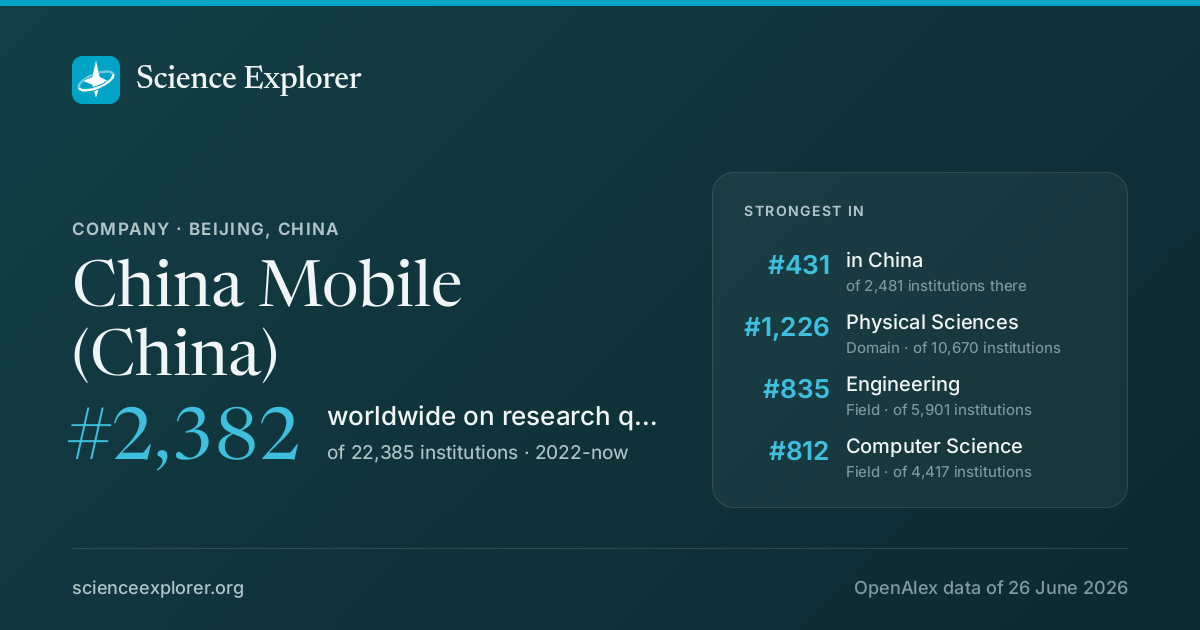
In research, China Mobile (China) stands highest in Physical Sciences (#1,226 of 10,670 worldwide), Engineering (#835 of 5,901 worldwide) and Computer Science (#812 of 4,417 worldwide), 2022-now. Relative to its size it is most specialised in Computer Networks and Communications, Hardware and Architecture and Signal Processing (Computer Networks and Communications is 14.3× its share of world research).
- World rank, 2022-now
- #2,382 of 22,385 · #3,777 all time
- Rank in China
- #431 of 2,481
- Research works
- 5.4k ▲ 240% vs 2018-21
- Citations
- 35k 6.4 per fractional work
- Top-10% rate
- 9.1% all institutions 10.0%
- vs its own fields
- 0.90× 1.00× is exactly expected
- Open access
- 16% world 40%
- International
- 9% world 18%
What is China Mobile (China) known for in research?
The fields where it stands highest, 2022-now, ranked among every institution above the floor in each field.
| Field | World rank | Where that sits | Top-10% rate | Works | All time |
|---|---|---|---|---|---|
| Physical SciencesDomain | #1,226 of 10,670 | 8.6% | 2,091 | #2001 | |
| EngineeringField | #835 of 5,901 | 10.0% | 946 | #1634 | |
| Computer ScienceField | #812 of 4,417 | 7.1% | 1,044 | #1276 | |
| Electrical and Electronic EngineeringSubfield | #468 of 2,176 | 8.9% | 482 | #853 | |
| Computer Networks and CommunicationsSubfield | #285 of 728 | 6.4% | 308 | #726 | |
| Artificial IntelligenceSubfield | #791 of 1,862 | 6.9% | 304 | #1323 | |
| Computer Vision and Pattern RecognitionSubfield | #423 of 963 | 9.4% | 196 | #785 | |
| Aerospace EngineeringSubfield | #392 of 785 | 10.7% | 158 | #849 | |
| Control and Systems EngineeringSubfield | #520 of 804 | 7.5% | 66 | #1364 | |
| Information SystemsSubfield | #903 of 1,321 | 6.0% | 118 | #1732 |
Each strip is that field's whole ranked pool, with the notch where China Mobile (China) sits in it, in the colour of the band that rank falls in. The track under the rate is the rate itself: it carries no average mark, because the average differs by field (from about 6% in Dentistry to 21% in Economics).
Which of those standings moved
The same fields on both windows: where it stood over the whole record, and where it stands in 2022-now. The distance is the story, and it is the one thing the two rank columns above cannot show.
- Physical Sciences#2,001 #1,226
- Engineering#1,634 #835
- Computer Science#1,276 #812
- Electrical and Electronic Engineering#853 #468
- Computer Networks and Communications#726 #285
- Artificial Intelligence#1,323 #791
- Computer Vision and Pattern Recognition#785 #423
- Aerospace Engineering#849 #392
- Control and Systems Engineering#1,364 #520
- Information Systems#1,732 #903
A dot further right is a better standing. Fields it was not ranked in over the whole record are left out.
Which fields of science does China Mobile (China) work in?
In 2022-now, 90% of research at China Mobile (China) is in Physical Sciences, 7% in Social Sciences. Its largest fields are Computer Science (45%), Engineering (40%), Social Sciences (3%). It does 2.3× the world's share of Physical Sciences.
Each ring splits the one inside it: the four domains of science, their fields, their subfields. Size is fractional works in 2022-now. Every slice is a page; the interactive view zooms down to single topics and colours each by how much more of it this institution does than the world.
Its 4 domains and 26 fields, with their numbers
- Physical Sciences2,30989.6%
- Computer Science1,15244.7%
- Engineering1,04040.4%
- Physics and Astronomy411.6%
- Environmental Science271.0%
- Materials Science210.8%
- Earth and Planetary Sciences110.4%
- Energy60.2%
- Mathematics50.2%
- Chemistry30.1%
- Chemical Engineering20.1%
- Social Sciences1786.9%
- Social Sciences682.6%
- Business, Management and Accounting532.1%
- Decision Sciences261.0%
- Psychology220.9%
- Economics, Econometrics and Finance70.3%
- Arts and Humanities20.1%
- Health Sciences481.9%
- Medicine381.5%
- Health Professions80.3%
- Dentistry10.0%
- Veterinary00.0%
- Nursing00.0%
- Life Sciences431.7%
What does China Mobile (China) specialise in?
Where its research is concentrated relative to its size: Computer Networks and Communications takes 14.3× the share of its output that it takes of world research.
- Computer Networks and CommunicationsSubfield · 329.6 works14×
- Hardware and ArchitectureSubfield · 28.2 works9.7×
- Signal ProcessingSubfield · 69.3 works8.9×
- Media TechnologySubfield · 59.9 works7.4×
- Computer Vision and Pattern RecognitionSubfield · 220.6 works6.8×
- Electrical and Electronic EngineeringSubfield · 533.2 works5.8×
- Computer ScienceField · 1,152.5 works5.8×
Location quotient, a volume reading rather than an impact one. It surfaces small, lopsided specialities.
Field profile
Location quotient across every field it publishes in: outside the ring is more than an institution of this size would be expected to publish, inside it is less.
Rings at 0.5×, 1× and 2×. Widest outward: Computer Science, 5.8×. Every wedge is a field page.
All 26 fields, with their numbers
- Computer Science5.75×1,152 works
- Engineering2.69×1,040 works
- Decision Sciences1.03×26 works
- Physics and Astronomy0.72×42 works
- Business, Management and Accounting0.64×53 works
- Neuroscience0.44×18 works
- Earth and Planetary Sciences0.28×11 works
- Psychology0.28×22 works
- Energy0.26×6 works
- Chemical Engineering0.23×2 works
- Materials Science0.23×21 works
- Environmental Science0.21×27 works
- Social Sciences0.21×68 works
- Mathematics0.16×5 works
- Health Professions0.13×8 works
- Economics, Econometrics and Finance0.13×7 works
- Biochemistry, Genetics and Molecular Biology0.12×16 works
- Veterinary0.09×0 works
- Pharmacology, Toxicology and Pharmaceutics0.08×1 works
- Medicine0.08×38 works
- Chemistry0.07×3 works
- Immunology and Microbiology0.06×2 works
- Agricultural and Biological Sciences0.05×6 works
- Dentistry0.04×0 works
- Nursing0.02×0 works
- Arts and Humanities0.02×2 works
- Computer Science 5.8×
- Engineering 2.7×
- Decision Sciences 1.0×
- Physics and Astronomy 0.7×
- Business, Management and Accounting 0.6×
- Neuroscience 0.4×
- Earth and Planetary Sciences 0.3×
- Psychology 0.3×
- Energy 0.3×
- Chemical Engineering 0.2×
- Materials Science 0.2×
- Environmental Science 0.2×
- Social Sciences 0.2×
- Mathematics 0.2×
- Health Professions 0.1×
- Economics, Econometrics and Finance 0.1×
- Biochemistry, Genetics and Molecular Biology 0.1×
- Veterinary 0.1×
- Pharmacology, Toxicology and Pharmaceutics 0.1×
- Medicine 0.1×
- Chemistry 0.1×
- Immunology and Microbiology 0.1×
- Agricultural and Biological Sciences 0.1×
- Dentistry 0.0×
- Nursing 0.0×
- Arts and Humanities 0.0×
Who are the top researchers at China Mobile (China)?
Ranked on the quality score, Shuangfeng Han, I Chih‐Lin and Qixing Wang lead among researchers whose main affiliation is China Mobile (China).
- 1
Shuangfeng Han
 China · #357,376 worldwide
12k citations · 106 works
- 2
I Chih‐Lin
China · #479,466 worldwide
19k citations · 289 works
- 3
Qixing Wang
China · #487,809 worldwide
3.7k citations · 199 works
- 4
Jinri Huang
China · #762,950 worldwide
839 citations · 38 works
- 5
Lu Lu
China · #853,069 worldwide
1.8k citations · 84 works
- 6
Yifei Yuan
China · #855,549 worldwide
1.4k citations · 117 works
- 7
Chao Deng
China · #950,745 worldwide
912 citations · 68 works
- 8
Leyi Zhang
China · #1,010,750 worldwide
902 citations · 74 works
- 9
Zhikun Xu
China · #1,114,713 worldwide
4k citations · 93 works
- 10
Qi Sun
China · #1,159,798 worldwide
4.1k citations · 71 works
Which keywords describe research at China Mobile (China)?
By fractional works in 2022-now, weighted toward what it does more of than the world: Deep Learning, Energy Efficiency, Internet of Things, Neural Networks, Machine Learning, 5G Networks, Security and Wireless Sensor Networks.
- Information Retrieval
- Intelligent Reflecting Surfaces
- Resource Allocation
- Cellular Networks
- IoT
- Channel Modeling
- Cloud Computing
- Heterogeneous Networks
- Anomaly Detection
- Wireless Communication
- 5G
- Wireless Communications
- Data Mining
- Wireless Networks
- Massive MIMO
- IoT Security
- Big Data
- 5G Networks
- Energy Efficiency
- Machine Learning
- Deep Learning
- Neural Networks
- Internet of Things
- Security
- Wireless Sensor Networks
- Smart Cities
- Convolutional Neural Networks
- Healthcare
- Security and Privacy
- Channel Estimation
- Edge Computing
- Mobile Edge Computing
- MIMO Systems
- Distributed Systems
- Spectral Efficiency
- Beamforming
- Fog Computing
- Interference Alignment
- Cybersecurity
- Non-Orthogonal Multiple Access
Size is fractional works in 2022-now in the topics tagged with each word; colour is the word's share of this institution's work against its share of the world's. The 40 words are chosen for being large and distinctive. Each links to the topic it comes from most.
All 40 words, with their numbers
- Deep Learning555▲ 6.2×82 topics
- Machine Learning231▲ 2.7×78 topics
- Neural Networks216▲ 5.4×37 topics
- Energy Efficiency210▲ 8.8×26 topics
- Internet of Things188▲ 8.5×26 topics
- 5G Networks126▲ 24×5 topics
- Security117▲ 6.8×20 topics
- Big Data113▲ 4.6×25 topics
- Wireless Sensor Networks107▲ 9.2×21 topics
- IoT Security106▲ 13×3 topics
- Smart Cities105▲ 15×6 topics
- Massive MIMO104▲ 50×3 topics
- Convolutional Neural Networks95▲ 5.1×14 topics
- Wireless Networks94▲ 24×9 topics
- Healthcare91▲ 3.1×12 topics
- Data Mining87▲ 4.6×17 topics
- Security and Privacy87▲ 18×3 topics
- Wireless Communications87▲ 19×5 topics
- Channel Estimation86▲ 38×4 topics
- 5G85▲ 57×3 topics
- Edge Computing82▲ 25×2 topics
- Wireless Communication81▲ 22×7 topics
- Mobile Edge Computing78▲ 19×2 topics
- Anomaly Detection76▲ 10×5 topics
- MIMO Systems75▲ 37×3 topics
- Heterogeneous Networks72▲ 28×2 topics
- Distributed Systems70▲ 16×6 topics
- Cloud Computing65▲ 8.8×13 topics
- Spectral Efficiency62▲ 37×2 topics
- Channel Modeling60▲ 19×6 topics
- Beamforming59▲ 22×4 topics
- IoT57▲ 5.9×15 topics
- Fog Computing57▲ 19×2 topics
- Cellular Networks55▲ 45×1 topic
- Interference Alignment55▲ 45×1 topic
- Resource Allocation50▲ 11×8 topics
- Cybersecurity48▲ 7.5×4 topics
- Intelligent Reflecting Surfaces48▲ 46×1 topic
- Non-Orthogonal Multiple Access48▲ 46×1 topic
- Information Retrieval46▲ 8.2×5 topics
Which research topics does China Mobile (China) publish most on?
By volume in 2022-now: IoT and Edge/Fog Computing, Advanced MIMO Systems Optimization, Advanced Wireless Communication Technologies and Software-Defined Networks and 5G.
Area is fractional works; colour is the subfield each topic belongs to.
- 1 IoT and Edge/Fog Computing Computer Networks and Communications 56 works
- 2 Advanced MIMO Systems Optimization Electrical and Electronic Engineering 55 works
- 3 Advanced Wireless Communication Technologies Electrical and Electronic Engineering 48 works
- 4 Software-Defined Networks and 5G Computer Networks and Communications 42 works
- 5 Network Security and Intrusion Detection Computer Networks and Communications 37 works
- 6 Telecommunications and Broadcasting Technologies Media Technology 36 works
- 7 Optical Network Technologies Electrical and Electronic Engineering 34 works
- 8 Topic Modeling Artificial Intelligence 33 works
- 9 Advanced Photonic Communication Systems Electrical and Electronic Engineering 30 works
- 10 Privacy-Preserving Technologies in Data Artificial Intelligence 29 works
How open and international is its research?
Against the world's own shares: the tick on each track. Both are shares of its output, so they sit on one scale and can be read against each other as well as against the world.
World: 40% of research is openly available.
World: 18% is written across borders.
How has China Mobile (China)'s research output changed?
Output in 2022-2025 was 240% higher than in 2018-2021.
The same series as a ribbon: one cell per year, darker for more. The line above answers how much; this answers when.
Its share of all research
Growing output can still be a shrinking share: all of science grows. This is China Mobile (China) as a percentage of every work published that year, 0.012% in 2024.
Fractional works of China Mobile (China) over all fractional works that year. How the balance of science has shifted.
How much of it reaches the world top 10%
Year by year, against all institutions in the same year.
Of each year's output, the share that reached the world's 10% most cited for its field and year. Peak 11.0% in 2017.
Other research institutions in Beijing
- Chinese Academy of Sciences
- Tsinghua University
- Peking University
- Chinese Academy of Agricultural Sciences
- University of Chinese Academy of Sciences
- Beihang University
- Beijing Institute of Technology
- Capital Medical University

Share China Mobile (China)'s ranking
Badges for a website1Each links back here and updates with every snapshot

Research measures only: rankings here say nothing about teaching, admissions or student experience. Comparable institutions and collaboration partners have tabs of their own, above.
Discussion
Ask a question or share a note about China Mobile (China). Posts are plain text and can be reported.