Flanders Hydraulics
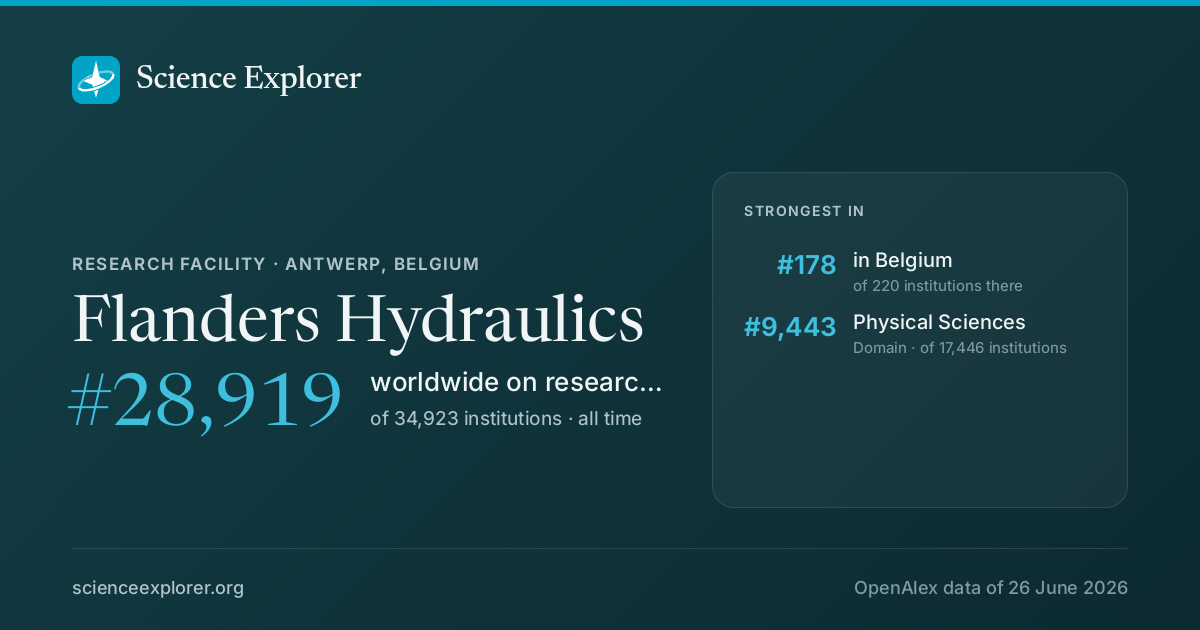
In research, Flanders Hydraulics stands highest in Physical Sciences (#9,443 of 17,446 worldwide), over all time.
- World rank, all time
- #28,919 of 34,923
- Rank in Belgium
- #178 of 220
- Research works
- 210 ▼ 25% vs 2018-21
- Citations
- 3.8k 18.0 per fractional work
- Top-10% rate
- 8.8% all institutions 10.0%
- vs its own fields
- 0.99× 1.00× is exactly expected
- Open access
- 56% world 40%
- International
- 41% world 18%
What is Flanders Hydraulics known for in research?
The fields where it stands highest, over all time, ranked among every institution above the floor in each field.
| Field | World rank | Where that sits | Top-10% rate | Works |
|---|---|---|---|---|
| Physical SciencesDomain | #9,443 of 17,446 | 11.1% | 184 |
Each strip is that field's whole ranked pool, with the notch where Flanders Hydraulics sits in it, in the colour of the band that rank falls in. The track under the rate is the rate itself: it carries no average mark, because the average differs by field (from about 6% in Dentistry to 21% in Economics).
Which fields of science does Flanders Hydraulics work in?
In 2022-now, 83% of research at Flanders Hydraulics is in Physical Sciences, 8% in Health Sciences. Its largest fields are Engineering (31%), Environmental Science (28%), Earth and Planetary Sciences (17%). It does 2.0× the world's share of Physical Sciences.
Each ring splits the one inside it: the four domains of science, their fields, their subfields. Size is fractional works in 2022-now. Every slice is a page; the interactive view zooms down to single topics and colours each by how much more of it this institution does than the world.
Its 4 domains and 17 fields, with their numbers
- Physical Sciences3783.1%
- Engineering1430.8%
- Environmental Science1328.5%
- Earth and Planetary Sciences816.8%
- Energy24.5%
- Physics and Astronomy11.4%
- Computer Science00.7%
- Mathematics00.2%
- Chemical Engineering00.2%
- Health Sciences47.8%
- Medicine25.6%
- Health Professions11.5%
- Nursing00.7%
- Life Sciences25.1%
- Social Sciences24.0%
Field profile
Location quotient across every field it publishes in: outside the ring is more than an institution of this size would be expected to publish, inside it is less.
Rings at 0.5×, 1× and 2×. Widest outward: Earth and Planetary Sciences, 10.7×. Every wedge is a field page.
All 17 fields, with their numbers
- Earth and Planetary Sciences10.72×8 works
- Environmental Science5.73×13 works
- Energy4.86×2 works
- Engineering2.05×14 works
- Nursing1.52×0 works
- Immunology and Microbiology1.48×1 works
- Agricultural and Biological Sciences0.74×2 works
- Physics and Astronomy0.61×1 works
- Health Professions0.56×1 works
- Chemical Engineering0.53×0 works
- Economics, Econometrics and Finance0.35×0 works
- Medicine0.29×2 works
- Business, Management and Accounting0.23×0 works
- Mathematics0.21×0 works
- Social Sciences0.20×1 works
- Computer Science0.10×0 works
- Biochemistry, Genetics and Molecular Biology0.02×0 works
- Earth and Planetary Sciences 10.7×
- Environmental Science 5.7×
- Energy 4.9×
- Engineering 2.0×
- Nursing 1.5×
- Immunology and Microbiology 1.5×
- Agricultural and Biological Sciences 0.7×
- Physics and Astronomy 0.6×
- Health Professions 0.6×
- Chemical Engineering 0.5×
- Economics, Econometrics and Finance 0.3×
- Medicine 0.3×
- Business, Management and Accounting 0.2×
- Mathematics 0.2×
- Social Sciences 0.2×
- Computer Science 0.1×
- Biochemistry, Genetics and Molecular Biology 0.0×
Who are the top researchers at Flanders Hydraulics?
Ranked on the quality score, Fernando Pereira, Tomohiro Suzuki and Thibaut Van Zwijnsvoorde lead among researchers whose main affiliation is Flanders Hydraulics.
- 1
Fernando Pereira
 Belgium · #2,089,882 worldwide
444 citations · 32 works
- 2
Tomohiro Suzuki
Belgium · #2,210,138 worldwide
6.2k citations · 306 works
- 3
Thibaut Van Zwijnsvoorde
Belgium · #2,946,484 worldwide
188 citations · 24 works
- 4
Peter Viaene
Belgium · #3,101,509 worldwide
536 citations · 25 works
- 5
George P. Schramkowski
Belgium · #3,492,963 worldwide
463 citations · 33 works
- 6
Wouter Vanneuville
Belgium · #3,507,135 worldwide
1.2k citations · 84 works
- 7
Chantal Martens
Belgium · #3,561,012 worldwide
312 citations · 20 works
- 8
Pieter Deckers
Belgium · #3,711,771 worldwide
284 citations · 29 works
- 9
L. Coen
Belgium · #3,723,869 worldwide
100 citations · 16 works
- 10
Sven Smolders
Belgium · #3,724,352 worldwide
389 citations · 53 works
Which keywords describe research at Flanders Hydraulics?
By fractional works in 2022-now, weighted toward what it does more of than the world: Climate Change, Sediment Transport, Remote Sensing, Sea-Level Rise, Wave Modeling, Climate Change Impacts, Coastal Dynamics and Shoreline Change.
- Water Framework Directive
- Shipping
- River Restoration
- Environmental Monitoring
- Surface Water Mapping
- Flood Inundation Modeling
- Fluid-Structure Interaction
- Energy Consumption
- Water Management
- Collision Avoidance
- Land Use Change
- Mangrove Forests
- Coastal Protection
- Renewable Energy
- Ship Maneuvering
- CFD Simulations
- Shoreline Change
- Climate Change Impacts
- Sea-Level Rise
- Sediment Transport
- Climate Change
- Remote Sensing
- Wave Modeling
- Coastal Dynamics
- Global Carbon Budget
- Hydrological Modeling
- Maritime Transportation
- Carbon Sequestration
- Ecosystem Services
- Wetland Restoration
- Free-Surface Flows
- Path Planning
- Agricultural Practices
- Flood Risk
- Numerical Simulation
- Risk Assessment
- Unmanned Surface Vehicles
- Riparian Vegetation
- Water Resources
- Wastewater Treatment
Size is fractional works in 2022-now in the topics tagged with each word; colour is the word's share of this institution's work against its share of the world's. The 40 words are chosen for being large and distinctive. Each links to the topic it comes from most.
All 40 words, with their numbers
- Climate Change9▲ 7.5×17 topics
- Sediment Transport7▲ 95×4 topics
- Remote Sensing6▲ 11×9 topics
- Sea-Level Rise6▲ 113×2 topics
- Wave Modeling4▲ 167×2 topics
- Climate Change Impacts4▲ 67×2 topics
- Coastal Dynamics4▲ 280×1 topic
- Shoreline Change4▲ 280×1 topic
- Global Carbon Budget4▲ 106×2 topics
- CFD Simulations3▲ 488×1 topic
- Hydrological Modeling3▲ 29×4 topics
- Ship Maneuvering3▲ 488×1 topic
- Maritime Transportation3▲ 120×2 topics
- Renewable Energy3▲ 4.0×3 topics
- Carbon Sequestration2▲ 78×2 topics
- Coastal Protection2▲ 80×2 topics
- Ecosystem Services2▲ 15×2 topics
- Mangrove Forests2▲ 142×1 topic
- Wetland Restoration2▲ 142×1 topic
- Land Use Change2▲ 17×3 topics
- Free-Surface Flows2▲ 114×2 topics
- Collision Avoidance2▲ 25×2 topics
- Path Planning2▲ 37×2 topics
- Water Management2▲ 37×2 topics
- Agricultural Practices2▲ 110×1 topic
- Energy Consumption2▲ 20×1 topic
- Flood Risk2▲ 56×2 topics
- Fluid-Structure Interaction2▲ 30×3 topics
- Numerical Simulation2▲ 16×3 topics
- Flood Inundation Modeling2▲ 49×1 topic
- Risk Assessment2▲ 5.8×1 topic
- Surface Water Mapping2▲ 49×1 topic
- Unmanned Surface Vehicles2▲ 123×1 topic
- Environmental Monitoring2▲ 9.4×2 topics
- Riparian Vegetation2▲ 122×1 topic
- River Restoration2▲ 79×1 topic
- Water Resources2▲ 14×4 topics
- Shipping1▲ 63×2 topics
- Wastewater Treatment1▲ 13×2 topics
- Water Framework Directive1▲ 1149×1 topic
Which research topics does Flanders Hydraulics publish most on?
By volume in 2022-now: Coastal and Marine Dynamics, Ship Hydrodynamics and Maneuverability, Coastal wetland ecosystem dynamics and Energy, Environment, Agriculture Analysis.
Area is fractional works; colour is the subfield each topic belongs to.
- 1 Coastal and Marine Dynamics Earth-Surface Processes 4 works
- 2 Ship Hydrodynamics and Maneuverability Ocean Engineering 3 works
- 3 Coastal wetland ecosystem dynamics Ecology 2 works
- 4 Energy, Environment, Agriculture Analysis Renewable Energy, Sustainability and the Environment 2 works
- 5 Maritime Navigation and Safety Ocean Engineering 2 works
- 6 Flood Risk Assessment and Management Global and Planetary Change 2 works
- 7 Hydrology and Sediment Transport Processes Ecology 2 works
- 8 Fluid Dynamics Simulations and Interactions Computational Mechanics 1 works
- 9 Environmental and Sediment Control Management, Monitoring, Policy and Law 1 works
- 10 Maritime Transport Emissions and Efficiency Environmental Engineering 1 works
How open and international is its research?
Against the world's own shares: the tick on each track. Both are shares of its output, so they sit on one scale and can be read against each other as well as against the world.
World: 40% of research is openly available.
World: 18% is written across borders.
How has Flanders Hydraulics's research output changed?
Output in 2022-2025 was 25% lower than in 2018-2021.
The same series as a ribbon: one cell per year, darker for more. The line above answers how much; this answers when.
Its share of all research
Growing output can still be a shrinking share: all of science grows. This is Flanders Hydraulics as a percentage of every work published that year, 0.00017% in 2024.
Fractional works of Flanders Hydraulics over all fractional works that year. How the balance of science has shifted.
Other research institutions in Antwerp
- University of Antwerp
- Instituut voor Tropische Geneeskunde
- Province of Antwerp
- ZNA Middelheim Hospital
- Ziekenhuisnetwerk Antwerpen Stuivenberg
- Domus Medica
- Provincial Institute for Hygiene
- GZA Ziekenhuizen Campus Sint-Augustinus
Share Flanders Hydraulics's ranking
Badges for a website1Each links back here and updates with every snapshot

Research measures only: rankings here say nothing about teaching, admissions or student experience. Comparable institutions and collaboration partners have tabs of their own, above.
Discussion
Ask a question or share a note about Flanders Hydraulics. Posts are plain text and can be reported.