- World rank, all time
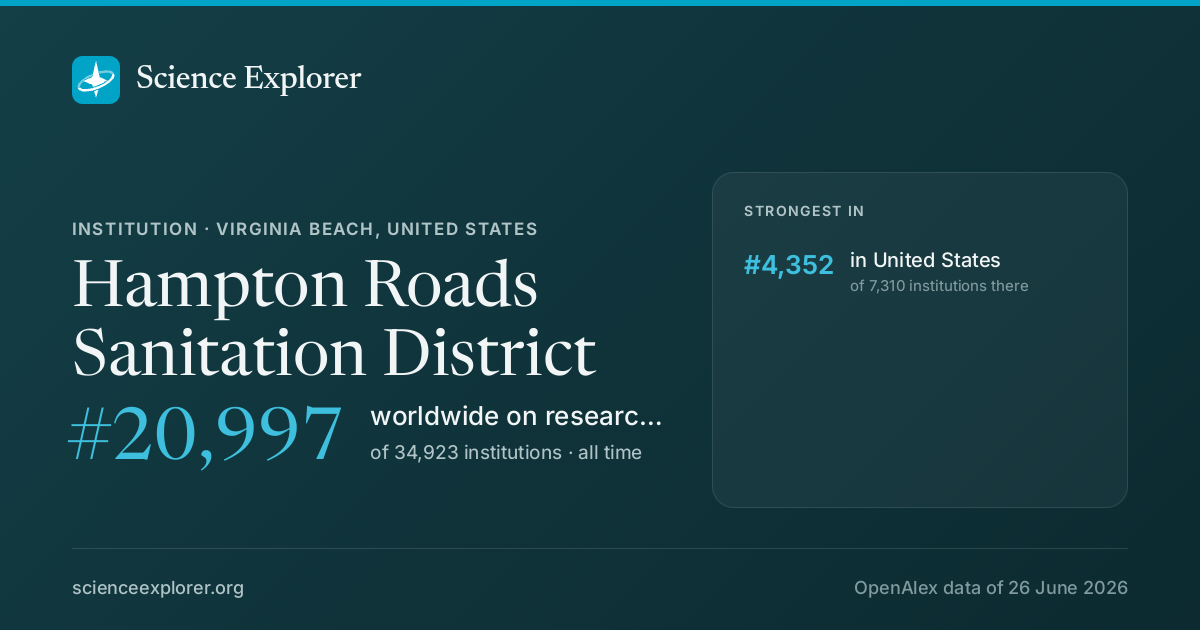
- #20,997 of 34,923
- Rank in United States
- #4,352 of 7,310
- Research works
- 163 ▼ 14% vs 2018-21
- Citations
- 2.4k 14.8 per fractional work
- Top-10% rate
- 14.4% all institutions 10.0%
- vs its own fields
- 0.99× 1.00× is exactly expected
- Open access
- 30% world 40%
- International
- 16% world 18%
Which fields of science does Hampton Roads Sanitation District work in?
In 2022-now, 69% of research at Hampton Roads Sanitation District is in Physical Sciences, 18% in Health Sciences. Its largest fields are Environmental Science (50%), Medicine (17%), Engineering (11%). It does 1.6× the world's share of Physical Sciences.
Each ring splits the one inside it: the four domains of science, their fields, their subfields. Size is fractional works in 2022-now. Every slice is a page; the interactive view zooms down to single topics and colours each by how much more of it this institution does than the world.
Its 4 domains and 19 fields, with their numbers
- Physical Sciences2468.6%
- Environmental Science1850.4%
- Engineering411.2%
- Chemical Engineering12.3%
- Earth and Planetary Sciences12.1%
- Materials Science00.9%
- Chemistry00.7%
- Physics and Astronomy00.6%
- Computer Science00.2%
- Mathematics00.2%
- Health Sciences617.8%
- Medicine617.1%
- Veterinary00.3%
- Health Professions00.3%
- Dentistry00.1%
- Life Sciences37.3%
- Social Sciences26.3%
Field profile
Location quotient across every field it publishes in: outside the ring is more than an institution of this size would be expected to publish, inside it is less.
Rings at 0.5×, 1× and 2×. Widest outward: Environmental Science, 10.1×. Every wedge is a field page.
All 19 fields, with their numbers
- Environmental Science10.14×18 works
- Chemical Engineering6.54×1 works
- Veterinary2.33×0 works
- Earth and Planetary Sciences1.32×1 works
- Medicine0.89×6 works
- Agricultural and Biological Sciences0.78×1 works
- Engineering0.75×4 works
- Biochemistry, Genetics and Molecular Biology0.60×1 works
- Chemistry0.45×0 works
- Business, Management and Accounting0.44×0 works
- Immunology and Microbiology0.43×0 works
- Arts and Humanities0.33×0 works
- Social Sciences0.31×1 works
- Physics and Astronomy0.28×0 works
- Materials Science0.27×0 works
- Dentistry0.22×0 works
- Mathematics0.16×0 works
- Health Professions0.10×0 works
- Computer Science0.02×0 works
- Environmental Science 10.1×
- Chemical Engineering 6.5×
- Veterinary 2.3×
- Earth and Planetary Sciences 1.3×
- Medicine 0.9×
- Agricultural and Biological Sciences 0.8×
- Engineering 0.8×
- Biochemistry, Genetics and Molecular Biology 0.6×
- Chemistry 0.5×
- Business, Management and Accounting 0.4×
- Immunology and Microbiology 0.4×
- Arts and Humanities 0.3×
- Social Sciences 0.3×
- Physics and Astronomy 0.3×
- Materials Science 0.3×
- Dentistry 0.2×
- Mathematics 0.2×
- Health Professions 0.1×
- Computer Science 0.0×
Who are the top researchers at Hampton Roads Sanitation District?
Ranked on the quality score, Raúl González, Dana González and Paul Dombrowski lead among researchers whose main affiliation is Hampton Roads Sanitation District.
- 1
Raúl González
 United States · #588,714 worldwide
2.2k citations · 55 works
- 2
Dana González
United States · #1,783,428 worldwide
885 citations · 27 works
- 3
Paul Dombrowski
United States · #2,083,565 worldwide
325 citations · 18 works
- 4
Charles B. Bott
United States · #2,093,508 worldwide
7.4k citations · 391 works
- 5
Kyle Curtis
United States · #2,217,430 worldwide
645 citations · 18 works
- 6
Stephanie Klaus
United States · #2,437,231 worldwide
619 citations · 55 works
- 7
Chris Wilson
United States · #2,523,813 worldwide
3.5k citations · 246 works
- 8
Frank R. Spellman
United States · #2,542,885 worldwide
1.8k citations · 754 works
- 9
Joanne E. Drinan
United States · #2,741,875 worldwide
261 citations · 38 works
- 10
Kester McCullough
United States · #2,857,895 worldwide
179 citations · 23 works
Which keywords describe research at Hampton Roads Sanitation District?
By fractional works in 2022-now, weighted toward what it does more of than the world: Wastewater Treatment, Anammox Bacteria, Nitrogen-Cycling Network, Health Effects, Water Treatment, Microbial Ecology, Drinking Water and Disinfection By-Products.
- Nexus
- Toxicity
- Membrane Technology
- Desalination
- Revision Surgery
- Black Studies
- Biosensors
- Climate Change
- Disinfection By-Products
- Microbial Ecology
- Health Effects
- Anammox Bacteria
- Wastewater Treatment
- Nitrogen-Cycling Network
- Water Treatment
- Drinking Water
- Genotoxicity
- Sustainability
- Global Distribution
- Civil Rights Movement
- Total Hip Replacement
- Epidemiology
- Polycyclic Aromatic Hydrocarbons
- Water Quality
- Water
Size is fractional works in 2022-now in the topics tagged with each word; colour is the word's share of this institution's work against its share of the world's. The 25 words are chosen for being large and distinctive. Each links to the topic it comes from most.
All 25 words, with their numbers
- Wastewater Treatment6▲ 71×6 topics
- Anammox Bacteria4▲ 339×1 topic
- Nitrogen-Cycling Network4▲ 339×1 topic
- Health Effects3▲ 15×6 topics
- Water Treatment3▲ 60×2 topics
- Microbial Ecology2▲ 40×2 topics
- Drinking Water2▲ 180×2 topics
- Disinfection By-Products2▲ 258×1 topic
- Genotoxicity2▲ 124×1 topic
- Climate Change2▲ 1.86×5 topics
- Sustainability2▲ 1.80×3 topics
- Biosensors1▲ 8.0×3 topics
- Global Distribution1▲ 61×2 topics
- Black Studies1▲ 180×1 topic
- Civil Rights Movement1▲ 180×1 topic
- Revision Surgery1▲ 30×2 topics
- Total Hip Replacement1▲ 30×2 topics
- Desalination1▲ 56×1 topic
- Epidemiology1◆ 0.89×8 topics
- Membrane Technology1▲ 42×1 topic
- Polycyclic Aromatic Hydrocarbons1▲ 58×2 topics
- Toxicity1▲ 7.5×3 topics
- Water Quality1▲ 7.8×4 topics
- Nexus1▲ 90×1 topic
- Water1▲ 52×1 topic
Which research topics does Hampton Roads Sanitation District publish most on?
By volume in 2022-now: Wastewater Treatment and Nitrogen Removal, Water Treatment and Disinfection, Race, History, and American Society and Membrane Separation Technologies.
Area is fractional works; colour is the subfield each topic belongs to.
- 1 Wastewater Treatment and Nitrogen Removal Pollution 4 works
- 2 Water Treatment and Disinfection Health, Toxicology and Mutagenesis 2 works
- 3 Race, History, and American Society Sociology and Political Science 1 works
- 4 Membrane Separation Technologies Water Science and Technology 1 works
- 5 Water-Energy-Food Nexus Studies Water Science and Technology 1 works
- 6 Toxic Organic Pollutants Impact Health, Toxicology and Mutagenesis 1 works
- 7 Constructed Wetlands for Wastewater Treatment Industrial and Manufacturing Engineering 1 works
- 8 Advanced oxidation water treatment Water Science and Technology 1 works
- 9 Orthopaedic implants and arthroplasty Surgery 1 works
- 10 Per- and polyfluoroalkyl substances research Environmental Chemistry 1 works
How open and international is its research?
Against the world's own shares: the tick on each track. Both are shares of its output, so they sit on one scale and can be read against each other as well as against the world.
World: 40% of research is openly available.
World: 18% is written across borders.
How has Hampton Roads Sanitation District's research output changed?
Output in 2022-2025 was 14% lower than in 2018-2021.
The same series as a ribbon: one cell per year, darker for more. The line above answers how much; this answers when.
Its share of all research
Growing output can still be a shrinking share: all of science grows. This is Hampton Roads Sanitation District as a percentage of every work published that year, 0.00010% in 2024.
Fractional works of Hampton Roads Sanitation District over all fractional works that year. How the balance of science has shifted.
Other research institutions in Virginia Beach
- Regent University
- Atlantic University
- George Washington University Virginia Campus
- Virginia Wesleyan University
- Urology of Virginia
- Virginia Aquarium & Marine Science Center
- Virginia Department of Game and Inland Fisheries
- Lifenet Health

Share Hampton Roads Sanitation District's ranking
Badges for a website1Each links back here and updates with every snapshot

Research measures only: rankings here say nothing about teaching, admissions or student experience. Comparable institutions and collaboration partners have tabs of their own, above.
Discussion
Ask a question or share a note about Hampton Roads Sanitation District. Posts are plain text and can be reported.